
Air Superiority Is No Longer Permission: Iran, the Gulf, and the Return of Contested Skies
Iran’s reported use of mobile, low-cost air-defence systems near the Strait of Hormuz suggests a shift from classical air superiority contests to distributed air-denial warfare.
WAR, SECURITY & GEOPOLITICS
Dr Danie Adendorff
6/3/202612 min read
Air Superiority Is No Longer Permission: Iran, the Gulf, and the Return of Contested Skies
By Dr Danie Adendorff
Introduction: When superiority is mistaken for freedom
For more than three decades, Western military and political thinking has often treated air superiority as the natural opening condition of modern war. Since the 1991 Gulf War, the prevailing assumption has been that a technologically superior air force, supported by stealth aircraft, precision weapons, intelligence platforms, electronic warfare and aerial refuelling, can enter hostile airspace, suppress opposition, strike critical targets and return with acceptable losses.
That assumption now requires serious correction.
The Iran/Gulf air campaign does not prove that Western air power has been defeated. It does not prove that Iran possesses parity with the United States, Israel or NATO air forces. It also does not mean that every claim about Iranian air defence, Chinese-supplied systems, drone saturation or missile performance should be accepted at face value.
But it does prove something strategically important: air superiority in the Gulf and Iranian theatre can no longer be treated as automatic permission. It must be produced, governed, coordinated and politically sustained under conditions of missile pressure, drone saturation, mobile air-defence threats, electronic warfare, coalition friction, maritime vulnerability and escalation uncertainty.
That is the real meaning of the recent aircraft incidents. The central issue is not whether Western air forces remain technologically superior. They do. The issue is whether technological superiority alone still guarantees uncontested operational freedom. It does not.
What uncontested air dominance used to mean.
Uncontested air dominance once implied more than the ability to defeat an enemy air force. It meant that a military power could largely control the air environment, decide the tempo of operations, penetrate enemy defences, suppress opposition, protect support aircraft, recover crews and impose costs from the air with limited operational interruption.
This concept shaped post-Cold War military confidence. In Iraq, Kosovo, Afghanistan, Libya and parts of Syria, Western air power often operated against opponents whose integrated air-defence systems were degraded, poorly coordinated, politically constrained or technologically inferior. Air campaigns still involved risk, but the larger strategic assumption remained that Western air forces would rapidly create permissive conditions.
The Iran/Gulf theatre is different.
Iran is not a peer air-power state in the Western sense. It does not possess the integrated air-superiority architecture of the United States. But that is not the same as saying that it is defenceless. Iran’s military problem set is based on depth, dispersion, missiles, drones, mobile systems, hardened sites, proxy networks, coastal geography, chokepoints, electronic ambiguity and political escalation.
Iran does not need to defeat the U.S. Air Force symmetrically in order to impose operational cost. A modern air campaign can be strategically disrupted without the weaker side winning the air war outright. It can be disrupted by forcing tanker rerouting, delaying sorties, complicating rescue operations, exhausting air defences, confusing identification systems, threatening bases, striking maritime flows and creating political pressure through the loss or near-loss of high-value aircraft and personnel.
This is the central shift. Air superiority is no longer a static condition. It is a temporary operational achievement that must be continuously regenerated.
The Gulf as a contested system, not merely a battlespace.
The Gulf is not simply an airspace. It is a compressed strategic system.
Aircraft, tankers, drones, cruise missiles, ballistic missiles, naval vessels, commercial shipping, civilian air routes, coastal radar, allied air defences, U.S. bases, Iranian launch sites, proxy networks and political capitals all operate within a narrow geography. The Strait of Hormuz is not merely a maritime chokepoint. It is also an air-defence, missile, drone and escalation chokepoint.
This compression matters. In an open theatre, air operations can often create space through distance, altitude, timing and layered control. In the Gulf, distance collapses. Flight paths, radar tracks, missile arcs, naval routes and civilian infrastructure overlap. The margin for misidentification and escalation narrows.
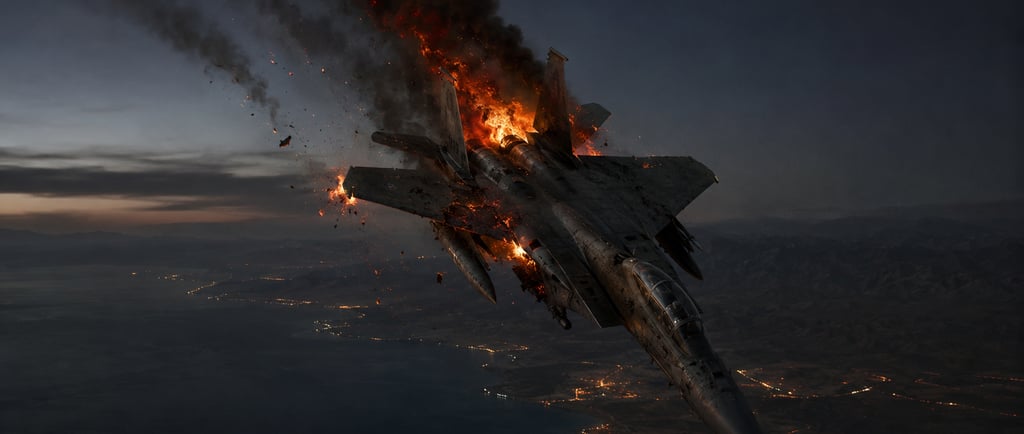
That is why the recent F-15E incidents matter. They should not be read as isolated accidents or dramatic war stories. They should be read as indicators of system stress.
Even if one removes the most dramatic reported detail — the claim that the same pilot was involved in both a Kuwaiti friendly-fire incident and a later shootdown over Iran — the article’s argument still stands. The confirmed and widely reported pattern is sufficient: coalition air operations in the Gulf have involved aircraft losses, friendly-fire risk, Iranian air-defence threat, combat search and rescue, tanker and support vulnerability, and a dense command-and-control environment. The thesis does not depend on a single anecdote. It depends on the cumulative evidence that the theatre itself has become more difficult to govern.
The Kuwaiti friendly-fire incident: coalition air defence under pressure.
The reported downing of three U.S. F-15E Strike Eagles by Kuwaiti air defences is one of the most important operational warning signs of the campaign. U.S. Central Command confirmed that three U.S. F-15s were involved in a friendly-fire incident in Kuwait, that all six aircrew ejected safely, and that Kuwait acknowledged the incident. Reuters and other established outlets reported the event as an apparent friendly-fire incident during active combat in the conflict with Iran.
This incident does not demonstrate Iranian air superiority. It demonstrates something different and arguably more relevant for coalition warfare: even friendly air-defence systems can become dangerous in a saturated, high-alert, missile-threat environment.
When allied aircraft are operating during or near an Iranian air assault, and when regional air defences are under pressure to detect and intercept hostile missiles or drones, the risk of misidentification increases. The problem is not merely technical. It is organisational and operational. It concerns rules of engagement, identification friend or foe, airspace coordination, sensor fusion, command authority, reaction time, training, communication discipline and the psychological effect of being under missile threat.
Friendly fire in such an environment is not a minor administrative failure. It is evidence that the air-defence system is operating under stress. The same defensive architecture designed to protect bases, cities and aircraft can become a source of risk if the battlespace is too congested, if tracks are ambiguous, or if the speed of decision exceeds the quality of identification.
This is exactly why the phrase “uncontested air dominance” is now misleading. A coalition may dominate the enemy air force and still struggle with the airspace-management consequences of missile war, drone saturation and allied-defence integration.
The F-15E shootdown over Iran: hostile airspace remained dangerous
The subsequent F-15E shootdown over Iran is even more strategically significant.
A single aircraft loss does not prove that Iran has defeated Western air power. No serious analyst should make that claim. Modern air campaigns involve losses, and even the most advanced air forces are not immune to mobile surface-to-air missiles, man-portable systems, localised radar cues, optical tracking, deception, tactical surprise, electronic contestation or simple bad luck.
But neither should the incident be dismissed as irrelevant.
Reuters reported that a U.S. F-15 was downed over Iran and that U.S. forces later rescued an airman behind enemy lines. CBS also reported the F-15E loss and the rescue effort. Whatever the final technical finding on the exact weapon system or engagement sequence, the operational meaning is clear: hostile airspace remained dangerous enough to impose cost, generate a personnel-recovery crisis and require the commitment of additional assets to recover crew.
That matters because air superiority is not measured only by enemy aircraft destroyed. It is also measured by freedom of movement, rescue feasibility, sortie confidence, support-aircraft protection and political tolerance for operational loss.
If an aircraft is downed inside hostile territory, the campaign immediately expands. The problem is no longer only strike execution. It becomes personnel recovery, intelligence support, helicopter penetration, armed overwatch, electronic support, deception, possible firefight, diplomatic risk and political messaging. A downed aircraft can transform a tactical event into a theatre-level decision problem.
That is the operational reality hidden beneath the language of air dominance.
The reported same-pilot linkage: useful, but not foundational
The reported claim that the same U.S. pilot survived both the Kuwaiti friendly-fire incident and the later shootdown over Iran should be handled carefully. CBS, citing two people familiar with the incidents, reported that the pilot of the F-15E downed over Iran had also been flying one of the aircraft shot down earlier by Kuwaiti friendly fire. That is credible reporting from an established outlet, but it is not the same as official named confirmation.
For that reason, the claim should not carry the article’s evidentiary burden.
If ultimately confirmed, it would be remarkable at the human level. But its analytical value is larger than the personal drama. It would symbolise the compression of risk in the campaign: the same aviator surviving first a coalition friendly-fire event and then a hostile shootdown would indicate not only individual resilience, but also the severe operational tempo and repeated exposure imposed by the campaign.
That matters because air power is not only aircraft, missiles and sensors. It is people, recovery systems, command judgement, rotation cycles, risk acceptance and institutional discipline. When aircraft losses, rescue events and repeated high-risk sorties accumulate, the campaign begins to test the human and organisational limits of the force.
The lesson is therefore not sentimental. It is operational. Air dominance depends on the sustained integrity of the whole system: aircraft, crews, maintenance, tankers, intelligence, search and rescue, basing, command coordination and political authority.
What these incidents do not prove.
It is important to state the limits clearly.
These incidents do not prove that Iran has achieved air superiority. They do not prove that U.S. or allied air forces cannot strike Iranian targets. They do not prove that Western stealth, precision weapons, electronic warfare or suppression of enemy air defences have failed. They do not prove that every Iranian claim about aircraft losses, missile performance or air-defence success is true.
Nor do they prove that Chinese technology, dual-use systems or external assistance directly controlled the kill chain. The use of a wider technology ecosystem, commercial dual-use capabilities or imported components is materially different from proving that Beijing, or any other external actor, directly commanded an engagement.
The distinction matters. Inflated claims weaken the argument. The serious argument does not require exaggeration.
The serious argument is that the Gulf/Iran theatre demonstrates a return of contested operational conditions. Western air power remains formidable, but it operates inside a denser, more politically volatile and more technically dangerous environment than the simplified idea of uncontested dominance allows.
What the incidents do prove.
The incidents prove that air superiority is now conditional.
It is conditional on intelligence quality. It is conditional on accurate identification. It is conditional on coalition discipline. It is conditional on suppression of enemy air defences. It is conditional on electronic warfare. It is conditional on tanker survivability. It is conditional on personnel recovery. It is conditional on base defence. It is conditional on escalation control. It is conditional on political willingness to absorb loss.
That is a very different proposition from saying that one side “controls the air.”
The modern battlespace does not need to deny every aircraft entry. It only needs to make entry more expensive, uncertain and politically dangerous. A small number of aircraft losses can have disproportionate strategic effect if they expose weaknesses in planning assumptions, generate rescue crises, embolden adversary propaganda, raise domestic pressure or force commanders to alter sortie patterns.
The return of contested skies is therefore not always a matter of mass attrition. It is often a matter of accumulated friction.
When air power becomes a political problem.
Political leaders often reach for air power because it appears to offer control without occupation, precision without mass casualties, and escalation without full commitment. That is precisely why air power is attractive in crisis management. It seems to provide punishment, deterrence and coercion while limiting political exposure.
But this assumption becomes dangerous when air superiority is treated as a given rather than as a condition that must be continuously maintained.
The Iran/Gulf campaign shows that air operations can rapidly become a decision problem rather than merely a military instrument. Once aircraft are lost, aircrew are missing, rescue helicopters are engaged, allied air defences are under scrutiny, tankers are threatened, shipping lanes are constrained and adversary missiles are still being launched, the political leadership no longer controls the escalation ladder as neatly as it may have assumed.
This is where the argument connects directly to executive decision-making. In Dr Danie Adendorff’s Decision Before Consequence framework, the critical failure is often not the absence of information. It is the failure to convert warning into accountable decision before consequences harden. Air power can create precisely this illusion of control. It can encourage leaders to believe that because a military instrument is available, the strategic decision is already manageable.
That is the danger.
The question is not merely whether an air force can strike. The question is whether the decision-maker understands the second- and third-order consequences of striking inside a contested system.
What happens if a crew is captured? What happens if a rescue mission fails? What happens if an allied air-defence battery shoots down another friendly aircraft? What happens if Iran retaliates against a Gulf airport, tanker route or regional base? What happens if commercial aviation, insurance markets and energy flows react faster than diplomatic channels can stabilise the crisis?
These are not peripheral questions. They are central to modern air-power decision-making.
Hormuz and the maritime-air trap
The Strait of Hormuz further complicates the picture because air dominance over the Gulf cannot be separated from maritime security.
In many political discussions, air operations and maritime operations are treated as separate domains. In the Gulf, they are not. Tankers, naval escorts, mine-clearance operations, drone threats, coastal missile systems, commercial shipping routes, civilian ports, offshore energy infrastructure and air-defence corridors form one integrated pressure system.
A campaign that begins as an air operation can quickly become a maritime-protection operation. A maritime crisis can then force additional air operations. Each domain pulls on the other.
If Iranian missiles or drones threaten Gulf air bases, aircraft must defend or strike. If shipping lanes are threatened, naval escorts require air cover, intelligence and surveillance. If tankers avoid the Strait, energy markets react. If commercial shipping slows, Gulf governments face economic pressure. If U.S. or allied forces strike Iranian coastal systems, Iran may answer through missile fire, maritime harassment, proxy attacks or renewed threats against shipping. The escalation chain does not remain neatly within one domain.
This is why Iran does not need to match the United States aircraft for aircraft. It can impose pressure through geography. It can exploit chokepoints. It can threaten commercial flows. It can use drones and missiles to stretch air defences. It can complicate allied basing and logistics. It can create uncertainty over the security of tankers, ports, airports and regional infrastructure.
The Gulf is therefore a system of linked vulnerabilities. Air superiority helps manage that system, but it does not dissolve it.
Strategic implications for the United States and its partners
For the United States, the operational lesson is clear. Technological superiority remains essential, but it is not sufficient. Air campaigns against Iran require resilient basing, integrated air and missile defence, disciplined coalition identification procedures, robust combat search and rescue, tanker protection, deception planning, electronic-warfare depth and political preparation for losses. The aircraft is only the visible tip of the system. The campaign depends on the integrity of the whole architecture around it.
For Gulf states, the lesson is more uncomfortable. Hosting Western forces and participating in integrated air defence may improve protection, but it also makes them part of the battlespace. Their airports, bases, radars, ports and air-defence systems become operationally and politically exposed. Friendly-fire risk is not merely a U.S. problem. It is a coalition-governance problem.
For Israel, tactical strike success must not be confused with strategic control. A campaign can destroy targets and still widen the threat environment if Iran retains missile, drone, proxy or maritime coercion options. The test is therefore not only whether targets can be hit. It is whether the resulting escalation environment can be managed.
For Iran, the same logic cuts in both directions. Aircraft incidents, drone attacks and maritime threats may support Tehran’s narrative that it can impose cost on stronger adversaries. But escalation is a double-edged instrument. The more Iran demonstrates capacity to threaten aircraft, shipping, bases or Gulf infrastructure, the more it risks wider retaliation, deeper economic isolation, coalition consolidation and domestic vulnerability.
For NATO and other Western planners, the broader lesson is that future air operations against capable regional powers will increasingly resemble system contests, not one-directional strike campaigns. The adversary does not need to win conventionally to complicate Western decision-making. It only needs to make the cost, tempo and uncertainty politically consequential.
Conclusion: air superiority must be governed, not assumed
The end of uncontested air dominance does not mean the end of Western air power. That would be a false conclusion.
Western air power remains technologically advanced, operationally experienced and globally unmatched in many respects. But the Iran/Gulf campaign shows that superiority is not the same as immunity. It also shows that dominance is not the same as permission.
The more accurate conclusion is this: air superiority is now a condition to be governed, not an assumption to be inherited.
It must be planned through intelligence, protected through integration, tested against adversary adaptation, and judged against political consequence. Aircraft losses, friendly-fire incidents and combat search-and-rescue crises are not merely tactical events. They are warning signs that the operating environment has become contested at the system level.
The strategic danger is not that Western leaders will forget that their air forces are powerful. The danger is that they will remember only that — and forget that power still has to move through geography, uncertainty, human error, adversary adaptation and political consequence.
Air superiority remains achievable. It is no longer automatic. And in the Gulf, it is no longer permission.
Source notes
This article relies on publicly reported and officially attributed incident lines. U.S. Central Command confirmed the Kuwaiti friendly-fire incident involving three U.S. F-15s and the safe recovery of all six aircrew. Reuters and other established outlets reported the same event as an apparent Kuwaiti friendly-fire incident during the Iran conflict. Reuters and CBS reported the later F-15E shootdown over Iran and associated rescue operations. CBS, citing two people familiar with the incidents, reported the same-pilot linkage; this article treats that linkage as credible reporting but not official named confirmation.
Author workflow disclosure
This article was produced through an AI-assisted but human-directed workflow. AI support was used for accessibility assistance, structuring, language refinement, source-discovery prompts, revision planning and conversion of analytical comments into amendments. Dr Danie Adendorff retained responsibility for the argument, accepted or rejected changes, checked the logic of claims, assessed source credibility and remained accountable for the final text. AI-generated material was not treated as empirical evidence, and synthetic or illustrative examples were not presented as observed data.


© 2026 WDA Publishing. All rights reserved.