
All Roads Lead to China
A sharp geopolitical analysis of how Trump’s and Putin’s visits to Beijing reveal China’s growing role as an unavoidable diplomatic centre of gravity in a fragmented world order.
POLITICS & SOCIETY
Dr Danie Adendorff
5/18/20267 min read
All Roads Lead to China
A news analysis article for The Rumblings of a Wanderer
By Dr Danie Adendorff
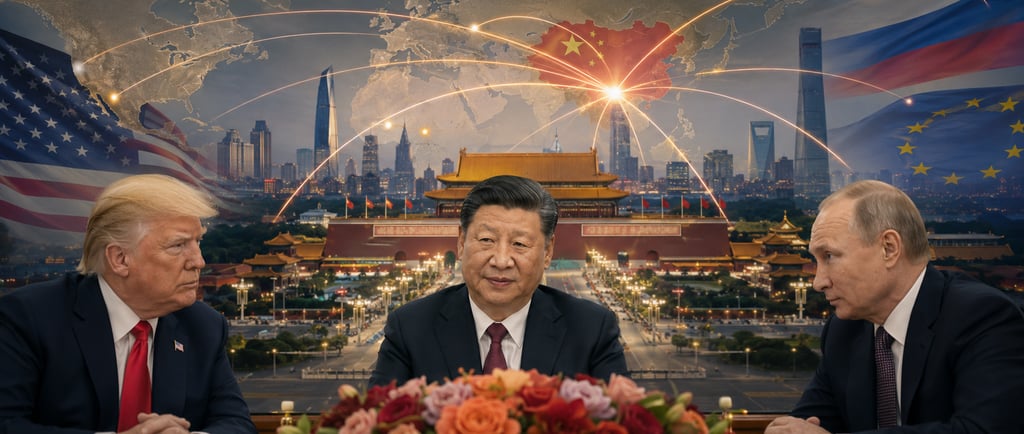
Beijing has become one of the most consequential diplomatic stages in the world. In May 2026, that reality became difficult to ignore. Chinese President Xi Jinping hosted US President Donald Trump in Beijing, including a formal state visit programme and a visit to the Temple of Heaven. Only days later, Russian President Vladimir Putin was due to arrive in China from 19 to 20 May, with the visit linked to the 25th anniversary of the 2001 Sino-Russian Treaty of Friendship and a wider agenda of bilateral, regional, and international issues.
The sequence is striking. First Trump, then Putin. First the leader of China’s principal strategic competitor, then the leader of China’s most important authoritarian partner. The image is powerful: Washington and Moscow, for very different reasons, both moving through Beijing at a moment when the global system is becoming more fragmented, more transactional, and more dependent on China’s economic and diplomatic weight.
That does not mean China controls the world. Nor does it mean every leader who visits Beijing endorses Chinese policy. Many states engage China because they must, not because they agree with it. But the diplomatic traffic is no accident. It reflects a hard structural fact: no major actor can now address trade, technology, energy, war, supply chains, sanctions, climate transition, critical minerals, or strategic stability without dealing with China.
The Trump visit showed one side of this reality. The United States continues to treat China as a systemic competitor, yet direct engagement remains unavoidable. The Beijing summit was framed around stabilising a relationship shaped by tariffs, Taiwan, technology controls, industrial policy, artificial intelligence, supply-chain security, and the wider contest for strategic advantage. Reporting after the summit suggested that Xi projected control and stability while making few major concessions, underscoring Beijing’s ability to use diplomatic theatre as a strategic asset.
For Washington, China is not simply another rival. It is a rival embedded inside the operating system of the global economy. American power remains formidable: military reach, reserve-currency depth, technological capacity, alliance networks, and financial influence. But the United States cannot manage semiconductor supply chains, rare-earth processing, electric-vehicle competition, solar manufacturing, Taiwan risk, North Korea, Iran, global shipping, or strategic-industrial policy without accounting for Beijing. The US-China relationship is therefore not a normal bilateral dispute. It is the central stress line of the global order.
Putin’s visit gives the moment a different strategic weight. Russia’s position after the invasion of Ukraine has made Moscow more dependent on Beijing. Sanctions, market isolation, restricted access to Western technology, and the long-term strain of war have increased Russia’s reliance on China as an energy buyer, political partner, and economic outlet. Beijing has not fully absorbed Moscow’s war aims as its own, but it has benefited from Russia’s weakened position. The result is not a formal military alliance of equals. It is a strategic partnership in which Russia needs China more than China needs Russia.
The symbolism of hosting Trump and Putin within days of each other therefore matters. Xi can present China as the state through which both sides of the great-power triangle must pass. He can talk to Washington about competition and stability, while speaking to Moscow about partnership and resistance to Western pressure. This is not neutrality. It is strategic positioning. Beijing gains status by becoming the venue, the broker, the interlocutor, and the unavoidable counterpart.
Europe has reached the same conclusion, although with greater discomfort. The European Union’s 25th EU-China summit took place in Beijing on 24 July 2025. European Council President António Costa and European Commission President Ursula von der Leyen met Xi, followed by talks with Premier Li Qiang; EU foreign-policy chief Kaja Kallas also participated. The summit demonstrated Europe’s dual-track China policy: engagement where necessary, caution where unavoidable.
Europe’s dilemma is sharper than its diplomatic language often admits. China is too important to ignore but too consequential to treat as an ordinary trading partner. European states want to reduce dependence on Chinese-dominated supply chains, particularly in green technology, batteries, solar panels, telecommunications components, and critical minerals. Yet a hard break with China would damage European exporters, slow the energy transition, raise industrial costs, and weaken competitiveness. The result is not containment. It is managed discomfort.
This is why the diplomatic flow to Beijing has not been limited to the Global South or to countries ideologically aligned with China. Western and allied governments have also pursued engagement. UK Prime Minister Keir Starmer met Xi in Beijing on 29 January 2026, with the British government presenting the encounter as part of a long-term, strategic relationship while also preserving room for disagreement. The language was careful, but the strategic meaning was clear: even a security-conscious Western government cannot afford diplomatic absence from Beijing.
The same pattern is visible across other European and allied engagements. Spain’s Prime Minister Pedro Sánchez visited China from 11 to 15 April 2026, reflecting Madrid’s preference for sustained engagement with Beijing despite broader European concerns. Spain’s approach illustrates a wider European fragmentation: some capitals emphasise risk, others opportunity, and most attempt to hold both positions at once.
In Asia, the logic is even more direct. Vietnam’s engagement with China is shaped by geography, trade, infrastructure, energy, and strategic balancing. Hanoi has serious disputes with Beijing, especially over the South China Sea, but it cannot escape China’s regional weight. For Vietnam, China is not an abstract geopolitical category. It is a neighbouring great power with economic, maritime, security, and diplomatic consequences.
This is the practical architecture of modern multipolarity. States are no longer divided neatly into rigid ideological blocs. They hedge, bargain, balance, diversify, and recalibrate. A government may deepen security ties with Washington while expanding trade with Beijing. It may distrust China’s intentions while depending on Chinese industrial capacity. It may criticise Beijing’s position on Ukraine while still seeking Chinese market access. It may oppose coercion in the South China Sea while accepting infrastructure investment or diplomatic dialogue.
The Global South dimension strengthens China’s position further. Beijing has spent years building itself as a diplomatic and economic platform for countries seeking alternatives, leverage, or bargaining space outside Western-dominated structures. Latin American, African, Middle Eastern, and Asian states often view China not through the lens of Western ideological competition but through infrastructure, trade, investment, energy, debt, technology transfer, and diplomatic recognition. That does not mean they are naïve. It means they are operating in a world where China offers tools, capital, and access that many states cannot ignore.
The danger is to confuse traffic with allegiance. Not every visit to Beijing is a victory for Chinese strategy. Not every handshake is alignment. Not every agreement signals trust. Diplomatic access is not the same as strategic loyalty. Economic dependence is not the same as ideological endorsement. A leader may go to Beijing to seek investment, reduce tension, protect exports, balance against Washington, manage a neighbour, or simply avoid exclusion from a major diplomatic arena.
China benefits from precisely this ambiguity. It can present itself as open to all sides. It can host Trump without abandoning Russia. It can host Putin without fully cutting economic engagement with Europe. It can speak the language of multilateralism while defending a highly centralised authoritarian political model. It can court the Global South as a development partner while competing for resources, ports, infrastructure corridors, and diplomatic support.
But centrality also creates exposure. The more China becomes the diplomatic centre of gravity, the more contradictions it must carry. It must preserve European trade while deepening ties with Russia. It must stabilise relations with the United States while asserting claims over Taiwan. It must sell itself as a responsible global actor while intensifying military pressure in contested regions. It must offer development finance without appearing to create dependency. It must remain indispensable without provoking a stronger counter-coalition.
This is why the phrase “all roads lead to China” is analytically useful, but only if understood carefully. It does not mean Beijing controls every road. It means China sits across many of the routes that now matter: trade, energy, technology, rare earths, manufacturing, sanctions evasion, green transition, digital infrastructure, maritime demand, war diplomacy, and great-power signalling.
The Trump-Putin sequence makes this visible. The United States comes to Beijing because rivalry without dialogue is dangerous. Russia comes because partnership with China is now central to its survival under pressure. Europe comes because economic decoupling is easier to declare than to execute. Regional powers come because geography and commerce require it. The Global South comes because China offers scale, finance, infrastructure, and diplomatic alternatives.
The strategic conclusion is therefore neither triumphalist nor alarmist. China has not replaced the United States as the sole centre of world power. It has not solved the contradictions of global order. It has not converted every visitor into an ally. But it has made itself structurally unavoidable.
Putin’s arrival after Trump’s departure is more than diplomatic theatre. It is a visible expression of the world’s new operating reality. The great powers, middle powers, and emerging powers are not converging on Beijing because China controls the destination. They are converging because many of the routes that now shape global politics pass through China.
All roads do not lead to China because Beijing owns the map. They lead there because no serious map of global power can now be drawn without China at the centre of the page.
Selected Sources and Evidence
Chinese Embassy / Chinese official reporting on Trump’s Beijing visit and state-visit programme, May 2026.
The Guardian, reporting on Xi Jinping hosting Vladimir Putin four days after Donald Trump’s Beijing visit, 18 May 2026.
Washington Post, analysis of Xi Jinping’s diplomatic positioning after the Trump summit in Beijing, May 2026.
Associated Press, reporting on Russia-China relations and Moscow’s increased reliance on Beijing after the Ukraine war.
European Council, 25th EU-China Summit, Beijing, 24 July 2025.
UK Government readout, Prime Minister Keir Starmer’s meeting with President Xi Jinping, 29 January 2026.
Reuters, reporting on Spanish Prime Minister Pedro Sánchez’s April 2026 visit to China.
Reuters and regional reporting on Vietnam-China engagement and To Lam’s April 2026 visit to China.
Reuters, reporting on China-CELAC and Brazil-China engagement in Beijing, May 2025.
Author workflow disclosure
This article was produced through an AI-assisted but human-directed workflow. AI support was used for accessibility assistance, article structuring, language refinement, source-discovery prompts, revision planning, and conversion of editorial comments into specific amendments. The author retained responsibility for the argument, accepted or rejected suggested changes, checked the logic of the claims, and remained accountable for the final text. AI-generated material was not treated as empirical evidence, and synthetic or illustrative examples were not presented as observed data.
Image note
The image accompanying this article is AI-generated and is intended for illustration purposes only.


© 2026 WDA Publishing. All rights reserved.