
Bridging the Gap Between AI Hype and Executive Reality
A management-focused AI governance article arguing that AI does not fail businesses by itself; unmanaged AI converts capability into consequence, while disciplined executive governance turns AI into accountable capability.
TECHNOLOGY & AILEADERSHIP & DECISION-MAKING
Dr Danie Adendorff
7/2/20268 min read

Bridging the Gap Between AI Hype and Executive Reality
Why AI does not fail businesses - unmanaged AI does
By Dr Danie Adendorff DSc (c.h), MSc
Artificial intelligence is not failing business. In many sectors it is becoming one of the most consequential instruments available to management: a way to accelerate analysis, reduce administrative drag, improve pattern recognition, support customer interaction, strengthen quality control and extend organisational reach. The strategic problem is not AI capability. The problem is the managerial illusion that capability can be separated from governance.
Many executives now meet AI first through hype: sales funnels, vendor demonstrations, social-media claims, conference optimism and promises of automation without friction. This shapes the first decision environment. It encourages leaders to ask what AI can replace before they ask what the organisation must still govern. The result is an Executive Awareness Gap: AI capability is understood before AI consequence.
The argument of this article is therefore not anti-AI. It is the opposite. AI, properly managed, may become one of the best instruments any business can possess. But AI without disciplined executive management converts capability into unmanaged consequence. The question is not whether AI failed. The question is whether AI was governed before consequence.
Decision Before Consequence addresses that gap as a management discipline. It treats AI neither as a miracle nor as a shortcut, but as a high-consequence capability requiring authority, validation, escalation, reversibility and a clear Human Return Point.
Capability Is Not Governance
The most common error in executive AI adoption is to confuse functional capability with organisational readiness. A system may generate text, route orders, analyse data, detect anomalies or automate customer interaction. None of that proves that the organisation has answered the management questions that determine whether the system is safe, lawful, reliable and commercially useful.
The emerging governance environment increasingly reflects this distinction. NIST’s Generative AI Profile frames generative AI as a lifecycle risk-management problem requiring organisations to identify, measure, manage and govern risks associated with deployment, not merely assess technical performance. The OECD AI Principles, updated in 2024, emphasise trustworthy, human-centred AI that respects rights, democratic values and responsible stewardship. The EU AI Act places human oversight, risk management, transparency and accountability at the centre of high-risk AI governance.
These frameworks point to the same conclusion: AI adoption is not merely a technology decision. It is a governance decision.
The cases that follow should not be read as evidence that AI is defective. They form a ladder of consequence: from customer-facing liability, to organisational recovery, to operational disruption, to strategic capital loss, and finally to frontier questions about human agency and institutional control.
Air Canada: The Chatbot Did Not Fail Alone
The Air Canada chatbot case is often presented as a story about AI hallucination. That is too narrow. The deeper lesson is managerial accountability.
In Moffatt v Air Canada, the British Columbia Civil Resolution Tribunal found Air Canada liable after its chatbot provided incorrect information about bereavement fares. Legal analysis of the case emphasised that companies remain responsible for information provided through their own automated customer-facing systems.
The important lesson is not that chatbots are useless. Customer-service AI can be valuable. The lesson is that once an organisation deploys AI as a public-facing representative, the organisation owns the consequence of what that system communicates.
The DBC question is therefore direct: where was the Human Return Point? Was there adequate validation of policy-sensitive outputs? Was there escalation when the answer involved refund entitlement? Was the chatbot clearly bounded? Was management accountable for the automated information environment it had created?
The chatbot did not fail in isolation. AI information governance failed.
Ford: Recovery Through the Expert Layer
Ford is the most constructive case in this article because it is not simply a failure story. It is a recovery story.
Recent reporting indicates that Ford rehired approximately 300 to 350 experienced engineers, including former employees and supplier-side veterans, after recognising that AI-supported and automated quality systems could not replicate the judgement, tacit knowledge and institutional memory of veteran engineering expertise. These engineers were not brought back to replace AI. They were brought back to strengthen the human layer around AI: programming tools, mentoring younger staff, identifying defects earlier and restoring experienced judgement to quality-control processes.
This makes Ford the strongest positive case for the article’s thesis. Management appears to have overestimated substitution and underestimated the expert layer. Recovery came not through abandoning AI, but through restoring human expertise as the governing and interpretive layer around AI-supported quality systems.
The reported outcome is significant. Ford subsequently achieved the top position among mainstream brands in the 2026 J.D. Power Initial Quality Study, with reporting also linking the quality recovery to reduced warranty and recall costs.
This is DBC in practice. Reversibility is not a technical property. It is an organisational capability. An organisation can recover from an AI-management error only if it still has access to the human competence, authority and institutional memory needed to correct the system.
Ford therefore supports a pro-AI management argument. AI becomes stronger, not weaker, when experienced human judgement remains inside the system.
Pizza Hut and Dragontail: Optimisation Without Operational Fit
The Pizza Hut / Dragontail litigation remains an allegation, not a final legal finding, and must be treated accordingly. A major franchisee has alleged that Pizza Hut’s mandated AI-powered delivery system caused cascading operational problems and more than $100 million in damages, including delivery delays, cold food, declining customer satisfaction, inadequate support and alleged incompatibility with the franchisee’s operating model.
Even at the allegation stage, the case is analytically useful because it illustrates a recurring AI-management risk: optimisation in the abstract can become dysfunction in the field.
An AI system may optimise one variable while disrupting the wider operating environment. In food delivery, the real system includes kitchens, drivers, customers, timing, incentives, staffing, franchise economics and brand expectations. AI does not enter a neutral environment. It enters a living organisational system.
The DBC question is not whether the delivery algorithm was technically sophisticated. The question is whether management validated the system against local operational reality before consequence. Was there staged deployment? Was there field-level feedback? Could franchisees escalate problems? Was there authority to suspend, adapt or reverse the system before commercial damage accumulated?
If the allegations are substantiated, the failure would not be AI capability. It would be AI management.
Zillow Offers: Algorithmic Confidence and Executive Reversibility
Zillow Offers remains a classic case of algorithmic ambition meeting strategic consequence. Stanford Graduate School of Business analysis describes how Zillow’s algorithmic home-buying venture collapsed after the firm struggled with the risks of buying, holding, repairing and reselling homes at scale. A 2024 academic case study argues that the failure extended beyond the limitations of AI or machine learning alone and involved broader business-model, operational and execution factors.
That distinction is critical. Zillow’s case should not be reduced to “the algorithm was wrong”. The deeper issue was the executive decision architecture surrounding algorithmic action. Housing markets are volatile, local, illiquid and operationally complex. A pricing model can inform judgement, but it cannot replace strategic risk discipline.
The DBC question is again managerial: what were the thresholds for stopping? How was reversibility assessed? How much exposure was permitted before escalation? Was executive confidence in the model greater than the organisation’s capacity to absorb model error?
Zillow shows that AI-supported strategy requires consequence mapping. When an algorithm is connected to capital deployment, inventory accumulation and market exposure, the governance system matters as much as the model.
Meta: A Warning Case, Not Yet a Reversal Case
Meta should be used cautiously. Current reporting suggests that Meta is increasing reliance on AI in content moderation and review, with some reports indicating an ambition to shift a much larger proportion of review activity to AI systems. It would, however, be premature to present Meta as a confirmed recovery case in the same way as Ford.
Its relevance is different. Meta represents the frontier problem: how far can human review be compressed before governance, legitimacy and error-correction capacity degrade?
Content moderation is not a routine administrative function. It involves safety, political speech, misinformation, extremism, child protection, fraud, reputational risk and legal exposure. AI may improve speed and scale, but the management question remains: what human capability must remain available when automated classification becomes contested, harmful or strategically consequential?
Meta therefore belongs in the article as an unresolved indicator. It is not evidence that AI has failed. It is evidence that executive AI governance is moving into domains where the Human Return Point must be explicit.
A Testable Claim, Not a Rhetorical One
A fair objection must be addressed. Explaining AI problems as management failures can sound circular: whenever AI succeeds, governance is credited; whenever AI fails, governance is blamed.
That criticism is valid if governance is invoked only after failure. DBC avoids that weakness by requiring management controls to be specified before deployment, not invented after consequence. A serious AI-governance claim must therefore be testable against observable organisational arrangements: authority lines, escalation thresholds, validation routines, audit trails, field feedback, stop mechanisms, reversibility planning and retained human expertise.
If those controls were absent, weak or ignored, the case for AI-management failure is strong. If they were present, functioning and still insufficient, the organisation has evidence for improving the governance model rather than merely blaming managers. This is why DBC is not a rhetorical device. It is a prospective management discipline: it asks what must be in place before consequence, and then judges performance against that standard.
The DBC Management Lesson
These cases do not prove that AI is defective. They prove that AI capability must be managed before consequence.
Air Canada shows that automated communication does not remove organisational liability. Ford shows that AI-supported quality improves when experienced human judgement is restored. Pizza Hut / Dragontail, if the allegations are substantiated, shows that AI optimisation must be tested against real operating systems. Zillow shows that algorithmic decision support requires executive reversibility and exposure control. Meta shows that AI substitution in high-consequence review environments raises unresolved governance questions.
The pattern is consistent: AI does not eliminate management. It increases the penalty for weak management.
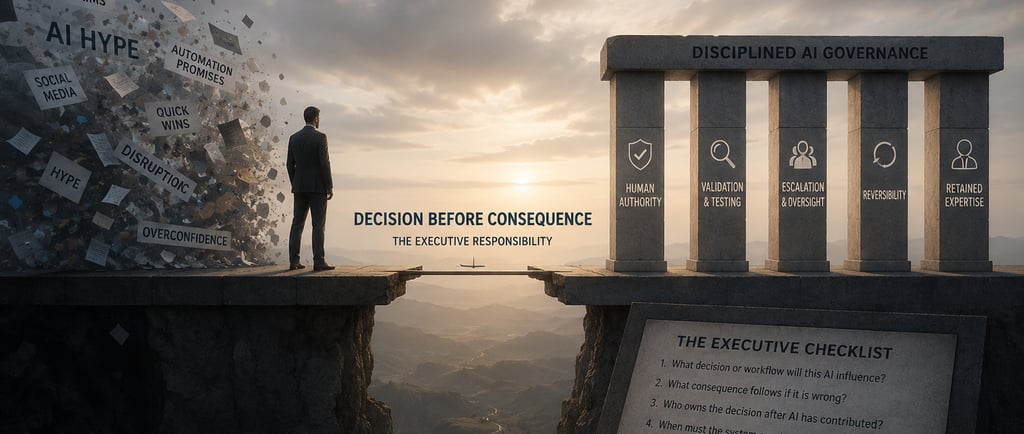
This is why DBC matters. It gives executives a decision discipline for the AI era. Before AI is scaled, leaders must ask:
1. What decision or workflow will this AI influence?
2. What consequence follows if it is wrong?
3. Who owns the decision after AI has contributed?
4. When must the system escalate back to human authority?
5. Can the organisation still reverse course?
6. Does the organisation retain the human expertise needed to recover?
This is the practical meaning of the Human Return Point. It is not a slogan. It is the point at which human authority, competence and accountability can still return to the system before consequence becomes irreversible.
RAND’s 2026 report, A Formal Model of How Artificial Intelligence Erodes Human Agency, is relevant here because it examines how AI can shift decision-making power and proposes ways to identify points beyond which those shifts may become irreversible. That aligns closely with the central DBC concern: AI risk is not only error. It is the erosion of human agency, judgement and organisational reversibility.
Conclusion
AI is not the enemy of management. AI is becoming the test of management.
The organisations that benefit most from AI will not be those that believe the strongest marketing claims. Nor will they be those that reject AI out of caution. They will be those that convert AI capability into accountable capability through disciplined executive governance.
The central question is not whether AI can perform the task. Increasingly, it can. The central question is whether leadership can govern what happens after AI performs the task.
That is the gap between AI hype and executive reality.
AI well managed may be one of the best instruments any business can possess. AI poorly managed becomes a consequence engine. Decision Before Consequence exists for that gap.
Sources
Air Canada Civil Resolution Tribunal (2024) Moffatt v Air Canada, 2024 BCCRT 149.
European Commission (2024) AI Act: Regulatory framework for artificial intelligence.
Moon, A. and Boudreaux, B. (2026) A Formal Model of How Artificial Intelligence Erodes Human Agency. RAND Corporation, RR-A4817-1.
National Institute of Standards and Technology (2024) Artificial Intelligence Risk Management Framework: Generative Artificial Intelligence Profile. NIST.
OECD (2024) OECD AI Principles. Organisation for Economic Co-operation and Development.
Stanford Graduate School of Business (2021) Flip Flop: Why Zillow’s Algorithmic Home Buying Venture Imploded.
Journal of Information Systems Education (2024) Exploring the Role of AI in the Closure of Zillow Offers.
Contemporary business reporting on Ford’s rehiring of experienced engineers, AI-supported quality control and the 2026 J.D. Power Initial Quality Study.
Contemporary business reporting on Chaac Pizza Northeast v Pizza Hut LLC / Dragontail litigation, filed May 2026.
Contemporary reporting on Meta’s increased use of AI in content review and moderation.
Image Declaration
Any accompanying visual used with this article should be treated as an editorial illustration, not as documentary evidence. No generated or illustrative image should be presented as a photograph, record or empirical source.
Author Workflow Declaration
This article was prepared through an AI-assisted but human-directed editorial workflow. AI support was used for structure, language refinement, source discipline, revision control and accessibility. The author retained responsibility for the argument, judgement, interpretation and final editorial decisions. AI-generated material was not treated as empirical evidence.


© 2026 WDA Publishing. All rights reserved.