
Britain Needs Civic Realism on Immigration
A forceful, evidence-based argument that Britain needs controlled, lawful, and integrated immigration policy to restore sovereignty, public trust, and civic stability without abandoning decency or genuine refugee protection.
POLITICS & SOCIETY
Dr Danie Adendorff
5/18/20269 min read
Britain Needs Civic Realism on Immigration
By Dr Danie Adendorff
Britain does not have an immigration problem because people from other countries wish to come here. Britain has an immigration problem because the state has allowed control, consent, enforcement, housing capacity, asylum processing, and integration to drift out of alignment.
That distinction matters. Immigration can strengthen a country. Uncontrolled or poorly governed migration can weaken public trust, overload institutions, reward irregular routes, and erode confidence in the rule of law. The serious argument is not between compassion and cruelty. It is between governed immigration and managed disorder.
A sovereign state must be able to decide who enters, who remains, who qualifies for protection, and who must leave. That is not an extreme proposition. It is the foundation of democratic government. Borders are not merely physical barriers; they are the legal perimeter of national political authority. If Parliament legislates on immigration but the state cannot apply that law in practice, sovereignty is weakened not as a theory, but as an operational fact.
This is why public concern should not be dismissed as prejudice. Many citizens are not objecting to immigration as such. They are objecting to a system they increasingly regard as unfair, expensive, opaque, and weak. They see illegal Channel crossings, prolonged asylum accommodation, hotel use, appeal delays, pressure on housing and services, and political language that often appears designed to soften the public's reaction rather than confront the administrative reality.
The official figures show why the debate remains politically serious. The Office for National Statistics estimated UK long-term net migration at 204,000 in the year ending June 2025. That was around two-thirds lower than the 649,000 recorded for the year ending June 2024. The fall was driven largely by fewer non-EU+ arrivals for work and study and a continued rise in emigration. That decline matters and should be recognised, but it does not settle the political question. The public is not asking only whether net migration has fallen. It is asking whether the system is lawful, selective, transparent, affordable, enforceable, and consistent with democratic consent. [1]
The asylum system remains under severe pressure. Home Office statistics show that 100,625 people claimed asylum in the UK in the year ending December 2025, including main applicants and dependants. That was 4% lower than in the year ending December 2024, but still more than twice the level recorded in the year ending December 2019. This matters because asylum demand is not merely a statistical category; it affects accommodation, public expenditure, local government, legal capacity, community consent, and the lives of applicants themselves. [2]
A slow asylum system is bad for everyone. It delays protection for genuine refugees. It prolongs uncertainty for those whose claims may fail. It increases costs for taxpayers. It leaves local communities feeling that decisions are being imposed on them without adequate planning or explanation.
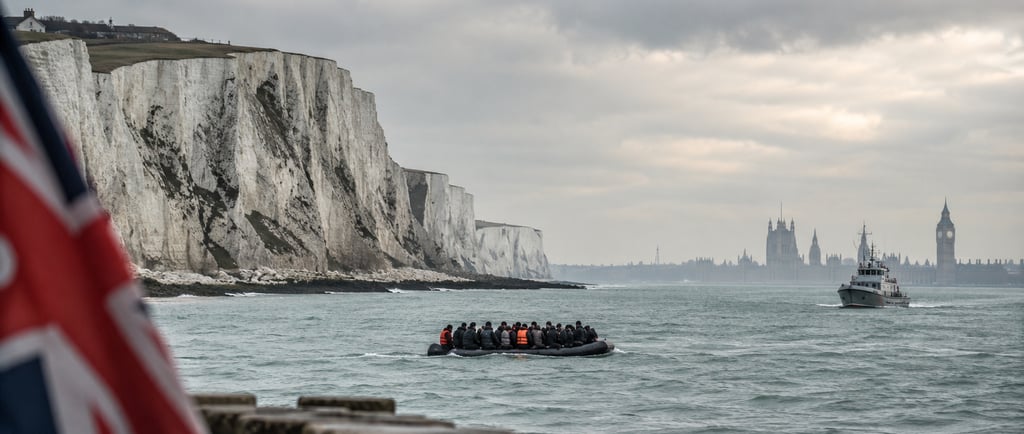
Small boats have become the most visible symbol of this loss of control because they show the state being challenged at its maritime frontier. The Migration Observatory's dedicated small-boats briefing reports that around 41,500 people were detected crossing the Channel in small boats in 2025, 13% more than the year before. It also states that 99% of people arriving by small boat in 2025 either applied for asylum or were named as dependants, and that small-boat arrivals made up 41% of all people applying for asylum in the UK that year. [3]
Those figures require care. They do not prove that every claimant is dishonest. They do not remove Britain's legal and moral obligations toward people with valid protection claims. But they do show that irregular maritime entry has become structurally connected to the asylum system. A dangerous, criminally facilitated route across the Channel has become, in practice, an alternative pathway into the country. That is a policy failure, not a humanitarian achievement.
Legality is not a technicality. It is the basis of trust. Migrants who use recognised routes must satisfy requirements, pay fees, provide documentation, wait for decisions, and obey the process. Citizens are expected to respect the rules-based framework even when doing so is inconvenient. If the public concludes that irregular entry can produce prolonged residence, support, legal delay, and eventual settlement through administrative attrition, the legitimacy of the whole immigration regime deteriorates.
A humane asylum system must protect genuine refugees. Britain should not become indifferent to people fleeing persecution, torture, war, or political repression. But compassion must be administered through law. When compassion is detached from procedural integrity, the result is not justice. It is disorder that benefits smugglers, frustrates lawful applicants, burdens taxpayers, weakens public consent, and leaves genuine refugees trapped in avoidable delay.
The accommodation crisis illustrates the problem with particular clarity. The Home Affairs Committee report on the Home Office's management of asylum accommodation states that the average cost per person per night was estimated at £23.25 in dispersal accommodation compared with £144.98 in contingency hotels. It also notes that hotel accommodation typically requires onsite catering, security, and laundry services, which create additional costs compared with dispersal accommodation. [4]
The obvious reader question is: if dispersal accommodation is cheaper, why use hotels at all? The answer is that hotels are not the root problem; they are the symptom. The Home Affairs Committee noted that hotels were stood up rapidly to meet the Home Office's statutory responsibilities to house destitute asylum seekers. Hotels are therefore used when intake, casework capacity, dispersal housing, local authority capacity, removals, and appeal processes fail to operate as a coherent whole. [4]
That does not excuse the cost. It explains why outrage alone is not enough. The policy requirement is faster initial decision-making, better casework capacity, sufficient lawful accommodation, credible removals for those with no right to remain, and strict limits on the use of emergency hotel provision. A state that relies on hotels at scale is effectively admitting that its normal asylum operating model has failed.
The financial problem is not limited to nightly costs. The Home Affairs Committee reports that Home Office spending on asylum support rose from £739 million in 2019-20 to a peak of £4.7 billion in 2023-24, and that the relevant contracts, originally estimated at £4.5 billion over their ten-year term, are now expected to cost £15.3 billion. That is not sustainable public administration. It is an expensive substitute for control. [4]
This administrative drift is mirrored in the wider economy, where the immigration debate requires an equally serious discussion of labour-market dependency. Britain has too often used migration as a pressure valve for domestic policy failure. If employers, public services, or sectors of the economy become structurally dependent on lower-paid overseas labour, government must ask why domestic training, productivity, wages, automation, regional labour-market planning, and workforce retention have been allowed to deteriorate.
This is not a case against skilled migration. A modern economy needs doctors, engineers, scientists, researchers, entrepreneurs, digital specialists, care workers, and many other forms of lawful contribution. But a serious state should not use immigration to postpone difficult reforms. If migration becomes a substitute for training British workers, improving pay conditions, investing in productivity, or planning public-sector capacity, it ceases to be a controlled national asset and becomes an avoidance mechanism.
That point is central to civic realism. Immigration should support national resilience, not conceal structural weakness. It should help meet defined needs, not become the default answer to every labour shortage. A country that constantly imports labour to compensate for weak training systems, poor workforce planning, or low productivity is not governing migration strategically. It is using migration to delay institutional reform.
Integration is the second half of the argument. It is not enough for immigration to be lawful. It must also be socially absorbable. Integration does not mean cultural erasure. It does not require newcomers to abandon their heritage, language, religion, family traditions, or identity. A confident country can accommodate cultural richness. But it cannot remain coherent if there is no shared civic foundation.
By cultural continuity, I mean the preservation of the civic inheritance that allows a liberal democratic society to function across generations: respect for the rule of law, equality before the law, freedom of speech, religious liberty, democratic consent, public order, institutional trust, and the understanding that citizenship carries duties as well as rights. This is not an ethnic argument. It is a civic argument. The issue is not whether people look, pray, eat, dress, or speak at home in different ways. The issue is whether all who settle in Britain accept the public norms that make peaceful pluralism possible.
The Casey Review remains relevant because it treated integration as a practical condition of social stability, not as a sentimental slogan. The GOV.UK publication page describes it as an independent review by Dame Louise Casey into opportunity and integration, undertaken in relation to isolated and deprived communities. Its continuing lesson is clear: integration cannot be assumed. It must be built. [5]
A society can be culturally diverse and civically united. It cannot remain stable if it becomes civically fragmented. Integration requires English-language acquisition, employment pathways, civic education, local participation, effective schools, credible policing, housing policy, community leadership, and consistent enforcement of common legal standards. Without those mechanisms, population change can outpace civic absorption.
This is where political leadership has often failed. Too many leaders have treated integration as a natural by-product of arrival rather than a serious state function. They have assumed that settlement automatically produces belonging, and that belonging automatically produces shared obligation. That is not policy. It is hope. Integration requires institutions, expectations, incentives, and enforcement. It also requires national confidence: the willingness to say that Britain's civic order is not optional.
Civic realism is the framework Britain now needs. It rejects both open-border romanticism and crude hostility. It accepts that lawful immigration can strengthen the country. It accepts that genuine refugees deserve protection. But it also insists that the state has duties to citizens, taxpayers, lawful migrants, local communities, and future generations. Immigration policy must therefore be controlled, selective, credible, affordable, and integrated.
This framework rests on three governing requirements.
First, Britain must restore lawful control. That means maintaining regular migration routes, but ensuring that admission is selective, transparent, and connected to national interest. Skills, language ability, self-sufficiency, contribution, and integration capacity are legitimate criteria. Asylum must remain available to those who genuinely qualify for protection, but illegal entry cannot be allowed to become a practical advantage over proper process. Claims should be decided quickly, protection should be granted where justified, and those with no right to remain should be removed without years of procedural drift.
Second, Britain must stop using immigration as an administrative escape route. Migration should not be the default substitute for domestic training, housing planning, productivity reform, workforce retention, or public-sector capacity. Where the country needs skilled migration, it should say so honestly. Where sectors have become dependent on continuous inflows because wages, training, or working conditions are inadequate, that dependency should be confronted rather than disguised as openness.
Third, Britain must make integration a central objective of immigration policy. English-language competence, respect for the rule of law, equality before the law, democratic norms, and civic responsibility should be treated as conditions of durable settlement. Cultural diversity can enrich a country, but only when there is a shared legal and civic order. The public realm cannot be governed by competing codes of obligation. Britain can respect private cultural difference while insisting on one common civic framework.
The government's own policy language recognises part of this problem. The 2025 white paper, Restoring Control over the Immigration System, sets out plans for an immigration system that promotes growth but is controlled and managed. Those principles are sensible as far as they go. But the public will not judge the government by white papers. It will judge it by outcomes: fewer dangerous crossings, faster decisions, fewer hotels, credible removals, better integration, and a migration framework that commands consent. [6]
The most important issue is institutional trust. Immigration policy cannot survive if citizens believe that rules are symbolic, enforcement is optional, and political leaders are more concerned with appearing virtuous than governing effectively. Nor can it survive if migrants who obeyed the rules believe that their compliance counts for less than someone else's ability to enter irregularly and remain through delay.
A serious immigration policy must therefore be firm and decent at the same time. Firmness without decency becomes punitive. Decency without firmness becomes disorder. Britain needs both: a humane asylum system for genuine refugees and a credible border system for everyone else. It needs lawful routes, but also real enforcement. It needs cultural openness, but also civic confidence. It needs compassion, but also competence.
The question before Britain is therefore not whether immigration is good or bad in the abstract. The question is whether immigration is lawful, controlled, fair, affordable, and integrated. If it is, it can strengthen the country. If it is not, it will continue to damage trust in government, strain local communities, reward criminal routes, and weaken the social contract on which democratic society depends.
Selected Sources and Evidence
[1] Office for National Statistics, Long-term international migration, provisional: year ending June 2025. https://www.ons.gov.uk/peoplepopulationandcommunity/populationandmigration/internationalmigration/bulletins/longterminternationalmigrationprovisional/yearendingjune2025
[2] Home Office / GOV.UK, Immigration system statistics, year ending December 2025: How many people claim asylum in the UK?. https://www.gov.uk/government/statistics/immigration-system-statistics-year-ending-december-2025/how-many-people-claim-asylum-in-the-uk
[3] Migration Observatory, People crossing the English Channel in small boats. https://migrationobservatory.ox.ac.uk/resources/briefings/people-crossing-the-english-channel-in-small-boats/
[4] House of Commons Home Affairs Committee, The Home Office's management of asylum accommodation. https://publications.parliament.uk/pa/cm5901/cmselect/cmhaff/580/report.html
[5] GOV.UK, The Casey Review: a review into opportunity and integration. https://www.gov.uk/government/publications/the-casey-review-a-review-into-opportunity-and-integration
[6] GOV.UK, Restoring Control over the Immigration System: white paper. https://www.gov.uk/government/publications/restoring-control-over-the-immigration-system-white-paper
Author workflow disclosure
This article was produced through an AI-assisted but human-directed workflow. AI support was used for accessibility assistance, article structuring, language refinement, source-discovery prompts, revision planning, and conversion of editorial comments into specific amendments. The author retained responsibility for the argument, accepted or rejected suggested changes, checked the logic of the claims, and remained accountable for the final text. AI-generated material was not treated as empirical evidence, and synthetic or illustrative examples were not presented as observed data.
Image note
The image accompanying this article is AI-generated and is intended for illustration purposes only.


© 2026 WDA Publishing. All rights reserved.