
Cyber Warfare and the AI Acceleration Problem
Artificial intelligence has not created cyber warfare, but it is accelerating, scaling, and complicating it in ways that make the invisible battlefield between peace and war more dangerous for governments, companies, infrastructure operators, and democratic societies
WAR, SECURITY & GEOPOLITICSTECHNOLOGY & AI
Dr Danie Adendorff
5/28/202614 min read
Cyber Warfare and the AI Acceleration Problem
The Invisible Battlefield Between Peace and War
Introduction: The Return of Code as War
When Anne Keast-Butler, Director of GCHQ, delivered the first GCHQ Annual Lecture at Bletchley Park on 27 May 2026, the location mattered. Bletchley Park was not merely a historical backdrop. It symbolised the moment in the Second World War when mathematics, cryptography, engineering, intelligence, and national survival converged under existential pressure. Codebreaking was not a technical sideshow. It was a strategic instrument.
Her warning from that same ground was clear: Britain and its allies are operating in a 'space between peace and war'. Algorithms are being weaponised below the threshold of traditional warfare. Russia is intensifying hybrid activity against the United Kingdom and Europe. Critical infrastructure, democratic processes, supply chains, public trust, undersea cables, pipelines, and data flows have become part of the modern battlespace.
The warning deserves serious attention because it captures the character of contemporary conflict. The cyber battlefield is not always visible. It often lacks smoke, tanks, aircraft, uniforms, and territorial movement. It appears instead as disrupted appointments, delayed ports, stolen identities, compromised suppliers, manipulated information, corrupted systems, and silent intrusions that remain undetected for months.
The central question is therefore not whether cyber warfare exists. It clearly does. The more important question is whether artificial intelligence has made cyber warfare faster, easier to scale, harder to attribute, and more difficult to defend against.
The answer is yes, but with necessary precision. AI has not invented cyber warfare. It has not made every unskilled actor capable of strategic cyber operations. It has not produced a world in which autonomous cyber weapons can simply replace human expertise, intelligence preparation, access, infrastructure, operational security, and strategic intent. But AI has changed the economics and tempo of cyber operations. It reduces friction. It accelerates reconnaissance. It improves social engineering. It helps process stolen data. It may assist vulnerability discovery and malware adaptation. It compresses the time available for defenders to detect, interpret, escalate, and act.
That compression is the decisive strategic problem. For democratic societies, the danger is not only that adversaries will use AI offensively. The danger is that governments, companies, universities, infrastructure operators, and citizens will continue treating cyber conflict as a technical inconvenience rather than as a national-security battlefield.
1. The Battlefield That Does Not Look Like War
Modern publics still recognise war through visual evidence: aircraft overhead, artillery fire, damaged buildings, military casualties, refugee flows, territorial maps, and frontline reporting. Cyber conflict rarely presents itself in this way. Its effects are dispersed, technical, delayed, and often privately absorbed.
For the ordinary citizen, cyber warfare is usually encountered as disruption rather than as battle. A hospital appointment is delayed. A payment fails. A public service website collapses. A fuel shortage emerges. A trusted institution announces that personal data has been stolen. A plausible video or message circulates before anyone can verify whether it is real. These are not always isolated technical incidents. Some are fragments of a wider contest over access, trust, continuity, and resilience.
This invisibility is not incidental. It is part of the strategic attraction of cyber conflict. Adversaries can impose cost without triggering the same political response as a conventional attack. They can probe, map, test, steal, influence, and prepare. They can exploit the gap between technical activity and political recognition.
A missile strike announces itself. A cyber campaign often waits to be discovered. That delay between hostile action and strategic recognition is where danger accumulates.
2. The Grey Zone Between Peace and War
Keast-Butler's phrase 'space between peace and war' is not rhetorical decoration. It describes the operational reality of grey-zone and hybrid conflict.
Grey-zone activity is designed to remain below the threshold of declared war while still imposing strategic pressure. It may combine cyber operations, espionage, sabotage, economic coercion, disinformation, proxy activity, covert finance, legal ambiguity, diplomatic denial, and selective threats of force. Each individual incident may appear insufficient to justify major retaliation. The cumulative campaign, however, can weaken national resilience and alter the strategic environment.
Russia has made this form of conflict central to its confrontation with the West. Its most destructive cyber operations remain heavily directed against Ukraine, but Western agencies have repeatedly warned that Russia also conducts cyber and hybrid activity against the United Kingdom, Europe, NATO members, and democratic institutions. These activities include espionage, infrastructure probing, hacktivist proxy operations, sabotage-related activity, information manipulation, and attempts to erode public trust.
China presents a different but equally serious challenge. Its cyber posture is less theatrical than Russia's, but strategically deep: long-term espionage, technology acquisition, supply-chain penetration, data access, and positioning inside networks of future operational significance. Keast-Butler's warning also placed China in a wider science-and-technology frame. China is not merely another cyber actor; it is a science and technology superpower rapidly narrowing the capability gap in artificial intelligence, quantum technologies, space, advanced computing, and cyber-enabled state power. That matters because cyber competition is no longer separable from the broader race over technological advantage.
Iran uses cyber capabilities for regional coercion, retaliation, espionage, and influence. North Korea uses cyber operations to generate revenue, steal cryptocurrency, evade sanctions, support intelligence objectives, and sustain regime priorities. Criminal groups and state-tolerated proxies further blur the boundary between crime, espionage, and conflict.
This is the structural difficulty. The defender is not facing a single category of threat. It is facing an ecosystem of state, proxy, criminal, commercial, and ideological actors operating across overlapping domains. AI does not create that ecosystem. It accelerates it.
3. How AI Changes Offensive Cyber Operations
The strongest but least responsible version of the AI-cyber argument claims that AI will soon create autonomous cyber weapons capable of independently destroying critical infrastructure at scale. That may be a future risk in some form, but it is not the strongest evidence-based argument today.
“AI does not make every cyber actor elite. It allows more actors to do more, faster, at lower cost, and at greater scale. — Dr Danie Adendorff”
The more accurate and strategically important argument is this: AI industrialises established attack methods. The principal areas of change are cle
Reconnaissance: AI can process large volumes of public, scraped, leaked, purchased, or stolen data to identify valuable targets, map organisations, infer reporting structures, identify privileged users, and prioritise access routes.
· Social engineering: Generative AI can produce fluent, credible, context-specific messages across languages and professional registers. The spelling errors, awkward phrasing, and poor translation that once helped users identify phishing attempts are disappearing.
Exploitation of stolen data: Once attackers exfiltrate emails, files, credentials, chat logs, contracts, customer data, or medical records, AI can classify, summarise, translate, search, and prioritise the material.
Vulnerability research and malware adaptation: AI can help analyse code, summarise technical documentation, identify patterns, assist scripting, and support parts of exploit-development workflows. Sophisticated operations against hardened targets still require expert human operators.
Time compression: Attackers can move faster from reconnaissance to exploitation, from stolen data to coercion, from vulnerability disclosure to mass probing, and from social-engineering concept to operational campaign.
Speed is not merely a technical advantage. It is a strategic advantage when defenders still depend on slow review cycles, manual escalation, fragmented visibility, and delayed executive decision-making.
4. The Economics of Attack Have Changed
Cyber defence has always been asymmetric. An attacker needs one viable route into a system. The defender must manage thousands of devices, identities, suppliers, cloud services, applications, legacy systems, user behaviours, patches, credentials, and configuration states.
AI sharpens this asymmetry. It gives attackers the ability to test more targets, produce more convincing lures, exploit more data, automate more preparation, and move faster across the attack lifecycle. It does not make skill irrelevant. It makes skilled teams more productive and weak teams less weak.
That distinction matters. The danger is not fantasy. It is not that AI instantly creates cyber super-soldiers. The danger is industrialisation: the volume of credible attacks increases; the quality of deception improves; the time between vulnerability disclosure and exploitation shrinks; the cost of targeting falls; and defenders must separate meaningful warning from noise at a scale that exceeds human capacity.
This is why AI-enhanced cyber warfare should be understood as a problem of speed, asymmetry, and warning failure.
5. Real-World Consequences: When the Invisible Becomes Visible
The cyber battlefield becomes visible only when consequences break through into public life.
The 2021 Colonial Pipeline ransomware attack showed how a cyber incident affecting privately operated infrastructure could produce strategic disruption. The company shut down pipeline operations in response to the attack, causing fuel supply problems and public anxiety across parts of the United States. A criminal ransomware incident became a national infrastructure event.
The 2022 Viasat KA-SAT cyberattack demonstrated the connection between cyber operations and military conflict with unusual clarity. The European Union later stated that the attack took place one hour before Russia's full-scale invasion of Ukraine on 24 February 2022. It disrupted satellite communications used in Ukraine and affected users in several European states. Cyber operations were not separate from the wider campaign; they were part of the preparation and opening conditions of conflict.
The 2024 ransomware attack on Synnovis, a pathology services provider supporting major London NHS hospitals, illustrated the human consequences of cyber disruption. NHS England reported that the incident caused delays to more than 11,000 outpatient and elective procedure appointments. A later UK parliamentary statement recorded that the disruption contributed to the death of a patient. That fact should remove any remaining illusion that cyber incidents are merely digital events without human consequence.
These examples are not identical. That is precisely the point. Cyber harm does not appear in one form. It may be criminal, strategic, state-linked, opportunistic, coercive, military-supporting, or financially motivated. But from the perspective of society, the consequence is often the same: essential systems fail, confidence erodes, and leaders confront decisions under uncertainty.
6. Machine-Speed Attack Requires Machine-Speed Defence
Keast-Butler's reference to embedding agentic AI into machine-speed cyber defence is strategically significant. It recognises that the defensive problem can no longer be managed entirely through human-paced processes.
AI can improve cyber defence in important ways. It can detect anomalies across large datasets. It can correlate weak signals from multiple systems. It can prioritise alerts. It can translate foreign-language threat material. It can summarise malware behaviour. It can support incident response triage. It can help identify unusual identity activity, suspicious network behaviour, abnormal data movement, and emerging attack patterns.
These are genuine capabilities. Under high-volume attack conditions, human analysts can be overwhelmed. AI can help compress detection and triage time.
But this creates a new governance problem. Machine-speed defence can easily become machine-speed error. False positives can overwhelm teams. False negatives can create false confidence. Automated containment can disrupt legitimate operations. Adversaries may attempt to manipulate models, poison data, evade detection, exploit AI tools, or attack the workflows into which AI has been embedded.
“The answer is not blind automation. It is accountable acceleration: faster detection and response support without dissolving human responsibility. — Dr Danie Adendorff”
Accountable acceleration means using AI to accelerate detection, triage, correlation, and response support while preserving human responsibility for escalation thresholds, legal authority, operational consequence, and strategic interpretation. AI may assist judgement. It must not dissolve accountability.
This principle is essential. A society that delegates cyber defence to machines without clear authority, auditability, oversight, and consequence management may replace slow failure with automated strategic error.
7. Critical Infrastructure Is the Strategic Centre of Gravity
Cyber warfare becomes strategically decisive when it reaches the operating architecture of national life: energy, water, transport, finance, healthcare, telecommunications, cloud services, ports, airports, satellites, logistics systems, undersea cables, pipelines, and military-support infrastructure.
This is why the focus on cables, pipelines, supply chains, democratic systems, and public trust matters. The strategic purpose of hostile cyber activity is not always immediate destruction. Often it is preparation, mapping, coercion, signalling, disruption, and future optionality.
Undersea cables and pipelines illustrate the hybrid nature of the problem. They are physical systems, but their monitoring, routing, maintenance, commercial ownership, repair coordination, and operational dependencies are deeply digital. A hostile campaign against seabed infrastructure may combine maritime surveillance, legal ambiguity, cyber reconnaissance, diplomatic denial, information manipulation, and physical interference.
The same logic applies to ports, hospitals, electricity networks, and logistics systems. A hostile actor does not need to destroy a state to weaken it. It may only need to delay its decisions, complicate its mobilisation, overload its institutions, fragment its public confidence, and demonstrate that essential systems are reachable.
That is the strategic logic of the invisible battlefield.
8. Attribution, Escalation, and Miscalculation
Cyber conflict is dangerous because attribution is difficult and response thresholds are unclear. AI makes both problems more severe.
· States may use proxies; criminal groups may operate with state tolerance; hacktivists may align themselves with state narratives.
· Infrastructure may be routed through third countries; technical indicators may be ambiguous; strategic motive may point in one direction while forensic evidence remains incomplete.
· Synthetic media can pollute the information environment around an incident, while AI-generated content can support false narratives.
· Automated campaigns can appear larger, more spontaneous, or more sophisticated than they are.
· AI-assisted code may reduce some of the recognisable stylistic signatures that analysts use in attribution.
· Faster exploitation compresses the time available for validation.
This is where miscalculation becomes a serious strategic risk. A state may interpret an intrusion as preparation for attack when the adversary intended espionage. An adversary may believe its activity remains below the response threshold and push too far. A government may overreact to uncertain attribution or underreact to a real campaign because confidence has not matured. A private organisation may delay disclosure for reputational reasons, weakening the national warning picture.
Cyber deterrence is therefore not only a matter of offensive capability. It depends on intelligence confidence, incident reporting, public-private trust, alliance coordination, resilience, legal clarity, and credible response options. These are institutional problems, not only technical ones.
9. The Executive Intelligence Pipeline: Where Cyber Warning Fails
Many cyber failures are described as technical failures. Sometimes that is correct. But often the deeper failure lies in the decision system.
The Executive Intelligence Pipeline is my analytical framework for diagnosing how warning becomes, or fails to become, accountable action. It can be expressed as follows:
“Signal → Validation → Interpretation → Escalation → Decision → Action → Adaptation — Executive Intelligence Pipeline, Dr Danie Adendorff (2026)”
In cyber security, the signal may be weak: an unusual login, an anomalous data transfer, a suspicious help-desk request, a vendor alert, a dark-web mention, an unexpected authentication pattern, or a low-confidence intelligence advisory.
If the signal is missed, the pipeline fails at the first stage. If it is seen but not validated, it remains noise. If it is validated but not interpreted strategically, it stays trapped inside the technical team. If it is interpreted but not escalated, leadership remains unaware. If it is escalated but no decision is made, warning becomes theatre. If a decision is made but no action follows, governance collapses. If action occurs but no adaptation follows, the organisation remains vulnerable.
This is why cyber resilience cannot be delegated to technical specialists alone. Cyber intelligence must be decision-driven. The central question is not merely: what data do we have? The question is: what decision must be made, by whom, by when, under what uncertainty, and with what consequence?
AI can support this pipeline. It can detect signals, assist validation, accelerate interpretation, and generate response options. But AI cannot carry consequence. It cannot be morally, politically, legally, or strategically accountable. Human institutions remain responsible for decisions made, avoided, delayed, or delegated.
This is the central governance challenge of AI-enhanced cyber conflict.
10. The F6-to-A1 Problem: Weak Signals Must Not Be Discarded
Cyber warning often begins as weak information. A minor anomaly may later prove decisive. A low-confidence alert may become the first trace of a major intrusion. A single-source warning may mature into confirmed intelligence. A rumour on a criminal forum may become a ransomware incident. A vendor advisory may become a supply-chain crisis.
The F6-to-A1 principle, as I use it in intelligence-style assessment, is a source-confidence discipline: weak early indicators must be labelled honestly, tracked carefully, tested against corroboration, and re-graded as evidence improves. The correct answer is neither to treat early signals as established fact nor to discard them because they are weak.
AI will increase the number of weak signals. Some will be noise. Some will be deception. Some will be early warning. The institutional task is to preserve uncertainty without paralysis and to act when confidence reaches the necessary threshold.
In this environment, strategic judgement depends on disciplined escalation, not perfect certainty.
11. What Must Change
Governments must treat cyber resilience as national security infrastructure. That means stronger intelligence sharing, mandatory and trusted incident reporting, clearer legal authorities, critical infrastructure mapping, supply-chain scrutiny, alliance coordination, and rehearsed response thresholds.
Corporate boards must stop treating cyber risk as an IT matter. Cyber risk is operational risk, legal risk, financial risk, reputational risk, safety risk, and in some sectors, national security risk. Boards should rehearse cyber incidents as seriously as financial crises, regulatory failures, physical security incidents, and continuity-of-government scenarios.
Universities and research institutions must recognise their exposure. They hold intellectual property, defence-relevant research, sensitive data, international partnerships, and emerging technology. Academic openness is a strength, but openness without security discipline becomes vulnerability.
Technology companies must design for adversarial use from the outset. AI systems, developer tools, cloud environments, identity platforms, and enterprise software are part of the modern attack surface. Security cannot be an afterthought added after scale has been achieved.
Citizens also have a role. Multi-factor authentication, passkeys, software updates, password discipline, phishing awareness, device hygiene, and scepticism toward synthetic media are no longer merely personal habits. They are elements of societal resilience.
Most importantly, leaders must understand that cyber security is no longer a defensive technical function. It is part of strategic judgement.
Conclusion: Decision Before Consequence
AI-enhanced cyber warfare is not a future possibility. It is already part of the operating environment of modern conflict.
The decisive issue is not whether AI will create cyber warfare. It will not. The decisive issue is whether AI will accelerate cyber conflict faster than democratic institutions can understand, govern, and respond.
That is the real danger. AI industrialises established attack methods. It improves deception, speeds reconnaissance, assists exploitation, scales data analysis, and compresses operational timelines. It also strengthens defence by improving detection, triage, correlation, and response support. But the contest is not simply AI against AI. It is decision system against decision system.
The invisible battlefield is dangerous because it does not look like war until consequences become visible. A country may be probed, mapped, manipulated, and strategically positioned against before a missile is fired. A company may be compromised before the ransom note appears. A hospital may discover the battlefield only when services fail. A democracy may be attacked through trust, data, and perception long before citizens understand that a campaign is underway.
The lesson from Bletchley Park is not nostalgia. It is institutional readiness. In 1939, foresight meant assembling the minds, machines, authorities, partnerships, and organisational seriousness required before the crisis fully arrived. In 2026, the same principle applies.
The societies that endure AI-enhanced cyber conflict will not be those that merely buy more technology. They will be those that build accountable acceleration into their defence systems, convert weak signals into strategic warning, and act before consequence becomes irreversible.
Cyber warfare is the war before the war. AI is making it faster. Leadership must make it visible.
Selected Sources for Publication
Anne Keast-Butler, 'GCHQ Annual Lecture 2026 — as delivered', Government Communications Headquarters, 27 May 2026. https://www.gchq.gov.uk/speech/gchq-annual-lecture-2026-as-delivered
Associated Press, 'UK cyberspying chief calls AI an unstoppable force and warns about Russia', 27 May 2026.
National Cyber Security Centre, 'Impact of AI on Cyber Threat from Now to 2027', 7 May 2025. https://www.ncsc.gov.uk/report/impact-ai-cyber-threat-now-2027
National Cyber Security Centre, 'The Near-Term Impact of AI on the Cyber Threat', 2024. https://www.ncsc.gov.uk/report/impact-of-ai-on-cyber-threat
National Cyber Security Centre, 'NCSC Annual Review 2025', especially Chapter 01 on countering the cyber threat. https://www.ncsc.gov.uk/collection/ncsc-annual-review-2025/chapter-01-cyber-threat-to-the-uk
Google/Mandiant, 'M-Trends 2026: Data, Insights, and Strategies from the Frontlines', Google Cloud, 23 March 2026. https://cloud.google.com/blog/topics/threat-intelligence/m-trends-2026
Google/Mandiant, 'M-Trends 2025: Data, Insights, and Recommendations from the Frontlines', Google Cloud, 23 April 2025. https://cloud.google.com/blog/topics/threat-intelligence/m-trends-2025
ENISA, 'ENISA Threat Landscape 2025', European Union Agency for Cybersecurity, 2025. https://www.enisa.europa.eu/topics/cyber-threats/threat-landscape
Council of the European Union, 'Hybrid Threats', Council policy page. https://www.consilium.europa.eu/en/policies/hybrid-threats/
NATO, 'Countering Hybrid Threats', NATO policy page. https://www.nato.int/cps/en/natohq/topics_156338.htm
U.S. Department of Energy, 'Colonial Pipeline Cyber Incident'. https://www.energy.gov/ceser/colonial-pipeline-cyber-incident
Council of the European Union, 'Russian cyber operations against Ukraine: Declaration by the High Representative on behalf of the European Union', 10 May 2022. https://www.consilium.europa.eu/en/press/press-releases/2022/05/10/russian-cyber-operations-against-ukraine-declaration-by-the-high-representative-on-behalf-of-the-european-union/
NHS England, 'Synnovis cyber incident'. https://www.england.nhs.uk/synnovis-cyber-incident/
UK Parliament, 'Cyber Security and Resilience', Written Statement HCWS1046, 12 November 2025. https://questions-statements.parliament.uk/written-statements/detail/2025-11-12/hcws1046
Frank G. Hoffman, 'Conflict in the 21st Century: The Rise of Hybrid Wars', Potomac Institute for Policy Studies, 2007.
Michael J. Mazarr, 'Mastering the Gray Zone', Strategic Studies Institute, 2015.
Thomas Rid, Cyber War Will Not Take Place, Oxford University Press, 2013.
Ben Buchanan, The Cybersecurity Dilemma: Hacking, Trust and Fear Between Nations, Oxford University Press, 2017.
Author workflow disclosure
This article was produced through an AI-assisted but human-directed workflow. AI support was used for accessibility assistance, article structuring, language refinement, source-discovery prompts, revision planning, and conversion of editorial comments into specific amendments. The author retained responsibility for the argument, accepted or rejected suggested changes, checked the logic of the claims, and remained accountable for the final text. AI-generated material was not treated as empirical evidence, and synthetic or illustrative examples were not presented as observed data.
Image note
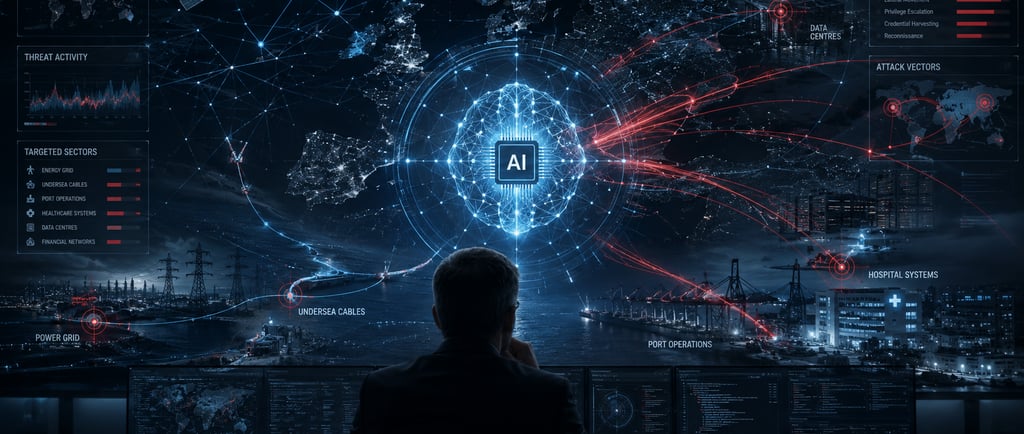
The image accompanying this article is AI-generated and is intended for illustration purposes only.


© 2026 WDA Publishing. All rights reserved.