
First We Were Just a Number. Now We Are Just an Algorithm.
A philosophical essay on how modern society has moved from reducing people to numbers to treating them as algorithmic profiles, and why human dignity depends on preserving consciousness, judgement and responsibility.
POLITICS & SOCIETY
Dr Danie Adendorff
6/28/20266 min read

First We Were Just a Number. Now We Are Just an Algorithm.
A philosophical reflection on human dignity in an age of prediction
By Dr Danie Adendorff
The older reduction
There was a time when society reduced us to numbers.
We became passport numbers, payroll numbers, student numbers, military numbers, taxpayer numbers, hospital numbers and customer numbers. The modern state required files. The modern corporation required records. The modern bureaucracy required identifiers. A number was impersonal, but it still remained attached to a recognisable person.
Today, something more subtle is happening. We are no longer merely counted. We are profiled, ranked, scored, predicted and modelled. Our behaviour is translated into patterns. Our choices become probabilities. Our habits become data trails. Our risks become institutional calculations. The number filed the person. The algorithm interprets the person.
First we were just a number. Now we are increasingly treated as an algorithm.
This is not simply a technological development. It is a philosophical and civic event. The question is not whether artificial intelligence is useful. It is useful. Nor is the question whether algorithms can assist institutions. In many settings they can. The deeper question is what happens to society when the human person is increasingly understood through systems of abstraction rather than through personhood.
Pascal and the thinking reed
In his Pensées, written in the final years before his death and published posthumously, Blaise Pascal described humanity with one of the most enduring images in Western thought: “Man is but a reed, the weakest in nature; but he is a thinking reed.”
Pascal understood human fragility without sentimentality. A human being is physically weak. The universe is vast. Nature can destroy us without intention, hatred or even notice. Yet Pascal refused to conclude that humanity is therefore insignificant. We are nobler than what kills us because we know that we die. The universe may crush us, but it does not know that it exists.
Human dignity begins there: not in physical strength, speed or efficiency, but in awareness. We are vulnerable, but not merely vulnerable. We are conscious of our vulnerability. That single fact changes the moral meaning of human life.
The new indifferent universe
Artificial intelligence confronts us with a new version of Pascal’s indifferent universe. It is vast, fast and increasingly present in the background of ordinary life. It can process extraordinary quantities of information. It can generate convincing language, classify images, recommend decisions, mimic styles and detect patterns that no individual mind could hold at once.
Yet processing is not awareness. Prediction is not conscience. Fluency is not wisdom. Computation is not lived experience.
This distinction matters because society is beginning to adopt the algorithm’s external view of the human being. Banks see credit risk. Employers see recruitment probability. Governments see compliance profiles. Platforms see engagement potential. Insurers see actuarial exposure. Retailers see purchasing likelihood. Universities see performance metrics. Health systems see predictive indicators.
Each system may have a practical justification. Modern life cannot function without records, models and institutional judgement. The danger lies elsewhere. It lies in forgetting that the model is not the person. A credit score may influence access to capital, but it is not a life. A risk profile may inform a decision, but it is not a character. A behavioural prediction may be useful, but it is not a human being.
Heidegger and the ordered world
Martin Heidegger warned that modern technology does more than give us new instruments. It changes how reality appears. Under the technological mode of thinking, the world is increasingly revealed as something to be ordered, measured, stored, optimised and used. Forests become timber reserves. Rivers become sources of power. Land becomes an asset. Time becomes productivity. Eventually, human beings become resources.
The algorithmic age extends this tendency into the human interior. The citizen becomes a statistical case. The worker becomes a productivity signal. The patient becomes a probability distribution. The voter becomes a behavioural target. The child becomes an educational performance curve. The person is not merely recorded from the outside; the person is increasingly interpreted from the outside.
This is not merely an administrative shift. It is a transformation in social imagination. A society becomes dangerous when it can no longer see the person behind the profile.
Arendt and the retreat of responsibility
Hannah Arendt helps us understand the political danger. She was deeply concerned with thoughtlessness, bureaucracy and the diffusion of responsibility. Bureaucracy, for Arendt, tends toward the rule of Nobody: a system in which power operates, consequences occur, but responsibility becomes strangely homeless. Someone signs the form. Someone follows the procedure. Someone applies the rule. Yet the moral centre disappears.
Algorithmic society risks producing a new version of that irresponsibility. When a system ranks, flags, recommends or excludes, institutions may treat the output as neutral fact. The human official may remain present, but judgement has already retreated. People begin to say: the process required it; the model indicated it; the system recommended it; the algorithm decided it.
No one fully decides, yet consequences still fall upon real people. That is the civic danger. A person may be denied, filtered, profiled, flagged or ignored because a system produced a result that no one feels personally responsible for questioning.
The distinctions we must not lose
A humane society therefore needs disciplined distinctions. They are not decorative philosophical phrases; they are safeguards against institutional thoughtlessness.
Information is not knowledge.
Knowledge is not understanding.
Understanding is not wisdom.
Prediction is not judgement.
Processing is not experience.
Simulation is not being.
The human remainder
A machine may describe grief, but it does not grieve. It may generate language about love, but it does not love. It may calculate risk, but it does not confront its own mortality. It may imitate moral language, but it does not carry moral guilt. It may process the concept of death, but it does not know that it will die.
The human being does.
That is Pascal’s reed: fragile, temporary and exposed, yet capable of standing before the universe and knowing the meaning of its own vulnerability. Human dignity cannot be reduced to intelligence if intelligence is defined merely as calculation, pattern recognition or linguistic fluency. Machines may exceed us in many such domains. But dignity does not rest on being faster than a machine. It rests on conscious existence, moral responsibility and the capacity to ask what ought to be done.
What civilisation risks forgetting
The danger of the algorithmic age is not only that machines may become more capable. It is that human beings may become less willing to defend the depth of their own humanity. We may begin to describe ourselves in the language of systems. We may confuse visibility with meaning, rating with worth, prediction with destiny, and institutional convenience with truth.
A human being is not only an observable pattern. A person has an interior life. That interiority is not a sentimental addition to politics; it is the ground of moral and civic civilisation. Without it, rights become administrative permissions. Freedom becomes behavioural management. Responsibility becomes compliance. Democracy becomes manipulation. Education becomes optimisation. Work becomes extraction.
The question, then, is not whether algorithms can assist society. They can. The question is whether society can use algorithms without surrendering its understanding of the person. Every score must remain contestable. Every automated recommendation must remain answerable to human judgement. Every institution must remember that efficiency is not the highest moral good.
The thinking reed in the age of prediction
Pascal’s thinking reed still matters because it reminds us that human greatness does not lie in domination. We are not great because we are stronger than nature or faster than machines. We are not great because we can produce, consume or optimise more. We are great because we know that we exist, that we suffer, that we are mortal, and that others suffer too.
From that awareness comes conscience. From conscience comes responsibility. From responsibility comes civilisation.
Artificial intelligence may become one of humanity’s most powerful instruments. It must remain an instrument within a moral order. The danger is not that the algorithm becomes human. The danger is that human beings allow themselves to be treated as algorithms.
First we were just a number. Now we are becoming an algorithm. The task before us is to remember that we are neither.
We are thinking reeds: fragile, conscious, accountable and human. No society remains free for long if it forgets the difference.
Author workflow disclosure
This article was produced through an AI-assisted but human-directed workflow. AI was used as an assistive tool for structuring, drafting support, language refinement and revision planning. The author retained responsibility for the argument, judgement, editorial decisions and final publication text. AI-generated material was not treated as empirical evidence.
Image Declaration
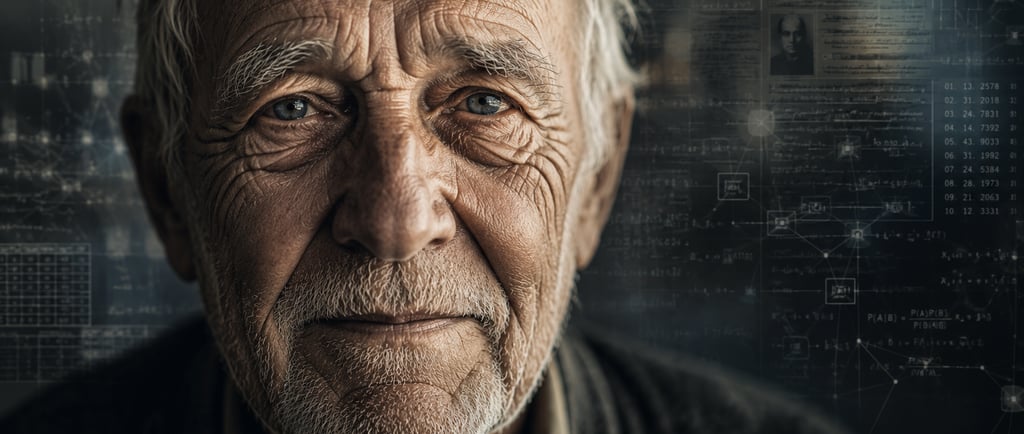
The image accompanying this article/post is AI-generated and is intended for illustration purposes only


© 2026 Dr Danie Adendorff. All rights reserved.