
Ford and the Cost of Removing the Team
A forensic Decision Before Consequence case study of Ford’s AI-enabled quality transformation, expert-layer restoration and the organisational meaning of reversibility.
TECHNOLOGY & AILEADERSHIP & DECISION-MAKING
Dr Danie Adendorff
6/30/202618 min read
Ford and the Cost of Removing the Team
AI, Reversibility, and the Human Return Point
Dr Danie Adendorff DSc (c.h), MSc
Ford’s quality recovery should not be read as a simple story of artificial intelligence failing and human expertise returning in triumph. The stronger lesson is that AI and automation can strengthen production, inspection, software testing and operational learning only when they operate inside a competent human system. Ford’s case shows the risk that emerges when technical capability is allowed to carry more organisational weight than it can safely bear.
Introduction
In this essay, DBC means Decision Before Consequence. It is a decision-pipeline process created by Dr Danie Adendorff to help leaders make accountable, consequence-aware decisions before damage becomes embedded. DBC is not a slogan and not a general call for better management. It is a structured decision discipline for high-consequence environments where delay, poor interpretation, weak authority, premature automation or misplaced technological confidence can create financial, operational, legal, reputational or safety consequences.
The DBC pipeline asks leaders to move through a disciplined sequence before committing the organisation to action. It begins with Situational Lock, where leaders define what is actually happening and prevent premature framing. It then moves to Intelligence Grading, where available information is assessed for reliability, source quality, uncertainty and decision relevance. Consequence Mapping identifies who or what will be affected if the decision is wrong, delayed, automated or poorly governed. Reversibility Assessment asks whether the organisation still has the capability to correct the decision before consequence becomes embedded. Authority Alignment ensures that responsibility, escalation and decision rights are properly assigned. Option Compression reduces possible courses of action to those that can realistically be governed. Adversarial Stress Test challenges the decision against failure modes, unintended effects and operational friction. Decisive Commitment makes the decision clear and owned. Command Execution implements the decision through accountable structures. Adaptive Correction then monitors consequences and corrects course before damage hardens into organisational failure.
The Ford case should be read against this pipeline. The issue is not whether Ford should have used AI. The issue is whether Ford’s leaders sufficiently protected the human expertise, institutional memory, authority and corrective capacity required to govern AI before quality, warranty, regulatory and reputational consequences became visible. In DBC terms, the central question is this: when Ford delegated more work to AI, automation and data-driven systems, did the organisation still retain a strong enough Human Return Point to interpret, challenge and correct those systems before consequence?
The Human Return Point is where delegated processing ends and accountable judgement resumes. It is not a token human presence after the machine has already shaped the decision environment. It is the point at which a competent, authorised and consequence-aware human being can interpret the system, question the output, stop the process, reopen the assumptions and accept responsibility for corrective action.
Ford did not move into AI, cloud, machine learning and automated quality systems irrationally. Like every major automaker, it faced pressure from electrification, software-defined vehicles, connected data, Tesla-style product cycles, rising warranty costs, recall exposure, supply-chain complexity and the demand for faster product development. In that environment, AI and automation were plausible instruments of modernisation.
The problem was not the decision to use AI. The problem was the executive assumption that AI and automation could carry judgement, experience and organisational memory more safely than the evidence later supported. The evidence does not prove a simple causal chain in which Ford laid off engineers because AI was explicitly intended to replace them. What it supports is more disciplined: Ford expanded AI, automation and data-driven quality systems during a wider period of EV and software restructuring; it also reduced staff in engineering, product-development and administrative functions; it then continued to face quality, warranty, recall and compliance pressures; and it later strengthened its quality recovery by restoring experienced technical specialists, design reviews, mentoring and human-guided improvement of AI-enabled tools.
That chronology is not an anti-AI argument. It is a governance argument. AI can assume tasks, but it cannot absorb responsibility.
Ford’s AI and Digital Transformation
Ford’s deeper movement into AI and data infrastructure was visible by early 2021. In February 2021, Ford and Google announced a six-year strategic partnership intended to accelerate Ford’s transformation and reinvent the connected-vehicle experience. Ford named Google Cloud as its preferred cloud provider, and the announcement referred directly to Google’s capabilities in artificial intelligence, data analytics, machine learning, compute and cloud platforms. The partnership also created Team Upshift, a joint Ford-Google group intended to explore data-driven opportunities, new customer experiences and connected services (Ford Motor Company and Google Cloud, 2021).
Ford’s 2021 integrated reporting shows that the company was not merely experimenting with AI in the abstract. It described advanced analytics and machine learning being used to support earlier detection of potential issues across its vehicle portfolio. Ford also described its Early Quality Issue Suite as drawing on multiple data sources, including connected vehicles and customer-service calls, with automatic anomaly detection and root-cause analysis intended to reduce the time from detection to correction (Ford Motor Company, 2021).
This matters because the Ford case cannot honestly be framed as a sudden, reckless leap into AI. Ford’s AI and machine-learning ambitions were part of a wider industrial transformation. In principle, the logic was legitimate. Connected vehicles generate data. Quality systems can detect anomalies earlier than traditional reporting channels. Computer vision can support assembly inspection. Software testing can be automated at scale. Data-driven tools can improve visibility across complex production systems.
The DBC issue is not whether such systems are useful. The issue is whether leadership correctly understood what kind of capability it was building — and what kind of human capability it still had to retain.
In Decision Before Consequence terms, the executive error risk arises when leaders confuse tool capability with organisational capability. A machine-learning system may detect signals, classify anomalies, accelerate inspection and generate hypotheses. But it does not, by itself, carry institutional memory, supplier history, manufacturing judgement, engineering intuition, accountability for trade-offs or authority to halt an unsafe trajectory. Those functions reside in the expert layer.
AI is not a replacement for the team. It is a force multiplier inside the team.
Workforce Restructuring and Capability Risk
The workforce context developed alongside the technology transformation. In August 2022, Reuters reported that Ford would cut 3,000 salaried and contract jobs, mostly in North America and India, as part of a restructuring to compete in software-driven electric vehicles (Reuters, 2022). In February 2023, Reuters reported that Ford planned to cut 3,800 roles in Europe, largely in product development and administration, while concentrating more engineering know-how in the United States (Reuters, 2023a). In June 2023, Reuters reported further layoffs in the United States and Canada, affecting mostly engineering jobs, as part of Ford’s move to exit unprofitable locations and reduce headcount (Reuters, 2023b).
These facts require restraint. The evidence does not prove that Ford reduced engineering or product-development roles because AI was formally intended to replace them. Any claim framed in that direct causal form would exceed the evidence. The stronger and more defensible formulation is narrower: Ford expanded AI, automation, analytics and digital quality systems while also reducing staff in engineering, product-development and administrative areas during a wider EV and software restructuring period.
That distinction matters. A serious essay must not transform temporal association into proven causation. However, it may examine the organisational risk created when automation, restructuring and expertise loss occur in the same strategic environment. The DBC question is therefore not, ‘Did AI cause the layoffs?’ The better question is, ‘What organisational capability may have been weakened during the transformation?’
An organisation can reduce headcount for many reasons: cost pressure, geography, EV transition, role duplication, weaker demand, strategic reprioritisation or restructuring of legacy operations. Yet it can still unintentionally damage the human capability required to govern new technology. Capability loss does not require ideological anti-human intent. It can occur through efficiency logic, retirement patterns, weak knowledge transfer, supplier fragmentation, weak mentoring or the assumption that codified requirements are an adequate substitute for lived engineering experience.
This is where the DBC pipeline becomes analytically useful. Consequence Mapping asks what may be lost if a human layer is thinned or removed. Reversibility Assessment asks whether the organisation will still possess the expertise required to reverse course if the new system underperforms. Authority Alignment asks whether the people capable of detecting system failure still have enough authority to intervene. Those questions are not anti-technology questions. They are governance questions.
The Quality Consequence
By 2024, Ford’s quality problem had become a governance problem, not merely an engineering inconvenience. Axios reported in February 2024 that Chief Executive Jim Farley acknowledged a major regret over not addressing Ford’s quality problems more decisively. The same report stated that quality problems had cost Ford billions in lost profits through warranty claims and delayed product launches, and that Ford faced $1.9 billion in excess warranty costs in 2023 (Axios, 2024).
Reuters reported in July 2024 that Ford’s second-quarter adjusted profit missed expectations as quality issues and electric-vehicle losses weighed on results. Ford’s warranty costs, reported at roughly $1.5 billion to $2 billion for the quarter, were about $800 million higher than the first quarter and around $700 million higher year-on-year, according to reporting citing Ford finance chief John Lawler (Reuters, 2024a).
The regulatory layer intensified the issue. In November 2024, the U.S. National Highway Traffic Safety Administration announced a consent order and civil penalty of up to $165 million after an investigation found that Ford failed to recall vehicles with defective rearview cameras in a timely manner and failed to provide accurate and complete recall information as required by federal law. The consent order included a $65 million upfront payment, $55 million deferred and $45 million in performance obligations (National Highway Traffic Safety Administration, 2024; Reuters, 2024b).
This is the consequence side of Decision Before Consequence. Quality failure does not remain inside the factory. It migrates. It becomes warranty cost, customer dissatisfaction, launch delay, regulatory scrutiny, recall burden, reputational damage and executive accountability. In Ford’s case, the evidence shows not just technical defects but a wider failure environment involving engineering, manufacturing, supply chain, compliance, data systems and management incentives.
That is why this case matters for AI governance. When automated systems underperform inside a weakened human system, the resulting exposure is not simply a software error. It becomes an organisational exposure. A camera may miss a defect. A model may be poorly trained. A dashboard may classify a signal incorrectly. But the deeper failure occurs when the organisation lacks the human authority, experience and institutional memory required to interpret the failure before it becomes consequence.
The AI-Assisted Quality System
The balanced reading is that Ford’s AI-supported quality systems were not useless. Business Insider reported that Ford introduced AI-powered quality-assurance systems, including AiTriz and MAIVS, to detect assembly defects in real time. Those systems used machine learning, video streaming and still-image inspection to identify misalignments and verify correct part installation (Business Insider, 2025).
The attribution of the AI-vision inspection figures must be handled carefully. WardsAuto reported that Ford’s computer-vision inspection work involved IBM’s Maximo Visual Inspection technology and described Ford’s Mobile AI Vision System operating across North American manufacturing facilities. The same report stated that MAIVS had performed 150 million individual inspections and flagged 400,000 quality issues that a human worker may have missed (WardsAuto, 2026). The relevant finding is therefore not that one branded tool solved the problem. It is that Ford had already deployed AI-enabled visual inspection at industrial scale and still concluded that automated inspection alone was insufficient without experienced human judgement.
These details prevent a false conclusion. Ford did not demonstrate that AI has no place in quality control. AI vision systems can be useful for repetitive inspection, high-speed assembly-line monitoring, connector verification, defect flagging and consistency in visual checks. In some circumstances, a camera-enabled model may identify a small misalignment that a human operator under production pressure could miss.
The DBC issue is therefore not whether AI can inspect. It can. The issue is whether inspection is the same as judgement. It is not.
A system may flag a defect, but it does not necessarily understand the design trade-off, supplier history, failure mode, customer use case, repair burden, regulatory implication or launch decision. A tool can detect a deviation. It cannot determine the organisational meaning of that deviation without competent interpretation. It cannot decide whether a pattern indicates isolated error, supplier drift, design weakness, software-integration failure or regulatory exposure.
This is why AI governance cannot be reduced to model performance. It must include human competence, authority, escalation, review, memory and correction. The tool may be strong. The decision system around the tool may still be weak.
Charles Poon and the Evidence of Substitution Failure
The most important evidence in the Ford case is the company’s own admission that AI and automation were insufficient without experienced judgement. Charles Poon, Ford’s vice-president of vehicle hardware engineering, stated that AI is a valuable tool, but only as good as the information used to train it. He also acknowledged that Ford had mistakenly believed that introducing AI and ingesting design requirements would produce a high-quality product (Business Insider, 2026; Fortune, 2026).
That admission is central. It is not an external commentator’s anti-AI reading of Ford’s experience. It is a senior Ford engineering executive identifying the failure mechanism: the organisation had treated formalised requirements and automated systems as more capable of carrying quality judgement than they were. Poon also said Ford had not paid enough attention in prior years to the experience of its most knowledgeable engineers, some of whom had left before their expertise was fully transferred into Ford’s systems (Fortune, 2026).
This is the strongest bridge between the Ford evidence and the DBC doctrine. Training data is not merely a technical input. In complex engineering environments, it is often a compressed residue of human expertise. If experienced people leave before their knowledge is transferred, the system may ingest the formal requirement while missing the practical judgement that gives the requirement meaning. That is not a minor data-quality problem. It is an organisational-memory problem.
The Poon admission also sharpens the reversibility issue. If the organisation removes or weakens the human capability required to train, audit, correct and challenge AI-enabled systems, then it may later discover that the decision is technically reversible but organisationally difficult to reverse. The software may be patched. The inspection model may be retrained. The process may be redesigned. But the lost judgement has to be rebuilt, rehired, relearned or recovered through costly organisational effort.
That is the beginning of reversibility debt.
The Restoration of the Expert Layer
Ford’s recovery effort centred not on abandoning AI, but on restoring experienced human judgement around it. Business Insider reported in June 2026 that Ford had hired, promoted or brought back about 350 experienced technical specialists as part of its effort to address vehicle-quality problems. These specialists reportedly mentored younger staff, led design reviews and helped improve the AI and automated quality tools used to catch defects before vehicles reached customers (Business Insider, 2026).
The same reporting stated that Ford’s quality reset began in 2023, that the company more than doubled its technical-specialist population, and that Ford created a more integrated approach across engineering, manufacturing and supply chain. Ford’s recovery was described as moving away from a reactive ‘find and fix’ model towards earlier prevention (Business Insider, 2026).
Other reporting confirms the same broad shift. The Verge reported that Ford’s overreliance on automated systems and AI contributed to quality difficulties, and that Ford responded by bringing experienced engineers back into the quality process, strengthening collaboration among software, engineering and manufacturing teams, and creating a dedicated software quality-assurance capability (The Verge, 2026). TechCrunch also reported that Ford executives said they had hired 350 veteran engineers, including former employees and supplier personnel, after artificial intelligence and automated systems failed to deliver the desired quality level (TechCrunch, 2026).
Ford’s 2026 quality result provides the outcome context. J.D. Power reported that Ford ranked highest among mass-market brands in the 2026 U.S. Initial Quality Study, with 152 problems per 100 vehicles. Porsche ranked highest overall with 138 PP100, while Genesis ranked second among premium brands with 151 PP100. J.D. Power also reported that industry-wide initial quality recorded its strongest year-over-year improvement since 1997 (J.D. Power, 2026). Ford’s own statement said the result represented its first No. 1 mainstream-brand position in the Initial Quality Study since 2010, with Ford improving by 41 fewer problems per 100 vehicles compared with the previous year (Ford Motor Company, 2026).
This must be interpreted carefully. The J.D. Power result is a significant quality indicator, but it is not proof that Ford has solved every recall, durability or lifecycle-quality problem. The study measures problems reported in the first 90 days of ownership. It is an initial-quality indicator, not a complete lifecycle verdict. Reuters also reported that Ford led mass-market brands in initial quality while noting that the company still had 51 recalls so far in 2026, many linked to older models (Reuters, 2026).
The stronger conclusion is that Ford’s quality recovery became visible after it combined AI-enabled systems with a restored expert layer: veteran engineers, technical specialists, cross-functional design review, supplier integration, software-quality assurance and preventive failure analysis. Ford recovered not by rejecting AI, but by restoring experienced human judgement around AI.
Adversarial Stress Test: Is This Also Ford’s Own Convenient Narrative?
A serious DBC reading must stress-test its own thesis. The most obvious counterargument is that the ‘AI fell short; experts returned’ narrative may also serve Ford’s retrospective public positioning. Ford was celebrating a J.D. Power win while still carrying a recall hangover, a NHTSA consent order and a multi-year quality reputation problem. A story about pairing AI with veteran engineers is cleaner than a story about warranty cost, delayed recalls, organisational silos, supplier complexity, software quality, EV restructuring and managerial accountability.
That counterargument does not destroy the DBC interpretation. It improves it. The Ford case should not be reduced to ‘AI caused the quality problem’. Quality failures had multiple drivers: older vehicle platforms, supplier interfaces, warranty exposure, software complexity, manufacturing execution, recall governance and organisational silos. Ford’s own executives did not say AI was inherently defective. Poon’s point was more precise: AI was useful, but it depended on the quality of the human knowledge used to train and govern it (Business Insider, 2026).
The stronger finding is therefore not that AI failed as a technology. The stronger finding is that AI was insufficient as a substitute for experienced human judgement. That distinction matters. It prevents the essay from becoming a polemic and keeps the analysis inside the DBC frame. The case is not about humans defeating machines. It is about leaders discovering, after consequence became visible, that the organisation still needed the expert layer to make automation reliable.
Reversibility as Organisational Capability
The Ford case is a practical test of the DBC principle that reversibility is not a technical property; it is an organisational capability. An AI decision is not reversible merely because the system can be switched off. It is reversible only if the organisation still possesses the human judgement capacity required to correct it.
This distinction is central. In technology management, reversibility is often imagined as a technical function: roll back the software, patch the model, retrain the algorithm, replace the vendor, add monitoring, install a new dashboard or reconfigure the workflow. Those actions may be necessary, but they are not sufficient. A decision remains reversible only while the organisation retains the capability required to understand what went wrong, diagnose the failure, challenge the output, recover lost knowledge, redesign the process and authorise corrective action before consequence becomes embedded.
Ford illustrates the danger of reversibility debt. A bad AI-substitution decision may appear efficient at the time because it removes cost, accelerates throughput or reduces dependence on expensive experts. But if the removed capability is the same capability needed to train, audit, interpret, correct and govern the AI system, the organisation has not gained efficiency. It has accumulated hidden debt. The debt becomes visible only later, when the system underperforms and the organisation discovers that the people who understood the failure mechanisms are no longer available, no longer empowered or no longer close enough to the decision process.
That is the DBC reading of the Ford reversal. The problem was not that AI could not help Ford. The problem was that AI could not substitute for the tacit knowledge embedded in engineers who had lived through multiple product cycles, understood the failure-prone intersections between design, manufacturing, software and hardware, and could challenge quality assumptions before defects became production or customer problems.
A software system may retain data. It does not automatically retain wisdom. A dashboard may preserve metrics. It does not preserve judgement. A model may process design requirements. It does not necessarily know which requirement is brittle, which supplier interface is historically unstable, which tolerance is too optimistic or which apparent compliance result masks a field failure waiting to happen. That is organisational capability, not technical capability.
The Human Return Point
The Human Return Point should not be treated as a procedural box marked ‘human review’. In Ford’s case, the return point had to be competent, authorised and early enough to influence design, manufacturing, supplier integration and software quality before problems travelled downstream.
A meaningful return point requires technical depth. The human reviewer must understand the system, the engineering domain and the likely failure modes. It also requires authority. A specialist who can see a problem but cannot stop the line, delay a launch, challenge a model, escalate a supplier issue or reopen a design review is not exercising accountable judgement; that person is observing a process already in motion.
Information and time are equally important. AI-generated alerts, production data, connected-vehicle signals, warranty claims and supplier feedback must be integrated into a decision picture that experienced judgement can interrogate. If those signals remain fragmented, the organisation may possess data without awareness. If the review cadence is too compressed, the human presence becomes performative rather than corrective.
The final condition is cultural. Experts must be permitted to challenge automated outputs and managerial assumptions. A culture that treats AI output or dashboard logic as presumptively superior will gradually silence the judgement required to prevent embedded failure. Ford’s quality reset appears to have moved in the opposite direction: technical specialists, design reviews, cross-functional integration, preventive failure analysis and human-guided improvement of AI tools.
The lesson for executives is direct. The Human Return Point must be designed before consequence, not improvised after the system has failed.
Executive Lessons from the Ford Case
The Ford case offers a practical rule for executives considering AI substitution: before removing a human capability, establish who will know when the system is wrong, who has authority to reverse it, and who can reconstruct the lost context if the system fails. If those questions cannot be answered, the organisation is not buying efficiency; it is booking reversibility debt.
Automation should therefore be treated as a capability amplifier, not as capability itself. It can execute, inspect, classify and accelerate, but the organisation still needs judgement, memory, escalation and correction. Senior engineers and technical specialists are not simply labour cost. In complex industrial systems, they form part of the organisation’s error-correction architecture.
The same logic applies to training data. In mature engineering environments, training data often reflects accumulated human experience. If experienced personnel leave before their knowledge is transferred, the system may inherit formal requirements while missing the tacit judgement that gives those requirements practical meaning. Executives should therefore assess knowledge transfer, authority and correction capacity before treating AI as a substitute for expertise.
Compliance and quality must also be understood as governance functions. A recall problem is not merely a technical defect. It is also a failure of escalation, reporting, accountability and consequence management. NHTSA’s 2024 action against Ford reinforces that safety and recall governance require timely, accurate and complete information, not simply better production tools (National Highway Traffic Safety Administration, 2024).
This connects directly to the wider DBC essay sequence. ‘When Layoffs Are Rebranded as AI Strategy’ warns against treating AI transformation as a legitimising language for capability removal. ‘The Human Return Point’ provides the management doctrine for accountable human return before consequence. The Ford case joins those arguments by showing how technical delegation can become organisational exposure when the expert layer is thinned before the decision system is mature.
Conclusion
Ford’s case does not justify rejection of AI. It supports a more demanding conclusion: AI must be governed inside a responsible human system. Ford continued to use AI vision systems, automated inspection, software testing and data-driven quality methods, but its recovery effort placed those tools inside a stronger human architecture of technical specialists, design reviews, supplier integration, mentoring and accountable engineering judgement.
The lesson is not that human expertise should resist automation. The lesson is that expertise must shape, train, test and correct automation before the consequences of weak delegation become embedded. Ford’s experience shows that a technologically advanced organisation can still lose decision quality if it undervalues the people who understand how defects emerge across design, manufacturing, software and supply chains.
For executives, the case reduces to a simple governance test. Before delegating a critical function to AI, ask whether the organisation still possesses the people, authority, memory and review mechanisms needed to recognise failure and recover from it. If not, the apparent gain in efficiency may conceal a future correction cost. Ford’s return to experienced judgement is therefore not a nostalgic lesson. It is a modern management warning: the team was not a legacy burden. It was the control system.
Sources
Adendorff, D. (2026a) ‘When Layoffs Are Rebranded as AI Strategy’. Rumbls essay series.https://rumbls.com/when-layoffs-are-rebranded-as-ai-strategy
Adendorff, D. (2026b) ‘The Human Return Point: Managing Trust, Simplicity and Accountability in the Enterprise AI Transformation’. Rumbls essay series.https://rumbls.com/the-human-return-point-managing-trust-simplicity-and-accountability-in-the-enterprise-ai-transformation
Axios (2024) ‘Ford CEO admits “big” regret over quality issues’, 15 February. Available at: https://www.axios.com/2024/02/15/ford-jim-farley-quality-issues
Business Insider (2025) ‘Ford’s AI cameras are catching hard-to-spot manufacturing errors. It could solve the company’s costly recalls’. Available at: https://www.businessinsider.com/ford-uses-ai-cameras-in-factories-prevent-recalls-costly-rework-2025-8
Business Insider (2026) ‘Ford says AI alone couldn’t fix its quality problems. It needed to rehire veteran engineers to help’, 25 June. Available at: https://www.businessinsider.com/ford-ai-hiring-veteran-engineers-2026-6
Ford Motor Company (2021) ‘Economic and Innovation’, Integrated Sustainability and Financial Report 2021. Available at: https://corporate.ford.com/microsites/integrated-sustainability-and-financial-report-2021/economic-and-innovation/index.html
Ford Motor Company and Google Cloud (2021) ‘Ford and Google to Accelerate Auto Innovation, Reinvent Connected Vehicle Experience’, 1 February. Available at: https://www.googlecloudpresscorner.com/2021-02-01-Ford-and-Google-to-Accelerate-Auto-Innovation%2C-Reinvent-Connected-Vehicle-Experience
Ford Motor Company (2026) ‘Ford is No. 1 Mainstream Brand in J.D. Power Initial Quality Study’, 25 June. Available at: https://www.fromtheroad.ford.com/us/en/articles/2026/ford-tops-jd-power-initial-quality-study
Fortune (2026) ‘Ford on why it hired 350 “gray beard” engineers’, 29 June. Available at: https://fortune.com/2026/06/29/ford-ai-hired-human-workers-gray-beards-automation/
J.D. Power (2026) ‘2026 U.S. Initial Quality Study’, 25 June. Available at: https://www.jdpower.com/business/press-releases/2026-us-initial-quality-study-iqs
National Highway Traffic Safety Administration (2024) ‘Ford Consent Order; $165 Million Civil Penalty’, 14 November. Available at: https://www.nhtsa.gov/press-releases/ford-consent-order-165-million-civil-penalty
Reuters (2022) ‘Ford cuts 3,000 jobs as it pivots to EVs, software’, 22 August. Available at: https://www.reuters.com/business/autos-transportation/ford-cuts-3000-jobs-it-pivots-software-future-2022-08-22/
Reuters (2023a) ‘Ford to cut one in nine jobs in Europe in electric revamp’, 14 February. Available at: https://www.reuters.com/business/autos-transportation/ford-eliminate-3800-engineering-administration-jobs-europe-2023-02-14/
Reuters (2023b) ‘Ford to cut jobs in the U.S., Canada to trim costs’, 27 June. Available at: https://www.reuters.com/business/autos-transportation/ford-cut-jobs-us-canada-2023-06-27/
Reuters (2024a) ‘Ford profit disappoints, stock falls as quality issues dog automaker’, 24 July. Available at: https://www.reuters.com/business/autos-transportation/fords-q2-adjusted-profit-falls-ev-hit-2024-07-24/
Reuters (2024b) ‘Ford Motor hit with $165 million U.S. civil penalty over delayed rearview camera recall’, 14 November. Available at: https://www.reuters.com/legal/ford-motor-hit-with-165-million-us-civil-penalty-over-delayed-rearview-camera-2024-11-14/
Reuters (2026) ‘U.S. automotive quality increased industrywide last year, with Ford taking top honors’, 25 June. Available at: https://www.reuters.com/business/autos-transportation/us-automotive-quality-increased-industrywide-last-year-with-ford-taking-top-2026-06-25/
TechCrunch (2026) ‘Ford rehires “gray beard” engineers after AI falls short’, 28 June. Available at: https://techcrunch.com/2026/06/28/ford-rehires-gray-beard-engineers-after-ai-falls-short/
The Verge (2026) ‘Ford had to hire back former engineers to fix mistakes made by its automated systems’, 26 June. Available at: https://www.theverge.com/transportation/956316/ford-quality-jd-power-ranking-ai-automated-mistakes
WardsAuto (2026) ‘How Ford flags assembly line defects with IBM’s AI-powered inspection tools’, 10 June. Available at: https://www.wardsauto.com/news/how-ford-flags-assembly-line-defects-with-ibms-ai-powered-inspection-tools/822404/
Image Declaration
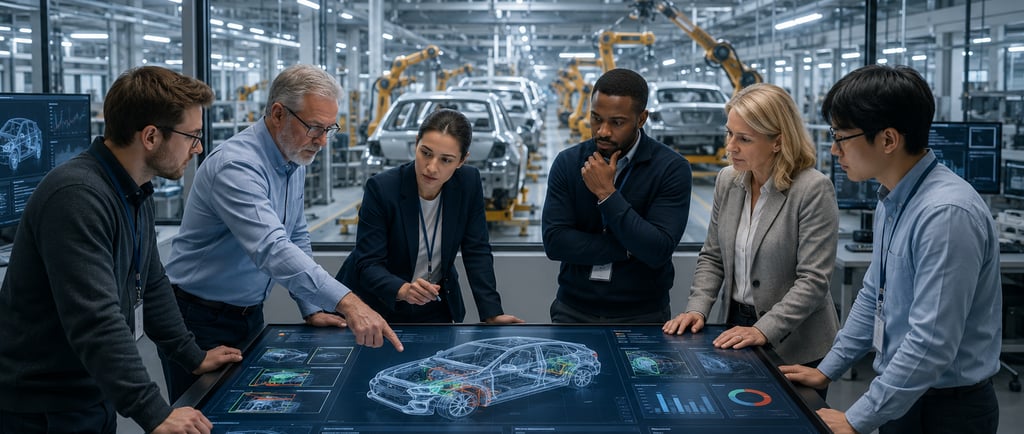
No image is included with this essay. If the image prompt in Annexure A is used to generate a supporting illustration, the image must be declared as AI-generated and used only as a conceptual editorial image. It must not be presented as a photograph of Ford facilities, Ford personnel, Ford meetings, Ford production systems or any real event.
Author Workflow Declaration
This essay was produced through an AI-assisted but human-directed workflow. AI was used for research structuring, chronology development, drafting support, language refinement, source organisation and editorial checking. The author retained responsibility for argument, interpretation, judgement, final approval and publication decision. AI-generated material is not treated as empirical evidence.


© 2026 WDA Publishing. All rights reserved.