
Freedom as the Antidote: Milton Friedman, Orwell, and the Case Against Control
George Orwell warned that political control does not always arrive as a violent revolution. Sometimes it arrives administratively.
POLITICS & SOCIETY
5/17/20268 min read

Freedom as the Antidote: Milton Friedman, Orwell, and the Case Against Control
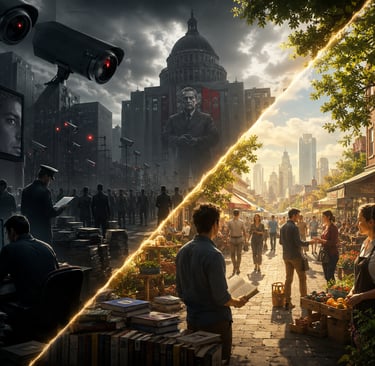
George Orwell warned that political control does not always arrive as a violent revolution. Sometimes it arrives administratively. It is built through language, fear, dependency, surveillance, and the gradual narrowing of what ordinary people are allowed to say, own, question, build, or become. In Nineteen Eighty-Four, Orwell imagined a society in which the state had absorbed almost everything: truth, memory, privacy, work, loyalty, identity, and even thought itself.
Milton Friedman’s Capitalism and Freedom, published in 1962, offers one of the strongest intellectual antidotes to that danger. Friedman’s argument was not merely economic. It was political and moral. His central claim was that economic freedom is a necessary condition for political freedom. When the state controls economic life, it gains the power to control social life. When it controls employment, money, education, licensing, prices, enterprise, and opportunity, it no longer needs to imprison every dissenter. It can make independent life impossible.
There is, of course, an important historical tension here. Orwell was not a free-market libertarian. He was a democratic socialist, deeply hostile to totalitarianism but also sceptical of crude capitalist power. Friedman, by contrast, was one of the twentieth century’s most influential defenders of market freedom and limited government. Yet despite their very different starting points, both men understood the same central danger: liberty is threatened when too much power gathers in too few hands.
That is why Friedman matters in any serious discussion of Orwell. Orwell showed what control looks like when it becomes total. Friedman explained how societies may drift toward that condition when they surrender economic independence in exchange for administrative protection, political management, or centralised promises of security.
Freedom Requires More Than Voting
A society can hold elections and still become deeply controlled. Political freedom is weakened when citizens depend entirely on the state, or on state-aligned institutions, for employment, income, housing, education, healthcare access, professional accreditation, financial permission, or access to public life. If authority controls the means by which people live, it can shape the range of views they dare to express.
Friedman understood that freedom requires dispersed power. A market economy, at its best, disperses decision-making across millions of individuals. It allows people to choose, trade, build, invest, compete, fail, recover, publish, organise, and create outside the direct command of political authority.
This does not make capitalism morally perfect. Markets can produce greed, inequality, exploitation, monopoly, and social disruption. Private power can become abusive. Corporations can seek privilege, suppress competition, and collude with government. But the existence of private economic space still matters because it creates alternative centres of power. It prevents one authority from becoming the master of social life.
That distinction is crucial. The question is not whether markets are flawless. They are not. The question is whether concentrated political control is safer. History suggests that it is not. When economic power and political power are fused, dissent becomes costly. A person who offends the ruling authority may lose not only political favour, but livelihood, mobility, reputation, access, and future opportunity.
Orwell’s nightmare was a world in which the individual had nowhere to stand outside the system. Friedman’s answer was that freedom requires independent space: private property, voluntary exchange, plural institutions, competitive enterprise, independent associations, and limits on the state.
Control Often Arrives as Protection
Modern control rarely announces itself as tyranny. It presents itself as protection. Citizens are told that more regulation, supervision, monitoring, restriction, or central coordination is necessary to solve urgent problems. Some of those problems may be real. A free society cannot be naïve about fraud, crime, disease, foreign interference, digital manipulation, economic instability, or national security threats.
But Friedman’s warning is that every intervention must be judged not only by its stated intention, but by the power it creates.
A policy may begin as a solution to a defined problem and still become an instrument of control. A licensing system may begin as consumer protection and become a barrier against competition. A welfare system may begin as compassion and become a mechanism of dependency. A monetary authority may begin as stabilisation and become a tool of inflationary manipulation. A censorship regime may begin as public safety and become ideological enforcement. A digital identity system may begin as administrative efficiency and become a platform for surveillance, exclusion, or behavioural monitoring.
This is the logic Orwell understood. Control expands most easily when it speaks the language of necessity. It does not usually say, “We want power.” It says, “We want order.” It says, “We are preventing harm.” It says, “Trust the system.”
Friedman’s response would be clear: do not judge political power only by its promises. Judge it by its incentives, limits, reversibility, accountability, and consequences.
Economic Freedom Gives Citizens Courage
There is a practical relationship between economic independence and moral courage. A person who can change jobs, start a business, move capital, publish independently, educate their children through alternative routes, or associate freely with others has more capacity to resist pressure. Freedom is not only a constitutional right. It is a lived condition.
If every opportunity depends on institutional approval, people become cautious. They self-censor. They avoid controversy. They repeat approved phrases. They learn which opinions are safe. They become outwardly compliant long before they are inwardly convinced.
This is where Orwell’s warning about thought control remains powerful. A society does not need a literal Ministry of Truth if professional, financial, reputational, and social penalties are strong enough to discipline speech. The machinery of control can be decentralised. It can operate through institutions, employers, banks, platforms, professional bodies, universities, regulators, and funding networks. It can function through incentives rather than open terror.
Friedman’s defence of capitalism is therefore also a defence of the dissenter. The entrepreneur, the writer, the independent teacher, the small publisher, the local association, the self-employed professional, and the private citizen with savings all represent forms of social resilience. They are not merely economic actors. They are buffers against monopoly power, including political monopoly.
The Corporate Proxy Problem
A serious defence of freedom must also recognise that private power can become a threat when it ceases to behave competitively and begins to operate as a proxy for political authority.
This is one of the major challenges of the modern age. Large technology companies, financial institutions, payment processors, employers, and digital platforms increasingly control access to communication, income, reputation, commerce, and public visibility. When such institutions act independently in competitive markets, they may still be constrained by consumer choice, law, and reputational pressure. But when they become aligned with state preferences, regulatory pressure, ideological fashion, or administrative expectation, the boundary between private decision and public mandate becomes blurred.
This is not free-market discipline. It is soft administrative control through nominally private channels.
In such a system, the state may not need to censor directly. Platforms can demote, de-rank, suspend, or exclude. Banks can close accounts. Employers can enforce conformity. Professional bodies can discipline dissent. Universities can narrow permissible debate. Public-private coordination can produce outcomes that look voluntary but function coercively.
Friedman’s deeper principle remains relevant here: freedom requires dispersed power, not merely private ownership. A corporation that depends on state favour, regulatory protection, monopoly privilege, or ideological alignment with government can become part of the control architecture. It may carry out the work of censorship, exclusion, or behavioural discipline while preserving the appearance of market choice.
The antidote is not blind trust in corporations. It is competition, transparency, due process, viewpoint neutrality in essential services, open markets, legal restraint, and the prevention of collusion between political authority and economic gatekeepers.
The Moral Case for Limited Government
Friedman did not argue that government has no role. He accepted the need for law, property rights, contract enforcement, monetary stability, national defence, and certain limited public functions. His argument was against the conversion of government from referee into manager of society.
The distinction matters. A referee enforces general rules. A manager directs outcomes. A free society needs law, but it should be cautious about allowing government to decide too much: which industries should win, which opinions are acceptable, which risks are permitted, which lifestyles deserve support, which citizens are productive, and which forms of association are approved.
Once government becomes the organiser of social purpose, freedom becomes conditional. Citizens are no longer treated primarily as responsible adults. They become subjects of policy design.
Friedman’s motivational power lies in this insistence: people must be trusted with their own lives. They must be allowed to choose, err, learn, build, associate, trade, and bear responsibility. A society that removes all risk also removes agency. A society that promises to plan everything eventually reduces the human being to an administrative object.
Freedom Is Not Comfort
The defence of freedom is difficult because freedom is untidy. It produces disagreement, competition, inequality of outcome, error, offence, and uncertainty. Controlled societies exploit this discomfort. They promise to remove conflict by imposing order. They promise to remove anxiety by narrowing choice. They promise to protect citizens from difficulty by expanding supervision.
But a life without meaningful choice is not secure. It is managed.
Freedom requires maturity. It requires citizens who can tolerate disagreement without demanding censorship; tolerate economic risk without demanding total planning; tolerate uncertainty without surrendering responsibility; and tolerate failure without asking the state to organise every outcome.
Friedman’s message is not that capitalism automatically creates virtue. It does not. His deeper message is that freedom creates the conditions in which virtue remains possible. Responsibility has meaning only where choice exists. Courage has meaning only where dissent is possible. Creativity has meaning only where permission is not required.
The Antidote to Orwell
The antidote to Orwell is not blind faith in markets, corporations, technology, or wealth. Corporate power can also threaten liberty when it becomes monopolistic, censorious, collusive, or dependent on state favour. The real antidote is dispersed power: political power limited by law, economic power disciplined by competition, institutions prevented from becoming monopolies, and citizens protected in their right to think, speak, build, trade, and dissent.
A free society must therefore resist both state domination and private concentrations of power that behave like delegated authorities. It must defend open competition, free speech, private property, independent education, sound money, voluntary association, due process, and the right to build a life without ideological permission.
Orwell warned us what happens when truth is centralised. Friedman warned us what happens when economic power is centralised. Together, they offer a single lesson: human freedom is lost when too much power is allowed to gather in too few hands.
The motivational lesson is clear. Freedom is not inherited permanently. It must be practised, defended, renewed, and institutionally protected. It requires citizens who refuse to exchange independence for managed comfort. It requires leaders who understand that control is not the same as order, regulation is not the same as justice, and supervision is not the same as safety. It requires a culture that values responsibility over dependency and courage over compliance.
A society remains free only when its people retain the material, moral, and political capacity to say no.
That is the enduring relevance of Capitalism and Freedom. Friedman’s argument still matters because the central danger has not disappeared. The machinery of control has merely become more sophisticated. It may now appear through digital systems, financial surveillance, speech management, institutional dependency, public-private enforcement, bureaucratic expansion, or moralised policy mandates.
Against that machinery, the answer remains disciplined and demanding: limit power, disperse authority, defend voluntary action, protect dissent, preserve economic independence, restrain monopolies, and trust free citizens more than central planners.
Orwell showed the prison. Friedman showed one way to keep the door from closing.
Author workflow disclosure
This article was produced through an AI-assisted but human-directed workflow. AI support was used for accessibility assistance, article structuring, language refinement, source-discovery prompts, revision planning, and conversion of editorial comments into specific amendments. The author retained responsibility for the argument, accepted or rejected suggested changes, checked the logic of the claims, and remained accountable for the final text. AI-generated material was not treated as empirical evidence, and synthetic or illustrative examples were not presented as observed data.
Image note
The image accompanying this article is AI-generated and is intended for illustration purposes only.


© 2026 WDA Publishing. All rights reserved.