
From Tripoli to Theran, Cape Town and The Hague
An investigation into the political and institutional network connecting the ANC, Hamas, Iran, Cape Town activism and South Africa’s use of international courts against Israel.
POLITICS & SOCIETYWAR, SECURITY & GEOPOLITICS
Dr Danie Adendorff
7/21/202613 min read
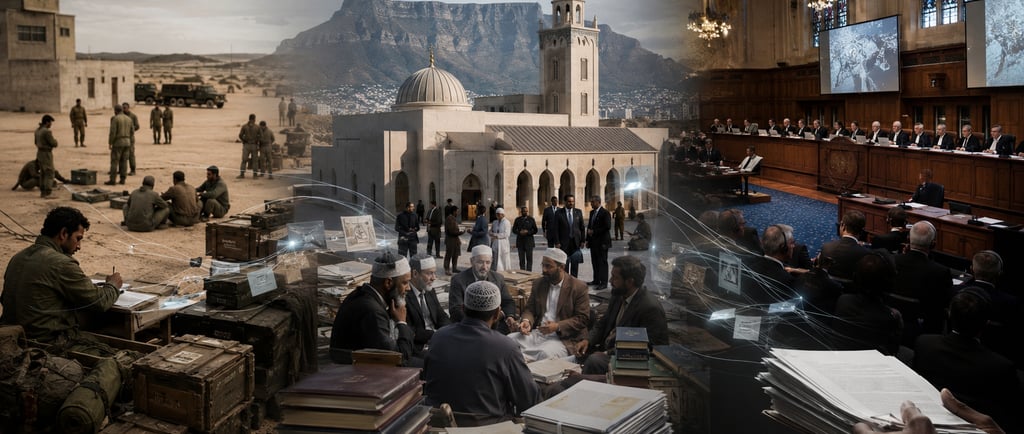
From Tripoli to Theran, Cape Town and The Hague
How revolutionary patronage, Iranian religious influence, Hamas diplomacy and ANC liberation politics converged in South Africa’s campaign against Israel
By Dr Danie Adendorff DSc (c.h), MSc.
THE NETWORK IS REAL
Khaled Mashaal did not come to Cape Town in October 2015 merely to praise Nelson Mandela. The Hamas political leader came to claim a place inside South Africa’s liberation story. Before an ANC-supported audience, he compared the Palestinian struggle with the campaign against apartheid. During the same visit, the ANC and Hamas signed a letter of intent designed to establish a lasting organisational relationship.
That relationship later acquired practical content. Cooperation extended to the Boycott, Divestment and Sanctions campaign, parliamentary pressure and the downgrading of South Africa’s diplomatic representation in Israel. The ANC did not treat Hamas as a temporary visitor or a distant cause. It treated Hamas as a fellow liberation movement and a political partner.
That decision matters because political classification changes what the public is asked to tolerate. Once an armed organisation is admitted into the moral category of ‘liberation movement’, its violence is more easily recast as resistance, its sponsors become allies, and scrutiny of its methods is dismissed as hostility to the cause it claims to represent.
Hamas is not Islam, and South African Muslims are not one political bloc. Hamas is a specific Palestinian Islamist and nationalist organisation with a military wing. Iran is a Shia revolutionary state. Their cooperation proves that strategic purpose can override sectarian difference. The issue is not an alleged conspiracy of Muslims. It is the existence of a political network linking Iranian state institutions, resident clerics, local religious organisations, Palestinian solidarity structures, Hamas representatives and ANC decision-makers.
That network is not theoretical. Its constituent parts are documented. Its influence is local, physical and institutional.
LIBYA PROVIDED THE EARLIER MODEL
The story begins before Iran became the central external actor. Muammar Gaddafi’s Libya built a system of revolutionary patronage that stretched across Africa, Europe and the Middle East. It offered recognition, money, military instruction, weapons and diplomatic protection to movements that described themselves as anti-colonial or national liberation organisations.
The ANC and the Provisional IRA were separate beneficiaries of that system. Nelson Mandela did not train in Libya with IRA members. His military exposure during his clandestine African journey in 1962 occurred elsewhere. Libya later trained ANC cadres, while also supplying the IRA with weapons, finance and Semtex. Mandela publicly thanked Gaddafi in 1990 for assisting South Africans involved in the armed struggle. British parliamentary investigations later documented the destructive consequences of Libyan matériel in the IRA campaign.
The important connection is therefore not a shared training photograph. It is a shared patronage architecture. An external state identified armed movements whose causes could advance its wider geopolitical position. It supplied resources without erasing their local identity. In return, it acquired influence, gratitude and durable political access.
Those debts survived the conflicts that created them. Mandela’s loyalty to Gaddafi after 1994 was not an eccentric attachment. It reflected a liberation movement’s memory of who provided assistance when Western governments had treated it as hostile or subversive.
Iran developed a more sophisticated version of the same method. It added clerical formation, religious institutions, cultural diplomacy, political media, ideological education and proxy warfare to the older model of money, weapons and training. It did not need every partner to become Shia or to accept direct command from Tehran. It needed local organisations willing to carry its interpretation of resistance, oppression and Western power.
IRAN’S CAPE TOWN PRESENCE IS NOT REMOTE
Iranian influence in Cape Town is often described as sympathy conducted at a distance. The historical record shows something more substantial.
The Iranian Revolution of 1979 had a direct effect on sections of South African Muslim political organisation. The Cape Town-based Qibla movement, formed under Achmat Cassiem, drew heavily from Ayatollah Ruhollah Khomeini’s revolutionary language. Qibla was not simply an Iranian branch. It combined anti-apartheid struggle, Black Consciousness, class politics and political Islam. Yet Khomeini’s doctrine gave it a model in which religious authority, revolutionary organisation and resistance to Western-aligned power formed a single political project.
That influence later developed an institutional base. Research on South African Shiism records that Pakistani-born Moulana Sayyid Aftab Haider arrived in 1991 with initial Iranian government support and established the Ahlul Bait Foundation of South Africa. The organisation developed a permanent mosque complex in Ottery, Cape Town, together with religious teaching, publications, community programmes, a madrassa and links to Shia centres abroad.
This was not an online campaign or occasional diplomatic courtesy. It involved resident clerics, local congregations, formal instruction and permanent institutions. Iranian-linked educational camps, visiting clerical delegations, lectures by former diplomats and support from institutions in Qom provided further channels through which doctrine and leadership were reproduced locally.
Field research also identified Cape-based clerics trained in Iran and Lebanon who maintained close relationships with Middle Eastern Shia centres. These connections brought religious literature, teaching, conferences, visiting scholars and financial support into local organisational life. The influence was embodied in people who lived and worked in the Cape. It did not depend on messages transmitted from Tehran to passive recipients thousands of kilometres away.
Strategic penetration is not measured by majority ownership. An external power does not need to direct every mosque or command an entire religious community before its influence becomes consequential. A single durable institution can train leaders. A single clerical pipeline can reproduce doctrine. One media platform can spread a political narrative far beyond its congregation. One well-positioned organisation can connect local mobilisation to governing-party access.
The evidence does not justify the claim that Iran controls every mosque in Cape Town. Cape Islam is predominantly Sunni, internally diverse and institutionally fragmented. Many Muslim leaders reject Iranian theology, Iranian state conduct or both. That diversity does not negate the existence of Iranian-controlled or Iranian-influenced nodes. It defines their boundaries.
The firmer conclusion is unavoidable: Iran has cultivated a local influence infrastructure in Cape Town through resident religious authorities, clerical education, institutional support, diplomatic engagement and revolutionary political messaging.
QUDS DAY: AN IMPORTED POLITICAL RITUAL
The annual Quds Day mobilisation makes that infrastructure visible. Ayatollah Khomeini established Quds Day in 1979 as an international campaign against Israel. Qibla introduced the observance into South Africa during the apartheid period. In Cape Town, the marches have brought together religious organisations, Palestinian solidarity groups, political activists and public figures under a political ritual created by the Iranian revolutionary state.
A march does not prove that every participant is controlled by Iran. It does show how Iranian political symbolism has been normalised inside a local activist environment. Iranian diplomatic representatives have continued to meet Cape Town clerics, prayer leaders, academics and campaigners. These engagements are not secret. They are public exercises in narrative alignment, political mobilisation and relationship maintenance.
The distinction between influence and control should not become a device for denying both. Influence is demonstrated when external ideas, money, training, institutions and diplomatic access shape local leadership and public action. Direct command is only one possible mechanism. It is not the threshold at which foreign penetration becomes real.
THE ANC–HAMAS BRIDGE
Iran’s relationship with Hamas is established. Tehran has provided money, weapons, training, technical assistance and strategic support. Hamas has retained organisational autonomy and has disagreed with Iran on important issues, including the Syrian war. Yet it remains a central component of the Iranian-supported ‘resistance’ network directed against Israel.
The ANC gives that network something Hamas and Iran cannot easily manufacture for themselves: the moral authority of the South African liberation struggle and the institutional capacity of a recognised state.
South Africa can translate the vocabulary of armed resistance into the language of human rights. It can present aligned political objectives as the independent judgement of Mandela’s constitutional democracy. It can move the conflict from tunnels, missiles and hostage-taking into parliaments, sanctions campaigns and international courts.
This makes the ANC more valuable than a conventional proxy. South Africa is not under Iranian military command. It performs a different strategic function. It supplies legitimacy, diplomatic reach and legal standing.
The ANC’s formal relationship with Hamas created the bridge. Hamas obtained access to a governing party that already understood the world through the categories of liberation, solidarity and historical debt. The ANC obtained a contemporary cause through which it could reactivate its own revolutionary identity.
THE ROAD TO THE HAGUE
The chronology before South Africa’s application to the International Court of Justice deserves serious examination.
On 17 October 2023, Foreign Minister Naledi Pandor spoke with Hamas leader Ismail Haniyeh. The government said the call concerned humanitarian assistance and denied that she had endorsed the 7 October attack. Five days later, Pandor travelled to Tehran, met President Ebrahim Raisi and held discussions with Iranian Foreign Minister Hossein Amir-Abdollahian. South Africa instituted proceedings against Israel on 29 December 2023. Iran immediately welcomed the case and later praised South Africa when the Court imposed provisional measures.
The sequence does not, by itself, prove that Iran ordered the application. It establishes political contact, opportunity, alignment and common strategic benefit. Those are not trivial facts. They are the foundations from which a proper counter-influence and financial investigation should begin.
The allegation of Iranian financial sponsorship became more serious because of the ANC’s condition at the time. The party had struggled to pay employees and faced substantial debt arising from the Ezulweni Investments dispute. Soon after the ICJ filing, it announced progress in stabilising its finances and resolving the dispute. Suspicion followed naturally: had foreign money rescued the governing party in return for South Africa’s legal action against Israel?
No publicly verified bank record, donor declaration, intelligence assessment or contract has proved such a transaction. Investigative reporting could not substantiate the payment, and both Iranian and ANC representatives denied it. Parliamentary records show that the South African state funded the legal proceedings through public appropriations.
That evidence answers only part of the question. Proof that the state paid the lawyers does not prove that no foreign support influenced the political decision to instruct them. Nor does the absence of a public bank record settle the matter when governing-party finances remain opaque.
The responsible conclusion is exact: direct Iranian payment for the ICJ case remains unproven. Iranian political sponsorship is visible. Strategic alignment is established. The financial question remains unresolved and warrants forensic disclosure rather than rhetorical dismissal.
WHAT A REAL INVESTIGATION WOULD EXAMINE
A credible investigation would not rely on photographs, sequence alone or political accusation. It would reconstruct the decision and the money.
It would require disclosure of the ANC’s foreign donations and third-party financial assistance during the relevant period; the full Ezulweni settlement and its funding mechanism; travel records, meeting minutes and communications surrounding the Hamas call and Tehran visit; all state and party discussions concerning the decision to institute proceedings; payments to lawyers, consultants and advocacy organisations; and financial relationships linking foreign governments, religious institutions, solidarity bodies and political actors involved in the campaign.
Until that record is available, the government is asking the public to accept an assurance of independence while withholding the evidence needed to test it.
ONE PLAYBOOK — BUT NOT ONE HISTORY
The ANC and Hamas are not identical organisations. Any serious comparison must begin there.
Apartheid was a racially authoritarian system that denied political rights to most South Africans. The ANC helped negotiate its replacement with a constitutional democracy. Hamas governed Gaza as an authoritarian enclave and led the 7 October 2023 assault, during which Hamas-led groups killed about 1,200 people and abducted 251. Human Rights Watch concluded that the attackers committed war crimes and crimes against humanity, including deliberate attacks on civilians and hostage-taking.
The historical difference does not place the ANC’s armed campaign beyond scrutiny. Umkhonto we Sizwe carried out attacks that killed civilians. The Church Street bombing, the Amanzimtoti shopping-centre bombing and the rural landmine campaign are part of that record. The Truth and Reconciliation Commission found the apartheid state responsible for the predominant share of gross violations. It also held the ANC politically and morally responsible for serious violations committed during the armed struggle.
The shared element is not identical moral status. It is a recognisable method: fuse political organisation with armed struggle; embed the cause within civilian society; frame violence as resistance; cultivate external sponsors; internationalise the opponent’s response; and use civilian suffering to drive sanctions, diplomatic isolation and legal action.
Hamas has taken the use of civilian space much further. It governed a densely populated territory while building military tunnels, command facilities, rocket positions and fighting infrastructure within the same urban environment. Civilian concentration increased the difficulty of attack and the political cost of every Israeli response.
That does not remove Israel’s obligations. The presence of fighters or military infrastructure does not turn an entire neighbourhood into a lawful target. Israel remains bound by distinction, proportionality and feasible precautions. One side’s violation does not cancel the law governing the other.
The strategic mechanism nevertheless remains visible: operate from civilian space; provoke or anticipate military retaliation; record the destruction; detach the images from the military activity that preceded them; and transfer the conflict into global media, universities, sanctions campaigns, parliaments and courts.
This is political warfare. The battlefield produces the imagery. The international campaign converts it into strategic effect.
THE COURTROOM AS AN OPERATIONAL THEATRE
The ANC understands international mobilisation because it helped isolate apartheid South Africa. Boycotts, sanctions, United Nations action and diplomatic pressure steadily increased the cost of maintaining the system.
The International Court of Justice’s 1971 advisory opinion on Namibia demonstrated the power of legal delegitimation. The Court declared South Africa’s continued presence unlawful and strengthened the case for non-recognition and international pressure. It was not an ANC case, but it supplied a durable lesson: a legal proceeding can impose political consequences long before it produces physical compliance.
South Africa’s current case against Israel follows that logic. The Court has imposed provisional measures. It has not issued a final judgment that Israel committed genocide. Political actors who speak as though genocide has already been judicially established misstate the legal position.
The process still produces immediate strategic value. It attaches the allegation of genocide to Israel in every diplomatic forum. It supports sanctions and divestment campaigns. It raises the reputational cost of military and commercial cooperation. It enables Hamas and Iran to benefit from a legal campaign conducted under South African authority.
The courtroom is not outside the conflict. It is one of its theatres.
INTERNATIONAL LAW FOR ENEMIES, EXCEPTIONS FOR FRIENDS
South Africa presents its position as a defence of universal law. Its conduct towards the International Criminal Court exposes a selective standard.
When Sudanese President Omar al-Bashir attended an African Union summit in Johannesburg in 2015, he was subject to ICC arrest warrants for alleged genocide, crimes against humanity and war crimes. A South African court ordered that he should not be permitted to leave while the matter was considered. The government allowed him to depart.
The ICC later found that South Africa had failed to comply with its obligation to arrest and surrender him. The ANC then supported withdrawal from the Court. When the ICC issued warrants for Israeli Prime Minister Benjamin Netanyahu and former Defence Minister Yoav Gallant in November 2024, the governing party rediscovered the Court’s authority and demanded compliance.
That is not universal fidelity to international law. It is institutional loyalty determined by the identity of the accused.
The same contradiction appeared when President Cyril Ramaphosa received Rapid Support Forces leader Mohamed Hamdan Dagalo in Pretoria in January 2024. Dagalo’s forces have been accused of mass killing, ethnic cleansing and crimes against humanity in Darfur. Diplomatic contact can be defended as mediation. The contrast remains: Israel was placed in the dock while an African commander implicated in atrocities received presidential access.
The pattern is difficult to avoid. Hamas remains a liberation partner. Iran remains a strategic friend. Al-Bashir was allowed to leave. Dagalo was received for engagement. Israel is pursued through the world’s principal legal institutions.
The defendant is selected first. The principle follows.
THE NETWORK DOES NOT REQUIRE TOTAL CONTROL
The relationship linking Iran, Cape Town religious institutions, Hamas and the ANC is not established by one dramatic document. It is established by accumulation.
Libya supplied the older culture of revolutionary patronage and political debt. The Iranian Revolution influenced identifiable organisations in Cape Town. Iranian-supported clerics helped build permanent religious institutions. Educational and clerical networks carried doctrine, training, literature and leadership into the Cape. Iranian diplomats maintained direct relationships with religious and political actors. Quds Day embedded an Iranian revolutionary ritual in the city’s activist calendar. The ANC formed an organisational partnership with Hamas. Senior South African officials engaged Hamas and Iran shortly before the ICJ application. Iran received clear strategic benefit from the case.
The direct-payment allegation is still unproved. That qualification does not erase the architecture around it.
Foreign penetration does not become real only when every institution has been captured. A state needs enough durable nodes to distribute its narrative, reproduce sympathetic leadership, mobilise supporters and reach decision-makers. Iran has developed those nodes in South Africa, particularly in Cape Town.
They do not represent every Muslim. They do not command every mosque. They do not remove the agency of South African political actors. They give Iran something more useful than universal control: local presence, trusted intermediaries, mobilisation capacity and access to power.
ACCOUNTABILITY CANNOT DEPEND ON ALLIANCE
South Africa is entitled to defend Palestinian rights. It is entitled to challenge Israeli conduct and to invoke international law where the evidence supports doing so. It is also obliged to disclose the political and financial ecosystem surrounding decisions taken in the country’s name.
The ANC cannot continue to treat Hamas as a fellow liberation movement while denying responsibility for the legitimacy that relationship confers. Nor can it demand strict obedience to international courts from adversaries while inventing exceptions for friends.
The standard must remain the same across the network.
Deliberate attacks on civilians remain crimes when Hamas commits them. Indiscriminate or disproportionate attacks remain unlawful when Israel commits them. Ethnic cleansing remains criminal when carried out by a Sudanese militia. ICC obligations remain binding when the suspect is an African ally. Foreign political and religious financing requires disclosure whether the money comes from Iran, Saudi Arabia, Qatar, China, Russia, the United States or any other state.
South Africa’s failure is not that it cares about Palestine. Its failure is that justice has become subordinate to political alignment.
The liberation label provides legitimacy. The religious network provides local reach. Iran provides political support and strategic alignment. Hamas provides the cause. The ANC provides the state. The Hague provides the theatre of legality.
That architecture is no longer hidden. It requires investigation, disclosure and accountability.
AUTHOR WORKFLOW DISCLOSURE
This article was developed by Dr Danie Adendorff using AI-assisted research, source checking, structural editing and language refinement. The argument, interpretation, analytical judgements and final publication decision remain the author’s responsibility.
REFERENCES
African National Congress (1985) National Consultative Conference: Call to the People of South Africa. Lusaka: African National Congress.
African National Congress (2023) Statement by ANC Secretary-General Fikile Mbalula on the latest political developments. Johannesburg: African National Congress.
Coalition for the International Criminal Court (2017) ‘South Africa: ICC withdrawal bid unconstitutional, say judges’. The Hague: CICC.
Department of International Relations and Cooperation (2023a) ‘Minister Pandor clarifies the content of her discussion with the leader of Hamas’, 17 October.
Department of International Relations and Cooperation (2023b) ‘Minister Pandor concludes visit to the Islamic Republic of Iran’, 24 October.
Hamming, T.R. (2014) Diffusion of Islamic Discourse: Saudi and Iranian Influence in Lagos and Cape Town. Master’s thesis. Paris: Paris School of International Affairs, Sciences Po.
Human Rights Watch (2009) Rockets from Gaza: Harm to Civilians from Palestinian Armed Groups’ Rocket Attacks. New York: Human Rights Watch.
Human Rights Watch (2024) ‘I Can’t Erase All the Blood from My Mind’: Palestinian Armed Groups’ October 7 Assault on Israel. New York: Human Rights Watch.
International Court of Justice (1971) Legal Consequences for States of the Continued Presence of South Africa in Namibia notwithstanding Security Council Resolution 276, Advisory Opinion.
International Court of Justice (2023–2026) Application of the Convention on the Prevention and Punishment of the Crime of Genocide in the Gaza Strip: South Africa v Israel, General List No. 192.
International Criminal Court (2017) Decision under Article 87(7) of the Rome Statute on the non-compliance by South Africa with the request for the arrest and surrender of Omar al-Bashir.
International Criminal Court (2024) ‘Situation in the State of Palestine: Pre-Trial Chamber I issues warrants of arrest’, 21 November.
NATO Strategic Communications Centre of Excellence (2019) Hamas’ Use of Human Shields in Gaza. Riga: NATO StratCom COE.
Sayed, M. (2010) Transformations of the South African Madrasah since Apartheid. Master’s thesis. Cape Town: University of Cape Town.
Truth and Reconciliation Commission of South Africa (1998) Final Report, Volumes I–V. Cape Town: Truth and Reconciliation Commission.
Truth and Reconciliation Commission of South Africa (2003) Final Report, Volume VI. Cape Town: Truth and Reconciliation Commission.
United Kingdom Parliament, Northern Ireland Affairs Committee (2017) HM Government Support for UK Victims of IRA Attacks that Used Gaddafi-Supplied Semtex and Weapons. London: House of Commons.
United Nations Security Council (2024) Final Report of the Panel of Experts on the Sudan, S/2024/65. New York: United Nations.


© 2026 WDA Publishing. All rights reserved.