
Intel and the Failure of AI-Era Decision Superiority
Intel’s decline shows how even a technically capable and nationally important company can lose strategic position when leadership fails to convert warning signals into timely executive action.
LEADERSHIP & DECISION-MAKING
Dr Danie Adendorff
6/1/202613 min read
Intel and the Failure of AI-Era Decision Superiority
How a Dominant Semiconductor Incumbent Lost Strategic Altitude
Dr Danie Adendorff DSc, MSc
The danger was not ignorance
Intel’s strategic deterioration is not a simple story of technological failure. It is a story of a company that saw many of the relevant signals but did not convert them quickly enough into decisive strategic position.
That distinction matters. Information is not intelligence until it changes judgement. Intelligence is not strategy until it changes commitment. And commitment is not enough unless it produces execution before the competitive window closes.
For decades, Intel represented the high ground of the semiconductor industry. Its x86 processors powered the personal-computer revolution and much of the enterprise-server market. Its integrated device manufacturer model gave it control over design, manufacturing, process technology, and product cadence. Its “Intel Inside” branding transformed a largely invisible component into a global mark of trust.
Yet by the mid-2020s, Intel was no longer the emblem of semiconductor leadership. Nvidia had become the defining company of the AI-infrastructure boom. TSMC had become the world’s most trusted advanced foundry. AMD had re-established itself as a serious competitor in data-centre CPUs and AI accelerators. Hyperscale cloud companies were increasingly designing custom silicon. Intel, meanwhile, was trying to defend its CPU base, restore process leadership, develop AI accelerators, build a foundry business, restructure internally, absorb heavy capital expenditure, and satisfy both investors and governments.
That is an overloaded strategic theatre.
The issue was not that Intel lacked intelligence, engineers, capital, or awareness. The issue was that the company’s decision system did not convert warning signals into timely, focused, accountable, and executable action before the consequences became difficult to reverse.
This is why Intel is such a powerful leadership case. It shows that a company can remain important, technically capable, and nationally strategic while still losing the decision race.
Intel’s former high ground
Intel’s historical strength rested on four mutually reinforcing advantages.
First, Intel dominated x86 computing. Its processors sat at the centre of the personal-computer ecosystem and later became deeply embedded in enterprise computing and data-centre infrastructure. That position gave the company scale, recurring demand, pricing power, and influence over industry roadmaps.
Second, Intel operated as an integrated device manufacturer. It designed and manufactured its own chips. When this model worked, it gave Intel enormous strategic control. Product architecture, manufacturing technology, and release timing could be coordinated inside one company.
Third, Intel possessed process leadership. Manufacturing was not merely a support function; it was part of Intel’s competitive identity. Smaller, faster, more efficient process nodes allowed the company to turn engineering capability into commercial advantage.
Fourth, Intel created brand legitimacy. “Intel Inside” turned a processor into a trust mark. That brand power mattered because it allowed Intel to convert technical credibility into market influence.
These strengths were real. They should not be dismissed with hindsight. Intel’s original model was not foolish. It was one of the most successful corporate technology models of the modern era.
The problem was that the industry changed.
Computing moved from PCs and servers into mobile devices, cloud infrastructure, AI training clusters, specialised accelerators, high-bandwidth memory, advanced packaging, and platform ecosystems. The centre of value shifted away from Intel’s old CPU-dominated high ground toward an AI-era stack in which GPUs, software libraries, developer lock-in, foundry trust, and cloud-scale deployment mattered more than legacy processor dominance.
Intel’s old high ground remained valuable. It was no longer sufficient.
The warning signals were visible
Intel’s warning signals accumulated over many years.
The first was the erosion of manufacturing leadership. Intel’s delays in advanced process-node transitions weakened the central logic of its integrated model. When a company built around design-manufacturing integration no longer leads reliably in manufacturing, the model’s strategic advantage becomes contested.
The second was the rise of the fabless-foundry ecosystem. Companies such as Nvidia, AMD, Apple, Qualcomm and others could design advanced chips without owning Intel-style fabrication capacity. TSMC became the trusted manufacturing partner for many of the world’s most important chip designers. This changed the structure of the industry. Owning fabs was no longer the only path to semiconductor power.
The third was AMD’s resurgence. AMD’s EPYC processors and Instinct accelerators showed that Intel’s data-centre position was no longer secure. AMD’s full-year 2024 Data Center segment revenue reached $12.6 billion, up 94 per cent year-on-year, driven by growth in both Instinct GPUs and EPYC CPUs.
The fourth was Nvidia’s platform power. Nvidia’s GPUs became central to AI training and deployment, but the deeper advantage was not hardware alone. It was the ecosystem: CUDA, libraries, developer familiarity, optimisation tools, cloud availability, and enterprise adoption. Once developers, cloud providers and enterprises standardise around a platform, competitors face switching costs that cannot be overcome by chip specifications alone.
The fifth warning signal was the AI infrastructure shift itself. Generative AI redirected capital, procurement, and investor attention toward GPUs, accelerators, networking, memory bandwidth, advanced packaging, and large-scale data-centre deployment. This was not an ordinary product cycle. It was a reordering of the semiconductor hierarchy.
The sixth was capital intensity. Intel’s effort to restore process leadership and build a foundry business required enormous investment. But while Intel was spending to recover credibility, its competitors were compounding advantage.
The problem was not absence of warning. The problem was warning-to-action conversion.
AI accelerated the consequences
Artificial intelligence did not create Intel’s difficulties. It accelerated their consequences.
Before the generative-AI boom, Intel had already faced process delays, AMD competition, missed mobile opportunities, and questions about manufacturing execution. AI increased the speed and severity of the test. It shifted investor attention and customer spending toward companies already positioned for accelerator-led computing.
Nvidia’s fiscal 2025 results show the scale of that shift. The company reported fourth-quarter revenue of $39.3 billion, up 78 per cent year-on-year, and fiscal 2025 revenue of $130.5 billion, up 114 per cent year-on-year. Intel reported full-year 2024 revenue of $53.1 billion, down 2 per cent year-on-year.
The comparison is not perfect because Nvidia and Intel have different business models. But it is strategically revealing. Nvidia’s AI-led data-centre position had become the market’s centre of gravity, while Intel was fighting to restore confidence in its manufacturing roadmap and AI relevance.
TSMC’s position tells the same story from a different angle. In its 2024 Annual Report, TSMC stated that it observed robust AI-related demand throughout 2024. Its annual-report materials also connect AI demand to strong momentum in advanced packaging, including CoWoS technologies used in AI infrastructure.
AI therefore rewarded the companies positioned around the new infrastructure layer: Nvidia in accelerators and software ecosystems, TSMC in trusted foundry execution and advanced packaging, and AMD in renewed data-centre competition. Intel was present in AI, but presence is not the same as control.
Intel had AI products, AI PC messaging, Gaudi accelerators, and foundry ambitions. The problem was that it did not command the decisive AI platform layer.
The OpenAI episode is a warning, not the whole story
The reported OpenAI episode is relevant, but it should not be sensationalised.
Reuters reported that Intel had opportunities in 2017 and 2018 to invest in or work with OpenAI, but did not proceed. That episode is useful because it illustrates the difficulty of executive judgement under technological uncertainty. At the time, generative AI had not yet become the commercial and strategic force it later became. It would be unfair to argue that Intel should have predicted the exact timing and scale of ChatGPT-style adoption.
The OpenAI episode should not be framed as “the mistake that destroyed Intel.” Intel’s problems were broader, older, and more structural.
Its value lies elsewhere. It raises the question of option value. In frontier technology domains, some investments should not be judged only by immediate revenue probability. They may buy strategic proximity, learning, early warning, and ecosystem visibility.
Intel did not need perfect foresight. No executive team has that. The stronger question is whether Intel’s decision system treated frontier AI as a strategic uncertainty requiring optionality, or as a speculative commercial opportunity that could safely be declined.
The lesson is not that Intel failed to predict the future. The lesson is that it may not have bought enough proximity to the future before that future became expensive.
Foundry strategy: necessary, but late and costly
Intel’s foundry strategy should be judged with balance.
It was not irrational. Intel’s manufacturing base has national-security importance. The United States and its allies have a clear interest in resilient access to advanced semiconductor manufacturing outside full dependence on Taiwan. From that perspective, Intel’s attempt to restore process leadership and build an external foundry business was strategically serious.
Pat Gelsinger’s IDM 2.0 strategy recognised that Intel needed to recover manufacturing credibility, increase transparency, serve external customers, and position itself as a trusted manufacturing partner.
The difficulty was timing and proof.
A foundry business cannot be created by announcement. It depends on process reliability, yield, design enablement, advanced packaging, customer trust, neutrality, and long-term roadmap confidence. TSMC’s foundry position was built over decades. It became trusted because it executed consistently for many customers, including companies that competed fiercely with one another.
Intel faced a harder task. It had to persuade potential customers to trust it as a foundry while Intel itself remained a product competitor. It had to spend heavily before external foundry demand had been proven at scale. It had to demonstrate manufacturing credibility after years of process doubts. It had to satisfy national-industrial expectations while competing against commercially stronger AI-era platforms.
The 18A story captures both promise and risk. Reuters reported in March 2025 that Nvidia and Broadcom were testing Intel’s 18A manufacturing process. Reuters also reported that chip companies typically build test chips before committing to a complete design because such commitments are more expensive and risky. That distinction matters. Testing is not the same as adoption.
The Broadcom signal also requires careful wording. Reuters reported in September 2024 that Intel’s manufacturing business suffered a setback after Broadcom tests disappointed, citing sources familiar with the matter. Tom’s Hardware, summarising Reuters reporting and Broadcom’s response, noted that Broadcom had not finalised its assessment and that evaluation was ongoing. The right interpretation is therefore cautious: Broadcom-related testing raised a negative confidence signal, but it should not be overstated as a final public rejection by Broadcom unless supported by confirmed company statements.
The Nvidia signal also requires caution. The fact that Nvidia tested Intel 18A was potentially positive for Intel Foundry, but testing alone did not prove a mass-production commitment. That distinction supports the central argument: Intel’s foundry challenge was not only technological development; it was customer-validation and trust conversion.
Intel also had positive signals. Microsoft’s reported Maia 2 AI-processor work on Intel 18A or 18A-P suggested that Intel Foundry was not without external-customer traction. But even positive signals must be measured against the scale of the challenge. One major customer win does not by itself create a foundry ecosystem.
The 14A node adds a further strategic risk. Intel’s own disclosures have indicated that future node economics depend on significant external customer commitments. This turns the foundry strategy into a customer-validation race, not merely a technology roadmap.
That is why Intel’s foundry strategy is so important to this case. It may be necessary. It may still be strategically essential. But necessary strategies can still be late, expensive, difficult, and poorly rewarded by markets if proof arrives too slowly.
Financial pressure gave the case its gravity
Intel remained a major company, but its financial profile weakened relative to AI-era leaders.
Intel reported 2024 full-year revenue of $53.1 billion, down 2 per cent year-on-year. Its 2024 GAAP result also requires context because the year included substantial impairment and restructuring charges. That qualification matters because it prevents readers from mistaking accounting charges for pure operating collapse. But the strategic pressure remains: Intel was stagnating during one of the most important semiconductor growth phases in modern history.
The foundry figures sharpen the issue. Intel’s earlier disclosure of an approximately $7 billion foundry operating loss referred to the 2023 Intel Foundry loss. The 2024 Intel Foundry operating loss was substantially larger, at about $13.4 billion, while external foundry revenue remained limited. Those figures matter because they show the scale of the transformation burden. Intel was attempting to build an external foundry business while the segment’s losses widened and customer proof remained incomplete.
AMD’s figures reinforced the pressure. AMD’s 2024 Data Center revenue reached $12.6 billion, up 94 per cent year-on-year, driven by Instinct GPUs and EPYC CPUs. AMD did not need to become the AI leader to hurt Intel. It only needed to show that Intel was no longer the default data-centre choice.
TSMC reinforced the point from below the chip-design layer. Its 2024 annual materials described robust AI-related demand and strong momentum in advanced packaging, which sits beneath much of the AI accelerator boom. AI-era value did not accrue only to chip designers. It also accrued to the foundry and packaging infrastructure that made the accelerator boom possible.
Government support added another layer. Intel and the U.S. Department of Commerce finalised an award of up to $7.86 billion in direct CHIPS Act funding, while Intel also received a separate $3 billion Secure Enclave manufacturing contract with the U.S. Department of Defense.
That support confirmed Intel’s national-industrial importance. But it did not resolve the market problem. Public support can buy time, preserve capacity, and reduce some financial pressure. It cannot by itself create product superiority, customer trust, developer adoption, or foundry profitability.
The financial lesson is clear: national importance and market leadership are not the same thing.
Technical capability is not operational adoption
Intel was not technologically empty. Its Gaudi 3 accelerator received serious technical attention, and some independent analyses found that it could be competitive in selected inference workloads. Reported comparisons varied by workload: Gaudi 3 appeared stronger in some large-output inference contexts, while Nvidia H100 and H200 generally remained stronger in workloads involving large inputs.
The deeper issue was not whether Intel could produce technically credible hardware. The question was whether it could overcome Nvidia’s operational ecosystem. AI infrastructure markets reward platforms, not isolated chips. Software maturity, developer adoption, cloud availability, procurement confidence, and optimisation support all matter.
There was also an irony inside Intel’s AI story. Gaudi 3 was manufactured on TSMC’s 5nm process, not on Intel’s own nodes. That did not make Gaudi technically irrelevant, but it reinforced the strategic tension: Intel’s AI accelerator effort depended on external foundry capacity while Intel was trying to restore its own manufacturing credibility.
Intel’s AI roadmap also became unstable. CRN reported in January 2025 that Intel no longer planned to sell Falcon Shores as a commercial AI accelerator and would instead use it as an internal development vehicle toward a rack-scale solution associated with Jaguar Shores. Tom’s Hardware later described Intel’s 2026–2028 roadmap as including customer testing for Crescent Island and a potential Jaguar Shores successor.
That roadmap fluidity matters. It shows that Intel was still searching for a credible AI data-centre architecture while Nvidia’s platform was already deeply embedded in customer operations.
This is where CUDA becomes strategically central. CUDA reduced adoption friction. It concentrated developer skill. It gave researchers, cloud providers and enterprises a familiar path. Once such an ecosystem becomes the default, competitors must overcome more than performance comparisons. They must overcome switching costs, software inertia, procurement risk, and operational familiarity.
Intel’s AI challenge was therefore not only chip design. It was ecosystem displacement. That ecosystem displacement became a decision-system failure when Intel could not convert technical capability into adoption momentum quickly enough to alter the market’s direction.
Intel as a leadership and decision-making case
The Intel case is ultimately about the conversion of warning into action.
The relevant signals were present: process delays, TSMC’s rise, Nvidia’s AI ecosystem, AMD’s resurgence, cloud-scale AI demand, hyperscaler custom silicon, and investor impatience. The failure lay in conversion. Intel recognised many of the right pressures, but recognition did not become sufficiently early, concentrated, and accountable strategic action.
This is the key leadership lesson. Information that does not change executive commitment remains informational. It may be discussed, modelled, reviewed, and reported, but it does not alter the firm’s trajectory.
Intel faced several hard choices. Should it preserve full vertical integration at any cost, or separate product and manufacturing economics more radically? Should AI accelerators have been treated as a central strategic theatre rather than one growth category among many? Should foundry capital expenditure have been tied more tightly to validated external customer demand? Should frontier AI opportunities have been treated less as speculative bets and more as strategic sensors?
These were not research questions. They were decision questions.
Intel also shows how reversibility decays. A missed mobile opportunity reduced future optionality. Process delays weakened the integrated model. TSMC’s rise made foundry recovery harder. Nvidia’s CUDA ecosystem increased switching costs. AI infrastructure demand rewarded those already positioned in accelerators and software. Foundry investment became harder to reverse once capital projects, government commitments, and strategic narratives had been established.
In technology transitions, delay is not passive. Delay compounds.
That is the distinction between decision latency and strategic displacement. Decision latency is the mechanism: the delay between recognising a strategic shift and acting with sufficient force. Strategic displacement is the outcome: the loss of position when competitors convert faster.
Intel’s deterioration was therefore not simply that rivals moved ahead. It was that Intel’s own decision system did not move fast enough to prevent that movement from becoming structural.
Three lessons for leaders and boards
The first lesson is that dominance in one era can obstruct adaptation to the next. Intel’s historical strengths were real, but they also reinforced assumptions about where value would remain. Boards must repeatedly ask whether the company’s strongest legacy asset is still central to future competition.
The second lesson is that ecosystems beat isolated products. In AI infrastructure, hardware performance is only one dimension. Software, developers, cloud availability, procurement confidence, and operational familiarity matter. A technically credible product can still fail to become strategically decisive if the surrounding ecosystem is weaker than the incumbent platform.
The third lesson is that public support buys time, not victory. Intel’s CHIPS Act funding and defence-related manufacturing support confirmed its national importance, but national importance is not the same as market leadership. Public money can preserve capacity. It cannot manufacture customer trust, execution credibility, or platform adoption.
Conclusion: delayed seriousness has consequences
Intel’s crisis is not a story of disappearance. It is a story of strategic displacement produced by decision latency.
The company remains important. It retains engineering depth, manufacturing assets, national-security relevance, and government support. But importance is not dominance. Intel lost its position as the unquestioned symbol of semiconductor leadership because the industry’s centre of gravity moved faster than Intel’s decision system adapted.
The most important lesson is severe but precise: Intel saw many of the signals, but did not convert them into timely decision superiority. It acted, but not with sufficient concentration. It invested, but under conditions of declining confidence. It recognised AI, but did not command the decisive AI platform layer. It pursued foundry recovery, but after TSMC had already become the trusted manufacturing centre of the AI era.
Intel is therefore not merely a technology case. It is a leadership case.
The danger was not ignorance. It was delayed seriousness.
In the AI era, the winners will not simply be those who possess technology. They will be those whose decision systems convert technological change into strategic position before the consequences become irreversible.
Selected sources
Advanced Micro Devices, 2024 Annual Report.
Reuters, “Intel Attracts Interest for Test Chips Using New Manufacturing Process,” 29 April 2025.
Author workflow disclosure
This article was produced through an AI-assisted but human-directed workflow. AI support was used for accessibility assistance, article structuring, language refinement, source-discovery prompts, revision planning, and conversion of editorial comments into specific amendments. The author retained responsibility for the argument, accepted or rejected suggested changes, checked the logic of the claims, and remained accountable for the final text. AI-generated material was not treated as empirical evidence, and synthetic or illustrative examples were not presented as observed data.
Image note
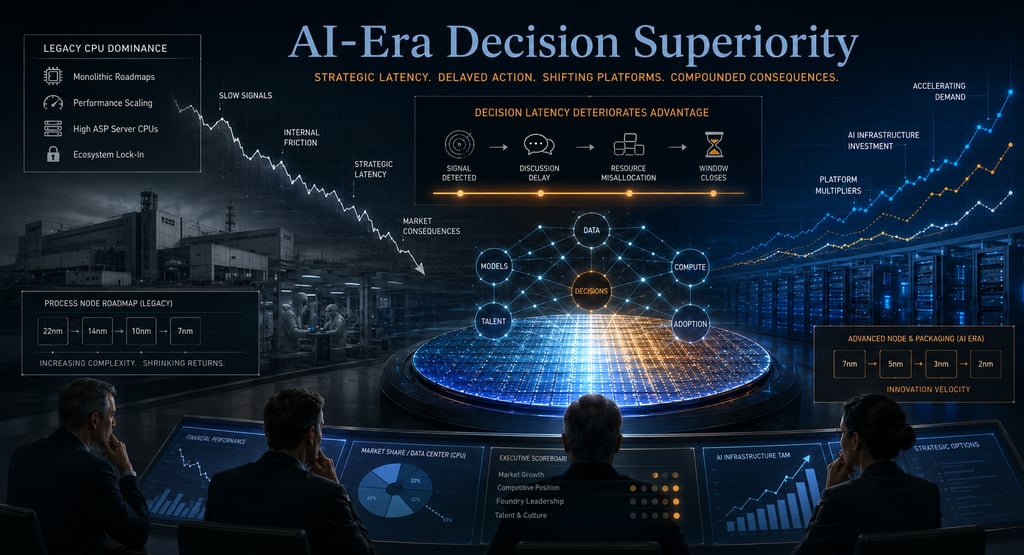
The image accompanying this article is AI-generated and is intended for illustration purposes only.


© 2026 WDA Publishing. All rights reserved.