
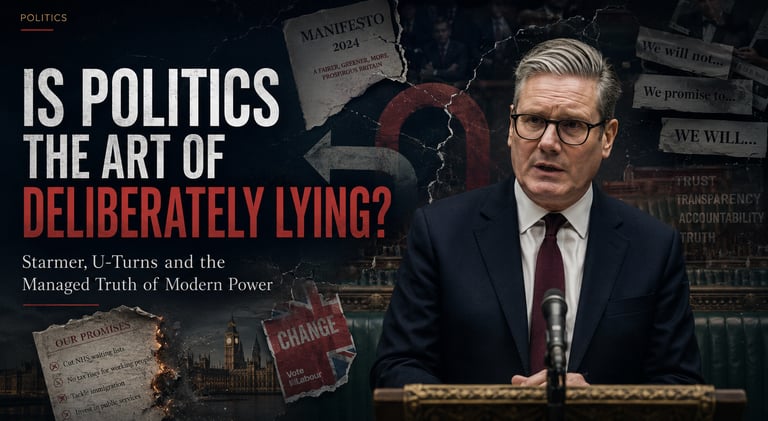
Is Politics the Art of Deliberately Lying? Starmer and the Managed Truth of Modern Power
A forensic political analysis of Sir Keir Starmer’s U-turns, abandoned pledges and managed explanations, asking whether modern politics now depends less on direct lies than on controlled public misdirection.
POLITICS & SOCIETY
Dr Danie Adendorff
5/25/202617 min read
Is Politics the Art of Deliberately Lying? Starmer and the Managed Truth of Modern Power
The Question That Will Not Go Away.
“Is politics nothing other than the art of deliberately lying?” The line is commonly attributed to Voltaire, although the precise textual source should be treated with caution. The safer formulation is that the sentiment is Voltairean in spirit and widely associated with the Enlightenment critique of power, rather than a quotation that should be presented without qualification. Voltaire was not a 2,000-year-old ancient authority; he was an eighteenth-century Enlightenment writer. The distinction matters because an article about truth in politics must begin by being truthful about its own sources. The point, however, remains powerful: politics has always had an uneasy relationship with candour, concealment, performance and tactical speech.
The question is not whether every politician lies in the crude sense. That would be too simple, and too easy to dismiss. The more dangerous question is whether modern politics has learned to avoid the direct lie while still producing the public effect of deception. A leader does not always need to make an openly false statement. He can create expectation, preserve ambiguity, delay disclosure, reverse course when power has been secured, and then explain the reversal through the language of responsibility, fiscal constraint or changed circumstances.
Sir Keir Starmer is a particularly important case study because he did not present himself as a populist showman. He presented himself as the antidote to political chaos, Conservative scandal and public exhaustion. He became Prime Minister on 5 July 2024, having previously been elected Labour leader in 2020. His political brand rested heavily on seriousness, discipline, legality and integrity. That makes the test harder, not easier. When a leader sells himself as the cure for broken politics, his own reversals cannot be treated as ordinary tactical adjustments. They must be judged against the standard he claimed to restore.
The central issue is therefore not whether Starmer can be called a liar in the strict legal or evidential sense. That would require proof that he knowingly made false statements with intent to deceive. The stronger and more defensible charge is broader: Starmer’s public record has repeatedly produced the democratic effect of deception. Voters and party members have been invited to believe one direction of travel, only to be governed or led in another.
What Counts as Political Lying?
A lie is a knowingly false statement made with intent to deceive. That is a demanding standard. It requires more than disappointment, more than inconsistency, and more than a broken promise. A politician may change position because circumstances have changed, because new evidence has emerged, because fiscal conditions have deteriorated, or because a previous policy was found to be unworkable. None of that automatically proves lying.
But democratic deception is wider than the strict lie. A misleading statement may be technically defensible while still creating a materially false impression. A broken promise may not prove dishonesty, but it can still damage consent. A U-turn may be rational in policy terms, but it becomes corrosive when the original commitment was used to secure authority. Strategic ambiguity is especially dangerous because it gives the public enough clarity to believe, but not enough precision to hold power accountable later.
That is why the Voltaire-attributed question remains useful. Politics does not always lie by saying the opposite of the truth. It can lie by omission. It can lie by timing. It can lie by selective emphasis. It can lie by saying one thing to party members, another to swing voters, another to financial markets, and another to Parliament. The modern political lie may not be one sentence. It may be a system of managed expectation.
In Starmer’s case, the issue is cumulative. One reversal can be explained. Two reversals can be defended. But repeated reversals begin to form a political method. The sequence becomes recognisable: promise, expectation, qualification, retreat, explanation. That sequence is the real subject of this article.
Starmer’s Original Contract with Labour Members.
Starmer’s 2020 Labour leadership campaign was not presented as a campaign to erase Labour’s previous radicalism. His published “Ten Pledges” promised to maintain Labour’s radical values and included commitments on economic justice, social justice, climate justice, common ownership, public services, workers’ rights, devolution, internationalism and party unity. The pledges included support for common ownership of rail, mail, energy and water and a broader anti-austerity posture.
Those pledges mattered because they were not casual comments. They were leadership-election commitments made to party members. They helped establish Starmer as a candidate who could unite competence with continuity. He could appear less chaotic than Jeremy Corbyn without appearing to abandon the moral and economic direction that many members still supported.
The later Starmer project moved substantially away from that posture. Labour’s 2024 general election manifesto was built around stability, economic growth, partnership with business, fiscal discipline and institutional repair. It was not a manifesto of radical structural transformation in the sense implied by parts of the 2020 leadership pitch. Labour described its 2024 programme as a plan to “kickstart economic growth” and bring about national renewal, but it did so in cautious, controlled and fiscally constrained language.
This does not automatically prove that Starmer lied to Labour members. But it does raise a harder question: were the 2020 pledges convictions, or were they instruments of acquisition? If a politician makes one set of commitments to win the leadership of a party and then governs or campaigns nationally on a materially different basis, the charge is not merely inconsistency. The charge is that promise-making has been used as a route to authority rather than as a binding democratic undertaking.
This is where the Voltaire question begins to sharpen. Politics as “the art of deliberately lying” need not mean a crude falsehood shouted from a platform. It may mean saying what is necessary to secure one audience, then later translating that promise into something much weaker for another.
Tuition Fees: The Promise That Became Disposable.
The tuition-fee reversal is one of the clearest examples. Starmer had supported the abolition of tuition fees. By May 2023, Reuters reported that he was likely to scrap that commitment. The report noted that tuition fees in England stood at up to £9,250 a year and that abandoning the pledge risked damaging Starmer’s standing with the Labour left. Starmer’s explanation was that Labour was looking at options for university funding and would announce a policy once one had been agreed.
That explanation may be fiscally understandable. Higher education funding is a difficult policy area. Universities face financial pressures; graduates face repayment burdens; governments face budgetary constraints. But the political question is different. When a commitment is made clearly and later withdrawn, the voter or party member is entitled to ask whether the original promise was ever properly tested.
A serious pledge requires more than moral attractiveness. It requires financial discipline, implementation analysis and political durability. If the abolition of tuition fees was not fiscally sustainable, that should have been clear before the pledge was used to build political support. If it was sustainable, then its abandonment requires a stronger explanation than “circumstances changed”.
The democratic injury is not only that a policy changed. The injury is that a group of voters and members were invited to believe that a specific burden would be removed, only to discover later that the promise was negotiable. That is not necessarily a provable lie. But it is a serious breach of political trust.
The £28 Billion Green Investment Retreat.
The retreat from Labour’s £28 billion green investment pledge is more significant because it involved not only one policy but a whole image of national transformation. Labour had used the pledge to signal ambition on climate, industry, infrastructure and growth. It suggested that a Starmer government would not merely administer decline but invest in a different economic future.
In February 2024, the Financial Times reported that Starmer had cut Labour’s flagship green spending plan from £28 billion annually to £4.7 billion a year, describing the decision as a major U-turn. The Associated Press similarly reported that Labour had watered down the green investment pledge, with environmental groups criticising the retreat and Starmer attributing the decision to the poor state of the economy inherited from the Conservatives.
Again, a limited defence is available. Borrowing costs matter. Inflation matters. Public finances matter. A party seeking government has a duty not to make irresponsible spending promises. But that defence does not remove the central problem. If the pledge was fiscally vulnerable, why was it allowed to become a major symbol of Labour’s ambition? If it was always conditional, why was that conditionality not communicated with equal force?
The brutal assessment is that the pledge appears to have served a political function before it served an operational one. It helped Labour look ambitious when ambition was useful. It was reduced when caution became more useful. That is not simply policy evolution. It is the management of public expectation.
Voltaire’s question returns: is the lie always in the direct statement, or can it sit in the gap between the emotional impression created and the governing reality later delivered?
Common Ownership and the Language of Pragmatism.
Starmer’s movement away from sweeping common-ownership commitments shows the same pattern. His leadership pledges included common ownership of rail, mail, energy and water. In July 2022, Sky News reported that Starmer had U-turned on the leadership-election pledge to renationalise those sectors, with Starmer presenting his approach as “pragmatic” and aligned with Rachel Reeves’s view that the policy was no longer compatible with Labour’s strategy.
“Pragmatism” is the central word in Starmer’s political vocabulary. It sounds serious. It suggests maturity, discipline and freedom from ideological rigidity. Sometimes pragmatism is necessary. A government that refuses to adapt becomes dangerous. But pragmatism can also become the polite word for abandonment.
The danger is that “pragmatism” empties promises of their binding force. A politician can make a commitment when principle is needed and then invoke pragmatism when the commitment becomes inconvenient. Over time, voters learn that the promise was not a decision. It was a posture.
The issue is not whether every nationalisation proposal was wise. The issue is whether Starmer’s leadership campaign created expectations that he later treated as politically disposable. If the original pledge was serious, the retreat required a clear account of what changed. If the original pledge was not serious, the charge becomes much more severe.
Tax, “Working People” and the Elastic Phrase.
The tax issue shows how political language can mislead even when it appears disciplined. Labour’s 2024 manifesto said that Labour would not increase taxes on working people and specified that it would not increase National Insurance, the basic, higher or additional rates of income tax, or VAT. Full Fact later assessed the broader pledge and rated it “Not kept”, arguing that the extension of frozen income tax and National Insurance thresholds meant people would pay more than they otherwise would have done.
The Institute for Government also noted that Labour’s manifesto committed to keeping taxes on working people as low as possible and not increasing National Insurance, income tax rates or VAT. The problem was not only the substance of tax policy. It was the language around “working people”, a phrase politically powerful precisely because it sounds morally obvious while remaining operationally contestable.
Full Fact’s criticism is important because it goes to the mechanics of modern political ambiguity. A phrase like “working people” reassures voters. It signals fairness. It distinguishes ordinary citizens from the wealthy or privileged. But unless it is precisely defined, it becomes an escape hatch. Different audiences can hear different meanings. The promise can later be defended narrowly while having been understood broadly.
This is not crude lying. It is more sophisticated. The public is not necessarily told a direct falsehood; instead, it is given a phrase that carries moral force without operational discipline. That may be legally safer for the politician, but it is democratically dangerous for the voter.
The art of political deception, in this form, is not the art of saying something false. It is the art of saying something sufficiently elastic that accountability becomes difficult.
Welfare, Poverty and the Moral Contradiction.
The two-child benefit cap exposed a deeper contradiction between Labour’s social-justice language and governing restraint. In July 2023, The Guardian reported that Starmer confirmed a Labour government would keep the Conservative two-child benefit cap. The report noted internal unease and criticism from academics and others, and stated that the policy had been blamed for pushing families into poverty. Starmer said he was “not changing that policy”.
This was not a hidden position; it was openly stated. Therefore, it should not be described as a cover-up. But it still matters because of the contrast between Labour’s moral language and its fiscal choices. A party can speak of fairness, poverty reduction and social justice while still deciding not to remove a policy that critics argue harms larger low-income families. That contradiction requires unusually honest explanation.
The problem is not that every expensive welfare reform must be implemented immediately. Government requires prioritisation. But if a party uses the language of compassion while preserving policies associated with hardship, voters are entitled to ask whether moral language has become decorative.
This is one of the most serious forms of democratic disillusionment. People do not only feel betrayed when a politician breaks a technical promise. They feel betrayed when the moral identity of a party no longer matches the material consequences of its decisions.
Voltaire’s question applies here in a more subtle form: does politics lie most efficiently when it speaks morally while governing administratively?
Winter Fuel Payments and the Politics of Reversal After Damage.
The winter fuel payment episode is a strong example of decision failure followed by narrative adjustment. The House of Commons Library recorded that the government changed the eligibility rules for Winter Fuel Payment so that, from winter 2024/25, households were no longer entitled unless they received Pension Credit or certain other means-tested benefits.
In May 2025, Reuters reported that Starmer signalled a U-turn on the controversial restriction after sustained criticism. The payments, worth £200 to £300, subsidised winter heating bills for older people. Reuters noted that offering the payments to more pensioners would be viewed as an embarrassing U-turn after Starmer had refused to back down despite opposition from Labour MPs and trade unions close to the party.
In June 2025, Reuters reported that the UK would restore winter fuel payments to millions of pensioners, with the reversal restoring payments to nine million pensioners while excluding around two million with incomes above £35,000.
The Institute for Government’s judgement was direct: Reeves and Starmer should have been honest about the winter fuel allowance U-turn, and the handling would damage trust. That is an unusually important criticism because it does not come from partisan attack journalism. It comes from a governance-focused institution assessing the quality of political handling.
The sequence is politically damaging. The government made a hard decision. It defended it. It faced backlash. It suffered political pressure. It then moved to reverse or soften the decision. The public lesson is not that the government listened. The public lesson is that it listened only after the cost became too high.
This is where wrong decisions become trust failures. A government may make an error and correct it. But if correction arrives only through political necessity, the correction does not restore confidence. It confirms that pressure, not candour, forced the admission.
Gifts, Freebies and the Integrity Gap.
The gifts and hospitality controversy did not prove corruption. It must not be presented as if it did. Rules exist for declaration, and controversy is not the same as illegality. But politically, the episode damaged Starmer because it cut directly against his integrity brand.
Reuters reported in October 2024 that Starmer repaid more than £6,000 worth of gifts following criticism over freebies received by the Prime Minister and other Labour politicians. The repayment covered six Taylor Swift tickets, four horse-racing tickets and a clothing rental agreement. Reuters also reported that Waheed Alli, a Labour donor and member of the House of Lords, was under investigation over alleged non-registration of interests.
Later in October 2024, Reuters reported that Alli had committed minor breaches of parliamentary rules by failing to declare certain interests, according to an investigation.
The narrow legal question is whether rules were broken and by whom. The broader political question is whether the conduct matched the public language of integrity. A leader who campaigns on restoring standards cannot afford to look casual about gifts, hospitality, clothing or donor proximity. Even when no corruption is proved, the appearance of entitlement damages moral authority.
The issue returns again to managed truth. Starmer’s defenders may say the rules were followed or that repayments were made. But the public does not experience politics only through compliance language. It experiences politics through moral contrast. If a government restricts benefits for pensioners while senior figures are defending or repaying hospitality and gifts, the symbolism is brutal.
Politics does not need a direct lie to become distrusted. Sometimes hypocrisy performs the same work.
Migration, Control and the Rhetoric of Delivery.
Migration is another area where political language often outruns operational reality. Starmer cancelled the previous Conservative Rwanda asylum plan, describing it as dead, and Labour moved toward a Border Security Command approach focused on criminal smuggling networks. Those decisions may be defended as a change in enforcement model. But they also created expectations of control, speed and competence.
The danger in migration politics is that language is often designed less to inform the public than to manage public anger. Words such as “control”, “security”, “smash the gangs” and “border command” carry operational force. They imply measurable improvement. If delivery lags behind rhetoric, the same trust problem emerges: voters hear certainty, but the state delivers complexity.
This is not unique to Starmer. British politics has repeatedly overpromised on migration. But Starmer’s problem is that he positioned himself as the serious alternative to slogan-based government. If the serious alternative also depends on hard-edged language that cannot rapidly produce visible results, the distinction between competence and performance begins to narrow.
The democratic test is simple: did the public receive a realistic explanation of what could be achieved, over what timescale, with what legal constraints, and at what cost? If not, the politics of control becomes another managed half-truth.
Defence, Security and the Cost of Strategic Candour.
Defence and national security require even greater honesty because the consequences are not merely domestic. Governments can speak strongly about NATO, Ukraine, deterrence, resilience and global leadership, but strategic credibility depends on resources, procurement, industrial capacity and sustained political will.
Starmer’s government has repeatedly used the language of seriousness and responsibility in foreign and security policy. That is appropriate for a Prime Minister. But the central question remains whether rhetoric and capability align. Defence commitments are not speeches; they are budgetary, industrial and operational undertakings. If the public is given strategic confidence without being told the full cost, the result is another form of managed belief.
This article does not argue that Starmer has lied on defence. The evidence required for that claim is not established here. The argument is more disciplined: in national security, the gap between declared ambition and funded capability is itself a democratic risk. A government must not use the language of strength while postponing the difficult explanation of what strength costs.
Where domestic policy can disappoint, security policy can expose the state. That makes political candour a strategic requirement, not merely a moral preference.
The Managed Half-Truth as a Method of Power.
The pattern across these examples is not identical in every case. Tuition fees, green investment, common ownership, tax language, welfare restraint, winter fuel payments, gifts and migration are different policy areas. Some involve explicit reversals. Some involve ambiguous language. Some involve poor judgement. Some involve controversy rather than proven wrongdoing. They should not be collapsed into one crude accusation.
But the cumulative pattern is difficult to ignore. Starmer’s political method repeatedly appears to rely on controlled language, narrowed commitments and retrospective explanation. The promise is allowed to do political work. Then, when circumstances become inconvenient, the promise is revised, softened or abandoned. The explanation arrives later, usually in the language of responsibility.
This is the managed half-truth. It is not always false. Indeed, its strength is that it is often partly true. Fiscal conditions are real. Economic inheritance matters. Universities do need sustainable funding. Green investment must be affordable. Welfare policy involves trade-offs. Migration control is complex. Defence requires prioritisation.
But half-truths become politically deceptive when the hard half is withheld until after consent has been secured. Voters are shown the aspiration before power and the constraint after power. They are sold the moral direction before the election and the fiscal limitation after the election. They are given the promise when support is needed and the explanation when retreat is unavoidable.
That is not honest democratic leadership. It is government by managed expectation.
Why Repeated U-Turns Are Worse Than Ordinary Adaptation.
A government that never changes course is dangerous. It becomes rigid, ideological and immune to evidence. U-turns are not always signs of weakness. Sometimes they are signs of learning. The problem is not change itself.
The problem is repeated change without adequate prior candour. When major commitments are abandoned one by one, voters begin to ask whether any commitment has binding value. A pledge becomes a mood. A manifesto becomes a marketing document. A leadership promise becomes a ladder to power. Public explanation becomes a repair mechanism rather than a duty of truth.
That is where democratic consent begins to weaken. Elections still happen. Parliament still sits. Manifestos are still printed. But the moral authority of the mandate declines if citizens no longer know what they have authorised.
Starmer’s deepest political danger is not that he is uniquely dishonest. It is that he may represent a more managerial form of the same disease he promised to cure. The Conservative years before him normalised scandal, evasion and political exhaustion. Starmer offered seriousness. But seriousness without candour becomes only a more disciplined form of evasion.
If politics becomes the art of saying enough to win and withholding enough to retreat, then Voltaire’s question has not aged. It has modernised.
The Democratic Damage Beyond Starmer.
This matters beyond one Prime Minister. A democracy cannot function if citizens assume that all promises are temporary. Public trust is not sentimental. It is operational. It allows governments to ask for sacrifice, patience, taxation, reform and strategic commitment. When trust collapses, every difficult decision is interpreted as betrayal.
Repeated political reversals also feed populism. When mainstream leaders appear to treat pledges as disposable, anti-system figures gain an easy argument: “They are all the same.” That argument may be crude, but it becomes powerful when the evidence of broken promises accumulates.
The danger is not only that voters become angry. It is that they become unreachable. Once citizens conclude that political language is merely instrumental, evidence itself loses force. Every explanation is heard as spin. Every correction is heard as panic. Every promise is heard as bait.
That is why the distinction between lying and democratic deception matters. A single lie can be exposed. A culture of managed ambiguity is harder to defeat because it hides inside respectable language: pragmatism, responsibility, stability, fiscal discipline, difficult choices. Those words are not inherently dishonest. But they become dishonest when they are used to launder broken commitments.
Conclusion: Return to the Quote.
“Is politics nothing other than the art of deliberately lying?” If the answer is yes, democracy is already hollow. But the Starmer case suggests something more subtle than the crude lie. It suggests the politics of the managed promise: the pledge made loudly, the retreat made carefully, the explanation made defensively, and the accountability delayed until pressure becomes unavoidable.
The evidence does not justify careless publication of the sentence “Starmer is a liar.” That is too blunt, too legally exposed, and too easy for critics to attack. The stronger judgement is more severe because it is harder to dismiss: Starmer’s politics has repeatedly produced the democratic effect of deception. The public was invited to believe in one kind of politics and then governed through another. Party members heard radical continuity. Voters heard stability without pain. Pensioners heard reassurance until benefits were restricted. Working people heard tax protection while definitions shifted. Environmental voters heard transformation before ambition was cut down. On issue after issue, the promise survived long enough to perform its political function, then yielded to explanation.
That is the modern art of political lying: not always the direct falsehood, but the management of public belief. It is the conversion of commitment into ambiguity, ambiguity into retreat, and retreat into responsible government language.
Voltaire’s question therefore remains alive. Politics may not be nothing other than deliberate lying. But when promise becomes provisional, truth becomes conditional, and accountability arrives only after damage is done, politics begins to resemble exactly what the quotation warns against: the organised art of making deception appear responsible.
Source Note on the Voltaire Attribution.
The quotation “Is politics nothing other than the art of deliberately lying?” should be used with caution. It is widely attributed to Voltaire, and related French formulations such as “La politique est-elle autre chose que l’art de mentir à propos?” circulate in connection with him, but the exact English wording should not be presented as a securely verified verbatim quotation. The article therefore uses “commonly attributed to Voltaire” or “Voltaire-attributed” rather than treating it as an authenticated primary-source quotation.
Selected Sources and References.
Sir Keir Starmer’s official UK Government profile, confirming his appointment as Prime Minister on 5 July 2024.
Keir Starmer’s 2020 “Ten Pledges” leadership campaign document and associated Labour leadership pledge material.
Labour Party, Change: Labour Party Manifesto 2024, including pledges on economic renewal, working people, tax and public service reform.
Reuters reporting on Starmer’s movement away from the pledge to scrap university tuition fees.
Financial Times and Associated Press reporting on the reduction of Labour’s £28 billion green investment pledge.
Sky News reporting on Starmer’s U-turn on leadership-election common-ownership pledges.
Full Fact Government Tracker assessment of Labour’s pledge not to increase taxes on working people.
Institute for Government explainer on Labour’s tax pledges.
The Guardian reporting on Starmer’s position on the two-child benefit cap.
House of Commons Library briefing on changes to Winter Fuel Payment eligibility rules.
Reuters reporting on the winter fuel payment U-turn and restoration of payments to millions of pensioners.
Institute for Government commentary on the handling of the winter fuel allowance U-turn and its effect on trust.
Reuters reporting on Starmer repaying gifts and hospitality costs, and on Waheed Alli’s breach of parliamentary rules.
Author workflow disclosure
This article was produced through an AI-assisted but human-directed workflow. AI support was used for accessibility assistance, article structuring, language refinement, source-discovery prompts, revision planning, and conversion of editorial comments into specific amendments. The author retained responsibility for the argument, accepted or rejected suggested changes, checked the logic of the claims, and remained accountable for the final text. AI-generated material was not treated as empirical evidence, and synthetic or illustrative examples were not presented as observed data.
Image note
The image accompanying this article is AI-generated and is intended for illustration purposes only.


© 2026 WDA Publishing. All rights reserved.