
Is Russia Losing the War?
Russia is not yet defeated, but the war is increasingly exposing a Russian military system under severe pressure from casualties, hunger, drone warfare, disrupted logistics, and Ukraine’s growing ability to strike deep into the Russian war machine.
WAR, SECURITY & GEOPOLITICS
Dr Danie Adendorff
5/27/20269 min read
Is Russia Losing the War?
When an Army Starts Eating Itself and the Sky Belongs to Drones
Russia is still fighting. Russia is still dangerous. Russia is still killing civilians, striking Ukrainian cities, and sending men into the line. But an army can continue fighting long after the logic of victory has started to collapse.
That is the point Russia may now be approaching.
The question is no longer whether Russia can still cause damage. It can. The question is whether Russia can still turn damage into strategic success. On the battlefield, in the trenches, in Crimea, and now deep inside Russian territory, the answer is becoming less convincing.
Ukraine’s latest wave of drone attacks against Moscow and other Russian targets shows that the war is no longer geographically contained in the way the Kremlin once expected. Russian citizens were once encouraged to see the war as distant, controlled, and politically manageable. Ukrainian drones are now reaching into the symbolic and operational depth of the Russian state.
This is not only symbolic. It changes the psychology of the war. Russia invaded Ukraine expecting to dominate the battlefield and insulate its own population from the consequences. Instead, Ukrainian drones are now reaching Moscow, Russian refineries, logistics nodes, air-defence systems, and military infrastructure far behind the front.
The front is no longer a line. It is becoming a depth battlefield.
The drone war is now shaping the ground war
The latest Battle Plans Exposed episode with Philip Ingram captures a shift that is visible across the wider battlefield: Ukraine is no longer using drones only as tactical battlefield tools. It is using them as a system of pressure across the Russian war machine — from trench-level infantry, to logistics, to air defence, to Crimea, to Russian territory itself.
The phrase “total drone superiority” is powerful, but it should be used carefully. Russia still has a large drone and missile capacity. A more precise formulation is that Ukraine is building operational drone superiority in selected battlespaces. Russia still strikes hard, but Ukraine is increasingly setting the tempo in the drone contest.
Ukraine’s medium-range and long-range strike activity is no longer an occasional supplement to conventional operations. It is becoming a central method of operational disruption. Repair areas, staging points, logistics corridors, fuel nodes, command sites, drone units, radars, and rear-area infrastructure are all part of the target system.
Russia can still mass forces. But mass becomes less useful when it can be seen, tracked, struck, and disrupted before it reaches the decisive point.
The Russian soldier is becoming the evidence
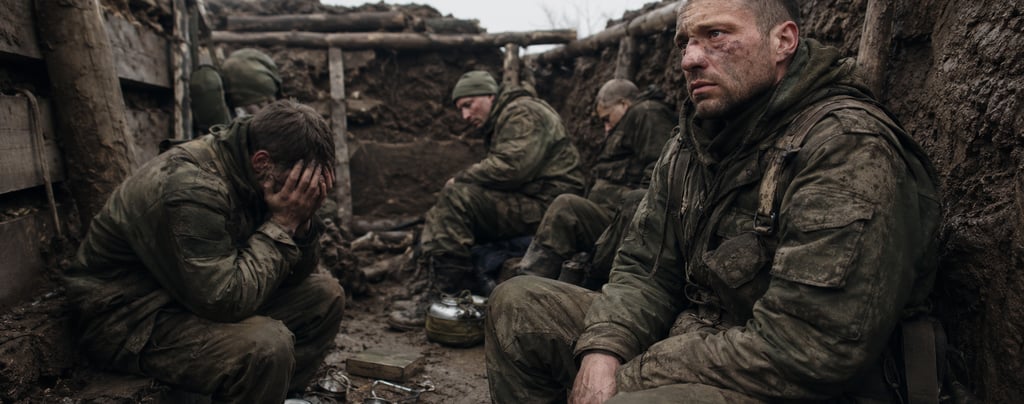
The condition of the Russian soldier now tells its own story.
Recent reporting from British tabloid sources and Ukrainian intelligence-linked claims has described severe disorder, hunger, brutality, and alleged internal violence among Russian troops. Some of these accounts are difficult to verify independently, but they sit within a wider and more credible battlefield pattern: exhausted units, poor rotation, weak sustainment, coercive command, and soldiers treated as expendable material.
Al Jazeera and other international reporting have also described severe food-supply problems at the front. Although some of that reporting focuses on Ukrainian troops in exposed positions, it also points to the wider reality of the current war: drones, destroyed roads, constant surveillance, and interdicted supply routes are turning food, water, evacuation, and rotation into decisive operational problems.
Food is not a minor issue in war. It is one of the basic tests of whether an army is functioning.
A soldier who cannot be fed cannot be treated as a reliable instrument of strategy. A soldier who cannot be rotated becomes exhausted. A soldier who cannot be evacuated loses faith in the system. A soldier who watches drones overhead day and night begins to understand that survival is no longer controlled by his own command.
Russia can still force men forward. But forcing men forward is not the same as sustaining a competent army.
Meat-grinder tactics are colliding with drone warfare
Russia’s tactical problem is becoming sharper. It has relied heavily on infantry assault, mass pressure, small-unit infiltration, drone reconnaissance, artillery support, glide bombs, and repeated attempts to grind through Ukrainian defences. This model becomes increasingly costly when the defender has persistent drone coverage and a dense kill web of FPV drones, loitering munitions, artillery correction, and mid-range strike systems.
The Battle Plans Exposed discussion highlights Russian troops riding unprotected quad bikes into drone ambushes and specialist drone operators allegedly being forced into infantry assault roles. Whether every example is independently confirmed or not, the tactical pattern is credible: Russia is burning through manpower and sometimes misusing scarce specialists in order to maintain pressure.
Drone operators are not disposable infantry. They are high-value battlefield specialists. If commanders are pushing them into assault roles, it suggests manpower desperation, poor command discipline, or a command culture that still treats human skill as expendable.
Russia’s army has manpower depth. Its problem is increasingly the quality and intelligent use of that manpower.
Crimea is becoming a trapped battlespace
Crimea is central to this shift. For Russia, Crimea is the political trophy of 2014, the Black Sea military platform, the logistics hub for southern operations, and the symbol of Putin’s imperial project. For Ukraine, Crimea is now being turned into a pressured, watched, and increasingly vulnerable battlespace.
Ukraine has repeatedly targeted Russian air-defence systems in occupied Crimea, including S-300 and S-400 systems, radars, launchers, Pantsir systems, logistics infrastructure, and command assets. This is not random targeting. It is a campaign to blind and thin Russia’s protective shield over Crimea.
An S-400 system is not just a launcher. It is a network of radars, command elements, power supply, launch vehicles, and protective short-range systems. Strike the radar, and the system loses its eyes. Strike the Pantsir that protects it, and the S-400 becomes more vulnerable. Strike logistics and command nodes behind it, and the entire air-defence architecture becomes more fragile.
Ukraine does not need to invade Crimea tomorrow to make Crimea progressively harder for Russia to use. It can isolate, blind, harass, and attrit the peninsula’s military value.
Ukraine’s domestic weapons industry is changing the strategic equation
A second major shift is Ukraine’s domestic weapons production. The war has forced Ukraine to innovate under pressure, and that innovation is now reaching strategic depth.
The reported Bars jet-powered drone family, sometimes discussed in relation to the user-mentioned “Boris” system, belongs to exactly the class of weapons Ukraine requires: cheaper than traditional cruise missiles, domestically scalable, and able to threaten Russian rear infrastructure without depending entirely on Western long-range missile permissions.
Ukraine has also revealed a domestically developed guided glide-bomb capability, presented as a cheaper homegrown alternative to imported precision munitions. This matters because Ukraine’s ability to strike with greater autonomy weakens Russia’s hope that the war can be won by exhausting Western supply decisions.
Ukraine does not need to match Russia platform-for-platform. It needs enough affordable, scalable, accurate systems to keep Russian depth under pressure and deny Moscow the ability to rebuild safely behind the front.
Russia is still striking hard, but its strikes no longer prove control
Russia continues to launch major missile and drone attacks against Ukraine. It still has destructive capacity, and that capacity must not be underestimated. Russian strikes punish Ukrainian cities, exhaust air defences, damage infrastructure, and kill civilians.
But destruction is not the same as decision.
A state can bombard because it is strong. It can also bombard because it cannot achieve decision by manoeuvre. Russia’s long-range strikes have not broken the Ukrainian state. They have not forced Kyiv to surrender. They have not restored Russian operational freedom.
The more Russia fails to create decision on the ground, the more it reaches for coercive bombardment, nuclear signalling, sabotage, and hybrid pressure against Europe.
That is not confidence. It is compensation.
The casualty-to-gain ratio is devastating for Moscow
The arithmetic of the war remains brutal. Western public assessments have described Russian casualties as extraordinarily high, while territorial gains remain limited. The exact figures will continue to be contested, but the strategic pattern is not difficult to see: Russia is paying an immense human price for limited operational return.
Those numbers should not be read as mere statistics. They describe an army consuming itself.
Every casualty removes not only a body but experience, cohesion, confidence, and command continuity. Every badly trained replacement may fill a trench, but he does not restore the unit. Every assault group thrown forward under drone observation becomes another entry in a ledger Russia is struggling to balance.
Russia’s problem is not simply that it is losing men. Russia has historically tolerated staggering losses. The problem is that it is losing men for limited operational return while Ukraine is increasingly able to strike the systems that make Russian pressure possible.
That is the shift.
Russia’s manpower machine is becoming more coercive
Russia can still recruit. It can still mobilise indirectly. It can still offer money, pardon prisoners, pressure regions, and use debt relief. But manpower generated through desperation does not automatically produce battlefield quality.
A war fought by exhausted soldiers, coerced recruits, undertrained replacements, misused specialists, and hungry trench units can continue for a long time. But continuation is not victory.
The front consumes men. The state searches for replacements. The cycle continues. At some point, the question becomes whether Russia is reinforcing strength or merely feeding weakness.
The war is moving against Russia’s theory of inevitability
Russia’s strongest weapon has not only been artillery or missiles. It has been the claim of inevitability.
Moscow wants Ukraine to believe resistance is futile. It wants Europe to believe support for Kyiv is only delaying the unavoidable. It wants Washington to believe the cost of continued aid is higher than the cost of forcing a settlement. It wants Russian citizens to believe the war is distant, controlled, and moving toward victory.
Ukraine’s drone campaign is attacking that theory.
When drones reach Moscow, the war is no longer distant. When Crimea’s air defences are repeatedly struck, the peninsula is no longer secure. When Russian refineries, ports, logistics nodes, and rear-area targets burn, Russia’s depth is no longer safe. When Russian soldiers appear in reports as hungry, abused, desperate, and expendable, the image of disciplined Russian inevitability cracks.
That is why the drone war matters politically as well as militarily. Ukraine is not only destroying equipment. It is destroying the story that Russia can impose victory by waiting.
Is Russia losing?
Russia is not defeated. It still occupies Ukrainian territory. It still possesses missiles, drones, artillery, manpower, intelligence services, cyber capability, nuclear weapons, and a high tolerance for brutality. It can still kill many more people. It can still threaten Europe. It can still drag the war out.
But Russia is losing the argument that it is winning.
It is losing men at a catastrophic rate. It is gaining too little ground for the price it is paying. It is relying on coercive manpower incentives and exhausted formations. It is seeing Crimea turned into a pressured battlespace. It is watching Ukraine’s domestic drone and missile ecosystem mature. It is facing strikes not only at the frontline, but across its rear and even near Moscow.
That is not the profile of a confident victorious army. It is the profile of a state trying to force victory through punishment because the battlefield is no longer delivering the decision it needs.
Conclusion: Russia can still fight, but can it still win?
Russia’s war has not ended. Its danger has not disappeared. Its capacity for destruction remains severe. But the internal condition of the Russian campaign is now visible.
An army that cannot reliably feed its men is in trouble. An army that burns through trained specialists is in trouble. An army that sends exposed vehicles into drone kill zones is in trouble. An army that loses hundreds of thousands for marginal gains is in trouble. An army whose prized air-defence systems are repeatedly blinded in Crimea is in trouble. An army whose capital now feels the reach of Ukrainian drones is in trouble.
Ukraine has not won the war. But Russia is no longer fighting from a position of uncontested escalation dominance. The sky over the battlefield is increasingly contested by Ukrainian drones. Russian depth is no longer safe. Crimea is no longer a secure fortress. Moscow is no longer psychologically distant from the war it launched.
Russia can still fire. Russia can still threaten. Russia can still kill. Russia can still endure.
But strategic victory requires more than endurance. It requires a war machine that can convert force into decision.
And that is where Russia’s problem now lies.
The question is no longer whether Russia can continue the war.
The question is whether Russia can still win it.
Selected source notes for verification
Battle Plans Exposed / Philip Ingram episode referenced by user: https://www.youtube.com/watch?v=Z4LlEtYCRAc
Al Jazeera reporting on frontline food-supply problems and Russia’s battlefield strain, May 2026.
Reuters reporting on Ukrainian strikes, Russian recruitment incentives, and battlefield assessments, May 2026.
Associated Press reporting on Russian missile and drone attacks against Ukraine, May 2026.
UK Government / OSCE statement on Russian losses and limited territorial gains, April 2026.
The Sun reporting on alleged Russian frontline disorder and extreme trench-level claims.
Author workflow disclosure
This article was produced through an AI-assisted but human-directed workflow. AI support was used for accessibility assistance, article structuring, language refinement, source-discovery prompts, revision planning, and conversion of editorial comments into specific amendments. The author retained responsibility for the argument, accepted or rejected suggested changes, checked the logic of the claims, and remained accountable for the final text. AI-generated material was not treated as empirical evidence, and synthetic or illustrative examples were not presented as observed data.
Image note
The image accompanying this article is AI-generated and is intended for illustration purposes only.


© 2026 WDA Publishing. All rights reserved.