
JUST TO KILL ANOTHER MAN
Modern Warfare
5/13/20263 min read
Human beings are capable of astonishing things. We split the atom. We map the human genome. We send sensors into orbit. We build machines that can learn, calculate, fly, track, and decide faster than any human being ever could.
And yet, on the battlefield, much of this brilliance is still directed toward one ancient purpose: finding another human being before he finds us, fixing his position, naming him a target, and killing him before he kills us.
The tools have changed. The moral reality has not.
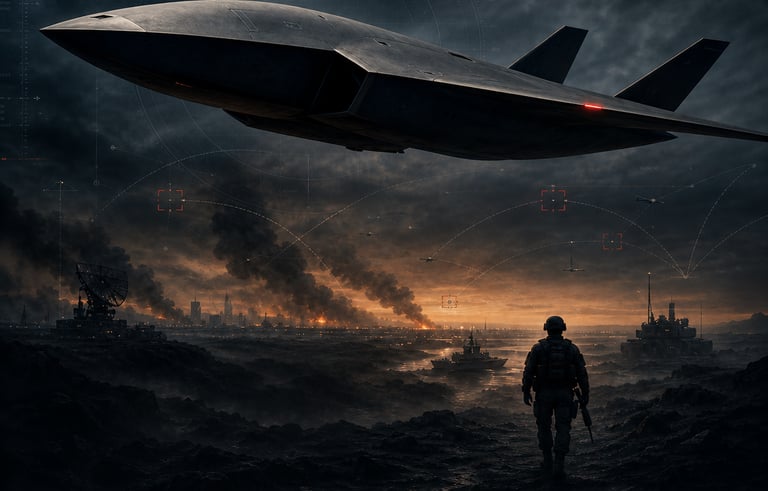
One symbol of this new age is the Boeing MQ-28 Ghost Bat, an uncrewed combat aircraft developed in Australia to fly alongside crewed aircraft. It belongs to a wider military trend: collaborative combat aircraft, loyal wingman drones, AI-assisted targeting, drone swarms, loitering munitions, hypersonic weapons, and networked systems that can sense, process, and strike at terrifying speed.
The language sounds technical, clean, almost harmless: “uncrewed platform,” “sensor fusion,” “combat mass,” “kill web,” “targeting recommendation,” “autonomous support.”
But beneath that language is a brutal truth: these systems exist because war remains organised violence. They are built to help one side see first, decide first, strike first, and survive.
That does not mean every military technology is evil. A drone can scout a dangerous area instead of a soldier. An uncrewed aircraft can enter hostile airspace instead of a pilot. A defensive AI-enabled system may intercept missiles quickly enough to save civilian lives. A robot may find mines before a human step on them.
Protecting soldiers matters. Protecting civilians matters. Speed can save lives.
But speed can also destroy judgement.
Modern warfare is moving from the old “kill chain” to the new “kill web.” Instead of a slow, linear process where humans gather intelligence, interpret it, approve action, and assign weapons, we are moving toward a battlefield where satellites, drones, radars, cyber tools, command systems, and weapons constantly exchange data.
A target that once took hours to confirm may now be detected, classified, and presented for attack within minutes. In some cases, seconds.
The question is not whether machines can help soldiers. They already do.
The question is whether human judgement can survive when war moves at machine speed.
International humanitarian law depends on principles such as distinction, proportionality, necessity, and precaution. These words matter. They stand between war and unrestricted slaughter. But AI does not truly understand context. A machine can identify a heat signature, a vehicle, a phone signal, or a pattern of movement. It can calculate probability. It can recommend action.
But classification is not judgement. Correlation is not context. Probability is not responsibility.
If an AI-assisted system recommends a strike, a commander approves it under pressure, a drone fires, and civilians die, who carries the guilt? The programmer? The contractor? The officer? The minister? The state?
The machine cannot be court-martialled. The algorithm cannot feel remorse. The software cannot visit the grieving family.
Responsibility must remain human, or it stops being responsibility at all.
This is why phrases such as “human in the loop” are not enough. A human who has only seconds to approve a machine’s recommendation is not truly in control. A commander who cannot challenge the system, understand the data, or slow the process down is not exercising judgement. He is simply giving human permission to an automated process.
That is not command. That is ritual.
The deepest danger is not that machines will suddenly become evil. Machines do not have souls, hatred, fear, ambition, or revenge. The deeper danger is that human beings may use machines to distance themselves from the moral weight of killing.
War may become easier to start if fewer pilots are at risk. Killing may feel cleaner if it happens through screens. Responsibility may become blurred if decisions are buried inside software, sensors, contractors, and classified systems.
But war is not cleaner because it is automated. Death is not lighter because it is delivered by a drone. A human being is not less dead because a machine helped find him.
The future of war is already arriving distributed, semi-autonomous, AI-assisted, networked, and increasingly fast. The issue is not whether these systems will exist. They already do, and more are coming.
The real issue is whether law, ethics, democratic oversight, and human conscience can keep up.
Machines may support military judgement. They must not replace human accountability.
AI may assist intelligence. It must not become command.
Autonomy may reduce risk to soldiers. It must not erase the consequences of killing.
A civilisation should not be judged only by what it can build. It should also be judged by what it refuses to build carelessly.
Because if all our brilliance leads us only to fly farther, think faster, strike harder, and kill more efficiently, then we must ask the question no machine can answer for us:
Author workflow disclosure
This article was produced through an AI-assisted but human-directed workflow. AI support was used for accessibility assistance, article structuring, language refinement, source-discovery prompts, revision planning, and conversion of editorial comments into specific amendments. The author retained responsibility for the argument, accepted or rejected suggested changes, checked the logic of the claims, and remained accountable for the final text. AI-generated material was not treated as empirical evidence, and synthetic or illustrative examples were not presented as observed data.
Image note
The image accompanying this article is AI-generated and is intended for illustration purposes only.


© 2026 WDA Publishing. All rights reserved.