
One Click Before Consequence: Ukraine’s AI Drone Interceptors and the New Human Return Point in Air Defence
Ukraine’s reported AI-enabled interceptor shows how machine-speed air defence is compressing human control into fewer, faster and more accountable command decisions.
WAR, SECURITY & GEOPOLITICSTECHNOLOGY & AILEADERSHIP & DECISION-MAKING
6/9/202614 min read
One Click Before Consequence: Ukraine’s AI Drone Interceptors and the New Human Return Point in Air Defence
Ukraine’s reported AI-enabled interception of a Russian Shahed drone is not merely a battlefield success. It is an early sign of how human judgement is being compressed, relocated and tested under machine-speed warfare.
Dr Danie Adendorff
The new command problem.
The most important fact in Ukraine’s reported AI-enabled interception of a Russian Shahed-type drone is not that a drone was destroyed. Shaheds are destroyed every week. The more important fact is the reported structure of control.
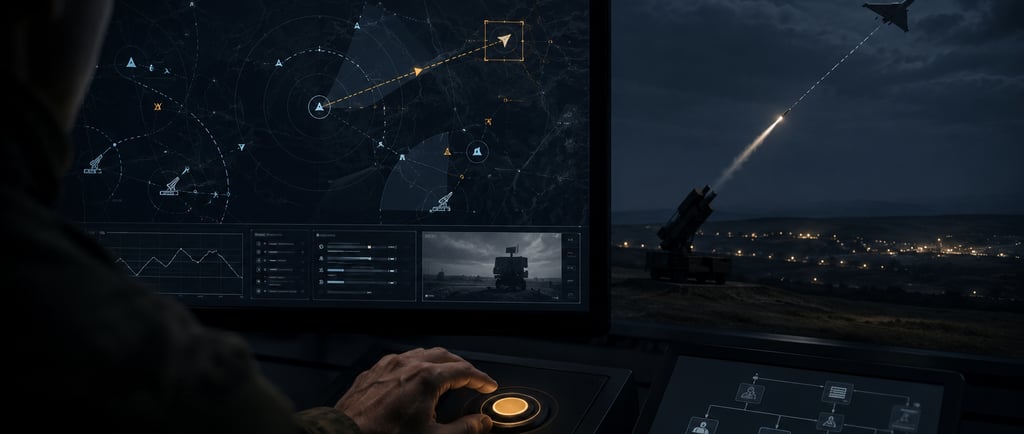
The operator did not continuously fly the engagement. The operator reportedly selected the target. After that, the system handled the interception process.
That is the real story.
A human looked, selected and authorised. A machine then calculated, pursued, locked and completed the destructive act. In practical terms, the human role appears to have moved from continuous control to bounded authorisation. The operator did not disappear. The operator became more concentrated.
This is where the development becomes strategically significant. Ukraine’s reported AI interceptor is not simply another battlefield innovation in a war already defined by drones, electronic warfare and rapid adaptation. It is evidence of a deeper shift in the architecture of military decision-making. The human is being pushed out of some functions because the engagement cycle is becoming too fast, too saturated and too electronically contested for traditional manual control.
But the human cannot be pushed out of responsibility.
That is the paradox. The machine may increasingly execute the engagement. The human system must still own the consequence.
The question is no longer whether the human is holding the joystick. The question is whether the human still controls the consequence.
The Shahed problem is not only technical. It is economic and organisational.
The Russian Shahed/Geran campaign against Ukraine is often described in technical terms: drones, engines, warheads, navigation, jamming, speed, interception rates. Those details matter, but they do not fully explain the pressure imposed on Ukraine.
The Shahed is a cost-imposition weapon. Its military value lies not only in the damage it may cause when it reaches a target, but in the defensive resources it forces Ukraine to consume before it gets there.
Every Shahed imposes a decision. Detect it. Classify it. Track it. Assign it. Engage it. Report it. Learn from it. Repeat the process under fatigue, darkness, jamming, weather, deception and saturation.
A single drone is a tactical problem. A massed wave is an organisational problem.
If Ukraine uses high-value surface-to-air missiles against low-cost one-way attack drones, Russia can exploit the cost-exchange ratio. If Ukraine relies too heavily on manually operated systems, Russia can exploit human workload. If Ukraine depends on centralised air-defence coordination, Russia can exploit time delay. If Ukraine’s defensive architecture cannot scale, Russia can turn cheap mass into strategic pressure.
That is why interceptor drones matter. They are not a technological luxury. They are part of Ukraine’s attempt to restore defensive economy. A cheaper interceptor used against a cheaper attacker changes the arithmetic. A system that can operate under jamming, at night and at low altitude changes the defensive envelope. A system that can reduce the operator’s continuous-control burden changes the human workload equation.
The decisive issue is not whether AI is glamorous. It is whether AI helps Ukraine defend cities, infrastructure and civilians without exhausting its missile stocks, operators and command structures.
Russia’s adaptation is compressing the defensive clock.
The reported Ukrainian AI interceptor must also be understood against Russia’s adaptation cycle.
Russia is not merely launching more Shaheds. It is reportedly modifying the family. Ukrainian and defence-media reporting has described faster jet-powered Geran variants, including Geran-3 and Geran-4 configurations linked to the Iranian Shahed-238 lineage. Some reporting attributes speeds of up to roughly 500 km/h to these newer variants, with further claims about faster systems treated here as directional inference rather than confirmed technical fact. These figures require caution, because wartime reporting often blends official assessment, technical observation and signalling. But the operational direction is clear: Russia is trying to make its long-range attack drones faster, harder to intercept and more difficult to suppress.
Speed is not a cosmetic improvement. Speed changes command.
A slower propeller-driven drone gives the defender more time to detect, classify, assign and engage. A faster jet-powered drone reduces that time. When speed is combined with mass, deception and electronic warfare, the defender’s problem becomes acute. The issue is no longer only whether a trained operator can fly an interceptor into a target. The issue is whether the entire defensive system can generate a valid engagement decision quickly enough.
Russia is also reportedly experimenting with electronic-warfare countermeasures and other modifications intended to disrupt Ukrainian interceptors. That is exactly what should be expected. In this war, every successful adaptation becomes a target for counter-adaptation. Drone warfare has become an evolutionary contest. Detection produces concealment. Jamming produces autonomy. Interception produces speed. Speed produces AI-guided interception. AI-guided interception will produce further deception.
The battlefield is not moving toward a stable solution. It is moving toward accelerated adaptation.
That is why the Ukrainian development matters beyond the individual engagement. It shows a defender attempting to move parts of the kill chain into machine-speed execution while retaining a human authorisation point.
This is the beginning of the command problem that will define AI-enabled warfare.
From remote piloting to supervised autonomy.
The public debate often uses the word “autonomous” too loosely. That weakens the analysis. Precision is required.
Remote piloting means the human operator continuously controls the platform. The machine is largely an extension of the human’s hands and eyes.
Automation means a system performs defined tasks according to programmed logic or constrained algorithmic procedures. It may follow a route, stabilise flight, track an object or execute a pre-set manoeuvre.
Supervised autonomy means the system can perform significant operational functions without continuous human control, but remains within a defined human-authorised envelope. The human may select the target, approve engagement, monitor the system, intervene if required, or define the conditions under which the system may act.
Fully autonomous lethal action, in the stronger and more controversial sense, means a system selects and applies force to targets without a meaningful human decision at the point where lethal consequence is produced.
This taxonomy is compatible with the ICRC’s and CCW Group of Governmental Experts’ concern with meaningful human control, but it applies that debate to the narrower operational setting of AI-enabled defensive interception rather than treating autonomy as a single abstract category.
Ukraine’s reported system appears, on available information, to sit closer to supervised autonomy than to unconstrained autonomous lethal action. The operator reportedly selects the target and gives the engagement command. The system then performs most of the interception sequence.
That distinction must be preserved. Overstating the case would be analytically irresponsible. But understating the case would also be a mistake. Even if the system is supervised, the shift is still profound. The human is no longer the continuous pilot of the engagement. The human becomes the authoriser of an engagement sequence that the machine then executes.
That is not a small change. It alters the location of judgement.
In legacy thinking, the human operator remains central because the operator continuously steers, corrects, observes and reacts. In supervised autonomy, the human may make one decisive intervention at the threshold of action. After that, the machine may operate too quickly, too independently or too opaquely for the human to meaningfully shape every subsequent movement.
This does not make the human irrelevant. It makes the human moment more important.
Ukraine’s reported AI interceptor does not remove the human from war; it compresses the human role into a smaller, more consequential moment.
The one-click fallacy.
The language of “one click” is dangerous if misunderstood.
In civilian software, one click often suggests ease, convenience and reduced friction. In military AI, one click can mean the compression of command responsibility into a single act of authorisation.
The one-click operator is not necessarily less responsible than the manual pilot. In some respects, the operator is more exposed. The pilot’s judgement unfolds through continuous action. The one-click operator’s judgement is concentrated at the threshold. The question becomes whether that threshold decision is informed, meaningful and accountable — or whether it is merely a human gesture attached to an automated process.
This is the one-click fallacy: the belief that reducing the human action reduces the human responsibility.
It does not.
If the system asks the operator to select a target, the operator must understand what is being selected. If the system presents a classification, the operator must understand the level of confidence. If the system recommends engagement, the operator must know the rules under which engagement is lawful, necessary and proportionate. If the system proceeds after authorisation, the command structure must know how to reconstruct what happened.
A one-click engagement system therefore requires more governance, not less.
It requires target-identification confidence.
It requires rules of use.
It requires operating-envelope constraints.
It requires abort or non-engagement logic where feasible.
It requires post-engagement auditability.
It requires training that teaches the operator not merely how to click, but when not to click.
The critical issue is not whether a human is present in the loop. A human may be present and still not exercise meaningful control. A human may be rushed, overloaded, poorly informed, interface-led or organisationally pressured into accepting the machine’s recommendation.
The future danger is not only that machines will make decisions without humans. It is that humans will be used to legitimise machine decisions they do not truly understand.
The Human Return Point.
The Human Return Point is the moment at which machine-generated action must return to accountable human judgement before irreversible consequence.
In the case of AI-enabled air defence, that return point may occur at several levels.
It may occur at design: what the system is allowed to detect, classify and engage.
It may occur at testing: what evidence is required before the system is declared fit for combat use.
It may occur at deployment: where, when and against what categories of target the system may operate.
It may occur at engagement: whether the operator authorises a specific target.
It may occur after action: whether the engagement is reviewed, logged and corrected.
This matters because machine-speed systems change the timing of responsibility. In a slow system, human judgement can occur during the action. In a fast system, much of the judgement must occur before the action. Command must move upstream.
This is one of the central governance lessons of AI warfare. Meaningful human control cannot be reduced to a last-second approval ritual. It must be designed into the whole operating architecture.
A meaningful Human Return Point has five features.
It must be informed. The human must understand what the machine believes, why it believes it, and how confident it is.
It must be timely. The human decision must occur early enough to alter the outcome.
It must be authoritative. The human must have real power to approve, delay, redirect, abort or prohibit action.
It must be bounded. The machine must operate within a defined envelope rather than an open-ended permission structure.
It must be auditable. After the event, the system’s conduct must be reconstructable, reviewable and attributable.
Without these conditions, human presence becomes theatre. The operator remains visible, but control has already migrated elsewhere.
AI does not abolish command responsibility. It relocates it.
There is a temptation to speak about AI as if it transfers responsibility from humans to machines. That is wrong. Machines do not carry command responsibility. They carry out functions. Responsibility remains human, institutional and political.
Responsibility moves into procurement decisions, data choices, testing regimes, user-interface design, rules of engagement, commander authorisation, operator training, audit logs, failure review and doctrine. A commander cannot excuse failure by saying the system acted autonomously if that commander authorised its use without proper constraints. A designer cannot claim neutrality if the system was built in ways that make meaningful operator judgement impossible. A political authority cannot celebrate AI-enabled speed while ignoring the accountability architecture required to govern it.
This is the deeper point. The problem of military AI is not only technical performance. It is the preservation of accountable authority under conditions where machines increasingly perform the visible act.
That lesson also extends beyond the battlefield.
In corporate AI systems, the executive may still “approve” a machine-generated recommendation. In public administration, a human may still “review” an automated decision. In medicine, a clinician may still “accept” an AI-supported interpretation. In finance, a manager may still “sign off” an algorithmic risk score. But if the human does not understand the system, cannot challenge the output, lacks time to review it, or is institutionally pressured to accept it, human accountability becomes decorative.
Ukraine’s reported AI interceptor is a military example of a broader governance crisis. AI compresses the human decision. It creates faster outputs, shorter review windows and stronger temptation to convert human judgement into procedural confirmation.
The strategic question is whether organisations can design Human Return Points that preserve responsibility when speed increases.
Defensive autonomy is not ethically simple.
It would be easy to treat Ukraine’s AI interceptor as ethically straightforward because it is defensive. That would be too simple.
There is a real moral difference between defending civilian infrastructure from incoming attack drones and using autonomous systems for offensive target selection against people. Ukraine is defending itself against aggression. Intercepting a one-way attack drone before it strikes a city, energy facility or civilian area can have clear humanitarian value.
But defensive purpose does not remove the need for control.
Air-defence systems can misclassify. They can engage the wrong object. They can operate in crowded airspace. They can fail under jamming. They can create falling debris. They can be hacked, spoofed or confused. They can also generate escalation risk if their operating logic is poorly understood or if engagements occur near sensitive borders, civilian corridors or allied platforms.
The ethical issue is therefore not whether defensive AI should be rejected in principle. That would be unrealistic and, in Ukraine’s context, potentially irresponsible. The ethical issue is whether defensive AI is fielded with disciplined constraints.
This requires a middle position. It must reject both naïve celebration and blanket condemnation.
Naïve celebration says: the system works, therefore it is good.
Blanket condemnation says: the system uses AI in a lethal context, therefore it is unacceptable.
A more serious defence-ethics position says: the operational value may be legitimate, even necessary, but the legitimacy depends on human authority, technical reliability, lawful use, proportionality, discrimination, auditability and command accountability.
That is the standard that should govern this debate.
The future of air defence is decision architecture.
Ukraine’s battlefield is showing the future earlier than most institutions are prepared to admit.
Future air defence will not be a single system. It will be a layered decision architecture. It will combine radars, acoustic sensors, optical detection, electronic warfare, machine learning classifiers, interceptor drones, guns, missiles, mobile fire teams, command networks, automated alerts and human authorisation points.
The key question will not be which individual system is superior. The key question will be how the architecture allocates time, attention and authority.
Which targets are assigned to expensive missiles?
Which are assigned to interceptor drones?
Which are suppressed by electronic warfare?
Which are ignored because they are decoys?
Which are escalated because they may be cruise missiles or ballistic threats?
Which require human authorisation?
Which may be engaged under pre-authorised defensive rules?
Which must never be engaged automatically?
This is where doctrine becomes decisive. Technology can sense and move quickly. Doctrine must decide what speed is allowed to do.
The danger is that military organisations acquire AI-enabled tools faster than they develop the decision architecture to govern them. That is the real risk. Not simply killer robots. Not science-fiction autonomy. The more immediate danger is fragmented adoption: clever systems inserted into old command structures, with human accountability assumed rather than designed.
Ukraine has little choice but to innovate under fire. Its battlefield necessity is real. But other militaries, governments and corporations watching Ukraine must not only copy the technology. They must study the command problem.
The future belongs not merely to the side with better drones, but to the side with better human-machine decision discipline.
The doctrine lesson.
The Ukrainian case points to a hard doctrine lesson: where AI accelerates action, governance must move upstream.
If the machine will track faster than the human, the human must define the permissible engagement envelope before contact.
If the machine will classify faster than the operator can inspect, the operator must be shown confidence, uncertainty and constraints.
If the machine will complete the engagement after authorisation, the command system must preserve logs, review outcomes and correct errors.
If the human role is compressed into one click, that click must sit inside a disciplined chain of judgement.
This is the Human Return Point doctrine applied to air defence. The human does not need to perform every mechanical action. That is no longer realistic in many machine-speed environments. But the human system must still decide what the machine may do, under what conditions, against what targets, with what evidence, and under whose responsibility.
The issue is not nostalgia for manual control. The issue is accountable consequence.
The joystick is becoming less central. The authorisation architecture is becoming more central.
That is a profound shift. It means commanders, engineers, lawyers, operators and political leaders must stop treating autonomy as a narrow technical property. Autonomy is a command relationship. It determines how human intention is translated into machine action under uncertainty.
Once that is understood, the reported Ukrainian interceptor becomes more than a drone story. It becomes a case study in the future of authority.
Conclusion: one click before consequence.
Ukraine’s reported AI-enabled interception of a Russian Shahed-type drone in Kharkiv Oblast is not yet a fully documented technical revolution. The details still require independent confirmation. The exact architecture, sensor suite, classification process, autonomy level and engagement record remain unclear in public reporting.
But the direction of travel is clear.
Russia is increasing the scale and sophistication of drone attack. Ukraine is answering with cheaper, faster and more autonomous defensive systems. Electronic warfare is weakening the assumption that human operators can continuously control every engagement. Jet-powered drones are compressing reaction time. Saturation attacks are overwhelming human attention. The battlefield is forcing a movement from manual operation to supervised autonomy.
That movement will not remain in Ukraine. It will shape the future of air defence, counter-drone doctrine and military AI governance across NATO and beyond.
The decisive question is not whether AI can help intercept a drone. It can. The decisive question is whether military institutions can preserve meaningful human authority when the machine increasingly performs the act.
In the age of AI air defence, accountability will not depend on how many seconds the operator controlled the machine. It will depend on whether the system preserved a meaningful human decision before irreversible action.
One click may be enough to authorise consequence.
It must therefore be more than a click.
It must be the visible point of a disciplined command architecture: informed, bounded, timely, auditable and accountable.
That is the lesson from Ukraine’s reported AI interceptor. The future of air defence is not simply human versus machine. It is speed versus judgement under accountable control.
Sources and Notes.
Ukraine’s Ministry of Defence, “Next-generation interceptors: Ukrainian drones already autonomously take down Shahed-type UAVs,” 8 June 2026. This is the primary official source for the reported Kharkiv-region combat testing of autonomous interceptor drones.
Brave1 official materials on Ukraine’s defence-technology ecosystem. These provide context for Ukraine’s state-supported innovation pipeline and its role in developing defence technologies under wartime conditions.
Reuters, “Ukraine begins mass production of interceptor drones to bolster air defence,” 14 November 2025. This report provides wider context on Ukraine’s move toward domestic interceptor-drone production, including the Octopus technology platform and reported performance under night, jamming and low-altitude conditions.
Business Insider, “Russia wants jet-powered Shaheds to make up 50% of attacks: Syrskyi,” June 2026. This report discusses Ukrainian Commander-in-Chief Oleksandr Syrskyi’s assessment that Russia intends to increase the use of jet-powered long-range drones. The report notes that Syrskyi did not provide direct evidence for the production-share claim.
Ukrainska Pravda, “The jet threat. Can Ukraine’s air defence withstand the new high-speed Shahed drones?”, May 2026. This article provides detailed Ukrainian reporting on Geran-3 and Geran-4 developments, including reported speed claims.
International Committee of the Red Cross, “Preserving human control over the use of force: A call to regulate lethal autonomous weapon systems,” 12 May 2025, and related ICRC autonomous-weapons material. These sources inform the discussion of human control, autonomous weapons and the ethical/legal requirement to preserve human responsibility over the use of force.
United Nations Convention on Certain Conventional Weapons (CCW), Group of Governmental Experts on Lethal Autonomous Weapons Systems. These proceedings provide the wider diplomatic and international humanitarian law context for debates over meaningful human control and human judgement in the use of force.
Source-confidence note: the core Ukrainian interceptor claim is treated here as credible but not fully independently verified in technical detail. In F6-to-A1 terms, the incident sits approximately in the B2/B3 range: official Ukrainian reporting, reinforced by aligned Ukrainian media and consistent with known interceptor-drone development, but still lacking independent public technical confirmation of the system architecture, autonomy boundaries, engagement logs and operator-control limits.
Author workflow disclosure.
This article was produced through an AI-assisted but human-directed workflow. AI support was used for accessibility assistance, structuring, language refinement, source-discovery prompts, revision planning and conversion of editorial comments into amendments. Dr Danie Adendorff retained responsibility for the argument, accepted or rejected changes, checked the logic of claims, assessed source credibility, and remains accountable for the final text. AI-generated material was not treated as empirical evidence. Synthetic or illustrative examples were not presented as observed data.


© 2026 WDA Publishing. All rights reserved.