
The Architecture of Control: Britain
Britain’s Civil-Liberties Drift in the Age of Digital Governanceescription.
POLITICS & SOCIETY
Dr. Danie Adendorff
5/17/20269 min read
The Architecture of Control: Britain’s Civil-Liberties Drift in the Age of Digital Governance
By Dr Danie Adendorff
Democratic erosion rarely announces itself as a constitutional emergency. In mature democracies, it usually arrives through architecture: databases, verification systems, policing powers, administrative rules, risk frameworks, surveillance tools, and legal thresholds that appear reasonable when examined separately but become more serious when viewed together.
That is the central issue now facing Britain. The danger is not that the country has ceased to be a democracy. It has not. The danger is that Britain is building a civic architecture in which more areas of ordinary life depend on state verification, state monitoring, state classification, or state permission.
This is not a dramatic collapse of liberty. It is quieter than that. It is cumulative. Digital identity, live facial recognition, expanded public-order powers, protest restrictions, and biometric policing are usually defended as separate responses to separate problems. Each is presented as practical, modern, efficient, and necessary. But when these systems are combined, they begin to change the operational meaning of citizenship.
A citizen is no longer simply a rights-bearing member of a political community. He becomes a verified user, a scanned face, a compliance subject, a potential source of disruption, or a data point moving through linked systems.
That shift deserves far more scrutiny than it is receiving.
Why Orwell Still Matters - But Only as a Warning, Not a Template
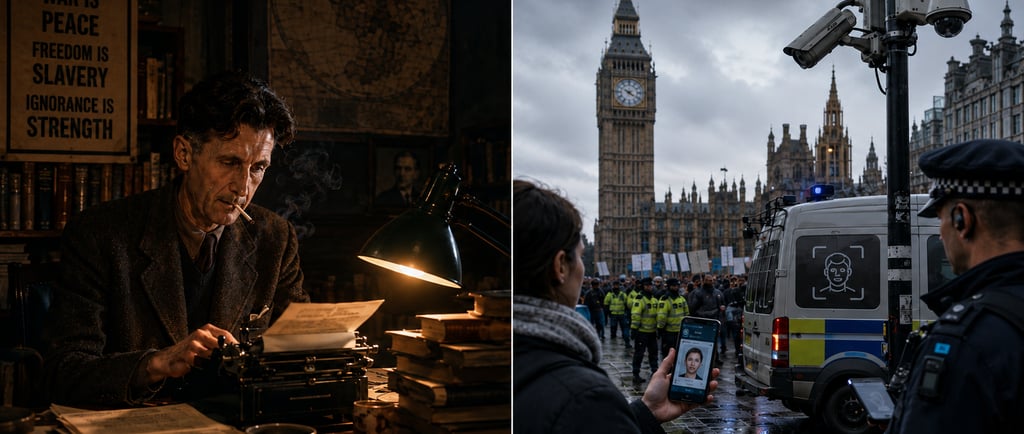
George Orwell remains useful here not because Britain resembles the world of Nineteen Eighty-Four in any literal sense. It does not. Orwell matters because he understood the relationship between language, surveillance, bureaucracy, and political obedience. His deeper warning was not only about dictatorship. It was about the way political systems can narrow freedom while claiming to act in the public interest.
Orwell’s suspicion of managerial politics was sharpened by his own democratic socialism. He was not opposed to social justice, public provision, or reform. He was opposed to the mentality that treats ordinary people as objects of expert management rather than as autonomous citizens. In The Road to Wigan Pier, he criticised the kind of middle-class reformer who believed progress meant policies imposed by “the clever ones” upon those deemed less capable of deciding for themselves.
That warning still has force. Modern governance increasingly speaks in the language of protection, modernisation, safeguarding, inclusion, risk management, and efficiency. Some of these aims are legitimate. But the language can conceal a more serious political transformation: the growth of systems that make citizens more visible to the state while making the state less directly accountable to citizens.
The question, therefore, is not whether modern British policymakers intend authoritarian outcomes. Intentions are not the main issue. Architecture is.
Fabian Gradualism and the Technocratic Method
The Fabian tradition is relevant to this argument, but not because it proves any conspiracy. It does not. Its importance lies in political method. Fabianism has historically preferred gradual reform through institutions, policy machinery, expert committees, legislation, and administrative influence rather than revolutionary rupture.
That method can produce serious public goods. It can also produce a form of state expansion that is difficult for citizens to see clearly because no single measure appears decisive. Power grows by increments. Each step is justified. Each reform appears technical. Each additional capacity is described as necessary to solve a specific administrative problem.
This is the political risk of technocracy. It can become so focused on system performance that it underestimates constitutional consequence. It asks whether a tool works before asking what kind of relationship the tool creates between state and citizen.
That distinction is now critical in Britain.
Digital Identity and the Permission Layer of Citizenship
Digital identity is the clearest example. The government presents digital ID as a modern administrative instrument: a way to reduce fraud, simplify access to services, support right-to-work checks, and improve public-sector efficiency. These objectives are not imaginary. Identity fraud, illegal working, fragmented databases, insecure paper documentation, and inefficient access to government services are real problems.
But a serious civil-liberties argument does not deny administrative benefit. It asks what constitutional price is being paid for that benefit.
A digital ID system becomes dangerous when it moves beyond convenience and becomes a practical condition for participation in ordinary life. If proof of identity becomes increasingly necessary for employment, housing, welfare, immigration status, financial services, public services, or online access, then the state becomes the central broker of civic participation.
That is the real issue. The citizen may still formally possess rights, but access to the exercise of those rights becomes mediated through a state-linked verification system.
The concern is not only privacy. It is dependency.
A paper document can be lost, forged, or checked. A digital identity infrastructure can be linked, expanded, queried, integrated, suspended, or repurposed. Its power lies not only in what it does at launch, but in what it enables later. That is why digital ID must be judged not merely by its current stated purpose but by its future administrative potential.
The central question is simple: does digital ID serve the citizen, or does it gradually make the citizen legible, manageable, and conditional within a state-controlled system?
A Worked Example: What Safeguards Should Look Like
Consider GOV.UK One Login and the wider digital identity ecosystem. A proper democratic control model would not merely ask whether the system is efficient. It would require strict limits from the start.
A serious safeguard would state that identity data collected for access to one public service cannot automatically be reused for unrelated policing, immigration, taxation, or private-sector purposes without explicit parliamentary approval. It would require an independent audit trail showing which department accessed identity data, for what lawful purpose, and under what authority. It would allow citizens to challenge errors quickly, especially where a digital identity failure affects employment, housing, welfare, or legal status. It would also contain a statutory prohibition on quiet function creep.
That is what reversibility and function-creep protection mean in practice. They are not abstract principles. They are design requirements. Without them, a system introduced for convenience can become a general infrastructure of civic control.
Live Facial Recognition and the Transformation of Public Space
Live facial recognition raises a different but related concern. It does not operate at the service counter. It operates in public space.
The state’s argument is predictable and not without force. Police need tools to identify dangerous offenders, locate wanted individuals, prevent violence, and protect the public. No serious critic should pretend that public safety is irrelevant. The question is whether live facial recognition changes public space in ways that a free society should resist.
A facial-recognition van is not simply a more efficient police officer with a notebook. It is a mobile biometric checkpoint. It allows the state to scan faces in public, compare them against watchlists, and act on automated identification. Even when used lawfully and even when aimed at serious offenders, it normalises the principle that citizens moving through public space may be subject to biometric assessment.
That changes behaviour.
Surveillance does not have to be universal to be disciplinary. It only needs to be visible, unpredictable, and credible enough for citizens to modify where they go, whom they join, what they say, and whether they participate in protest. The effect is not always direct repression. It is self-restraint.
This is why live facial recognition at protests or large public gatherings is constitutionally sensitive. Protest is not merely another crowd-management problem. It is a democratic right. When citizens assemble under the possibility of automated identification, the character of assembly changes. People may still be legally free to protest, but they do so under a stronger shadow of state observation.
That shadow matters.
Protest Law and the Pre-Emptive Management of Dissent
The third part of the architecture is protest law. Britain has moved increasingly toward public-order rules that focus not only on actual harm but on anticipated disruption, anticipated intimidation, or anticipated disorder. This matters because protest is often disruptive by nature. A democracy that protects only invisible, frictionless protest does not truly protect protest at all.
The state may legitimately punish violence, criminal damage, intimidation, or serious obstruction. But it must not blur the line between criminality and dissent. When preparatory protest activity attracts severe custodial consequences, or when police are given broad powers to restrict assemblies based on what might happen, the law moves from punishing conduct into managing political possibility.
That is a profound shift.
It is also where the cumulative architecture becomes most visible. Digital identity verifies the citizen. Facial recognition identifies the citizen in public space. Public-order law regulates the citizen’s capacity to assemble and object. Data retention then preserves traces of that activity. None of these powers needs to be total on its own. Their significance lies in combination.
The danger is not one law. It is the system formed by many laws and tools.
The Language of Administrative Inevitability
Modern state expansion is rarely described as expansion. It is described as modernisation, safeguarding, resilience, public confidence, fraud prevention, harm reduction, or community protection. These terms are not automatically dishonest. Many describe legitimate objectives. But they can also narrow democratic debate.
If digital ID is framed only as modernisation, critics are made to sound backward. If facial recognition is framed only as catching criminals, critics are made to sound indifferent to victims. If protest restrictions are framed only as preventing disruption, critics are made to sound hostile to public order.
This is how language converts political choice into administrative inevitability.
A free society should reject that framing. The fact that a policy has a legitimate objective does not mean it is proportionate. The fact that a technology can solve one problem does not mean it should be normalised across civic life. The fact that a measure is efficient does not mean it is constitutional.
Efficiency is not liberty. Administrative convenience is not democratic consent.
The Democratic Control Test
The proper response is not anti-technology romanticism. Britain cannot govern a digital society with purely analogue tools. The state needs lawful capacity to prevent fraud, protect citizens, manage borders, and maintain public order. But every expansion of state power over identity, biometric surveillance, and protest should pass a strict democratic control test.
First, the government must prove necessity with specific evidence. Vague references to safety, fraud, extremism, or efficiency are insufficient.
Second, the measure must be proportionate. If a narrower or less intrusive tool can achieve the legitimate objective, that tool should be preferred.
Third, the power must be clearly defined in law. Major surveillance or identity systems should not expand through administrative practice, procurement decisions, or departmental convenience.
Fourth, there must be independent oversight and practical redress. Citizens wrongly identified, wrongly excluded, wrongly recorded, or wrongly restricted must be able to challenge the system quickly and effectively.
Fifth, function creep must be prohibited by design. Data collected for one purpose should not silently migrate into another domain.
Sixth, the system must be reversible. Emergency or experimental powers should not become permanent by default. Sunset clauses, parliamentary review, and deletion requirements are not optional safeguards; they are democratic necessities.
This test is not an obstacle to good governance. It is what separates democratic governance from managerial control.
The Cumulative Threat
The main error in the public debate is to examine each measure separately. Digital ID is debated as an identity issue. Facial recognition is debated as a policing issue. Protest law is debated as a public-order issue. Data retention is debated as an operational issue. But citizens experience these systems together.
That is why the architecture matters.
A state that can verify identity, scan faces in public, regulate assembly, retain records, and integrate administrative systems possesses a qualitatively different relationship with its citizens from one that cannot. The question is not whether that power is always abused. The question is whether a free society should build such capacity without stronger constitutional restraint.
This is also why party politics is a distraction. A surveillance power created by one government becomes available to the next. A protest restriction justified against one unpopular movement can later be used against another. An identity infrastructure introduced for service efficiency can later be expanded for enforcement, exclusion, or behavioural regulation.
Civil liberties cannot depend on trusting the current office-holders. Liberal democracy is built on the opposite principle: power must be limited because no government can be trusted permanently.
Conclusion: Architecture Before Crisis
Britain’s civil-liberties problem is architectural and cumulative. That is the point from which the debate should begin and to which it must return.
The issue is not whether the country has become authoritarian overnight. It has not. The issue is whether Britain is constructing systems that make future overreach easier, faster, more automated, and harder to resist. Digital ID, biometric policing, public-order restrictions, and administrative data integration may each be defended as practical reforms. Together, they risk creating a society in which citizenship is increasingly mediated through verification, surveillance, permission, and compliance.
A free society does not survive merely because its leaders claim good intentions. It survives because its institutions limit power before power becomes dangerous.
Britain should modernise where necessary. It should protect the public. It should prevent fraud. It should maintain order. But it must not confuse administrative efficiency with democratic legitimacy. It must not treat dissent as a management problem. It must not build identity systems that turn rights into permissions. It must not normalise biometric monitoring as the background condition of public life.
The architecture of control is not built in one moment. It is assembled piece by piece, often by reasonable people pursuing reasonable objectives. That is precisely why it is difficult to resist.
It must be resisted early, while the design is still visible.
Selected References and Source Base
Fabian Society. Keir Starmer: The Road Ahead. Fabian Society, 2021.
Government Digital Service. GOV.UK One Login and GOV.UK Wallet public information and related government material.
Home Office. Public material on digital identity, facial recognition, public order, and policing powers.
Human Rights Watch. Silencing the Streets: The Right to Protest Under Attack in the United Kingdom. 2026.
Orwell, George. The Road to Wigan Pier. London: Victor Gollancz, 1937.
Orwell, George. Nineteen Eighty-Four. London: Secker & Warburg, 1949.
Statewatch. The Decline of Rights Under UK’s Labour: 2024-2026. 2026.
UK Parliament and House of Commons Library. Research briefings and parliamentary material on digital identity, policing, biometric surveillance, and public-order law.
Author workflow disclosure
This article was produced through an AI-assisted but human-directed workflow. AI support was used for accessibility assistance, article structuring, language refinement, source-discovery prompts, revision planning, and conversion of editorial comments into specific amendments. The author retained responsibility for the argument, accepted or rejected suggested changes, checked the logic of the claims, and remained accountable for the final text. AI-generated material was not treated as empirical evidence, and synthetic or illustrative examples were not presented as observed data.
Image note
The image accompanying this article is AI-generated and is intended for illustration purposes only.


© 2026 WDA Publishing. All rights reserved.