
The Attrition Illusion: What Casualty Ratios Can and Cannot Tell Us About the War in Ukraine
A disciplined analysis of why casualty ratios alone cannot determine who is winning the war of attrition in Ukraine.
WAR, SECURITY & GEOPOLITICS
Dr Danie Adendorff
6/25/20267 min read
The Attrition Illusion: What Casualty Ratios Can and Cannot Tell Us About the War in Ukraine
Why kill ratios alone cannot explain who is winning an attritional war.
By Dr Danie Adendorff DSc, MSc
A familiar figure circulates in commentary on the Russo-Ukrainian war: Russia is said to lose five, eight, or sometimes even more soldiers for every Ukrainian killed. Read quickly, that number appears to settle the question of who is paying the higher human price. A force trading men away at that rate, the argument suggests, must be losing the attrition contest decisively.
That conclusion is too simple. It may even be wrong.
Exchange ratios are among the most misread statistics in modern war. The problem is not necessarily that the ratios are false. The problem is that they answer a narrower question than the one they are often used to settle. A casualty ratio can indicate the relative efficiency of killing. It does not, by itself, prove which side is losing the war of attrition.
The distinction matters. In a long war, the decisive issue is not only how many soldiers each side loses. It is whether those losses consume each side’s available military manpower faster than the state, society and military system can regenerate it.
A Ratio Is Not a Result
The intuitive error is easy to see. Suppose one side loses eight soldiers for every one the other side loses. Stated as a bare exchange ratio, this sounds catastrophic for the side taking heavier losses. But a casualty is not costly in the abstract. It is costly in relation to the available pool from which it is drawn.
Imagine, purely for illustration, an army of 100 soldiers losing eight men, while an army of 10 soldiers loses one. The exchange ratio is eight to one. On the surface, the smaller force appears to be winning the exchange. Yet the larger army has lost 8 percent of its strength, while the smaller army has lost 10 percent. Measured proportionally, the smaller army is eroding faster despite the favourable exchange ratio.
This is the central defect in citing a kill ratio on its own. It counts losses without counting the denominators that make those losses strategically meaningful.
The Arithmetic of Attrition
The relationship can be expressed simply. Let the kill ratio be the number of soldiers the larger side loses for every soldier the smaller side loses. Let the manpower ratio be the number of times larger the bigger side’s available manpower pool is.
The proportional burden on the smaller side can then be understood as:
RELATIVE BURDEN = MANPOWER RATIO ÷ KILL RATIO
If the result is greater than one, the smaller side is losing a larger share of its force. The larger army may be losing more soldiers in absolute terms, but the smaller army is being consumed faster.
If the result is one, both sides are losing manpower at the same proportional rate.
If the result is less than one, the smaller side is imposing losses at a rate that erodes the larger army’s numerical advantage faster than the larger army can exploit it.
This is why casualty ratios must be treated carefully. A favourable kill ratio only wins the attrition contest if it exceeds the opponent’s manpower advantage. If the manpower disadvantage is steeper than the kill advantage, the smaller force may still be losing the long war.
The First Uncertainty: The Kill Ratio
The most dramatic kill ratios attached to the Ukraine war should be treated cautiously. Public discussion often cites very high Russian-to-Ukrainian loss ratios, including eight to one or higher. Such figures may circulate widely, but they do not automatically survive comparison with more cautious independent assessments.
A defensible analytical range appears to be meaningfully in Ukraine’s favour, but not necessarily at the extreme levels often repeated in informal commentary. Serious estimates have placed Russian losses well above Ukrainian losses, but with substantial uncertainty and wide margins. A working range of roughly two-and-a-half to five Russian soldiers killed for every Ukrainian soldier killed is more analytically cautious than the most dramatic claims.
The “eight to one” figure is especially vulnerable to misuse. In some contexts, it has referred not to a kill ratio at all, but to a local manpower imbalance — for example, the number of Russian troops concentrated against Ukrainian defenders in a specific sector such as Pokrovsk. That is a statement about force concentration, not necessarily about casualty exchange. A figure describing how many attackers are present can easily migrate into commentary as a figure describing how many attackers are being killed. These are not the same measurement.
The prudent position is therefore not a single precise ratio. It is a range. The exchange of losses likely favours Ukraine, but the exact degree of that advantage remains contested.
The Second Uncertainty: What Counts as Manpower?
The second input is even more important. “Manpower ratio” can mean different things.
The first meaning is the total manpower stock: the broad population and mobilisable pool from which each country can theoretically draw. On this measure, Russia’s advantage is large. Russia’s population is far greater than Ukraine’s, and Ukraine’s available population has been reduced further by occupation, displacement, emigration and wartime demographic pressure. On this broad stock measure, Russia’s advantage may be several times larger than Ukraine’s.
The second meaning is manpower flow: the rate at which each side can recruit, mobilise, train, equip and deliver usable soldiers to the front. This is often more relevant for operational sustainability. A large theoretical reserve is not the same as a deployable replacement stream. Soldiers must be recruited, processed, trained, equipped, commanded and moved. If the front consumes them faster than the system can replace them, the theoretical stock matters less.
This distinction changes the conclusion.
If one uses a large stock-based manpower ratio and a conservative kill ratio, Russia’s larger population base may still offset its heavier losses. On that calculation, Ukraine’s favourable exchange rate may not be enough to win the attrition contest.
If one uses a narrower replacement-flow ratio and a higher kill ratio, the conclusion can flip. Russia may still lose substantially more soldiers than Ukraine, while no longer replacing them easily enough to sustain the same rate of pressure indefinitely.
The same war can therefore produce opposite analytical conclusions depending on which denominator the analyst chooses. That is why confident claims about “who is winning attrition” should be treated with caution unless they specify whether they are measuring population stock, military mobilisation capacity, monthly recruitment flow, trained deployable personnel, or effective frontline strength.
The Frontage Problem
There is also a structural disadvantage that arithmetic alone can miss.
Ukraine must hold a long line of contact. A front of hundreds of kilometres requires a minimum absolute number of soldiers to occupy trenches, rotate units, sustain defensive positions, provide depth and prevent gaps. Below that threshold, ratios become less important. A unit can be inflicting favourable losses and still be too understrength to hold its assigned sector.
This is the frontage floor.
A smaller army reaches that floor sooner. Even if it suffers losses at a favourable exchange rate, it may lack the absolute density required to defend everywhere it must defend. This is why Ukraine’s manpower problem cannot be dismissed merely by pointing to Russian losses. If Ukrainian brigades are understrength, if rotations are delayed, if reserves are thin, or if defensive sectors cannot be adequately manned, then the operational pressure becomes real irrespective of the headline casualty ratio.
For the smaller force, attrition is therefore not only proportional. It is also spatial. The question is not merely how many soldiers are lost compared with the enemy. It is whether enough soldiers remain in the right places, with the right equipment, at the right time, to hold the line.
What Can Be Said with Confidence
A disciplined reading is narrower than both triumphalist and fatalist interpretations.
First, Russia appears to be paying a heavier human cost than Ukraine in the exchange of losses. That is strategically significant and should not be dismissed.
Second, the kill ratio alone does not decide the attrition contest. It must be weighed against Russia’s manpower advantage, Ukraine’s mobilisation constraints, replacement flows, training capacity, equipment supply and the physical requirement to hold a long front.
Third, the most relevant question is not simply how many soldiers Russia loses for every Ukrainian killed. The more important question is whether each side can regenerate combat power faster than the battlefield consumes it.
Fourth, Ukraine’s external support remains central. Western equipment, intelligence, air defence, artillery, drones, logistics, training and financial assistance allow Ukraine to substitute technology, firepower and operational adaptation for some of the manpower it lacks. Without that support, the same casualty ratio would mean something very different.
The war is therefore not being settled by a single number. It is being shaped by slower and more difficult variables: replacement rates, mobilisation politics, frontline density, force regeneration, external support and the ability of each side to convert losses into sustainable military pressure.
The Strategic Lesson
The casualty ratio is not meaningless. It matters. But it is not a verdict.
Used properly, it tells us something about battlefield efficiency and the relative cost imposed in combat. Used carelessly, it creates the illusion that attrition can be understood through one dramatic statistic. That illusion is analytically dangerous.
A kill ratio answers a limited question: how many soldiers one side loses compared with the other. It does not answer the larger strategic question: which side is being depleted faster in relation to the manpower it can actually sustain, deploy and regenerate.
That distinction should govern serious analysis of the Ukraine war. The apparent simplicity of the ratio conceals the harder reality of attrition. Wars are not won by arithmetic alone. They are won or lost by the interaction between manpower, mobilisation, geography, logistics, political endurance, external support and command judgement.
The casualty ratio is therefore a useful signal, but a poor conclusion. It should begin the analysis, not end it.
Sources and Notes
This article draws on published assessments and reporting associated with the Center for Strategic and International Studies, The Economist, the International Institute for Strategic Studies, the Congressional Research Service, the Carnegie Endowment for International Peace, and contemporaneous reporting on recruitment, mobilisation and battlefield manpower.
All casualty and manpower estimates in the Russo-Ukrainian war should be treated as contested ranges rather than verified totals. Ukraine restricts much of its own casualty data for military reasons. Russia has strong incentives to suppress, minimise or manipulate its own loss figures. Even careful external estimates carry wide error margins. The argument advanced here does not depend on any single figure being exact. It rests on a structural point: a ratio of losses, by itself, cannot determine who is winning an attritional war.
Author Workflow Disclosure
This article was produced through an AI-assisted but human-directed workflow. AI assisted with structuring, language refinement, accessibility support, revision planning and conversion of editorial direction into publishable prose. Dr Danie Adendorff retained responsibility for the argument, claim logic, source credibility, interpretation and final text. AI-generated material should not be treated as empirical evidence.
Image declaration
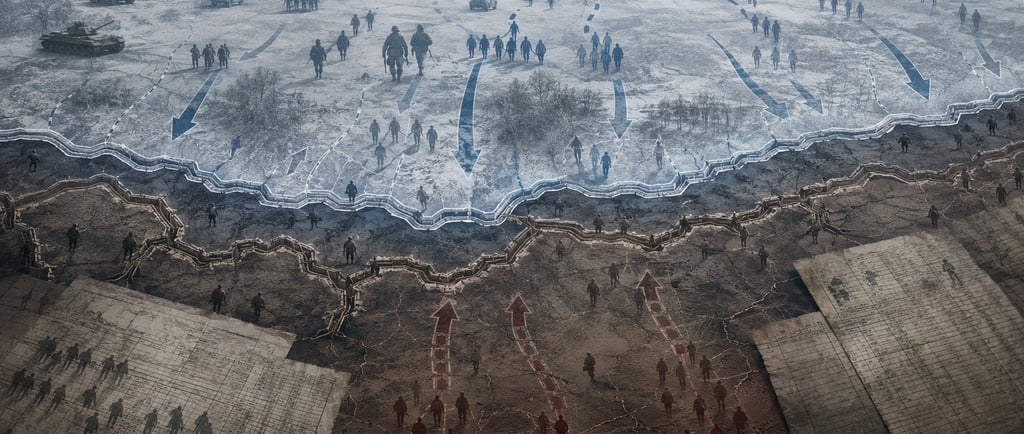
The image accompanying this article/post is AI-generated and is intended for illustration purposes only.


© 2026 Dr Danie Adendorff. All rights reserved.