
THE C-SUITE COMMAND CENTRE
A defence-informed executive-leadership essay arguing that the CEO office has become a command centre because modern leaders must preserve judgement inside contested information, financial, technological and communication environments.
LEADERSHIP & DECISION-MAKING
Dr Danie Adendorff
6/29/202614 min read


THE C-SUITE COMMAND CENTRE
Decision Before Consequence in the Age of Hybrid Pressure and AI Hype
By Dr Danie Adendorff DSc (c.h), MSc
29 June 2026
Abstract: The modern executive is rarely defeated by obvious lies. The greater danger is an untruthful operating environment built from communications that appear truthful enough to act upon. Through a controlled fictional C-suite crisis, this essay argues that the CEO's office has become a command centre because modern leaders must preserve judgement inside contested information, financial, technological and communication environments. It positions Decision Before Consequence as a disciplined executive doctrine for restoring validation, authority and human judgement before irreversible consequence.
Introduction
The modern executive is not fighting a war in the literal military sense. A chief executive is not a battlefield commander, a company is not an army, and commercial crisis should not be dressed up in theatrical combat language. Yet the comparison cannot be dismissed entirely, because the modern executive now operates inside a contested decision environment.
The CEO's office has become a command centre.
Not because business should imitate the military, but because the executive office increasingly performs command-centre functions. It receives signals from multiple domains. It grades information. It distinguishes fact from pressure. It interprets ambiguity. It aligns authority. It directs action. It protects people. It manages consequence. Above all, it must preserve judgement before action becomes irreversible.
The modern executive is rarely defeated by obvious lies. The greater danger is an untruthful operating environment built from communications that appear truthful enough to act upon.
That is the central problem this article addresses.
An obvious lie can often be detected, challenged or corrected. An untruthful operating environment is more dangerous because it is not made only from falsehood. It is assembled from partial truths, selective evidence, confident briefings, AI-generated outputs, financial pressure, consultant language, media amplification, regulatory anxiety, internal optimism, adversarial messaging and institutional fear. It does not always deceive by inventing reality. It distorts reality sufficiently to make poor decisions appear rational.
This is where defence, management, communication theory and AI governance now meet.
The Meridian Crisis: A Controlled Fiction
Consider a fictional company: Meridian Infrastructure Systems.
Meridian is a listed technology and infrastructure firm. It supplies software, sensors and AI-enabled monitoring tools to transport networks, energy utilities and port authorities. It is not a defence company, but its products sit close to critical national infrastructure. Its clients include commercial operators, public agencies and regulated infrastructure providers. Its share price depends on confidence. Its contracts depend on trust. Its reputation depends on the credibility of its technology.
At 05:40 on a Monday morning, Meridian's CEO arrives at the office.
By 06:15, the C-suite has become a command centre, although nobody uses that phrase. The CFO reports unusual pre-market trading. Investor relations has received analyst questions about whether Meridian overstated the capability of its AI platform. The communications director reports a fast-moving social-media claim alleging that Meridian's system failed during a transport disruption. The general counsel has received notification of a preliminary regulatory inquiry. The CISO reports suspicious network activity, not yet confirmed as intrusion. The COO warns of delayed components from a key supplier. The HR director reports internal anxiety after leaked messages suggest staff reductions linked to automation.
No single signal is yet decisive.
Individually, each can be explained. Markets move. Social media exaggerates. Regulators ask questions. Cyber teams investigate anomalies. Suppliers miss deadlines. Employees worry. Analysts speculate.
Together, however, these signals form a contested operating environment.
The CEO is not facing one clear attack. The CEO is facing a convergence of financial pressure, communication pressure, regulatory pressure, cyber uncertainty, operational fragility, workforce anxiety and AI credibility risk. Some of the information may be true. Some may be false. Some may be incomplete. Some may be opportunistic. Some may be hostile. Some may be coincidence. Some may be early warning.
The danger is not one lie. The danger is that the executive team may begin to act inside a false decision world.
From Truth Decay to the Executive Decision Space
The concept of an untruthful operating environment does not appear from nowhere. It sits in a wider lineage of work on information disorder, propaganda, strategic communication and epistemic degradation. RAND's work on Truth Decay describes the declining role of facts and analysis in public life. RAND's firehose of falsehood model explains how high-volume, rapid, repetitive and inconsistent messaging can overwhelm truth-testing. Work on information disorder, computational propaganda, hybrid threats, deepfakes and the liar's dividend has similarly shown that modern communication environments can damage trust, verification and shared reality.
The executive problem is a specific version of that wider condition.
The phrase untruthful operating environment shifts the focus from the public information ecosystem to the bounded executive decision space. The issue is not only whether society is confused, whether propaganda circulates, or whether digital platforms amplify falsehood. The issue is whether a board, CEO, commander, minister or senior decision-maker is forced to act inside an environment where information appears sufficiently credible to trigger action but is insufficiently validated to justify consequence.
That is the contribution of the executive frame.
The problem is not simply misinformation. It is decision contamination.
Hybrid Pressure Without Declared War
Hybrid warfare offers a useful analytical frame, provided it is translated carefully. In national-security contexts, hybrid threats combine instruments across domains: information operations, cyber activity, economic pressure, covert influence, coercive diplomacy, proxy activity, sabotage, lawfare and, where necessary, conventional force. Their purpose is often to remain below clear thresholds while degrading the target's ability to interpret, decide and respond.
The civilian executive environment is not identical. But it can become hybrid-like.
In the Meridian Crisis, the pressure is multi-domain. Finance creates one form of pressure. Media creates another. Cyber uncertainty creates technical pressure. Regulation creates legal pressure. Staff anxiety creates internal pressure. AI capability claims create strategic pressure. Client concerns create contractual pressure. The board creates governance pressure.
No single domain controls the crisis. Their interaction controls the crisis.
This is why the CEO's office becomes a command centre. The executive must not treat finance, communication, law, cyber, operations, human resources and AI governance as separate administrative lanes. Under pressure, they become mutually reinforcing elements of one decision environment.
Finance moves through confidence. Media moves through narrative. Cyber moves through uncertainty. Law moves through liability. Operations move through dependency. Employees move through trust. AI moves through output. Governance moves through authority.
The CEO must command across these different tempos without allowing any one tempo to become the whole truth.
Financial Pressure as Psychological Pressure
Financial pressure is never only financial.
When Meridian's share price falls, the CFO sees market capitalisation, liquidity exposure and investor confidence. The CEO sees strategic vulnerability. The board sees reputational risk. Employees see insecurity. Clients see possible operational exposure. Competitors see opportunity. Journalists see a story. Short sellers see confirmation. Regulators may see public-interest concern.
A falling share price becomes a communication event. A communication event becomes a governance event. A governance event becomes an operational event. An operational event becomes a morale event.
This is why finance belongs inside the command centre.
Numbers describe reality, but under pressure they also shape behaviour. Debt covenants, quarterly expectations, liquidity constraints, analyst notes, activist investors, insurance conditions and credit ratings can all compress judgement. Financial pressure can make a risky decision appear necessary. It can make premature reassurance appear prudent. It can make staff reduction appear strategically disciplined when it may merely be a panic response.
The CFO therefore cannot function only as keeper of numbers. In a serious executive crisis, the CFO becomes an intelligence officer for financial consequence. The question is not only whether the balance sheet is strong. The question is how financial signals are shaping executive perception.
A financially pressured executive may mistake liquidity fear for strategic necessity. That is a pathway to command failure.
Communication as Battlespace
The communications director in the Meridian Crisis does not merely manage messaging. That phrase is too weak for the seriousness of the task.
Communication is part of the executive battlespace.
Internal communication affects whether employees trust leadership or leak against it. Investor communication affects whether markets interpret uncertainty as concealment. Client communication affects whether contracts are preserved or suspended. Public communication affects whether journalists frame Meridian as responsible, evasive, negligent or deceptive. Regulatory communication affects whether authorities see cooperation or obstruction.
The CEO must understand a central principle: communication does not simply report the organisation's position. It helps create the organisation's operating environment.
A premature statement can create legal exposure. Silence can create suspicion. Overconfidence can destroy credibility. Excessive caution can signal panic. Technical language can appear evasive. Emotional language can appear unserious. Defensive language can escalate scrutiny.
In military terms, strategic communication and psychological operations shape perception, confidence, morale and interpretation before action occurs. In corporate terms, communication shapes the confidence ecology in which the organisation must survive.
The CEO's question is therefore not merely, What should we say? The deeper question is: what reality will our communication help create, and can we stand inside that reality when evidence changes?
AI Hype as Decision-Environment Contamination
Meridian's crisis began partly because the company had described its AI platform too confidently.
The platform was not useless. It performed well in several controlled environments. It improved monitoring in specific use cases. It reduced manual review burden. It created real efficiencies. The company did not simply lie.
The problem was more subtle.
Marketing language outran validation. Investor presentations simplified operational limits. Sales teams converted technical possibility into commercial certainty. Executives began using transformation language before the governance architecture was mature. Internal critics were treated as slow or negative. The board became accustomed to AI success language. The market priced in confidence. Clients heard capability claims as assurance.
AI hype became an operating condition.
This is how AI creates danger in the executive environment. Not because AI has no value, but because ungoverned expectation turns possibility into pressure. Once an organisation declares that AI will transform performance, reduce cost, improve risk detection and accelerate service, every later ambiguity is interpreted against that promise.
The executive then faces a problem of self-created strategic communication. The organisation's own language has shaped the battlefield.
AI fatigue is not caused only by AI. It is caused by unmanaged AI expectations colliding with unmanaged AI implementation. In the Meridian Crisis, Meridian is not merely responding to external pressure. It is dealing with the consequences of its own premature certainty.
This is why AI governance must be treated as command discipline, not technology policy. AI output is not intelligence until it is validated. AI recommendation is not decision until accountable authority accepts consequence. AI acceleration is not transformation if the organisation cannot govern what it accelerates. AI capability without governed workflow is not transformation. It is unmanaged operational exposure.
A1 to F6: Executive Intelligence Discipline
At 07:30, Meridian's CEO orders a classification review.
Every signal must be graded. Nothing is to be treated as fact merely because it is urgent, visible, senior, technical, expensive, repeated or emotionally persuasive.
The A1-F6 discipline is derived from intelligence practice. It uses two separate axes: the letter grades the reliability of the source, while the number grades the credibility of the information. A reliable source can still provide uncertain information. A weak or unknown source can still produce a signal that later proves important. The discipline lies in keeping those two judgements separate before action is taken.
The CISO's network anomaly is graded C3: a reasonably credible internal technical source, but information not yet confirmed as intrusion. The hostile social-media claim is graded F6: unknown source and unverified content, but still monitored because amplification may create operational consequence. The supplier delay is graded B2: a generally reliable source with information supported by independent confirmation. The regulatory inquiry is graded A2: a confirmed communication from a competent authority, although the scope remains uncertain. The analyst rumour about overstated AI capability is graded D4: circulating externally, partially inferential and requiring investor-relations monitoring. Employee anxiety is graded B3: credible internal reporting, but variable interpretation.
This is not bureaucracy. It is executive self-defence.
Without grading, the loudest signal wins. With grading, the executive can hold multiple truths at once. A low-confidence item can be monitored without being accepted. A high-confidence item can be acted upon without waiting for perfection. A weak signal can be escalated without becoming policy. A rumour can be watched without driving strategy.
F6 information must not be suppressed. In security and defence, weak signals often matter. Today's F6 may become tomorrow's A1. But F6 must never be treated as A1.
That rule belongs in the modern C-suite.
Positioning DBC: Sensemaking, OODA and Recognition-Primed Decision
Decision Before Consequence sits near several established traditions. Karl Weick's sensemaking explains how people and organisations construct meaning under uncertainty. Boyd's OODA loop emphasises observation, orientation, decision and action under competitive tempo. Gary Klein's recognition-primed decision model shows how experienced decision-makers act under time pressure by recognising patterns and mentally simulating courses of action.
DBC does not replace these traditions. It draws from the same family of problems: uncertainty, interpretation, tempo, pressure and consequence. Its distinct contribution is executive governance before irreversible action. It asks not only how leaders make sense, orient faster, or recognise patterns, but how accountable authority prevents contaminated information, AI output, institutional pressure and premature certainty from becoming consequential action.
The DBC question is therefore specific: before this decision becomes consequence, has the organisation preserved judgement, validated intelligence, mapped consequence, aligned authority and identified the human return point?
That is the bridge between management thinking and command discipline.
Decision Before Consequence as the Operating Doctrine
Meridian's CEO now faces the decisive question: how does the organisation act without surrendering to pressure?
DBC provides the operating doctrine. It does not remove uncertainty. It disciplines the path from uncertainty to action.
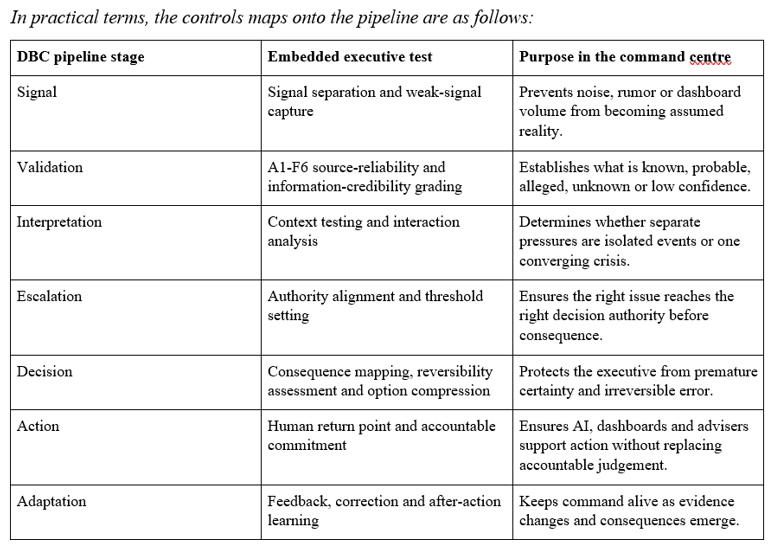
The executive intelligence pipeline begins with signal. Meridian separates signals from noise: trading anomalies, social-media claims, regulatory communication, cyber alerts, employee concerns, supplier delays and AI credibility questions.
It then moves to validation. Each signal is assessed for source reliability, information credibility and corroboration. Claims are not rejected merely because they are inconvenient, but they are not accepted merely because they are urgent.
The next stage is interpretation. The C-suite asks how the signals interact. A cyber anomaly, regulatory inquiry, investor concern and AI capability dispute may be separate, or they may form one converging crisis.
Escalation follows. The right issues must reach the right authority. Technical staff should not carry strategic liability alone. Communications should not outrun legal and operational evidence. The board should be informed without being allowed to panic the organisation into premature certainty.
Decision then requires consequence mapping. What happens if Meridian confirms too much? What happens if it denies too early? What happens if it pauses the AI platform? What happens if it continues? What happens to clients, regulators, staff, investors and public trust?
Action follows only after reversibility has been assessed. A cautious holding statement is reversible. Misleading the market is not. Pausing a feature may be reversible. Concealing a safety concern is not. Delaying a product launch may be costly. Losing institutional credibility may be catastrophic.
Adaptation completes the cycle. Command is not a single decision. It is disciplined correction as reality clarifies.
This is the DBC architecture: Signal, Validation, Interpretation, Escalation, Decision, Action, Adaptation. Within that architecture, the practical tests are not a separate doctrine; they are embedded controls. The pipeline provides the sequence. The tests provide the discipline inside each stage.
Adair Inside the Command Centre
John Adair's Action-Centred Leadership remains relevant because it keeps command human. The leader must hold three obligations in balance: achieving the task, maintaining the team and developing the individual.
In the Meridian Crisis, the task is clear: protect safety, legality, operational continuity, client trust and organisational credibility while determining whether the AI platform failed or was misrepresented.
The team must remain coherent. CEO, CFO, CISO, COO, general counsel, communications director, HR, investor relations and board chair must not fight separate wars from separate rooms.
The individual must be protected and developed. Technical staff must be able to report uncomfortable findings. Managers must not be bullied into false assurance. Employees must receive honest communication. Executives must not hide behind AI outputs, consultants or lawyers.
If the CEO focuses only on the task, the organisation may become brutal, defensive and blind to weak signals. If the CEO focuses only on team harmony, difficult truths may be suppressed. If the CEO focuses only on individuals, the organisation may lose tempo and fail to act.
Adair's value is that he keeps leadership balanced under pressure. DBC gives the command architecture. Adair gives the leadership balance. Together they prevent the C-suite from becoming either a panic room or a theatre of control.
The Human Return Point
The most dangerous moment in the Meridian Crisis occurs when the AI risk dashboard recommends a low-risk public assurance.
The dashboard has processed internal incident reports, historic performance data, media sentiment, regulatory correspondence and operational logs. It assigns a low probability to systemic failure. Several executives are relieved. The market opens in ninety minutes. The chair wants reassurance. The communications director believes a confident statement may stabilise the share price. The CFO warns that silence could deepen the sell-off.
The CEO asks the decisive DBC question: where is the human return point?
The dashboard may support interpretation, but it cannot carry legal, ethical or strategic accountability. The machine has no duty to clients. It does not testify before a regulator. It does not face employees. It does not carry the burden of misleading the market. It does not understand institutional honour.
The CEO orders a disciplined pause.
The statement is rewritten. It does not over-assure. It does not deny what is not yet known. It confirms that Meridian is investigating specific claims, cooperating with regulators, reviewing system performance, protecting clients and providing further updates as verified information becomes available.
The share price still falls. But the organisation has preserved credibility.
That is command discipline.
What the CEO Actually Wins
By midday, Meridian has not won in the dramatic sense. The crisis is not over. The share price is down. The regulator remains active. The cyber anomaly is still under investigation. Journalists are still circling. Employees remain anxious. The AI platform may still require corrective action.
But the CEO has won something more important: the organisation has not surrendered its decision environment.
It has not treated rumour as fact. It has not treated AI output as authority. It has not allowed financial pressure to dictate truth. It has not allowed communication to outrun evidence. It has not allowed legal caution to become operational evasion. It has not allowed technical uncertainty to become executive paralysis.
The command centre has preserved judgement.
That is the victory before the operational recovery.
The C-Suite Command Centre
The CEO's office is now a command centre because the executive decision space is contested.
The business leader and the front-line commander are not the same. Their instruments, legal authorities, ethical obligations and consequences differ. But both must preserve judgement under conditions of friction, pressure, incomplete information and adversarial or hybrid-like shaping.
The commander knows that capability can be degraded before it is destroyed. The executive must learn the same lesson.
In the AI era, organisations may be degraded before they fail: by hype before implementation, by dashboards before understanding, by communication before truth, by finance before strategy, by speed before validation, by artificial confidence before accountable decision.
The greatest danger is not that the executive will believe one obvious lie. The greater danger is that the executive will operate inside a false reality built from communications that appear truthful enough to act upon.
That is how organisations drift into consequence.
The task is not to militarise business. The task is to discipline executive judgement. The task is to restore truth to the operating environment before action becomes irreversible.
That is Decision Before Consequence.
It is not merely a management tool. It is a command discipline for serious decisions.
References
Adair, J. (1973) Action-centred leadership. London and New York: McGraw-Hill.
Adendorff, D. (2026) 'From Sandhurst to the C-Suite: Why John Adair Still Matters in the AI Era', The Rumblings of a Wanderer, 12 June. Available at: https://rumbls.com/from-sandhurst-to-the-c-suite-why-john-adair-still-matters-in-the-ai-era (Accessed: 29 June 2026).
Boyd, J.R. (1987) A discourse on winning and losing. Unpublished briefing collection. Maxwell AFB, AL: Air University Library Document No. M-U 43947.
Chesney, R. and Citron, D.K. (2019) 'Deep fakes: A looming challenge for privacy, democracy, and national security', California Law Review, 107(6), pp. 1753-1820. doi: 10.15779/Z38RV0D15J.
Council of the European Union (n.d.) 'Hybrid threats'. Available at: https://www.consilium.europa.eu/en/policies/hybrid-threats/ (Accessed: 29 June 2026).
Hybrid CoE (n.d.) 'Hybrid threats as a concept'. Available at: https://www.hybridcoe.fi/hybrid-threats-as-a-phenomenon/ (Accessed: 29 June 2026).
Janjeva, A., Harris, A., Mercer, S., Kasprzyk, A. and Gausen, A. (2023) The rapid rise of generative AI: Assessing risks to safety and security. London: The Alan Turing Institute/Centre for Emerging Technology and Security.
Kavanagh, J. and Rich, M.D. (2018) Truth decay: An initial exploration of the diminishing role of facts and analysis in American public life. Santa Monica, CA: RAND Corporation. doi: 10.7249/RR2314.
Klein, G. (1998) Sources of power: How people make decisions. Cambridge, MA: MIT Press.
Lange-Ionatamisvili, E. (2015) Analysis of Russia's information campaign against Ukraine. Riga: NATO Strategic Communications Centre of Excellence.
Lewandowsky, S. et al. (2020) The Debunking Handbook 2020. Available at: https://sks.to/db2020 (Accessed: 29 June 2026). doi: 10.17910/b7.1182.
NATO (2026) 'Countering hybrid threats'. Available at: https://www.nato.int/en/what-we-do/deterrence-and-defence/countering-hybrid-threats (Accessed: 29 June 2026).
Paul, C. and Matthews, M. (2016) The Russian 'firehose of falsehood' propaganda model: Why it might work and options to counter it. Santa Monica, CA: RAND Corporation. doi: 10.7249/PE198.
Shandra, A. and Seely, R. (2019) The Surkov leaks: The inner workings of Russia's hybrid war in Ukraine. RUSI Occasional Paper. London: Royal United Services Institute.
Wardle, C. and Derakhshan, H. (2017) Information disorder: Toward an interdisciplinary framework for research and policy making. Strasbourg: Council of Europe.
Weick, K.E. (1995) Sensemaking in organizations. Thousand Oaks, CA: SAGE Publications.
Woolley, S.C. and Howard, P.N. (2017) Computational propaganda worldwide: Executive summary. Oxford: Oxford Internet Institute, University of Oxford.
Author Workflow Disclosure
This article was produced through an AI-assisted but human-directed workflow. AI support was used for accessibility assistance, structuring, language refinement, source-discovery prompts, revision planning and conversion of editorial direction into draft amendments. Dr Danie Adendorff retained responsibility for the argument, accepted or rejected changes, checked the logic of claims, assessed source credibility and remains accountable for the final text. AI-generated material was not treated as empirical evidence, and synthetic or illustrative examples were not presented as observed data.
Image Declaration: The image accompanying this article/post is AI-generated and is intended for illustration purposes only.


© 2026 Dr Danie Adendorff. All rights reserved.