
The End of Uncontested Air Dominance?
Iran’s reported use of mobile, low-cost air-defence systems near the Strait of Hormuz suggests a shift from classical air superiority contests to distributed air-denial warfare.
WAR, SECURITY & GEOPOLITICS
Dr Danie Adendorff
6/3/202611 min read
The End of Uncontested Air Dominance?
Iran, the Persian Gulf, and the New Economics of Air Denial
By Dr Danie Adendorff
The Persian Gulf air war does not show the end of American air power. It shows something more operationally serious: the erosion of the assumption that Western air dominance can be exercised over Iran without persistent attrition, political exposure and cost-imposition by cheaper, mobile defensive systems.
The Problem is not Defeat. It is Friction.
Western military strategy has long treated air superiority as the enabling condition for modern expeditionary warfare. Once an adversary's radar network, command architecture and surface-to-air missile batteries are degraded, Western forces expect to impose tempo, sequence the battlefield and shape the political terms of the conflict from the air. That assumption was not written into doctrine from first principles; it was reinforced by experience, particularly since the 1991 Gulf War.
The United States and its allies still possess overwhelming advantages in stealth, electronic warfare, aerial refuelling, airborne command-and-control, space-enabled surveillance, precision strike and expeditionary logistics. Iran cannot match that full-spectrum capability. The serious question is therefore not whether Tehran can defeat Western air power in a symmetrical contest. It cannot.
The more important question is whether Iran can impose sufficient intermittent risk to make Western air operations over the Persian Gulf more expensive, less politically clean and less operationally predictable. On the available evidence, the answer is yes, at least within defined tactical windows and around sensitive geography such as the Strait of Hormuz. That does not end Western air dominance. It does make it more conditional.
The F-15E Loss and the Return of Political Risk.
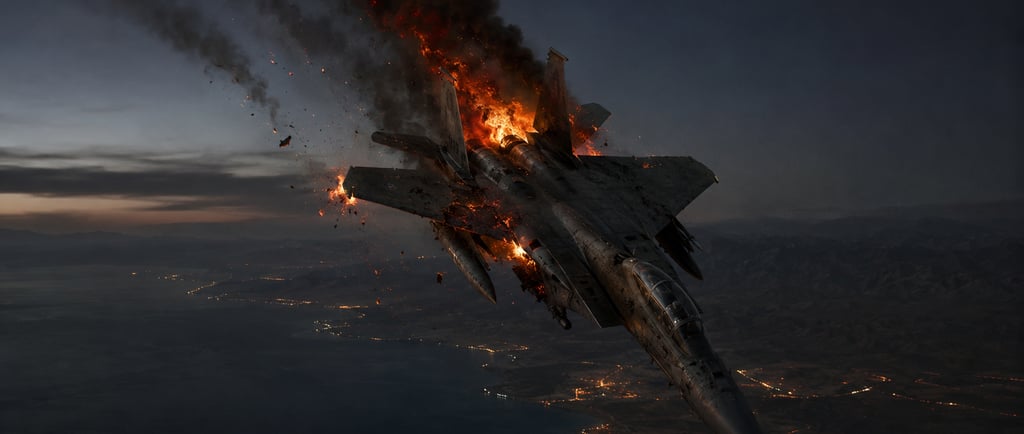
The most consequential operational fact is the loss of a U.S. Air Force F-15E Strike Eagle over Iran on 2 April 2026. U.S. Central Command stated that two American service members were rescued from Iran after their F-15E was shot down during a combat mission, with the crew recovered in separate search-and-rescue operations. The aircraft loss therefore has to be treated as a confirmed event, not simply an adversary claim or social-media rumour.
That does not settle the tactical mechanism. Open sources have offered competing explanations: a shoulder-fired missile, an Iranian derivative of a foreign system, a Chinese-origin weapon, or another surface-to-air engagement. None of those explanations has yet met the public evidential threshold for confident attribution. The proper distinction is clear: the aircraft loss is established; the weapon and kill chain remain unresolved.
The strategic significance is nevertheless substantial. A drone loss is costly. A manned aircraft loss is political. It triggers personnel-recovery requirements, exposes aircrew to capture risk, creates adversary propaganda opportunities and narrows the freedom of civilian leaders to treat the air campaign as a clean coercive instrument. Even when the crew is recovered, the loss punctures the perception of uncontested air operations over Iran.
This is the first major doctrinal lesson. Air dominance does not need to be defeated outright before it becomes strategically constrained. It only needs to become politically expensive enough to change planning assumptions.
The Drone Picture: Cost Exchange, but with Platform Discipline.
The drone-loss narrative is more complicated. Iranian media and several secondary outlets have claimed U.S. MQ-9 Reaper losses near the Strait of Hormuz, including a claimed shootdown near Qeshm Island using Iran's newly publicised Arash-e Kamangir system. Other reporting has referred to a U.S. MQ-1 drone shootdown and U.S. strikes against Iranian air-defence and drone-control sites around Goruk and Qeshm. Those strikes matter because they suggest the drone contest was part of a wider struggle over air-defence command nodes, sensors and launch chains, not merely an isolated platform-loss narrative. Platform identification matters. MQ-1, MQ-9 and generic references to 'U.S. drones' should not be collapsed into a single category.
The distinction is not pedantic. The MQ-9 Reaper is a larger, more capable and more expensive medium-altitude, long-endurance system than older Predator-type platforms. It is valuable because it provides persistence, surveillance, targeting support and command visibility. It is vulnerable because it is not a stealth aircraft and was never designed to operate freely inside dense or residual air-defence threat environments.
If Iran is repeatedly able to threaten or destroy high-value unmanned platforms with cheaper mobile systems, the cost-exchange problem becomes real. The weaker actor does not have to match the superior power platform for platform. It has to impose enough attrition, rerouting, defensive escorting, stand-off distance and intelligence uncertainty to raise the operational price of persistence.
This is the second doctrinal lesson. In contemporary conflict, the question is no longer only who possesses the best aircraft. It is whether cheaper, more numerous, more concealable systems can impose a cost curve that alters how those aircraft and drones are used.
Arash-e Kamangir: The System is Unproven; the Concept is Plausible.
Arash-e Kamangir is the most interesting and least settled element of the case. Iranian-linked reporting presents it as a low-cost, mobile air-defence interceptor used against U.S. drones near Qeshm Island. Reporting by regional and international outlets has treated the claim cautiously, noting that the system's detailed configuration and combat performance remain difficult to verify independently.
That caution is essential. The available open-source evidence does not establish the system's guidance method, sensor package, launch architecture, range, endurance, target set or relationship to earlier loitering surface-to-air concepts sometimes associated with Project 358 or SA-67-type systems. Nor does it prove that Arash-e Kamangir, specifically, was responsible for any given U.S. platform loss.
Yet the concept should not be dismissed merely because the label is Iranian and the claims are politically useful to Tehran. A mobile, low-signature, relatively cheap air-denial system would fit Iran's evident operational logic: survive coalition suppression by reducing dependence on fixed radar emitters; disperse launchers; exploit passive or intermittent detection; and target surveillance aircraft, drones or rescue-support assets at moments of exposure.
The article's central analytical point therefore does not depend on accepting every Iranian claim. Arash-e Kamangir may prove to be a limited system, an adaptation of an existing design, a propaganda label or a genuine new capability. The broader shift is still important: Iran appears to be moving from prestige air defence towards survivable air denial.
Why Iran’s Old Air-Defence Network Was Vulnerable.
The possible shift in Iranian doctrine has to be understood against the weaknesses of its legacy air-defence architecture. Iran's pre-conflict network relied on a limited number of high-value systems, including Russian-supplied S-300PMU-2 batteries and indigenous Bavar-373 and Khordad-15 systems. These systems matter, but they do not solve Iran's underlying problem: a vast country cannot be comprehensively defended by a small number of visible, radar-dependent nodes.
Large radar-dependent systems create targets. Once they emit, they can be detected, mapped, jammed, deceived or struck. If a targeting radar is destroyed or blinded, the launcher may physically survive while becoming operationally degraded. A system can remain on the battlefield and still lose its function.
Analyses of the 2025 Israel-Iran exchanges had already identified serious weaknesses in Iran's air-defence integration. The most damaging problem was not merely a shortage of launchers. It was the fragility of the sensor-to-shooter chain: the ability to identify a target, validate it, assign engagement authority, pass usable data and launch effectively before the target or attacker completes its mission.
Coalition suppression of Iranian air defences may therefore have achieved tactical success while also accelerating Iranian adaptation. The destruction of visible nodes encourages the defender to disperse, conceal, decentralise and rely on residual threat pockets. In doctrinal terms, Iran's problem shifted from defending airspace to denying predictability.
From Air Defence to Air Denial.
The distinction between air defence and air denial is central. Classical air defence seeks to protect airspace through layered radars, command networks and missile batteries. It is expensive, hierarchical and vulnerable to systematic mapping. Air denial is less ambitious. It does not need to control the airspace. It needs to make selected operations hazardous, uncertain or politically costly.
That can be achieved by smaller systems: mobile short-range launchers, man-portable air-defence systems, passive electro-optical sensors, decoys, dispersed command posts, intermittent emitters, militia-linked launch teams and opportunistic targeting. Such a network may be untidy and uneven. Its strength lies in survivability, not elegance.
This creates a different problem for Western planners. A fixed radar can be targeted by anti-radiation weapons. A mobile launcher that emits rarely, moves frequently and uses passive cueing may be much harder to find. The attacker may win the opening suppression campaign and still face lethal fragments of the defensive system.
That is the operational meaning of residual air denial. The defender loses the formal battle for control but retains enough distributed capacity to impose friction.
China: A Serious Watch Item, not a Proven Kill Chain.
The Chinese dimension is strategically important and analytically sensitive. Reuters reported in April 2026 that U.S. intelligence indicated China was preparing a weapons shipment to Iran, citing CNN and people familiar with intelligence assessments. The reported concern included possible air-defence systems, including shoulder-fired anti-air missiles. That makes Chinese support a serious watch item.
It does not prove that China enabled a specific engagement. Claims that Chinese radar, satellite cueing, BeiDou navigation, Jilin-1 imagery or Chinese-origin missiles directly caused the F-15E loss or particular drone shootdowns remain below the threshold for confident public assertion. They may be plausible intelligence questions, but they are not established facts in open sources.
The more rigorous formulation is that Iran's air-denial evolution may be occurring within a broader Chinese-enabled or Chinese-adjacent technology ecosystem. That ecosystem could include dual-use electronics, navigation services, commercial imagery, passive sensing, procurement channels and weapons-transfer risk. But access to a technology ecosystem is not the same as active command-and-control by Beijing. Dual-use components, commercial data services or indirect procurement pathways may help an Iranian system function without proving that Chinese authorities directly controlled, cued or enabled a particular Iranian kill chain.
The distinction matters for policy. Overstatement risks turning a serious military assessment into an unsupported geopolitical accusation. Understatement risks missing the deeper trend: modern air-denial systems do not require a single formal alliance pipeline. They can be assembled from military imports, dual-use components, commercial data, domestic adaptation and partner-state technology ecosystems.
The Economics of Air Denial.
The strongest implication is economic. A modern Western aircraft, drone sensor package, long-range strike package, refuelling orbit or personnel-recovery mission is expensive in financial, operational and political terms. A cheaper system that damages, destroys, diverts or deters such an asset may deliver disproportionate effect even if it is technologically inferior.
This pattern is now familiar across contemporary warfare. In Ukraine, low-cost drones have imposed losses on armour, artillery, logistics vehicles and air-defence systems, forcing commanders to disperse, camouflage and move assets that were once treated as comparatively secure behind the forward line. In the Red Sea, Houthi missiles and drones forced advanced naval forces into costly defensive patterns, where cheap offensive systems generated expensive interception, rerouting and insurance consequences. In the Persian Gulf, Iran appears to be applying a similar logic to the air domain: not defeating the superior force symmetrically, but making selected operations more expensive than expected.
For the United States and its allies, this turns cost-exchange analysis into a campaign-level requirement. The relevant question is not only whether an adversary system can be destroyed. It is how many times it must be destroyed, how quickly it can reappear, what it costs the defender to replace and what political price is paid if even one engagement succeeds.
Hormuz Turns Tactical Air Defence into Strategic Leverage.
The Strait of Hormuz makes the problem politically sharper. Air defence near Hormuz is not only about aircraft. It is about shipping flows, tanker insurance, Gulf-state confidence, oil prices, blockade enforcement, mine warfare, sanctions pressure and ceasefire bargaining. A residual Iranian air-denial capability near this corridor carries diplomatic value even when its military effect is limited.
A drone shot down near Qeshm Island, a radar site struck at Goruk, a claimed missile or drone attack towards Gulf infrastructure, or a U.S. strike against a drone-control station all feed the same strategic message: the Gulf cannot be treated as a clean Western operating space. That message may be exaggerated, but it does not need to be wholly false to have coercive value.
For Washington, this creates an awkward decision problem. Escalation may be militarily feasible but politically expensive. Restraint may be strategically sensible but vulnerable to accusations of weakness. Continued pressure may degrade Iran further while also creating more opportunities for Iranian asymmetric successes. The weaker power does not need to defeat the stronger power. It needs to complicate the stronger power's decision cycle.
What Western Doctrine Must Absorb.
The Gulf evidence does not invalidate Western air-power doctrine. It does require adjustment. Air superiority should not be understood as a permanent condition achieved after the first suppression phase. It must be treated as a continuously revalidated state, particularly when an adversary can disperse, hide and regenerate air-denial threats.
Drone operations require a more honest survivability model. Medium-altitude surveillance platforms remain invaluable, but they cannot be treated as low-risk assets in a theatre where mobile air-defence systems and residual kill chains survive. The operational value of persistent surveillance must be weighed against attrition risk, platform replacement, loss of sensors and political effect.
Combat search and rescue (CSAR) must also be designed as a strategic function, not a technical contingency. In Iran, the recovery of downed aircrew is not merely a personnel-recovery mission. It is an escalation-management problem, a diplomatic problem and a narrative problem. A rescue mission can require additional aircraft, expose supporting forces to further air-defence risk and create immediate pressure for retaliation if personnel are captured, harmed or publicly displayed. For that reason, CSAR planning in a Gulf campaign belongs inside political-military escalation design, not at the margins of operational planning.
Finally, passive and mobile air-defence threats cannot be solved by anti-radiation weapons alone. If the system does not emit in a predictable manner, the attacker needs a different detection model: multi-sensor fusion, infrared search, electronic pattern analysis, human intelligence, cyber penetration, persistent intelligence, surveillance and reconnaissance (ISR), and rapid strike authority. The task is no longer simply to kill radars. It is to detect and disrupt hidden kill chains.
Conclusion: Not the End of Air Dominance, but the End of Complacency.
The right conclusion is neither alarmist nor complacent. Iran has not defeated American air power. It has not demonstrated an integrated air-defence network capable of denying the United States access to the Gulf theatre. It has not proved that Arash-e Kamangir is a revolutionary system. It has not shown that Chinese support directly enabled specific shootdowns.
What Iran may have demonstrated is more limited, and therefore more credible: a residual and distributed air-denial capacity sufficient to impose cost, uncertainty and political risk on Western air operations. That is enough to matter.
The F-15E loss is established in official U.S. reporting. The drone-loss picture remains mixed and requires platform discipline. Arash-e Kamangir remains plausible but technically unverified. Chinese assistance remains a serious watch item rather than a proven operational kill chain. Yet the doctrinal signal is clear. Future Western air campaigns will face adversaries that combine older strategic systems, mobile residual threats, cheap interceptors, passive sensors, dual-use technology and information effects.
The age of Western air superiority is not over. The age of assuming that air superiority is politically and economically uncontested is ending. That is the lesson from the skies over the Persian Gulf, and it is a lesson Western doctrine should absorb before the next campaign rather than after it.
Source Confidence and Limits
The evidential position is strongest for the F-15E loss and crew recovery, which rest on U.S. Central Command reporting. The specific weapon used against the aircraft remains unresolved in open sources. Claims of repeated MQ-9 losses near Qeshm should be handled more cautiously because some reporting conflates MQ-1, MQ-9 and generic U.S. drone references.
Arash-e Kamangir should be treated as a plausible but technically unverified indicator of Iranian adaptation. Chinese support should be treated as a serious intelligence watch item, especially in light of Reuters/CNN reporting on possible weapons transfers, but not as proof of direct Chinese involvement in any specific engagement.
Source Notes
1. U.S. Central Command, “U.S. Continues Strikes into Iran After Successful Rescue of F-15E Aircrew”, press release, 5 April 2026. https://www.centcom.mil/MEDIA/PRESS-RELEASES/Press-Release-View/Article/4451965/us-continues-strikes-into-iran-after-successful-rescue-of-f-15e-aircrew/
2. U.S. Air Force, “F-15E Strike Eagle Fact Sheet”. https://www.af.mil/About-Us/Fact-Sheets/Display/Article/104499/f-15e-strike-eagle/
3. U.S. Air Force, “MQ-9 Reaper Fact Sheet”. https://www.af.mil/About-Us/Fact-Sheets/Display/Article/104470/mq-9-reaper/
4. Dr Jannus TH Siahaan, “Could Iran’s new air defense system be a game changer?”, Middle East Monitor, 31 May 2026. https://www.middleeastmonitor.com/20260531-could-irans-new-air-defense-system-be-a-game-changer/
5. Reuters, “US intelligence indicates China preparing weapons shipment to Iran, CNN reports”, 11 April 2026. https://www.reuters.com/world/china/us-intelligence-indicates-china-preparing-weapons-shipment-iran-cnn-reports-2026-04-11/
6. NDTV, “‘Arash-e-Kamangir’: Weapon Iran Claims To Have Used To Shoot Down US Drone. What It Is”, 29 May 2026. https://www.ndtv.com/world-news/arash-e-kamangir-weapon-iran-claims-to-have-used-to-shoot-down-us-drone-what-it-is-11563727
7. Foreign Policy Research Institute, “Shallow Ramparts: Air and Missile Defenses in the June 2025 Israel-Iran War”, 17 October 2025. https://www.fpri.org/article/2025/10/shallow-ramparts-air-and-missile-defenses-in-the-june-2025-israel-iran-war/
Author Workflow Disclosure and Image Disclosure
Author workflow disclosure:
This article was produced through an AI-assisted but human-directed workflow. Artificial intelligence was used for accessibility support, structural planning, language refinement, source-discovery prompts, revision planning, and the conversion of editorial comments into specific amendments. Dr Danie Adendorff retained responsibility for the argument, assessed the logic and evidential basis of the claims, accepted or rejected proposed changes, and remains accountable for the final text. AI-generated material was not treated as empirical evidence, and any synthetic or illustrative examples were not presented as observed data.
Image disclosure:
The image accompanying this article was generated using artificial intelligence and is provided solely for illustrative purposes. It does not constitute documentary evidence or a verified visual record of the event, platform, or operational circumstances described in the text.
© 2026 Dr Danie Adendorff. All rights reserved. Rumbls.com is an independent analytical blog.