
The Jar Without the Lid
A Greek-philosophy-grounded takedown of Andy Burnham's "bring back hope" rhetoric, arguing that his appeal to hope is a symptom of exhausted policy, not a substitute for it.
POLITICS & SOCIETY
Dr Danie Adendorff
7/27/20267 min read
The Jar Without the Lid
Andy Burnham, the Politics of Hope, and the Greek Case Against It
Dr Danie Adendorff DSc (c.h), MSc
I. The Word on the Doorstep
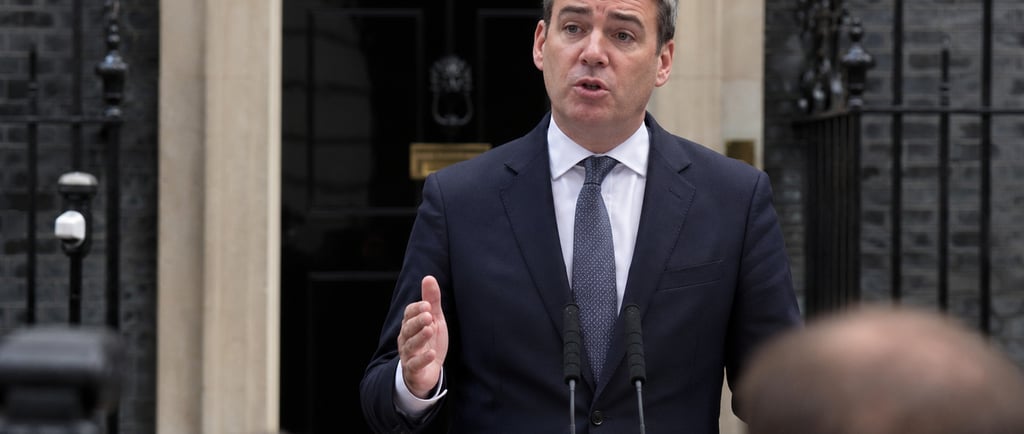
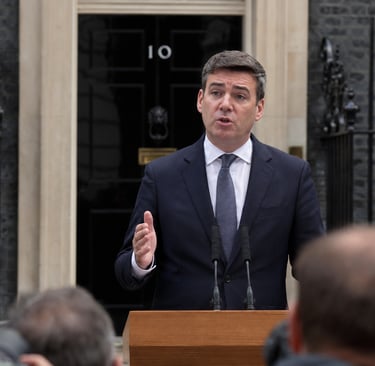
On 20 July 2026, standing on the same Downing Street doorstep that six predecessors had occupied in the preceding decade, Andy Burnham closed his first address as Prime Minister with the line he clearly intended to be remembered: “Let us make this the moment when Britain starts to believe again, the moment we bring back hope.” It followed a week in which he had already told the Labour special conference that his mission was to “turn the light of hope back on” — the same phrase, in fact, that he had used as a leadership challenger back in 2015, a decade of failed hoping ago.
This article takes that word — hope — and asks what work it is actually doing. Not as a matter of taste or tone, but as a matter of classical political philosophy, which examined elpis (hope) more rigorously, and more suspiciously, than any tradition since. The Greek verdict, set out in full elsewhere, is that hope is not a report on reality but a psychological reflex the mind reaches for precisely when its analysis has run out. Applied to Burnham's opening act as Prime Minister, that verdict is not flattering.
II. What Was Actually Said
In fairness to the record, Burnham's speech was not pure abstraction. He named a £340 million commitment to tackling homelessness, promised measures on the cost of living “starting tomorrow,” and undertook to bring forward “a new plan for Britain, a 10-year plan” later in the year. These are specific enough to be checked against outcomes in due course, and a fair critique must credit them as such rather than folding them into the general charge of vagueness.
But it is precisely the placement of “hope” in the speech that repays scrutiny. It did not arrive as a description of what the concrete measures were expected to achieve. It arrived as the peroration — the emotional cadence the speech was built toward — immediately after an admission that his own generation of politicians, “myself included,” had failed to fix the model, and immediately before markets began, within hours, questioning whether he had a policy agenda capable of doing so. Investors and commentators were reported the same day to be sceptical of his direction, against a backdrop of UK growth projected at just 0.8% for the year. Hope, in other words, was not offered as a summary of a plan already shown to work. It was offered in the gap where the plan is not yet shown to work — which is exactly the position elpis occupies in the Greek analysis: not the content of an argument, but what a speaker reaches for once the argument has run out.
III. The Seventh in a Decade
The number matters more than rhetoric usually allows it to. Burnham is the seventh Prime Minister in ten years and the fourth since 2022 alone. Each of his predecessors arrived promising some version of renewal; several used the language of hope explicitly. The Greek historian Thucydides did not treat this kind of repetition as coincidence. In the Melian Dialogue he has the Athenians tell a besieged and out-matched city that hope is a comfort the strong can afford to indulge without much cost, but that it ruins those who commit everything to it, precisely because its true character is only recognised after it has already failed them. Burnham's own line — “the moment we bring back hope” — is not the first such moment Britain has been offered this decade. It is, on the historical record, roughly the seventh. A construct that is invoked at every point of political exhaustion and vindicated at almost none of them is behaving exactly as Thucydides said it would: not as a signal correlated with success, but as a ritual performed at the moment success cannot yet be demonstrated.
IV. Hesiod's Jar, Reopened
Hesiod's myth is worth recalling in full rather than as ornament. When every evil escaped Pandora's jar into the world, hope alone stayed behind, sealed under the rim — neither given to mortals as comfort, nor removed as a further affliction, but held back in a way the poet himself refuses to resolve as either mercy or curse. The structural point transfers cleanly to a modern doorstep speech: hope is what remains available to be offered precisely because everything else — growth, stability, a proven governing model — has already been used up by the six administrations before it. Burnham did not invent this move. He inherited an empty jar and, like his predecessors, reached for the one thing still inside it.
V. The Stoic Diagnosis: Hope as Premature Assent
The Hellenistic philosophers gave this reflex a precise name: mistaken assent to an impression the evidence does not yet support. Chrysippus classified hope, alongside fear, as a pathos — not a judgement about the world but an error in judgement, the mind treating a wished-for future as though it were already secured. Epictetus's entire practical discipline consists in training the will to withhold exactly this kind of assent, to distinguish sharply between what is demonstrably within one's power and what is merely hoped for. On this analysis, “believe again” and “bring back hope” are not policy; they are an instruction to the electorate to perform the very act of premature assent the Stoics spent four centuries warning against. The instruction is addressed to the public's psychology, not to Britain's growth rate, its energy costs, or its borrowing position — none of which move by being believed in.
VI. Hope as an Excuse for Inaction
This is the charge worth stating plainly, and the Greek record supports it more directly than modern political commentary usually allows. A leader who has delivered a verifiable result does not need to ask the public to believe; the result argues for itself. The request to hope is functionally necessary only at the point where verifiable results are not yet available — which means that, structurally, an appeal to hope is an admission, not an achievement. It substitutes an emotional transaction (the public's act of believing) for the empirical transaction (the government's act of delivering) that alone could justify it. Aristotle's own definition of hope in the Rhetoric makes the mechanism explicit: hope is the pathos appropriate to a good that is possible but not yet actual. To campaign on it is, by definition, to campaign on the not-yet-actual. That is not necessarily dishonest — all new governments begin before their results exist — but it is not, either, a substitute for the results themselves, and the historical pattern in Britain's last decade suggests the substitution has become the habit rather than the exception.
VII. The Fair Objection
The strongest reply available to Burnham's defenders is Aristotle's own: hope is not always empty reaching, but can be a rational expectation grounded in genuine possibility, and a leader who forecloses all hope forecloses the public's willingness to endure the short-term costs that real reform requires. There is force in this. The Stoics themselves did not counsel despair; Epictetus's programme redirects effort toward what is within one's power rather than abandoning effort altogether, and a government wholly unwilling to speak in the register of expectation would likely be unable to govern at all. The distinction the Greek sources press for is not between hope and no hope, but between hope offered as a supplement to demonstrated action and hope offered as its substitute. Burnham's £340 million pledge and his promised 10-year plan are the test of which kind his government intends to practise. The rhetoric of the doorstep speech cannot answer that question; only the record can.
VIII. Conclusion: The Jar Is Still Sealed
Hesiod would not tell us, and did not pretend to know, whether the hope left in Pandora's jar was mortals' one mercy or their final affliction. Twenty-six centuries later, that refusal to resolve the question remains the more honest position than either uncritical faith in a new Prime Minister's promise or uncritical cynicism toward it. What the classical record does settle is narrower but firmer: hope is not evidence, does not correlate with outcomes, and is invoked by leaders precisely at the moments when evidence is unavailable. Andy Burnham's call to “bring back hope” should be read in that light — not as a policy, because on the Greek analysis it cannot be one, but as a marker of the point his government has reached before its policies exist. The jar remains sealed. What comes out of it over the next year, not what was said on the doorstep in July, is what will tell Britain whether it was hope or evasion.
References
Aristotle (n.d.) Rhetoric, Book II, on the pathe including elpis (hope).
Chrysippus, fragments preserved in Cicero, Tusculan Disputations, Book IV, on the classification of the passions.
CNBC (2026) 'UK gets new prime minister as Trump slams Britain as "Poverty Stricken Disaster"', 20 July. Available at: https://www.cnbc.com/2026/07/20/uk-prime-minister-burnham-trump-poverty-stricken-disaster.html
CNN (2026) 'Andy Burnham pledges to end instability after becoming UK's seventh prime minister in a decade', 20 July. Available at: https://www.cnn.com/2026/07/20/world/live-news/andy-burnham-uk-prime-minister-intl
Epictetus (n.d.) Enchiridion.
Hesiod (n.d.) Works and Days, lines 90–105.
ITV News (2026) 'In full: Andy Burnham's first speech as prime minister', 20 July. Available at: https://www.itv.com/news/2026-07-20/in-full-andy-burnhams-first-speech-as-prime-minister
GOV.UK (2026) 'Prime Minister'. Available at: https://www.gov.uk/government/ministers/prime-minister
Thucydides (n.d.) History of the Peloponnesian War, Book V, the Melian Dialogue.
Time (2026) 'Andy Burnham Calls for "New Politics" in U.K. in First Speech as Labour Leader', 17 July. Available at: https://time.com/article/2026/07/17/andy-burnham-first-speech-labour-leader-incoming-prime-minister/
Author workflow disclosure.
This article was produced through an AI-assisted but human-directed workflow. AI support was used for accessibility assistance, structuring, language refinement, source-discovery prompts, revision planning, and conversion of editorial comments into amendments. Dr Danie Adendorff retained responsibility for the argument, accepted or rejected changes, checked the logic of claims, assessed source credibility, and remained accountable for the final text. AI-generated material was not treated as empirical evidence. Synthetic or illustrative examples were not presented as observed data.


© 2026 WDA Publishing. All rights reserved.