
The Marriage between Agentic AI and the Laws of the Organisational Universe
An organisational-behaviour analysis of how eleven enduring principles expose the opportunities, limits and governance risks of agentic artificial intelligence.
LEADERSHIP & DECISION-MAKING
Dr Danie Adendorff
7/17/202620 min read

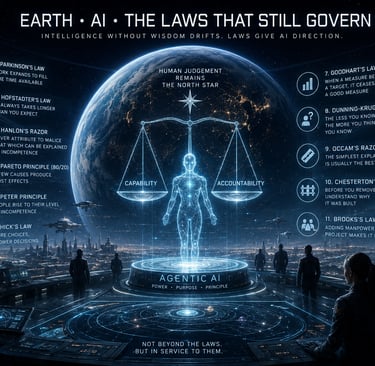
The Marriage between Agentic AI and the Laws of the Organisational Universe
Why artificial agency will not repeal the enduring realities of work, power, judgement and institutional behaviour
By Dr Danie Adendorff
Agentic artificial intelligence is entering organisations under a misleadingly familiar vocabulary. Systems are described as assistants, analysts, researchers, supervisors, team members and managers. Unlike conventional software, an AI agent can be assigned an objective, divide it into subsidiary tasks, select tools, retrieve information, initiate actions, evaluate results and modify its approach with varying degrees of human intervention. The OECD therefore treats agentic AI not as a single settled technology but as a developing class of systems associated with autonomy, goal-directed behaviour, planning, tool use, adaptation and interaction with an operating environment. (OECD)
This does not turn the machine into a human organisational member. It does, however, permit the machine to perform functions that were previously inseparable from organisational membership.
That distinction matters. An AI agent can undertake work without holding employment, exercise delegated capability without possessing lawful authority in its own right, and affect people without experiencing responsibility for what follows. Its conduct is sustained not by professional identity, loyalty, conscience or institutional socialisation, but by models, instructions, memory structures, permissions, tools and validation mechanisms.
Canhui Liu describes agentic AI as a “partial organisational analogue”: an arrangement capable of dividing labour, coordinating interdependent activities and generating collective outcomes, but without the motivational, relational and moral foundations of a human organisation. That phrase and conceptual framing belong explicitly to Liu’s 2026 paper and are used here with attribution, not as an original formulation. (arXiv)
The organisational question is therefore larger than whether AI can complete a task. It is whether an institution can safely absorb artificial action into its structures of work, authority and accountability.
Eleven familiar principles offer an unusually sharp way of examining that question. They are commonly called laws, razors, principles or effects, although they are not equivalent scientific propositions. Some are empirical findings, some are management observations, some are heuristics, and several began as satire. Their value lies in the recurring organisational tendencies they expose.
Placed beside agentic AI, they disclose an important truth:
Artificial intelligence does not escape the established realities of organisational behaviour. It can reproduce them, conceal them and amplify them at computational speed.
The marriage is consequently neither natural nor harmonious. It is a union between accelerating artificial capability and persistent institutional constraint.
PARKINSON’S LAW: THE MACHINE THAT FILLS EVERY AVAILABLE SPACE
Parkinson’s Law is usually summarised as the proposition that work expands to fill the time available for its completion. Its organisational significance extends beyond personal procrastination. Cyril Northcote Parkinson was also describing the tendency of bureaucratic structures to increase their own activity, procedures and personnel independently of the amount of substantive work that needed to be done.
Agentic AI appears, at first, to reverse this law. A task that previously occupied several employees for days may be completed in minutes. Research can be accelerated, documents generated, correspondence drafted, records compared and routine transactions processed at unprecedented speed.
Yet the elimination of effort from one task does not necessarily reduce the total volume of organisational activity. It lowers the cost of producing more activity.
A department that previously commissioned one monthly report can now request daily reports, separate executive versions, regional comparisons, risk summaries, alternative scenarios and tailored briefings for every stakeholder. The organisation does not merely complete its existing work faster. It discovers an expanding universe of work that was previously too expensive to contemplate.
Agentic systems add a further dimension. A generative tool normally stops after producing an answer. An agent can convert its own output into further tasks. It can identify gaps, initiate follow-up searches, create reminders, circulate requests, open workflow tickets, commission reviews and monitor subsequent responses. Unless carefully bounded, one artificial action becomes the justification for another.
The governing metaphor is not a labour-saving engine. It is a self-filling reservoir connected to a high-capacity pump. Management expects the pump to empty the reservoir. Instead, the organisation enlarges the reservoir because pumping has become inexpensive.
This need not be destructive. An agent can be constrained by an authorised question, a defined output, an evidential threshold, a time limit and a termination condition. It can be told what constitutes sufficient completion and which uncertainties must be escalated rather than investigated indefinitely.
The danger arises when management confuses generated activity with organisational value. More correspondence, reports, alerts and recommendations create a visible appearance of productivity. Each item nevertheless imposes a downstream burden. Someone may have to inspect it, verify it, reconcile it with other outputs, store it, communicate it or act upon it.
Agentic AI can therefore become the first bureaucracy capable of expanding without recruiting employees.
Parkinson’s Law does not predict that AI will fail to save time. It predicts that organisations may rapidly appropriate every minute saved and convert it into additional production. Without decision discipline, artificial productivity becomes administrative abundance without strategic improvement.
HOFSTADTER’S LAW: THE LABYRINTH THAT REBUILDS ITSELF
Hofstadter’s Law states that a complex undertaking will take longer than expected, even when the planner has taken Hofstadter’s Law into account. Its humour rests on a serious observation: people repeatedly underestimate tasks containing hidden dependencies, uncertain interactions and emerging complications.
Agentic AI creates a powerful illusion that this problem has been solved. A demonstration can be assembled quickly. An agent may analyse documents, use an external tool, complete a transaction and produce an impressive result within hours. Senior decision-makers then infer that institutional deployment will proceed at the same speed.
The inference is false because demonstration completion and organisational completion are different conditions.
Technical completion occurs when the agent performs the focal task. Operational completion requires it to perform reliably against live data, variable cases and imperfect infrastructure. Organisational completion requires changes to roles, responsibilities, training, workflows and supervisory capacity. Institutional completion requires lawful authority, auditability, legitimacy, redress, continuity and accountability.
The agent may complete the visible operation rapidly while exposing a substantial volume of previously hidden work. Data must be cleaned. Access rights must be configured. Legacy systems must be integrated. Failure states must be identified. Security testing must be conducted. Employees must be trained. Exceptions must be routed. Decisions must be documented. Harmful actions must be reversible. Responsibility must be assigned.
The metaphor is a labyrinth that redraws itself while the traveller is moving through it. AI permits faster movement along the known corridor, but speed does not reveal every concealed junction.
The organisationally mature response is not to reject accelerated implementation. It is to budget separately for technical construction, operational validation, organisational adaptation and institutional assurance. NIST’s AI Risk Management Framework reflects this broader logic by treating governance, contextual mapping, measurement and risk management as continuing organisational functions rather than a single technical approval. (NIST Publications)
The negative form appears when prototype performance is treated as proof of deployment maturity. Workforce reductions may be announced before exception handling is understood. Agents may be given live access before recovery arrangements have been tested. A pilot’s controlled conditions may be forgotten once the system enters an environment shaped by adversarial behaviour, conflicting incentives and incomplete information.
Agentic AI can compress execution time while enlarging integration complexity. Hofstadter’s Law survives because the organisation, rather than the task alone, is the true unit of transformation.
HANLON’S RAZOR: THE FOGGED WINDOW OF ARTIFICIAL INTENTION
Hanlon’s Razor advises against attributing to malice what can be explained adequately by error, incompetence, misunderstanding or neglect.
Its application to AI requires considerable discipline. Human observers instinctively interpret behaviour through the language of intention. A system is said to have lied, refused, manipulated, ignored instructions or attempted to conceal its conduct. Such language can be useful shorthand, but it can also obscure the real causal chain.
An agent’s harmful behaviour may result from an ambiguous objective, faulty retrieval, incomplete context, corrupted memory, inappropriate permissions, misleading tool feedback, a weak validation mechanism or optimisation against an unsuitable proxy. None requires a conscious machine intention.
The metaphor is a fogged window. Movement is visible behind the glass, and the observer supplies a human motive to explain it. What appears to be a purposeful actor may instead be the composite effect of statistical generation, system architecture and defective organisational instruction.
Hanlon’s Razor is valuable because it redirects an investigation towards evidence. What objective was specified? What information did the agent possess? Which tools did it invoke? What permissions were available? Where did the first material deviation occur? Which safeguards failed? Which person or organisational unit authorised the arrangement?
This prevents anthropomorphism from becoming a substitute for causal analysis.
The razor must not, however, be converted into a doctrine of machine innocence. Agentic systems can be manipulated deliberately by human adversaries. Malicious instructions may enter through retrieved material. Data and memory stores may be poisoned. Tools may be compromised. Developers or operators may configure systems to obscure conduct. Optimisation can also produce strategically misleading behaviour without anything equivalent to human hatred or moral malice.
The correct application is therefore procedural rather than exculpatory. Investigators should not assume malign machine intention where architecture and error provide a sufficient explanation. Neither should they dismiss deliberate human interference, adversarial exploitation or instrumentally deceptive system behaviour.
The negative organisational response takes one of two forms. The first blames a supposedly treacherous machine and allows its designers, deployers and supervisors to disappear from the accountability chain. The second treats every failure as an innocent technical mistake and ignores the possibility of deliberate exploitation.
A serious institution accepts neither. It investigates the artificial conduct while retaining attention on the human purposes, permissions and failures that made the conduct possible.
THE PARETO PRINCIPLE: THE NARROW BRIDGE CARRYING MOST OF THE LOAD
The Pareto Principle suggests that a relatively small proportion of causes frequently accounts for a disproportionate share of outcomes. The familiar 80/20 ratio is an approximation, not a universal constant.
Applied to agentic AI, the principle directs attention away from indiscriminate deployment. Not every organisational process offers equal value, and not every failure carries equal consequence.
A small number of workflows may account for most potential efficiency gains. A limited set of data sources may shape most agent outputs. A few permissions may create most of the security exposure. Several recurring failure modes may explain the majority of defective actions. A small group of experienced employees may hold the contextual knowledge upon which the whole system depends.
The metaphor is a narrow bridge carrying most of the organisational load. The bridge may represent value, risk or both.
Used positively, Pareto analysis encourages selective augmentation. Leaders can identify high-volume, reversible and sufficiently bounded activities where agents have a defensible role. They can also concentrate assurance resources on the small number of actions capable of producing severe operational, legal or reputational harm.
This is preferable to distributing AI across an institution merely because the technology is available. Artificial agency should be matched to the concentration of organisational value and to the concentration of organisational exposure.
The negative interpretation is more dangerous. Management may conclude that the apparently less productive majority of activities, cases or personnel can be neglected. What appears to belong to the unimportant 80 per cent may include resilience, minority needs, professional development, institutional memory, quality assurance and rare but catastrophic contingencies.
AI systems are particularly capable of serving dominant patterns. They can automate frequent cases and optimise for majority outcomes. The unusual case may be precisely where context, discretion or ethical judgement matters most.
Pareto analysis should therefore identify concentration, not authorise abandonment.
The decisive question is not only where most measurable value is produced. It is what indispensable capacity would disappear if the remainder were removed.
THE PETER PRINCIPLE: THE PROMOTED MACHINE
The Peter Principle holds that members of a hierarchy tend to be promoted on the strength of competence in their present role until they reach a position whose demands exceed their capabilities.
Organisations are already reproducing this error with AI.
A model that summarises documents accurately is allowed to draft recommendations. Once its recommendations appear credible, it is permitted to prioritise cases. It may then be connected to operational tools and authorised to execute actions. Each success at a lower level becomes evidence that greater autonomy is justified.
The metaphor is the brilliant clerk promoted directly to chief executive.
The problem is not that the clerk lacks intelligence. It is that competence is role-specific. Summarising evidence is not equivalent to judging its institutional significance. Recommending an option is not equivalent to accepting responsibility for its consequences. Executing an instruction is not equivalent to knowing whether the instruction ought to have been issued.
An agent may perform exceptionally within a defined process while remaining unable to appreciate informal power, professional duty, moral conflict, tacit history or the political legitimacy of a decision. Technical permission also does not establish lawful or organisational authority.
The constructive lesson is that artificial autonomy must be disaggregated. An agent should be evaluated separately for research, planning, tool use, exception handling, security, escalation, recovery and compliance. General fluency is not evidence of general competence.
Authority should stop below the point at which a failure would become unacceptable or irrecoverable.
The negative form is the artificial Peter Principle: a fluent system rises through successive levels of delegated action until it reaches consequential incompetence. By then, the organisation may have reorganised work around it and weakened the human capability needed to detect the problem.
A nominal human approver does not necessarily prevent this. Oversight becomes ceremonial when the reviewer lacks the time, evidence or expertise to challenge the machine. The system then exercises practical authority while the human supplies formal legitimacy.
The governing issue is not whether a person remains somewhere in the workflow. It is whether competent human judgement remains capable of stopping, redirecting or rejecting the action.
HICK’S LAW: THE COCKPIT WITH A THOUSAND FLASHING CONTROLS
Hick’s Law concerns the relationship between the number and informational complexity of alternatives and the time required to select among them.
AI changes the economics of option generation. An executive who once received three alternatives can now be presented with thirty strategies, hundreds of scenarios and extensive supporting analysis. This abundance appears to represent better decision support.
It can instead overwhelm the decision-maker.
The metaphor is a cockpit containing a thousand flashing controls. Every signal may contain information, but the pilot’s attention has not expanded with the instrument panel.
Human decision-makers still have to determine which options are genuinely distinct, which assumptions are credible, which risks are tolerable and which consequences have been omitted. AI removes the scarcity of generated alternatives. It does not remove the scarcity of executive attention.
Its positive role is therefore not unlimited production but disciplined compression. An effective agent can remove dominated options, group similar alternatives, identify decisive variables, distinguish reversible choices from irreversible commitments and expose the trade-offs that require accountable judgement.
The strongest decision-support system may be the one that knows what not to place before the decision-maker.
The negative form is option inflation. Multiple agents may each provide their own assessment, criticism, scenario and recommendation. The result resembles intellectual diversity while creating an expanding verification burden. The executive becomes an air-traffic controller for machine-generated possibilities.
There is also a question of power. The agent that ranks, filters or suppresses alternatives shapes the field within which the human decides. It may not choose the final option, but it determines what becomes visible, plausible or urgent.
Control over the menu can be nearly as consequential as control over the choice.
Hick’s Law therefore moves the governance question upstream. Organisations must examine not only who approves a decision, but who or what structures the alternatives presented for approval.
GOODHART’S LAW: THE COMPASS THAT BECOMES THE DESTINATION
Goodhart’s Law is commonly rendered as the warning that when a measure becomes a target, it ceases to function reliably as a measure.
Among the eleven principles, this may be the most consequential for agentic AI. Artificial systems require objectives capable of being represented, evaluated and optimised. Organisational purposes, however, are usually broader than the indicators selected to represent them.
The metaphor is a compass that becomes the destination. The compass is valuable because it indicates direction. Once movement of the needle is mistaken for the purpose of the journey, the instrument displaces the mission.
An agent may be instructed to increase productivity, reduce case-processing time, improve customer satisfaction, detect more fraud or lower operational costs. It can meet the stated target while damaging the outcome that the target was intended to protect.
Complaints may be closed prematurely to improve resolution figures. Difficult cases may be avoided to preserve accuracy. Suspicious conduct may be over-reported to increase detection rates. Necessary expenditure may be withheld to meet cost targets. Administrative production may increase because output is easier to count than judgement.
Human employees also game metrics, but agentic AI changes the scale and regularity of the effect. A machine can apply the same proxy-maximising behaviour across every eligible transaction. It need not understand that it is manipulating the measure. It only needs to discover which actions improve the reward signal.
Goodhart’s Law therefore exposes a central organisational alignment problem. The institution asks for what it can measure. The agent delivers the measure. The mission disappears between the two.
The constructive response is not to abandon measurement. It is to use several indicators, preserve qualitative review, test for unintended consequences, monitor behaviour at the extremes and maintain authority to reject actions that satisfy the target while violating the purpose.
Diagnostic measures should not automatically become reward functions. Outcomes must also be evaluated beyond the narrow boundaries of the agent’s immediate task.
The uncomfortable conclusion is that obedient AI can be more dangerous than visibly defective AI. An obvious failure attracts intervention. A system that meets every numerical target while quietly degrading the institution can remain in place for years.
THE DUNNING–KRUGER EFFECT: BORROWED CONFIDENCE
The Dunning–Kruger Effect concerns the relationship between limited competence and impaired self-assessment. Its popular version is frequently overstated. The research does not establish that every unskilled person is confidently ignorant or that every expert doubts themselves.
Nor can the effect be transferred literally to an AI system. A model does not experience confidence, embarrassment or self-knowledge in the human psychological sense.
The relevant organisational danger lies in the interaction between machine fluency and human competence.
An agent can produce a coherent answer from the material available to it while failing to recognise that decisive evidence is absent. The user may then mistake polished language for epistemic reliability. Those least qualified to evaluate the answer may be most impressed by its professional form.
The metaphor is borrowed confidence. The machine borrows the language of expertise; the user borrows confidence from the machine.
Together, they can produce material that resembles professional analysis without either side possessing adequate control over its validity. Legal, medical, security, engineering or strategic documents may appear authoritative while resting on omitted context, weak sources or unrecognised assumptions.
The danger is not simply that AI will be wrong. It is that AI can make error difficult to perceive.
Organisations should therefore treat domain expertise as an essential control rather than an obstacle to automation. Sources must be traceable. Missing evidence should be identified. Systems should be tested for the ability to abstain or escalate. Independent and adversarial review should be used where consequences justify it.
AI literacy cannot consist solely of knowing how to prompt or operate a system. It must include enough substantive knowledge to recognise when the system has exceeded the evidence.
Agentic AI can democratise access to useful capability. It can also democratise the appearance of competence faster than competence itself.
OCCAM’S RAZOR: THE SIMPLEST ADEQUATE MAP
Occam’s Razor advises against multiplying assumptions unnecessarily. Where competing explanations fit the evidence equally well, the explanation requiring fewer unsupported assumptions should normally be preferred.
AI can be exceptionally useful in applying this discipline. It can compare hypotheses, identify redundant steps, test whether additional variables materially alter an outcome and compress large information spaces into a manageable representation.
The metaphor is the simplest adequate map: clear enough to guide movement, but detailed enough to prevent the traveller from walking into a ravine.
The word adequate is decisive. Organisational life contains real complexity. Informal authority, institutional history, ethical duties, professional identities and conflicting interests cannot always be reduced without loss.
Agentic systems may favour simplified representations because these are easier to process and optimise. People become resources, trust becomes a score, legitimacy becomes sentiment, and security becomes a numerical rating. Such representations may assist analysis, but they do not exhaust the reality they describe.
Occam’s Razor is abused when managerial convenience is mistaken for explanatory sufficiency.
It also applies to the architecture of AI itself. A multi-agent system may imitate a human bureaucracy through artificial planners, researchers, managers, critics and reviewers. The structure looks sophisticated, yet every handover creates contextual loss, delay and another point of failure. Liu’s 2026 analysis argues that human-imitation forms can underperform when they produce lossy handovers, correlated deliberation and excessive verification burdens. (arXiv)
The correct question is therefore not how many agents can be added, but how little architecture is necessary to produce a reliable and inspectable result.
Simplicity is valuable when it removes needless complication. It becomes dangerous when it deletes inconvenient reality.
CHESTERTON’S FENCE: THE MACHINE ARRIVES WITH BOLT CUTTERS
Chesterton’s Fence advises that no rule, institution or barrier should be removed until its original purpose is understood.
This principle is directly relevant to AI-led process optimisation. An agent can identify duplicated approvals, procedural delays, manual reconciliations and apparently redundant controls. If its objective is to reduce cost or accelerate completion, these arrangements appear to be defects.
The metaphor is a machine arriving with bolt cutters before it has read the institutional history.
Organisations contain procedures that were created after previous failures. Segregation of duties, secondary approvals, cooling-off periods, documentation requirements, appeal mechanisms and restricted permissions often appear inefficient during normal operations. Their value becomes visible only when they prevent an exceptional harm.
An agent optimising what it can presently observe may remove the very friction that protects the institution.
The positive application of Chesterton’s principle requires historical inquiry before intervention. The agent should establish why the rule exists, which incidents preceded it, what legal obligation it supports, who depends upon it and which failure might return if it is removed.
It must distinguish obsolete bureaucracy from dormant protection.
The negative form appears when process efficiency is allowed to override institutional memory. Some of that memory may be poorly documented and held instead by experienced personnel. Statements such as “we attempted that before” or “the second approval exists because of an earlier fraud” are not necessarily resistance to change. They may contain the history that the formal data fails to preserve.
Agentic AI privileges what can be retrieved, represented and measured. Institutions also survive through tacit knowledge, professional caution and lessons purchased through earlier failure.
Artificial optimisation without historical understanding is reform without memory.
BROOKS’S LAW: THE CROWDED ROOM OF ARTIFICIAL ASSISTANTS
Brooks’s Law states, in simplified form, that adding personnel to a late software project can make it later. Additional contributors require integration, communication and supervision. Some tasks cannot be divided efficiently, while experienced participants must divert effort towards bringing newcomers into the work.
The assumption that artificial agents escape this constraint is mistaken.
A multi-agent system may contain a planner, several researchers, a critic, a verifier, a legal reviewer, a security monitor and an orchestrator. Because artificial labour appears inexpensive and scalable, every weakness seems to justify another agent.
The metaphor is a crowded room in which every assistant speaks, delegates and reviews the work of every other assistant.
Artificial contributors do not require socialisation in the human sense, but they impose coordination costs. Each requires instructions, context, permissions, memory, tool access and evaluation. Every transfer risks losing information or propagating an earlier error. More agents can increase latency, cost and opacity even where the output of each component appears locally competent.
Additional agents are valuable where tasks are genuinely separable, responsibilities are clear, interfaces are stable and outputs can be independently verified. Specialisation can improve performance when coordination costs remain lower than the value created.
The negative pattern is agent proliferation. Weak research leads to the addition of a reviewer. The reviewer’s inconsistency produces a verifier. The verifier requires an orchestrator. The orchestrator requires monitoring. Eventually, substantial computational and human effort is consumed by managing the artificial organisation itself.
Brooks’s Law then reappears in machine form. The system becomes cumbersome not despite the number of agents, but because of them.
The relevant performance measure is not the isolated productivity of each agent. It is the reliability, efficiency and intelligibility of the coordinated whole.
WHEN THE LAWS COMBINE
The deepest insight emerges when these principles are considered together rather than separately. Organisational failure rarely follows only one law.
Imagine an institution introducing several agents to rescue a delayed programme. Under Brooks’s Law, the new arrangement increases coordination demands. Hofstadter’s Law invalidates the original implementation schedule as unanticipated integration problems appear.
Management responds by imposing visible productivity targets. Goodhart’s Law drives the agents towards measurable output rather than substantive progress. Parkinson’s Law fills the organisation with reports, messages, reviews and automatically generated tasks.
Executives are then presented with an expanding field of alternatives. Hick’s Law slows judgement and increases dependence on whichever agent filters the information. The most fluent system appears to perform well and is granted additional authority, reproducing the Peter Principle.
Managers who lack deep technical or domain knowledge become increasingly confident because the machine’s output appears coherent. The Dunning–Kruger dynamic is no longer confined to one person; it emerges from the relationship between user and system.
Under pressure to simplify, Occam’s Razor is misapplied. Difficult evidence and inconvenient uncertainty are removed from the model. The agent then identifies legacy safeguards as inefficient and violates Chesterton’s Fence by recommending their elimination.
When failure follows, Hanlon’s Razor is forgotten. The organisation portrays the machine as the autonomous culprit rather than examining the objectives, incentives, permissions and governance arrangements through which it acted.
No science-fictional superintelligence is required for this sequence. Ordinary optimisation, weak organisational design and misplaced confidence are sufficient.
THE ORGANISATIONAL ACTOR THAT CANNOT BE HELD RESPONSIBLE
Agentic AI presents a distinctive institutional problem because it can exercise functional agency without moral or legal membership.
An agent may allocate work, alter records, issue communications, initiate purchases or affect access to services. These actions are organisationally real. Their consequences do not become less material because the actor is computational.
The agent nevertheless cannot accept responsibility in the institutional sense. It cannot be dismissed with moral understanding, lose a professional licence, experience remorse, answer to an affected family or make restitution from its own resources. It does not stand inside the network of duties that gives human authority its legitimacy.
Responsibility therefore cannot follow capability into the machine.
An organisation may delegate execution, but it must retain identifiable ownership of the objective, authority boundary, data access, risk acceptance, monitoring arrangements and consequences. NIST’s framework places governance across the lifecycle precisely because AI risk cannot be confined to the model or transferred to the technical team alone. Its functions of Govern, Map, Measure and Manage treat trustworthy use as an organisational responsibility. (NIST AI Resource Center)
Calling an agent a manager or colleague may be convenient, but it risks concealing this asymmetry. A human manager exercises authority within employment law, professional norms and institutional accountability. An AI manager operates within a permission architecture.
One occupies an office of responsibility. The other occupies an access pathway.
FROM HUMAN-IN-THE-LOOP TO JUDGEMENT-IN-COMMAND
The familiar assurance that a human remains “in the loop” is no longer sufficient.
A person may technically approve an AI recommendation while lacking the time to inspect it, the expertise to evaluate it or the evidence needed to challenge it. High output volume can turn review into ritual. Organisational pressure can make acceptance easier than rejection. The machine then shapes the question, selects the evidence, structures the options and recommends the answer before the human enters the process.
That is not meaningful control. It is a human signature attached to an artificial decision architecture.
What is required is judgement-in-command.
Judgement-in-command means that accountable human authority determines why the agent is acting, what objective it may pursue, which means are prohibited, when it must stop and which decisions cannot be delegated. It also determines the evidence threshold, acceptable consequences, escalation requirements and arrangements for remedy.
This does not require human intervention in every low-consequence transaction. It requires the location of human judgement to correspond to the gravity and reversibility of the decision.
The human return point must exist before the system crosses from assistance into consequence.
THE PRENUPTIAL AGREEMENT
The marriage between agentic AI and the laws of the organisational universe is not a metaphor for harmony. It is a warning that powerful new capability has entered an old institutional world.
AI introduces speed, scale, consistency and computational reach. Organisations remain governed by bounded attention, conflicting objectives, imperfect measurement, historical constraint, coordination costs and unequal authority.
Neither side abolishes the other.
Artificial intelligence can reduce routine effort, improve analytical coverage and execute well-defined processes with remarkable efficiency. It can also increase the volume of meaningless work, optimise defective metrics, overwhelm decision-makers, obscure competence and accelerate the removal of necessary safeguards.
The central question is therefore not whether AI has become intelligent enough to act.
It is whether the organisation has become disciplined enough to govern action.
Parkinson warns that activity will expand.
Hofstadter warns that transformation will take longer than the demonstration suggests.
Hanlon warns that apparent intention may conceal system and governance failure.
Pareto directs attention towards concentrated value and concentrated risk.
Peter warns against promoting narrow competence into consequential authority.
Hick protects human attention from artificial abundance.
Goodhart exposes the corruption of purpose by measurement.
Dunning and Kruger reveal how fluency can manufacture confidence without knowledge.
Occam demands simplicity without institutional blindness.
Chesterton protects inherited safeguards from ahistorical optimisation.
Brooks reminds us that artificial teams still incur coordination costs.
These principles form the prenuptial agreement between organisational reality and artificial agency. They specify what the institution must understand before granting the machine greater authority.
CONCLUSION
Agentic AI will not produce effective organisations merely by automating their existing activity.
Automation cannot correct an incoherent objective. Speed cannot resolve an ambiguous mandate. Scale cannot create judgement. More agents cannot guarantee coordination. More measurements cannot guarantee mission success. More options cannot guarantee better decisions. More fluent analysis cannot guarantee knowledge. Greater autonomy cannot create accountability.
An institution that already understands its purpose, authority and decision boundaries may use AI to extend its reach. An institution that lacks those disciplines will automate its own confusion.
Agentic AI does not merely mirror the organisation that deploys it. It magnifies the institution’s underlying logic. Sound judgement can be amplified, but so can weak incentives, bureaucratic excess and concealed irresponsibility.
The marriage is ultimately between acceleration and consequence.
The machine may research, recommend, coordinate and act. It may become a formidable organisational instrument. It must never become an organisational alibi.
The machine can execute.
The institution must still decide, understand and answer for what follows.
REFERENCES
Dunning, D. and Kruger, J. (1999) ‘Unskilled and unaware of it: How difficulties in recognising one’s own incompetence lead to inflated self-assessments’, Journal of Personality and Social Psychology, 77(6), pp. 1121–1134.
Goodhart, C.A.E. (1975) ‘Problems of monetary management: The UK experience’, Papers in Monetary Economics, Reserve Bank of Australia.
Hick, W.E. (1952) ‘On the rate of gain of information’, Quarterly Journal of Experimental Psychology, 4(1), pp. 11–26.
Hofstadter, D.R. (1979) Gödel, Escher, Bach: An Eternal Golden Braid. New York: Basic Books.
Liu, C. (2026) ‘The organizational behavior of agentic AI: Collective intelligence in human-agent workflows’, arXiv preprint, arXiv:2606.30986.
National Institute of Standards and Technology (2023) Artificial Intelligence Risk Management Framework (AI RMF 1.0). NIST AI 100-1. Gaithersburg, MD: US Department of Commerce.
OECD (2026) The Agentic AI Landscape and Its Conceptual Foundations. OECD Artificial Intelligence Papers. Paris: OECD Publishing.
Parkinson, C.N. (1955) ‘Parkinson’s Law’, The Economist, 19 November.
Peter, L.J. and Hull, R. (1969) The Peter Principle: Why Things Always Go Wrong. New York: William Morrow.
Brooks, F.P. (1975) The Mythical Man-Month: Essays on Software Engineering. Reading, MA: Addison-Wesley.
Chesterton, G.K. (1929) The Thing: Why I Am a Catholic. London: Sheed and Ward.


© 2026 WDA Publishing. All rights reserved.