
The Other Side of the Coin
A disciplined strategic analysis arguing that Iran-related de-escalation should not be declared victory until nuclear verification, Hormuz normalisation, sanctions sequencing and allied reassurance have been proven by outcomes rather than narrative.
WAR, SECURITY & GEOPOLITICS
Dr Danie Adendorff
6/9/202614 min read
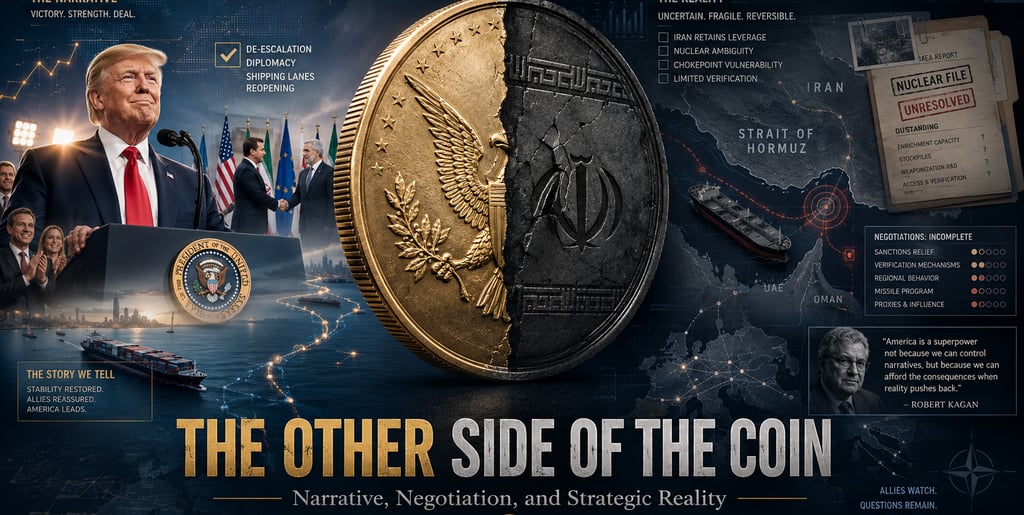
The Other Side of the Coin
Iran, Hormuz, and the Strategic Cost of Calling De-escalation Victory
By Dr Danie Adendorff, DSc
9 June 2026
The present evidence does not yet support a clean victory narrative. It supports a more uncomfortable judgement: the Iran conflict may be moving from open escalation toward managed ambiguity, while the central strategic tests - verified nuclear constraint, normalised Hormuz transit, disciplined sanctions sequencing and allied reassurance - remain unresolved.
That distinction matters.
Narrative asks: how can this be presented?
Strategy asks: what has actually changed?
A ceasefire can be necessary without being triumphant. De-escalation can be prudent without proving strategic success. A temporary pause in fighting can reduce risk while leaving the central contest unresolved. A negotiation can be real without being decisive. A diplomatic framework can be useful without demonstrating that coercive pressure has achieved its stated aims.
This is the other side of the coin in the Iran case.
The strategic question is not whether diplomacy is preferable to a wider regional war. In most circumstances, it is. A wider conflict involving Iran, Israel, the United States, Gulf energy infrastructure, Hezbollah, Iraq, Syria, Lebanon, the Strait of Hormuz and global oil markets would carry severe human, military, economic and political risk. Responsible statecraft should seek to prevent that outcome where possible.
The harder question is whether de-escalation is now being presented as victory because the original coercive strategy has not produced the decisive outcome it promised.
Modern narrative management does not always require a direct falsehood. Its more dangerous form is the selective arrangement of true facts into a misleading strategic impression. Tactical success is highlighted. Strategic objectives are blurred. Ambiguity is called progress. A pause is called control. A negotiation is called victory before its terms have been verified.
That is the analytical danger now surrounding Iran.
De-escalation is not victory.
The dominant political narrative is simple and attractive. The United States and Israel applied pressure. Iran absorbed military damage. Tehran was forced into negotiations. Hormuz may eventually reopen. Oil markets may stabilise. Iran may offer nuclear assurances. Washington may claim that coercive diplomacy worked.
That account may ultimately prove correct. It should not be dismissed merely because it is politically convenient.
But it cannot be accepted merely because political leaders declare it.
Strategic success has to be measured against objectives, not against rhetoric. If the aim was to produce verifiable nuclear rollback, restore uncontested freedom of navigation through Hormuz, reinforce allied confidence, reduce Iranian coercive leverage and impose enforceable limits on future escalation, then the tests remain demanding.
A ceasefire does not answer them. A public statement does not answer them. A provisional deal does not answer them. A market rally does not answer them.
The difference between risk reduction and victory is not semantic. It is strategic.
A state can reduce the immediate probability of war while failing to achieve its stated objectives. A leader can end escalation while losing leverage. A negotiated pause can prevent wider conflict while confirming that coercive pressure has reached its limits. That may still be good policy. But it should be described honestly.
The issue is not diplomacy versus war. The issue is honest accounting.
This is where interim de-escalation deserves serious treatment rather than easy dismissal. In high-risk conflicts, interim arrangements often perform necessary strategic functions. They can prevent miscalculation, reduce pressure on civilians, stabilise energy markets, create negotiation space and prevent a regional war from widening. They may be necessary precisely because maximal objectives are no longer realistically available at acceptable cost.
But necessity is not the same as success. Prudence is not the same as victory. A responsible pause may still reveal that earlier coercive ambitions exceeded what force and diplomacy could jointly deliver.
That is the distinction the public debate must not lose.
Kagan’s warning remains useful, but the evidence must carry the argument.
Robert Kagan’s recent argument deserves attention because it forces this uncomfortable distinction into the open. Kagan is not a neutral observer without a foreign-policy tradition. He is a long-standing American strategic commentator associated with an interventionist outlook. His judgement must therefore be assessed critically, not adopted as doctrine.
Yet it would be intellectually unserious to dismiss the argument merely because it is politically inconvenient.
Kagan’s central warning is that Washington may be trying to convert an inconclusive or deteriorating strategic position into a politically usable victory story. In that interpretation, the United States escalated, accepted regional risk, imposed pressure, and then moved toward a negotiated exit that may leave Iran battered but still strategically relevant, its regime intact, its nuclear file unresolved, its leverage over Hormuz demonstrated, and its bargaining power preserved.
That thesis should not be treated as proven. But it should be treated as a serious analytical hypothesis.
Its value lies in the test it imposes. What was the objective? Was Iran’s nuclear programme materially rolled back? Was the enriched uranium stockpile removed, diluted, transferred or placed under continuous inspection? Was Hormuz restored as an open international maritime passage, or did Iran demonstrate that disruption of the chokepoint can be converted into bargaining power? Were allies reassured, or did they learn that American escalation can be dramatic, personalised and politically reversible?
Kagan’s argument does not settle the case. It defines the questions that must be answered before any claim of victory can be accepted.
The stronger analytical position is therefore not ‘Kagan is right.’ It is this: the outcome has not yet passed the verification tests required to prove Kagan wrong.
The nuclear test: assurance is not verification.
The nuclear issue remains the core of the strategic assessment. Without a verified nuclear outcome, the language of victory is unstable.
The central distinction is between assurance and verification.
An assurance is political. Verification is technical. An assurance tells the public what a government says Iran intends to do. Verification establishes what Iran has actually done, what nuclear material exists, where it is located, whether enrichment has stopped, whether inspectors have access, and whether declared obligations are being met.
Those are not equivalent.
The International Atomic Energy Agency’s February 2026 reporting remains strategically important because it did not merely provide a stockpile estimate. It identified a verification problem. The Agency’s quantified estimate recorded 440.9 kg of uranium enriched up to 60 percent U-235. That enrichment level is far beyond ordinary civilian energy requirements and close enough to weapons-grade enrichment to create acute proliferation concern.
The timeline matters and must be stated precisely.
The loss of access was not a single event. It developed in stages. Following the June 2025 U.S.-Israeli strikes on Iranian nuclear facilities, the IAEA lost access to struck facilities and affected material. Iran nevertheless continued to allow some limited access to unaffected facilities through late 2025 and into early 2026. The more severe threshold came on 28 February 2026, when Iran terminated all IAEA inspector access, disabled cameras, removed seals and evacuated inspectors as the wider conflict escalated.
This concern was reinforced by the IAEA Director General’s 2 March 2026 statement that the Agency had not had access to Iran’s previously declared inventories of low-enriched uranium and high-enriched uranium for more than eight months, making verification long overdue.
That two-stage timeline is analytically important. It shows a progressive ratcheting of access denial rather than a single administrative interruption.
By early June 2026, the central problem remained unresolved. The Agency still could not fully account for the fate, location and condition of Iran’s low- and highly enriched uranium stocks. It had not regained the access required to restore continuity of knowledge. The international community therefore could not simply assume that the material was gone, diluted, transferred or contained.
This is the decisive point. A statement that Iran does not intend to produce a nuclear weapon is not the same as verified stockpile removal. A promise to discuss disposal later is not the same as a binding agreement. A diplomatic formula is not a technical constraint. A ceasefire does not restore IAEA continuity of knowledge.
If the final agreement requires Iran to account for all enriched uranium, permits IAEA access, establishes verified dilution or transfer, sequences relief after compliance, and creates consequences for obstruction, then the agreement may be defensible as coercive diplomacy.
But if nuclear constraints remain vague, deferred or politically worded, then the strategic result will fall far short of victory.
The nuclear test is simple: no verification, no strategic proof.
This does not exclude the possibility that Washington is still using pressure to secure a stronger final nuclear outcome. If the eventual agreement compels Iran to account for its enriched uranium, restores IAEA access, and sequences relief after verified compliance, then the settlement may still qualify as coercive diplomacy rather than managed retreat. But that judgement cannot be made before the verification architecture is visible.
Hormuz: reopening is not automatically restored deterrence.
The Strait of Hormuz is not merely a maritime feature. It is a strategic pressure point. It connects regional conflict to global energy security. It allows Iran to impose costs beyond the battlefield. It gives Tehran a coercive instrument that reaches shipping, insurance, oil prices, Gulf security, U.S. force posture, European energy anxiety and Asian import dependence.
For that reason, reopening Hormuz cannot automatically be interpreted as restored deterrence.
There are two very different possibilities.
In the first, Hormuz reopens because Iran accepts normal international passage, removes restrictions, ceases interference, and loses the ability to condition maritime transit. That would be a meaningful strategic outcome.
In the second, Hormuz reopens because Iran has demonstrated that it can close, restrict, toll, mine, harass or condition passage, and then exchange partial normalisation for sanctions relief, asset access, reduced blockade pressure or nuclear ambiguity. That would not be restored deterrence. It would be successful coercive bargaining.
The distinction matters because the latest reporting does not yet support a clean victory narrative. Hormuz has remained contested. The United States has conducted strikes against Iranian radar, command-and-control and drone-related sites. U.S. forces have continued operating in a hazardous maritime environment. A U.S. Apache helicopter incident near the Strait, with the crew rescued, further illustrated the continuing operational risk, even though the cause remained unclear at the time of reporting.
This is not normal maritime order. It is contested de-escalation.
That does not mean reopening the strait would be meaningless. It would reduce energy risk, reassure shipping markets, lower immediate escalation pressure and provide diplomatic space. But those are risk-reduction effects. They are not, by themselves, proof that Iranian leverage has been broken.
The strategic test is not whether ships eventually move again. The test is whether Iran’s ability to use Hormuz as a bargaining weapon has been reduced, normalised or rewarded.
The emerging pattern: interim management, not decisive settlement.
The evidence increasingly points less toward decisive victory than toward interim management.
That is not automatically a failure. Interim arrangements often perform necessary functions. They can stop escalation, prevent miscalculation, create space for further negotiation, reduce pressure on civilians, stabilise energy markets and give adversaries a path away from direct confrontation.
But an interim arrangement should not be sold as a final strategic solution.
The reported direction appears to involve partial relief, maritime de-escalation, continued nuclear negotiation and an attempt to freeze the conflict below full war. That may be the only politically achievable path in the short term. It may even be the responsible path if further escalation cannot reliably solve the nuclear problem.
But it leaves several unresolved questions.
Will Iran account for its enriched uranium?
Will the IAEA regain sufficient access?
Will sanctions relief be conditional and reversible?
Will Hormuz reopen as a normal international waterway or as a negotiated concession?
Will Israel accept the settlement or retain freedom of action?
Will Hezbollah and Lebanon remain a parallel escalation track?
Will Gulf states regard the outcome as stabilising or as evidence that Iran can extract concessions through pressure?
Will Russia and China read the result as evidence that American coercion can be absorbed and outlasted?
These questions are not marginal. They are the strategic substance of the case.
If an interim deal lowers risk while leaving those questions unresolved, it may be prudent. But it is not yet victory.
Narrative management: how uncertainty becomes triumph.
Strategic narrative management follows a recognisable pattern.
A real tactical success is highlighted while strategic objectives are blurred. The language of strength is used to conceal concessions. Selective leaks allow each side to claim progress. Political media ecosystems convert provisional claims into certainty. Public fatigue is used to bury accountability. Market relief is treated as geopolitical confirmation. Battlefield damage is confused with political success. De-escalation is made to look like dominance.
This pattern is not unique to Donald Trump, nor to the United States. It is a recurring pathology of war politics. Governments prefer victory narratives because publics dislike unresolved endings. Leaders prefer symbolic closure because strategic ambiguity is politically expensive.
This is precisely why strategic analysis must remain disciplined.
The question is not whether Trump, Tehran, Israel or any other actor can produce a persuasive public story. The question is whether the outcome satisfies the strategic tests.
Narrative asks: how can this be presented?
Strategy asks: what has actually changed?
That distinction is the heart of the matter.
Europe, NATO and adversarial learning.
The Iran outcome matters beyond Iran because allies and adversaries will draw lessons from it.
For Europe, the issue is not only whether a U.S.-Iran ceasefire holds. The issue is what the episode reveals about American political steadiness, force allocation, escalation management and alliance reliability. Europe already faces pressure from the war in Ukraine, defence-industrial bottlenecks, rearmament demands, U.S. political volatility and uncertainty over long-term American commitment.
If Washington appears to initiate a high-risk coercive campaign and then politically reframe an inconclusive outcome as victory, European anxiety will increase. That anxiety will not be confined to the Gulf. It will feed directly into debates over Ukraine, NATO burden-sharing, European strategic autonomy, maritime security and the credibility of American guarantees.
The same applies to adversarial learning.
If Iran appears to have absorbed strikes, retained regime cohesion, preserved nuclear ambiguity and converted Hormuz disruption into bargaining leverage, Russia, China and other actors will study the episode carefully. They may conclude that escalation can be absorbed, energy pressure can be exploited, allied divisions can be widened, and U.S. political attention can be tested.
But the China case also complicates the lesson.
China is not merely an observer of the Hormuz crisis. It is an exposed energy importer. Reuters reporting on 1 June 2026 recorded China’s seaborne crude arrivals at 6.36 million barrels per day in May, down from 8.10 million barrels per day in April and the weakest level since October 2016. That means Hormuz disruption carries real economic consequences for Beijing as well as for Western economies.
China’s reading of the episode may therefore be ambivalent. It may study Iran’s use of maritime pressure as a coercive model, but it must also absorb the vulnerability such disruption creates for its own energy security.
This qualification strengthens the analysis. It prevents a simplistic conclusion that all adversaries benefit equally from Hormuz instability. They do not. The same crisis that exposes U.S. and European vulnerability also exposes Asian import dependence.
The broader lesson remains serious. Strategic communication is part of deterrence. If communication becomes detached from outcomes, deterrence suffers. Allies become uncertain. Adversaries become experimental. Neutral states become more cautious. Energy markets become more politically conditioned. The credibility of future coercive diplomacy is weakened when declared success outruns verified achievement.
The serious case for the alternative interpretation.
A balanced assessment must recognise the strongest counterarguments, not merely list them near the end as a formal gesture.
First, interim de-escalation may be strategically necessary. War termination is rarely clean. A ceasefire that prevents wider regional war may be justified even if it does not settle every strategic issue immediately. Avoiding a wider conflict involving Gulf infrastructure, U.S. forces, Israel, Hezbollah and global energy markets may be a valid national-security objective in itself.
Second, reopening Hormuz could still become a genuine achievement. If the strait is reopened without recognising Iranian coercive rights, without tolls or conditions, and without normalising future closure as a bargaining tool, then Washington could claim a meaningful operational success.
Third, sanctions relief is not automatically capitulation. Relief can be an inducement if it is conditional, reversible and sequenced after compliance. The problem is not relief as such. The problem is front-loaded relief without verified strategic return.
Fourth, avoiding escalation is not weakness by definition. A president should not continue military action merely to preserve the appearance of toughness. Strategic strength includes the ability to recognise when force has reached diminishing returns.
These counterarguments are serious. They do not defeat the warning. They define the evidence required to defeat it.
To refute the pessimistic interpretation, the final outcome must show enforceable nuclear terms, credible inspection access, disciplined sanctions sequencing, normalised maritime passage, allied consultation and consequences for non-compliance.
Without those elements, the claim of victory remains narrative rather than strategy.
Intelligence-style assessment.
Kagan’s thesis should be treated as a serious analytical interpretation, not confirmed fact. Source confidence: B2. Kagan is an identifiable and experienced foreign-policy analyst, but his thesis is interpretive and politically charged.
Reuters reporting on negotiations, maritime incidents and regional developments should be treated as high-reliability reporting on current events, but many diplomatic details remain provisional. Source confidence: A2/B2, depending on whether the claim concerns observed events or unnamed-source negotiation detail.
IAEA reporting remains the strongest technical source for safeguards and nuclear-stockpile context. Source confidence: A2. The central caveat is that the Agency itself reports incomplete access and loss of continuity of knowledge.
U.S. administration claims are operationally important but politically interested. Source confidence: B3 for stated position; lower for claims about future compliance or final outcomes.
Iranian official and semi-official claims are important for signalling, bargaining posture and domestic political constraints. Source confidence: C3/B3 depending on corroboration.
Social-media amplification and partisan commentary should remain low-confidence unless independently corroborated. Source confidence: E5/F6.
The discipline is essential. Weak claims should not be treated as established facts. Political interpretation should not be confused with verified evidence. A serious assessment must separate what is confirmed, what is reported, what is inferred and what remains rhetorical positioning.
Concluding judgement.
As of 9 June 2026, the evidence supports a clear but bounded judgement: de-escalation may be under way, but strategic victory has not yet been demonstrated.
The nuclear file remains unresolved because verification has not been restored. Hormuz remains strategically contested because reopening, even if achieved, has not yet been shown to equal restored deterrence. Sanctions relief remains analytically ambiguous because its strategic meaning depends on sequencing, reversibility and compliance. Allied reassurance remains uncertain because the episode has reinforced doubts about U.S. steadiness and escalation discipline. Adversarial learning remains active because Iran’s ability to absorb pressure and retain bargaining leverage will be studied closely, even by states that are themselves vulnerable to energy disruption.
This does not mean the emerging settlement is necessarily a surrender. Nor does it mean continued war would be wiser. A responsible interim arrangement may be preferable to further escalation. But if the outcome is interim, it should be described as interim. If the nuclear issue is deferred, it should be described as deferred. If Hormuz is reopened through bargaining rather than restored freedom of navigation, that distinction should be made explicit. If sanctions relief is granted before verification, the strategic cost should be acknowledged.
The other side of the coin is therefore not pro-Iran, anti-American or anti-Western. It is pro-accountability, pro-evidence and pro-strategic clarity.
The question is not whether political leaders can declare the episode a success. They can. The question is whether the outcome can withstand disciplined strategic audit.
At present, the audit is incomplete.
The correct public judgement is therefore neither triumphalism nor defeatism. It is conditional scrutiny. De-escalation should be welcomed where it reduces risk. Diplomacy should be supported where it produces enforceable results. But victory should be withheld as a judgement until the strategic tests are met.
A war narrative can declare success.
Only verified outcomes can prove it.
Evidence and source note.
This article relies on open-source reporting and analysis available through 9 June 2026. Several claims concern an emerging and contested diplomatic framework and should therefore be treated as provisional. Reuters is used as the primary factual anchor for current reporting on negotiations, maritime incidents, the Strait of Hormuz, oil-market effects and the status of hostilities. IAEA reporting is used for nuclear-stockpile and safeguards context. Brookings and The Atlantic are used to identify Robert Kagan’s analytical thesis, not as proof of its correctness. Official U.S., Iranian and Israeli claims are treated as strategic signalling unless independently corroborated by reporting, inspection data or final agreement text.
Selected references.
• Robert Kagan, “Checkmate in Iran,” The Atlantic, 10 May 2026. [link]
• Robert Kagan, “Trump’s Endgame Is Surrender,” The Atlantic, 21 May 2026. [link]
• Brookings, “Has the US lost the Iran war?”, May 2026. [link]
• Reuters, Samia Nakhoul, “War may end in interim deal that leaves Iran battered but unbowed,” 3 June 2026. [link]
• Reuters, “First IAEA report on Iran’s nuclear programme since February shows little change,” 4 June 2026. [link]
• Reuters, “US struck Iranian drone command sites over the weekend, military says,” 1 June 2026. [link]
• Reuters, “US strikes Iran radar sites after Iranian drone launch,” 5 June 2026. [link]
• Reuters, “Israel kills eight in strike on Lebanon; US rescues helicopter crew from Hormuz,” 9 June 2026. [link]
• Reuters, “Oil falls as investors await clarity after Iran-Israel halt attacks,” 9 June 2026. [link]
• Reuters, Clyde Russell, “China’s crude oil imports slump, but it’s economics not altruism,” 1 June 2026. [link]
• International Atomic Energy Agency, GOV/2026/8, “Verification and monitoring in the Islamic Republic of Iran,” 27 February 2026. [link]
• IAEA Director General, “Introductory Statement to the Board of Governors,” 2 March 2026. [link]
• EU Institute for Security Studies, “Assessing the damage: What the Iran war really means for Europe’s defence,” 2026. [link]
Author workflow disclosure.
This article was produced through an AI-assisted but human-directed workflow. AI support was used for accessibility assistance, structuring, language refinement, source-discovery prompts, revision planning and conversion of editorial comments into amendments. Dr Danie Adendorff retained responsibility for the argument, accepted or rejected changes, checked the logic of claims, assessed source credibility and remained accountable for the final text. AI-generated material was not treated as empirical evidence, and synthetic or illustrative examples were not presented as observed data.


© 2026 WDA Publishing. All rights reserved.