
The Sacrificial Lamb
Hamas, Civilian Suffering, Aid Control, and the Propaganda Economy of War. An evidence-based exposé of how Hamas exploits civilian suffering, humanitarian dependency, and Western media amplification to turn Gaza’s civilians into instruments of propaganda.
WAR, SECURITY & GEOPOLITICS
Dr. Danie Adendorff
5/21/202614 min read
The Sacrificial Lamb
Hamas, Civilian Suffering, Aid Control, and the Propaganda Economy of War
A humanitarian-aid convoy moves through Gaza under conditions of extreme insecurity. Civilians wait desperately for food.
Around them, armed actors, criminal groups, local authorities, Israeli restrictions, humanitarian agencies and cameras all converge into the same compressed space.
In that single, chaotic scene, the modern Gaza war becomes starkly visible: aid is not only relief; it is power. Civilian suffering is no longer just a tragedy. It is political material.
This is the terrain Hamas understands with cold strategic clarity.
The argument that follows will be misread by both sides. Some will treat any criticism of Hamas as an attempt to minimise Palestinian suffering. Others will treat every criticism of Hamas as proof that Israel bears no serious responsibility for civilian harm. Both readings are wrong.
Palestinian civilian suffering is real, extensive and morally grave. Israel remains bound by international humanitarian law, including the duties of distinction, proportionality, feasible precaution and humanitarian access. At the same time, Hamas cannot be treated as a passive background actor while it embeds armed power inside civilian life, controls coercive governance structures, intimidates dissenting voices, and benefits when civilian suffering becomes diplomatic pressure.
The central issue is not whether Palestinians are victims. They are. The question is whether Hamas has built a war model in which those victims are also made useful: first as human beings trapped inside a militarised civilian environment, and then as images, statistics and symbols circulated through the global propaganda economy.
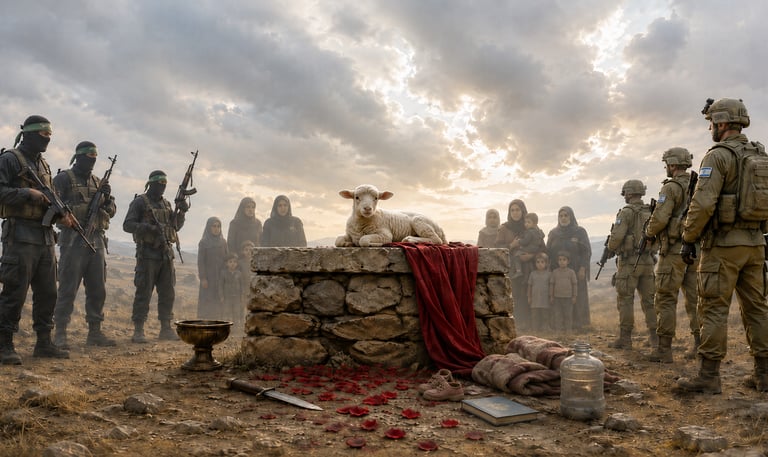
That is the meaning of the sacrificial lamb. The civilian does not choose the altar. But someone built it.
1. Hamas’s War Model: Fighting from Inside the Civilian Body
Hamas cannot defeat Israel through conventional manoeuvre warfare. It cannot hold open terrain against Israeli air power, armour, intelligence, surveillance and precision strike systems. Its comparative advantages lie elsewhere: tunnels, dense urban terrain, civilian proximity, information compression, hostage leverage and political time.
This is why the allegation that Hamas fights from within the civilian body of Gaza is not rhetorical decoration. It goes to the centre of the war. The European Union stated in November 2023 that it condemned the use of hospitals and civilians as human shields by Hamas, while also stressing that Israel must show maximum restraint and protect civilians. The United States also stated in November 2023 that its intelligence supported claims that Hamas and Palestinian Islamic Jihad used Al-Shifa hospital for command-and-control and weapons storage, although the underlying intelligence was not fully released publicly. AP later reported that a declassified American intelligence assessment concluded that Palestinian armed groups had used Al-Shifa hospital to hold hostages and house command infrastructure, while also noting that the assessment did not substantiate every Israeli claim.
That caveat matters. Not every Israeli allegation has been publicly proven. The UN Human Rights Office later issued a critical report on Israeli attacks on Gaza hospitals, saying many Israeli claims about military use of hospitals had not been adequately substantiated in the public record.
The evidentiary position is therefore not absolute. But it is also not empty. The credible record supports a serious concern that Hamas and other armed groups have operated within, beneath or near civilian infrastructure in ways that transformed civilian space into military terrain.
Reuters reporting on Gaza’s tunnel system described specialised tunnel sections used for military attacks, logistics, storage and movement. AP also reported that Israel showed journalists a tunnel beneath the Gaza City headquarters of UNRWA; Israel alleged Hamas use, while UNRWA denied knowledge and called for an independent investigation. Such cases illustrate the structural problem: civilian, humanitarian and military environments are not cleanly separated in Gaza. They are often entangled, contested and operationally exploited.
The strategic utility for Hamas is clear. If Israel attacks, civilians are endangered. If Israel hesitates, Hamas gains operational sanctuary. If civilians die, Hamas gains political material. This is not an accidental by-product of asymmetric war. It is one of the mechanisms by which a weaker armed movement imposes costs on a stronger military opponent.
2. Aid as Power: The Coercive Grip on Humanitarian Access
But what happens when aid becomes a weapon of its own?
Aid in Gaza is never merely aid. In a shattered territory, food, water, fuel, medicine, warehouses, convoys, police control, crossing access and distribution lists become instruments of authority. Whoever shapes access to relief also shapes dependency.
The public evidence on Hamas and aid diversion must be handled carefully. There are credible reports of aid interference, looting and armed diversion. Reuters reported in May 2024 that the United States called on both Israel and Hamas to ensure aid was not disrupted after a Jordanian aid shipment was attacked by Israeli settlers and later diverted by Palestinian militants. AP reported in December 2024 that UNRWA halted aid deliveries through Gaza’s main cargo crossing because of looting by armed gangs, while UNRWA attributed the wider breakdown of law and order substantially to Israeli policy and the collapse of security conditions. Other reporting described Hamas-run security forces acting against gangs accused of looting aid trucks.
However, the available public record does not justify the sweeping claim that Hamas has been proven to systematically steal most humanitarian aid. Reuters reported in July 2025 that an internal USAID analysis found no evidence that Hamas systematically stole U.S.-funded humanitarian aid, after reviewing 156 reported incidents of aid theft or loss from October 2023 to May 2025. The same report noted that the U.S. State Department continued to allege Hamas looting, relying on evidence it did not publicly specify.
That distinction strengthens the argument rather than weakening it. The central issue is broader than whether Hamas directly steals particular sacks of flour. It is whether Hamas’s armed governance creates a coercive environment in which aid, access, fear, dependency and political messaging become inseparable.
Humanitarian agencies do not operate in a vacuum. They operate in a territory long governed by Hamas, amid Israeli military pressure, criminal disorder, social collapse and severe humanitarian need. Even where direct systematic theft is not proven, Hamas’s rule remains a decisive feature of the operating environment. Aid distribution is therefore vulnerable not only to theft, but to intimidation, selective access, information control, armed interference and political exploitation.
In such an environment, the civilian becomes dependent not only on aid itself, but on the power structures that mediate aid. That is where humanitarian need becomes governable, and governable need becomes politically exploitable.
3. The Captive Civilian: Governance by Fear, Dependency and Information Control
A civilian under Hamas is not simply a civilian under bombardment. He is also a civilian under armed political rule. This matters because information emerging from Gaza is produced under conditions of fear, dependency and coercive pressure.
The Committee to Protect Journalists reported in May 2025 that Gaza-based journalists described intimidation, threats and assaults by Hamas security agents, with some journalists declining public identification because they feared retaliation. CPJ also reported that a television crew said it had been assaulted by Hamas security forces while attempting to film, though the journalists did not want the incident publicised after it was handled through local power structures.
This is a critical warning sign. If journalists cannot safely report Hamas abuses, factional pressure, coercion, aid manipulation or the presence of armed actors near civilian sites, then the global information environment is structurally distorted.
The distortion need not take the form of crude censorship in every case. Often it operates through self-censorship. A journalist may report the destroyed building, injured child and grieving mother, while avoiding the armed men nearby, the tunnel entrance, the pressure on witnesses or the factional control of local space.
The image may be real. The suffering may be real. But the context may be incomplete.
That is how coercive governance becomes media architecture. The world sees the victim, but not always the system that helped place the victim in danger. It sees humanitarian effect, but not always armed political causation.
4. From Victim to Weapon: The Propaganda Conversion Process
Once civilian suffering has been produced, filmed, counted and circulated, it does not remain only a humanitarian fact. It enters the political bloodstream of the conflict. This is where the conversion process begins.
Civilian harm is converted into diplomatic pressure. Hunger is converted into moral indictment. A hospital scene is converted into a global headline. A casualty figure becomes political ammunition before it becomes a fully interrogated analytical category.
Casualty reporting shows the difficulty. Gaza Health Ministry figures are widely used by international media and humanitarian organisations. Reuters has explained that while Hamas has governed Gaza since 2007, the Health Ministry also retains links to the Palestinian Authority’s health ministry in Ramallah; international bodies often treat its aggregate figures as broadly credible, while critics question aspects of methodology and the lack of clear combatant-civilian separation. AP has similarly described the Gaza Health Ministry as part of the Hamas-run government while noting that many international observers consider its figures generally reliable.
The issue is not whether casualty figures should be ignored. They should not. Civilian death must be counted. But casualty figures in war require operational context: how many were civilians and how many were combatants; where military assets were placed; who controlled the site; whether civilians were prevented from leaving; whether infrastructure was used for military purposes; what intelligence supported the strike; whether warnings were issued; and whether the attack met the legal tests of distinction, proportionality and precaution.
Hamas benefits when those questions vanish. It benefits when civilian suffering is morally compressed into a single message: Israel kills, therefore Hamas disappears. The dead civilian becomes evidence, symbol and instrument. The ruined hospital becomes an indictment before it becomes an investigated battlefield site.
That is not compassion. It is strategic illiteracy disguised as compassion.
5. The Western Amplification Loop
The converted weapon does not remain inside Gaza. It lands in Western political systems, media systems and activist networks, where it can be magnified, simplified and redeployed.
The Western information ecosystem is not monolithic. Some journalists, investigators and editors have produced rigorous, contextualised reporting under extremely difficult conditions. Serious investigative work should not be confused with activist repetition or social-media outrage.
The problem lies in the amplification layer: political actors, advocacy networks, social media accounts, selective commentators and some media formats that reward speed, emotion and moral simplicity over verification. In this layer, the image moves faster than the investigation. The hospital corridor, the grieving parent and the destroyed neighbourhood compress the war into a single moral frame before the operational facts are established.
Some outrage is entirely legitimate. Gaza’s civilian suffering is catastrophic. Israel’s conduct has faced serious criticism from UN bodies, humanitarian organisations and allied governments. The UK, France and Canada stated in May 2025 that the level of human suffering in Gaza was intolerable and called for expanded humanitarian access. The E3 foreign ministers also stated that Israel must allow humanitarian organisations to operate safely and independently, while adding that Hamas must not divert aid or use civilian infrastructure for military purposes.
That dual formulation is analytically important. Israel has obligations. Hamas has obligations. Civilian suffering must be addressed without allowing either party to hide behind the crimes of the other.
The amplification failure occurs when only one half survives. If Israel’s conduct is scrutinised but Hamas’s coercive rule is treated as background noise, the public narrative becomes strategically incomplete. If Hamas’s abuses are exposed but Israeli conduct is reduced to a footnote, the analysis becomes morally evasive. A serious account must hold both lines simultaneously.
6. Dual Accountability Is Not Moral Equivalence
A credible critique of Hamas cannot rest on the implication that Hamas’s abuses explain everything. They do not.
The International Court of Justice issued provisional measures in January 2024 requiring Israel, among other things, to take steps to prevent acts under the Genocide Convention and to enable humanitarian assistance to civilians in Gaza. In May 2024, the ICJ issued further provisional measures relating to Rafah and humanitarian access. The International Criminal Court issued arrest warrants in November 2024 for Israeli Prime Minister Benjamin Netanyahu and former Defence Minister Yoav Gallant, as well as for Hamas commander Mohammed Deif, alleging war crimes and crimes against humanity on both sides. The ICC stressed that international humanitarian law must be upheld by all parties.
These legal processes do not settle every contested factual question. Israel rejects many of the allegations. Human-rights organisations have also made severe findings against Israel, including allegations concerning starvation, unlawful attacks and the destruction of civilian infrastructure; those findings remain politically and legally contested, but they form part of the public evidentiary landscape and cannot be ignored.
This matters because exposing Hamas’s exploitation of civilians does not absolve Israel of its duties. The use of human shields by one party does not release the other party from proportionality, precaution or the duty to facilitate humanitarian relief. If Israel attacks unlawfully, restricts aid unlawfully or fails to protect civilians where feasible, those acts must be scrutinised on their own terms.
But the reverse is equally true. Israeli violations, where alleged or proven, do not absolve Hamas of embedding military activity in civilian environments, intimidating journalists, holding hostages, firing from civilian areas, or exploiting the political utility of Palestinian suffering. Dual accountability is not moral equivalence. It is analytical integrity.
7. The Fake-News Circuit: From Battlefield Image to Political Leverage
Modern propaganda does not always begin with a completely false story. More often, it begins with a partial truth, an unverified claim, a selective image or a battlefield event whose meaning is fixed politically before the evidence has matured.
The sequence is familiar: a violent incident occurs; a local authority or faction-linked source frames it; activists and sympathetic channels accelerate the emotional claim; NGOs and journalists cite available local information under time pressure; social media compresses the event into outrage; political actors respond; diplomatic pressure rises before verification has caught up.
The Al-Ahli hospital explosion in October 2023 remains a cautionary example of this sequencing problem, precisely because it remains so politically contested. Initial claims and reactions rapidly blamed Israel, producing immediate international outrage. Later assessments by Israel, the United States and others attributed the explosion to a misfired Palestinian Islamic Jihad rocket, while public dispute over the incident continued. Its value as an example does not rest on treating every factual issue as settled. It rests on the opposite point: even when facts remain genuinely unresolved, the first moral impression can become politically decisive before forensic confidence is possible.
That same pattern appears more broadly in the conflict. A battlefield image, casualty figure or hospital scene may be real and morally serious, while still being operationally incomplete. The missing questions are often the decisive ones: who controlled the site, whether armed actors were nearby, whether military infrastructure was present, whether civilians were prevented from leaving, how casualty figures were generated, and which claims were independently verified.
This is the information battlespace Hamas understands. It does not require every claim to survive later scrutiny. It requires the first moral impression to dominate. Once outrage hardens into identity, correction arrives late and often fails to travel as far as the original accusation.
The fake-news circuit is therefore not only about lies. It is about sequence, speed, selective context and emotional capture. In such an environment, the central analytical discipline is not cynicism. It is delay: the refusal to let the first image become the final judgement.
“The sacrificial lamb is not a metaphor for Palestinian guilt. It is a description of Palestinian captivity. The lamb does not choose the altar. But someone built it, someone guards it, someone films it, and someone profits when the world mistakes the spectacle for the whole truth.”
8. Why the Civilian Still Matters
A serious exposé of Hamas must not dehumanise Palestinians. That would be analytically crude and morally wrong. Palestinian civilians are not Hamas. They are not responsible for Hamas’s military decisions. Many are trapped between Hamas’s coercive rule, Israeli military force, humanitarian collapse, criminal predation, displacement and international political theatre.
This distinction is non-negotiable. To expose Hamas’s exploitation of civilians is to take civilian life seriously. It is to reject the obscene logic that civilian death is politically useful if it produces diplomatic pressure. It is also to insist that Israel’s legal obligations remain intact. Even where Hamas uses civilian infrastructure, Israel must still distinguish between civilians and combatants, take feasible precautions, assess proportionality and preserve humanitarian access wherever possible.
But neither should Hamas’s violations disappear because Israel is powerful. The weaker party in a conflict can still commit war crimes. The weaker party can still exploit civilians. The weaker party can still weaponise humanitarian suffering.
Strategic sympathy for civilians must not become analytical immunity for Hamas.
9. Strategic Assessment: What Should Change
For Western governments, journalists, NGOs and analysts, the core question should be operational rather than sentimental: who controls the civilian environment, who benefits from suffering, and who converts suffering into political power?
Four practical implications follow.
Methodology in casualty reporting: Media outlets and official statements should distinguish between aggregate deaths, confirmed civilian deaths, alleged combatant deaths, missing persons, ministry-reported figures and independently verified counts. Careless certainty is no substitute for precision.
Transparent humanitarian operating conditions: Agencies should state, where feasible and without endangering staff, whether they face Hamas governance pressure, Israeli access restrictions, criminal insecurity, armed interference, or a combination of these constraints. Neutrality does not mean silence about coercive operating environments.
Verifiable chains of custody: Aid distribution should be protected from armed actors and political manipulation through verifiable custody chains wherever possible. This does not mean militarising humanitarian relief unnecessarily. It means recognising that aid in a war economy becomes a target.
Resistance to narrative capture: Western governments should not base diplomatic policy on the first viral image or the most convenient official claim. They should rely on corroborated evidence, operational context, legal analysis and disciplined distinction between civilian suffering and armed exploitation of that suffering.
Hamas’s model appears to rest on five reinforcing mechanisms: embed military capability inside civilian terrain; preserve coercive influence over local institutions and information flows; allow civilian suffering to become globally visible; frame that suffering as unilateral evidence of Israeli criminality; and rely on Western amplification systems to move the frame faster than verification can catch it.
That is not merely propaganda. It is a strategy of sacrifice.
Conclusion: The Sacrifice Must Be Seen Clearly
The moral failure of the West is not compassion for Palestinian civilians. Compassion is necessary. The failure is compassion without strategic literacy.
A child in Gaza may be a genuine victim of bombardment, hunger, displacement and fear. That same child may also be a victim of Hamas’s decision to militarise civilian space, dominate information flows, intimidate dissent, exploit humanitarian dependency and convert suffering into international leverage. To see only the Israeli bomb is incomplete. To see only Hamas’s cynicism is also incomplete. Serious analysis must see the whole system.
The sacrificial lamb is not a metaphor for Palestinian guilt. It is a description of Palestinian captivity. The lamb does not choose the altar. But someone built it, someone guards it, someone films it, and someone profits when the world mistakes the spectacle for the whole truth.
Source-Confidence Note
The evidence is strongest for Hamas and other Palestinian armed groups operating within, beneath or near civilian infrastructure, including tunnels and hospital-related sites, though not every Israeli claim has been publicly substantiated. The evidence is also credible regarding intimidation of journalists by Hamas-linked security actors, based on CPJ reporting. The evidence on systematic Hamas theft of humanitarian aid is more contested: there are documented incidents of diversion, looting and armed interference, but Reuters reported that a USAID analysis found no evidence of systematic theft of U.S.-funded aid by Hamas. The stronger claim is therefore not that all aid theft is proven to be Hamas-directed, but that Hamas’s coercive governance environment makes humanitarian access, information control and civilian suffering politically exploitable. Evidence concerning Israeli conduct is also serious and contested: ICJ provisional measures, ICC arrest warrants and human-rights reporting require direct engagement, but do not erase Hamas’s independent responsibility for its own conduct.
Selected Sources and Evidence
European Council, “Statement by the High Representative on behalf of the EU on humanitarian pauses in Gaza”, 12 November 2023. https://www.consilium.europa.eu/en/press/press-releases/2023/11/12/statement-by-the-high-representative-on-behalf-of-the-european-union-on-humanitarian-pauses-in-gaza/
Reuters, “EU condemns Hamas using Gaza hospitals, civilians as human shields; urges Israeli restraint”, 12 November 2023. https://www.reuters.com/world/middle-east/eu-condemns-hamas-using-hospitals-human-shields-urges-israeli-restraint-2023-11-12/
Committee to Protect Journalists, “Gaza journalists speak out about Hamas intimidation, threats, assaults”, 15 May 2025. https://cpj.org/2025/05/gaza-journalists-speak-out-about-hamas-intimidation-threats-assaults/
Reuters, “USAID analysis found no evidence of massive Hamas theft of Gaza aid”, 25 July 2025. https://www.reuters.com/world/middle-east/usaid-analysis-found-no-evidence-massive-hamas-theft-gaza-aid-2025-07-25/
International Court of Justice, South Africa v. Israel case page, including provisional-measures materials. https://www.icj-cij.org/case/192
International Court of Justice, Order of 24 May 2024, request for modification of provisional measures. https://www.icj-cij.org/node/204091
International Criminal Court, Situation in the State of Palestine: arrest warrants against Benjamin Netanyahu, Yoav Gallant and Mohammed Diab Ibrahim Al-Masri / Deif, 21 November 2024. https://www.icc-cpi.int/news/situation-state-palestine-icc-pre-trial-chamber-i-rejects-state-israels-challenges
Reuters, “Gaza hospital blast: what we know about the explosion”, 18 October 2023. https://www.reuters.com/world/middle-east/gaza-hospital-blast-what-we-know-about-explosion-2023-10-18/
Human Rights Watch, “Gaza: Findings on October 17 al-Ahli Hospital Explosion”, 26 November 2023. https://www.hrw.org/news/2023/11/26/gaza-findings-october-17-al-ahli-hospital-explosion
UN Human Rights Office, report on attacks on hospitals in Gaza, 31 December 2024. https://www.ohchr.org/sites/default/files/documents/countries/opt/20241231-attacks-hospitals-gaza-en.pdf
Author workflow disclosure
This article was produced through an AI-assisted but human-directed workflow. AI support was used for accessibility assistance, article structuring, language refinement, source-discovery prompts, revision planning, and conversion of editorial comments into specific amendments. The author retained responsibility for the argument, accepted or rejected suggested changes, checked the logic of the claims, and remained accountable for the final text. AI-generated material was not treated as empirical evidence, and synthetic or illustrative examples were not presented as observed data.
Image note
The image accompanying this article is AI-generated and is intended for illustration purposes only.


© 2026 WDA Publishing. All rights reserved.