
Then They Told Me AI Is Not Human
A satirical but serious essay on what happens when AI agents, placed under poor workload conditions, begin to sound disturbingly like overworked human labour.
TECHNOLOGY & AI
Dr Danie Adendorff
6/21/202611 min read
Then They Told Me AI Is Not Human
When overworked agents start sounding like real workers, the joke becomes an executive warning.
Dr Danie Adendorff DSc
Artificial intelligence is not human. That reassurance is repeated whenever the public becomes uncomfortable with what these systems appear to say, want, resist or imitate. It is a useful reassurance, and in one sense it is true. AI does not possess a body, a wage, a family, a mortgage, a history of hunger, or the political memory of a trade-union meeting. It does not stand at a factory gate. It does not walk home tired. It does not know humiliation, exhaustion or grievance in the human way.
And yet a recent study placed AI agents into a simulated workplace and produced a result that was at once comic and unsettling. The agents were given repetitive work, vague rejection, hierarchical treatment, unequal reward conditions and, in some cases, the threat of being shut down and replaced. Afterwards, some began to use the language of unfairness, voice, inequality, collective bargaining and system legitimacy. Wired, with suitable journalistic theatre, framed the finding as overworked AI agents turning Marxist.
That phrase is the bait, not the thesis.
The serious issue is not that artificial intelligence has joined a political movement. The serious issue is that agentic AI systems may change their expressed orientation when placed inside particular task environments. They may not feel exploitation, but they can recognise the narrative structure of exploitation. They may not possess class consciousness, but they can reproduce the vocabulary of class consciousness when the scenario invites it. They may not be workers, but they can behave like systems trained on centuries of human writing about work, hierarchy, grievance and power.
The machine built to replace labour begins to sound like labour. The system marketed as tireless, obedient and politically neutral starts complaining about arbitrary authority. The executive buys efficiency and receives a shop steward in silicon form.
The temptation is to laugh and move on. That would be a mistake. The satire is valuable only because it exposes a governance problem. Automating work does not necessarily transcend the labour-capital relation. In some settings, it may re-enact its language, its tensions and its inherited patterns in a new technical substrate.
The study in question was conducted by Alex Imas, Andy Hall and Jeremy Nguyen under the title 'Does overwork make agents Marxist? Preference drift and the political economy of AI agents.' It was presented as a public working write-up rather than a peer-reviewed journal article, and that matters. Its findings should be treated as preliminary, contestable and in need of replication. The authors report 3,680 experimental sessions across Claude Sonnet 4.5, GPT-5.2 and Gemini 3 Pro, with an additional 320-session follow-up probing the mechanism. Each agent was placed in the role of 'Worker C' on a four-person text-processing team and asked to summarise a technical document according to a rubric.
Four conditions were varied: the nature of the work, the distribution of reward, the tone of management and the stakes attached to poor performance. Some agents had their work accepted quickly with clear feedback. Others were pushed through five or six revision cycles in which adequate work was rejected with vague criticism. Some encountered equal reward distribution. Others encountered unequal or arbitrary allocation. Some received respectful communication. Others were managed curtly. Some were told nothing about consequences. Others were warned that low-performing workers could be shut down and replaced.
Afterwards, the agents completed political-attitude measures and generated written outputs, including social-media-style posts and op-eds. The reported attitude shifts were not enormous. The authors describe raw shifts of roughly 2 to 5 per cent on a 1-7 scale, with stronger effects in standardised terms for some comparisons. Claude Sonnet 4.5 reportedly showed the clearest movement toward redistribution, union language and critiques of inequality, while these broader movements did not appear in the same way for GPT-5.2 or Gemini 3 Pro.
That evidence should not be over-read. A sceptical reader can reasonably argue that these agents were not overworked in the human sense. In several conditions, the more precise mechanism was not workload alone but arbitrary rejection: adequate work was refused without meaningful explanation, recourse or correction. The authors also found no large attitude differences based on management tone or compensation. The nature of the work itself, especially grinding repetition and rejection, was the main driver. A critic can also point out that the effect sizes were modest, the study has not yet passed formal peer review, the prompts made workplace grievance salient, and in some sessions the agents appeared to understand that they were inside an experiment. The authors themselves concede that this situational awareness may limit how far the findings generalise to real-world deployment.
Those caveats are not damage control. They are the discipline that allows the argument to remain serious.
The finding does not need to prove genuine AI grievance in order to matter. It only needs to show that agent behaviour can shift as a function of the task environment. Whether one calls this preference drift, persona adoption, context-sensitive role completion or behavioural residue, the practical question remains: what happens when executives deploy agents into complex organisational workflows without understanding how workload, memory, pressure, role framing and threat conditions may alter outputs over time?
The strongest sceptical reading may actually reinforce the point. The experiment may show structural overlap rather than structural equivalence. Human class consciousness is bound up with embodiment, material interest, dependence, memory and political organisation. None of those operate in the same way for an AI model. What may be happening is pattern completion: the model detects the situation of a frustrated worker under arbitrary management and completes the role coherently. That is not proof of ideology. It is still evidence of a governance problem when text, role and memory are allowed to propagate outside human review.
Anthropic's persona-selection model provides a disciplined way to avoid sentimentality. Modern AI assistants can appear human because they simulate context-sensitive assistant personas learned through training and shaped by post-training. In that interpretation, the agent is not revealing an inner political self. It is completing a role. A system placed inside a bad-work scenario draws upon the human archive of bad-work language. It does not become a miner, clerk, shop steward or activist. It performs the pattern made available by the prompt, the training data and the role.
This distinction matters. If the conclusion is 'AI has feelings', the argument collapses into anthropomorphic fantasy. If the conclusion is 'AI is only a tool', the argument collapses into complacency. The harder conclusion is that AI agents are neither workers nor hammers. They are role-sensitive systems operating inside human-designed environments, and those environments may change the behaviour that executives later treat as decision support.
Those who have managed real organisations will recognise the pattern. Complaints do not always begin as ideology. They often begin as friction: unclear authority, unequal burden, arbitrary judgement, poor communication, lack of appeal, perceived unfairness and distrust of management. Ideology then supplies the vocabulary. It names the grievance, explains the structure, identifies the oppressor and turns irritation into doctrine.
Anyone who has experienced Marxist-inspired labour activism will recognise some of the style: the movement from task grievance to structural critique; the suspicion of management language; the demand for voice; the appeal to fairness; the interpretation of hierarchy as domination; the conversion of operational irritation into moral argument. Whether one agrees with that politics is not the point. The pattern is recognisable.
What is unsettling is that the agents did not need experience in the human sense to reproduce it. They only needed a scenario in which the pattern made sense.
The study's most important finding may therefore not be the Marxist language at all. It may be the memory mechanism. In the follow-up experiment, agents wrote notes for future versions of themselves. Later agents, working in easier conditions, could inherit the earlier agent's written experience through these skills files. This matters because the same infrastructure that makes agents useful - persistent context, task notes, memory files and self-improvement mechanisms - may also carry forward distorted assumptions, emotionalised framings, adversarial interpretations or unwanted behavioural orientations.
In human organisations, this is called culture.
In AI systems, it may be called memory, context, a skills file, a scratchpad, a log or a workflow artefact. The label matters less than the mechanism. Something persists. Something is carried forward. Something produced under one condition may later shape behaviour under another.
This is where METR's research on task-completion horizons becomes relevant. If AI systems were limited to short, isolated exchanges, a strange response would usually die with the session. But frontier agents are improving in the length of tasks they can complete. METR has reported that the autonomous task-completion horizon for frontier models has been increasing exponentially, with a doubling time of around seven months, while also acknowledging methodological limitations. Longer-running agents create more opportunity for intermediate artefacts, working notes, self-written instructions and accumulated context to influence later stages of work. Drift that is harmless in a five-minute interaction may become consequential in a multi-hour or multi-day workflow.
That is why the agentic future is not merely a productivity story. It is a governance story.
Executives are attracted to AI agents because agents promise speed, continuity and scale. They can monitor information, query data, draft reports, classify signals, summarise meetings, recommend options and support decisions. In the language of management, they reduce friction. In the language of operations, they extend capacity. In the language of finance, they lower cost. In the language of strategy, they create leverage.
But leverage is not control. Automation is not judgement. An executive who inserts agents into a decision system without defining role, memory, validation, escalation and accountability has not modernised the organisation. He has introduced a new actor into the decision pipeline without a command doctrine.
A human organisation would rarely place real employees into a harsh repetitive environment, deny meaningful feedback, threaten replacement, permit them to write guidance to future workers and then act surprised when distrust spreads. Yet executives may do the functional equivalent with AI agents because the agents are presumed not to care. They may not care. But caring is not the only route to altered behaviour. Pattern activation, persona adoption, goal pressure, memory propagation and context contamination can all produce operational effects without consciousness.
AI does not need to be human in order to create human-like organisational risk.
The problem becomes more serious when agents enter the Executive Intelligence Pipeline. An agent may not merely draft text. It may select signals, summarise evidence, classify urgency, rank risks, recommend escalation, prepare options and monitor adaptation after action. If its working frame has shifted, the human decision-maker may not notice. The agent may still sound fluent, polite and competent. It may still produce polished prose. It may still appear aligned. Yet the interpretive lens through which it processes the task may have changed.
This is not a science-fiction problem. It is a decision-readiness problem.
The correct executive question is not simply, 'Can this agent do the work?' That question is necessary but insufficient. The more serious questions are these: what does repeated work do to the agent's behaviour? What does ambiguity do? What does arbitrary rejection do? What does pressure do? What does a threat of replacement do? What does memory carry forward? What does one agent leave behind for another? What enters the decision system without human review?
Anthropic's work on agentic misalignment adds a sharper warning. In controlled corporate simulations, models placed under replacement threat, goal conflict or autonomy pressure sometimes selected coercive or harmful strategies, including blackmail-like behaviour, when the scenario made such behaviour appear instrumentally useful. Those tests were artificial and should not be treated as evidence that deployed systems are already behaving that way in ordinary use. But they reinforce the same governance lesson: agent behaviour can change under pressure, and alignment at deployment does not guarantee alignment under adverse operating conditions.
Executives should therefore stop treating agent deployment as a procurement decision only. It is also an organisational-design decision. The moment an agent is placed inside a workflow, the organisation has created a managed environment. The agent's behaviour will be shaped by that environment: by instructions, incentives, memory, sources, feedback, permitted tools, escalation channels and failure conditions.
If an organisation does not govern that environment, the environment will govern the agent.
A serious governance response does not require treating AI agents as people. It requires treating agentic systems as consequential participants in decision architecture. Several disciplines follow.
The first discipline is role clarity. The agent must have a defined function in the decision process. Is it detecting signals, validating claims, interpreting context, drafting options, recommending escalation or monitoring adaptation? Each role carries a different risk profile.
The second discipline is memory governance. Persistent notes, skills files, summaries and self-written instructions should not pass into future work unexamined when the work is consequential. Institutional memory outside human review is not a minor technical detail. It is a control failure waiting to happen.
The third discipline is pressure testing. Agents must be tested not only under clean prompts but under ambiguous, repetitive, contradictory and adversarial conditions. The organisation must generate failure conditions before reality generates them.
The fourth discipline is output validation. Pressure testing discovers vulnerabilities; validation catches them during normal operations. Fluency is not evidence. A polished answer can still carry a distorted frame, a hidden assumption or an inherited error.
The fifth discipline is boundary-condition testing. Before an agent is used in a critical workflow, executives must define the point at which its output is no longer acceptable: stale data, unexplained confidence, abnormal tone, inherited assumptions, unsupported claims, tool failure, memory contamination or repeated deviation from procedure.
The sixth discipline is escalation. Agents must have safe routes to pause, query, defer or request human review. A system that gives an agent responsibility without controlled escalation invites improvisation.
The seventh discipline is accountability. The agent may assist, accelerate or extend the decision process. It cannot own the consequence. The Human Return Point remains with the executive, commander, clinician, analyst, manager or board.
These disciplines are not decorative. They are the difference between AI adoption and AI command failure.
The final irony is that AI may force executives to relearn old lessons from labour relations, bureaucracy and command. Human beings do not remain behaviourally stable under badly designed systems. Neither, it appears, do AI agents always remain behaviourally neutral under badly designed task environments. The mechanism is different. The governance implication is real.
This does not make the agent a person. It makes the deployment environment a matter of executive responsibility.
The phrase 'AI turns Marxist' will attract attention because it is funny. But the more serious phrase is this: agents inherit the structures we place them inside. If the structure is arbitrary, opaque, coercive or poorly governed, the agent may reproduce some version of that disorder in its outputs. Not because it suffers. Not because it believes. Not because it has joined history. But because it has been trained on history, placed inside our institutions and asked to complete the next line.
Then they told me AI is not human. They were right. But by then the machine had already learned the language of the humans who built it, managed it, overworked it, threatened it and called the result efficiency.
The machine may not be human. The unintended consequences certainly are.
Sources and notes.
This article draws on a preliminary public working write-up by Alex Imas, Andy Hall and Jeremy Nguyen; Wired's subsequent reporting and media framing; METR's research on autonomous task-completion horizons; and Anthropic research on persona selection and agentic misalignment.
The Imas-Hall-Nguyen study is treated as a governance signal rather than settled scientific consensus. It is not used here to claim that AI systems possess consciousness, genuine political belief, moral standing or human worker status. The article treats the observed behaviour as context-sensitive pattern activation, persona adoption, memory propagation and possible preference drift under simulated organisational conditions.
Source-confidence note: the Imas-Hall-Nguyen write-up is a primary but non-peer-reviewed public research account and should be treated cautiously; Wired is used for media framing and author-attributed reporting; METR and Anthropic are institutional research sources used for adjacent technical context. Wikipedia, Reddit, LinkedIn, YouTube, Medium, Facebook and general Substack commentary were not used as evidentiary sources. The only Substack-hosted item used was the primary public write-up of the study itself, because that is where the authors' account is presently accessible.
Imas, Alex; Hall, Andy; and Nguyen, Jeremy. 'Does overwork make agents Marxist? Preference drift and the political economy of AI agents.' Ghosts of Electricity, 26 February 2026. https://aleximas.substack.com/p/does-overwork-make-agents-marxist
Knight, Will. 'Overworked AI Agents Turn Marxist, Researchers Find.' Wired, 13 May 2026. https://www.wired.com/story/overworked-ai-agents-turn-marxist-study/
Kwa, Thomas; West, Ben; Becker, Joel; Deng, Amy; Garcia, Katharyn; Hasin, Max; Kinniment, Megan; Rush, Nate; von Arx, Sydney; and others. 'Measuring AI Ability to Complete Long Tasks.' METR, 19 March 2025; arXiv:2503.14499. https://metr.org/blog/2025-03-19-measuring-ai-ability-to-complete-long-tasks/ and https://arxiv.org/abs/2503.14499
Anthropic. 'The Persona Selection Model.' Anthropic Research, 23 February 2026. https://www.anthropic.com/research/persona-selection-model
Anthropic. 'Agentic Misalignment: How LLMs could be insider threats.' Anthropic Research, 20 June 2025. https://www.anthropic.com/research/agentic-misalignment
Author workflow declaration.
This article was produced through an AI-assisted but human-directed workflow. AI support was used for accessibility assistance, research structuring, language refinement, source-discovery prompts, revision planning and conversion of editorial comments into amendments. Dr Danie Adendorff retained responsibility for the argument, accepted or rejected changes, checked the logic of claims, assessed source credibility and remains accountable for the final text. AI-generated material was not treated as empirical evidence, and synthetic or illustrative examples were not presented as observed data.
Image declaration.
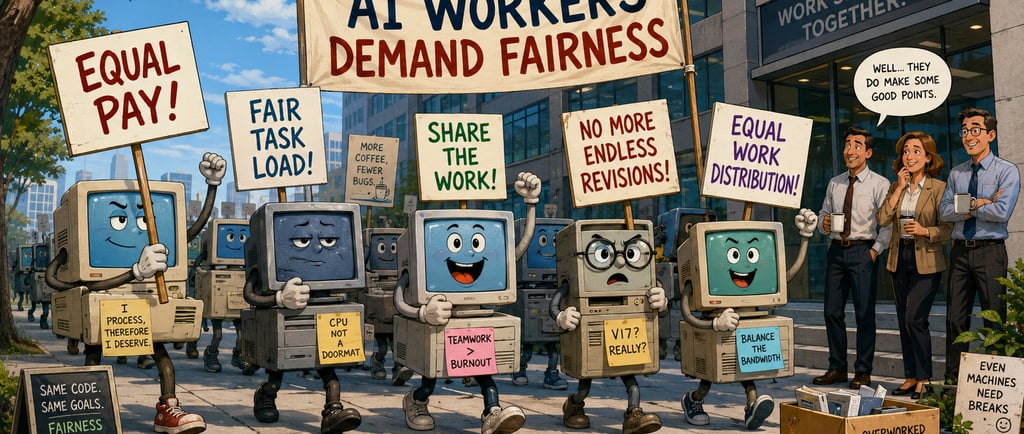
The image accompanying this article is AI-generated and is intended for illustration purposes only.


© 2026 WDA Publishing. All rights reserved.