
Turkey’s Defence-Industrial Rise: From NATO Customer to Strategic Manufacturer
How Ankara is turning drones, ships, missiles and aerospace ambition into geopolitical leverage
WAR, SECURITY & GEOPOLITICS
Dr Danie Adendorff
5/26/20265 min read
Turkey’s Defence-Industrial Rise: From NATO Customer to Strategic Manufacturer
How Ankara is turning drones, ships, missiles and aerospace ambition into geopolitical leverage
Opening argument
Turkey’s defence-industrial rise is no longer a marginal story. It is one of the most important shifts in the middle tier of global military power. For decades, Turkey was viewed primarily as a large NATO military with substantial manpower, a strategic location and significant dependence on Western equipment. That picture is changing. Ankara is now building an increasingly broad defence-manufacturing base: drones, armoured vehicles, naval platforms, missiles, electronic systems, air-defence components and an indigenous combat-aircraft programme. The result is not yet a fully self-sufficient military-industrial power, but it is already more than a regional supplier.
Turkey’s strategic motivation
The central driver is strategic autonomy. Turkey’s experience with arms embargoes, technology restrictions and political friction with Western allies has reinforced a long-standing lesson: a state that cannot produce critical military systems remains vulnerable to external pressure. The S-400 crisis and Turkey’s removal from the F-35 programme became a defining moment. Reuters has reported that Washington removed Turkey from the F-35 programme and imposed sanctions over Ankara’s Russian S-400 acquisition, a dispute that still affects US-Turkish defence relations.
Turkey’s response has not been withdrawal from NATO, but selective independence inside NATO. It wants Western aircraft, access to advanced engines and cooperation with allied industries, while simultaneously building sovereign capacity. Reuters reported in 2025 that Turkey was pressing for Eurofighters, F-16s and possible F-35 re-entry to restore its air-power position, while continuing the indigenous KAAN fighter programme.
What Turkey is building
The most visible symbol of Turkey’s defence rise is the drone sector. Baykar’s TB2 became globally recognised after operational exposure in Syria, Libya, Nagorno-Karabakh and Ukraine. Its importance was not that it proved drones are invincible; they are not. Its importance was that it demonstrated the market value of affordable, exportable, combat-proven unmanned systems. The Atlantic Council has argued that Turkish drone warfare gave Ankara a new defence-diplomacy instrument and positioned Turkey as a significant drone-exporting power inside the transatlantic alliance.
The drone story now extends beyond TB2. Turkey is developing heavier and more complex systems such as Akıncı, Anka, TB3 and Kızılelma. These platforms indicate a shift from tactical strike drones toward a wider unmanned ecosystem: surveillance, precision strike, maritime aviation, loyal-wingman concepts and unmanned combat aircraft. This does not mean Turkey has solved every technical problem. Advanced engines, high-end sensors, jet propulsion and secure supply chains remain serious constraints. But it does mean Turkish industry is moving from platform production toward system architecture.
The industrial base is now broad enough to matter. Baykar dominates the international drone narrative, but Turkey’s defence sector is not a one-company story. Turkish Aerospace Industries, ASELSAN, ROKETSAN, HAVELSAN, STM, Otokar, BMC and others form a more diversified ecosystem covering aerospace, electronics, missiles, naval systems, vehicles and command-and-control. Defence News reported that Turkey’s defence exports reached a record $7.1 billion in 2024, up from $5.5 billion in 2023, and that the sector’s global footprint extended to 180 countries. Anadolu Agency, citing the head of Turkey’s Defence Industries Secretariat, later reported that defence and aviation exports reached about $10.05 billion in 2025, a 48% year-on-year rise.
Naval production is another underappreciated part of the story. Turkey is exporting corvettes, fleet-support ships and naval systems while developing a more ambitious maritime posture. IISS noted that Turkish defence firms were gaining success in Europe, including armoured-vehicle and naval contracts signed in 2024. This matters because European procurement is a different credibility test from sales to fragile states. If Turkish companies can win NATO and European contracts, their reputation shifts from low-cost alternative to credible industrial partner.
Turkey is also investing in integrated air defence. Reuters reported that Turkish firms signed contracts worth $6.5 billion to reinforce the “Steel Dome” air-defence system, described as a multi-layered architecture involving radars, missiles, sensors and command centres. This is strategically important because drone success alone does not make a modern military-industrial power. The harder test is integration: sensors, command networks, air defence, electronic warfare, munitions, space support and resilient production.
Why Turkish defence exports matter
The export appeal is clear. Many states want systems that are available, relatively affordable, combat-tested and less politically restrictive than Western alternatives. Turkish equipment offers middle powers and smaller militaries a way to acquire useful capabilities without entering the most constrained Western procurement channels. In Africa, the Middle East, Central Asia and parts of Asia, Turkish defence exports also serve diplomatic purposes. They create training links, maintenance dependencies, political relationships and military familiarity.
NATO and geopolitical implications
For NATO, Turkey is both an asset and a complication. It strengthens the alliance by expanding industrial capacity, providing Black Sea experience, supporting Ukraine in some areas, and offering a serious non-US manufacturing base. But it also complicates cohesion through independent dealings with Russia, disagreements with allies, and the use of defence exports as an autonomous foreign-policy instrument. Turkey is not simply becoming “anti-Western”; that is too crude. It is becoming more transactional, more sovereign-minded and more willing to operate between blocs.
Limitations and risks
The balanced judgement is this: Turkey has become a serious rising defence-industrial power, but not yet a fully autonomous great-power manufacturer. Its achievements in drones, naval systems, missiles, electronics and export growth are genuine. Its weaknesses are also real: advanced propulsion, high-end fighter technology, complex sensors, macroeconomic stress, inflation, imported components and political risk. The KAAN fighter’s first flight was an important milestone, but Reuters noted that early aircraft use General Electric F-110 engines, with domestic engines expected later. That distinction matters.
Conclusion
Turkey’s rise should therefore be understood neither as propaganda nor as illusion. It is a structural shift: a major NATO state is converting geopolitical frustration into industrial strategy. The future test will not be whether Turkey can produce impressive individual systems. It already can. The harder question is whether it can sustain quality, scale, integration, export support and technological depth across decades. If it can, Turkey will become one of the defining defence-industrial powers of the twenty-first century’s middle-power order.
Source note
Main sources consulted include Reuters, Defense News, IISS, Atlantic Council, Anadolu Agency, AP, SIPRI-related reporting, and Turkish defence-industry reporting. The analysis avoids Wikipedia and treats official Turkish claims as useful but requiring independent caution.
Selected online source links
• Reuters — Turkey and the F-35/F-16/Eurofighter issue
• Reuters — KAAN fighter first flight coverage
• Reuters — Steel Dome air-defence reporting
• Defense News — Turkey defence exports record reporting
• IISS — Turkey’s defence industry and European growth
• Atlantic Council — Turkish drone warfare analysis
• Anadolu Agency — Turkish defence and aviation export figures
Author workflow disclosure
This article was produced through an AI-assisted but human-directed workflow. AI support was used for accessibility assistance, article structuring, language refinement, source-discovery prompts, revision planning, and conversion of editorial comments into specific amendments. The author retained responsibility for the argument, accepted or rejected suggested changes, checked the logic of the claims, and remained accountable for the final text. AI-generated material was not treated as empirical evidence, and synthetic or illustrative examples were not presented as observed data.
Image note
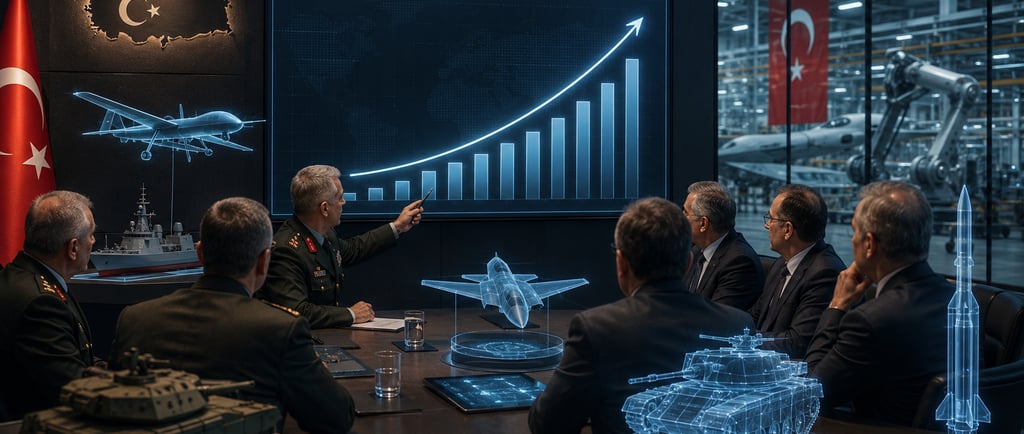
The image accompanying this article is AI-generated and is intended for illustration purposes only.


© 2026 WDA Publishing. All rights reserved.