
When Climate Becomes Law: Why I Oppose Coercive Climate Legalism
Opinion Piece
POLITICS & SOCIETY
Dr D Adendorff
5/16/20266 min read
When Climate Becomes Law: Why I Oppose Coercive Climate Legalism
By Dr Danie Adendorff
I do not oppose environmental responsibility. I do not oppose cleaner air, resilient infrastructure, better energy systems, or practical measures to protect communities from flood, drought, heat, coastal erosion, and extreme weather. Any serious society should manage environmental risk intelligently.
What I oppose is something different: the conversion of climate policy into an expanding legal architecture of coercion, liability, financial transfer, bureaucratic control, and judicial activism.
That is why the recent Verfassungsblog article on Vanuatu, the International Court of Justice, and the proposed UN General Assembly resolution deserves close attention. The article argues that the ICJ’s climate advisory opinion has changed the legal landscape. It presents climate obligations as increasingly legal, substantive, and enforceable, and explains how Vanuatu’s resolution seeks to turn the advisory opinion into an ongoing institutional process inside the UN system. The article also notes that domestic and regional courts are already beginning to use the ICJ opinion as interpretive guidance in climate litigation.
That is precisely where the debate begins.
The climate-law argument says: the science has established the seriousness of the problem; therefore, law must now compel action.
My counter-argument is narrower and more cautious: science may justify prudent policy, adaptation, innovation, cleaner technology, and better risk management. It does not automatically justify open-ended legal authority over states, industries, investors, households, farmers, transport systems, energy systems, and national development choices.
This distinction is essential.
The IPCC states clearly that human activities, principally through greenhouse-gas emissions, have caused global warming. I do not need to deny that conclusion in order to question the legal and political machinery now being built around it. The real issue is not whether climate risk exists. The issue is whether complex, probabilistic, long-range environmental risk should be converted into coercive legal mechanisms without strict tests of proportionality, causation, democratic consent, economic cost, and institutional accountability.
Courts are not laboratories. Judges are not climate modellers. International institutions are not neutral machines. NGOs, governments, corporations, development banks, legal campaigners, insurers, investors, energy firms, and activist networks all operate with incentives. Some incentives are noble. Some are commercial. Some are ideological. Some are bureaucratic. None should be exempt from scrutiny.
This is why I am sceptical of climate legalism.
I am not arguing against law itself. Law has a legitimate role in pollution control, environmental protection, land-use regulation, infrastructure standards, disaster preparedness, energy security, and public accountability. But when law moves from regulating specific harms to assigning global historical responsibility for planetary outcomes, the evidentiary and democratic burden must become much higher.
The Verfassungsblog article welcomes the fact that climate law is being built through accumulation: ICJ advisory opinions, General Assembly resolutions, domestic litigation, human-rights arguments, regional courts, and coalitions of willing states. Its authors regard this accumulation as necessary because conventional multilateral politics moves too slowly.
I see the same development differently.
Legal accumulation can become law-making without ordinary democratic restraint. An advisory opinion becomes interpretive authority. Interpretive authority becomes litigation strategy. Litigation strategy becomes pressure on governments. Pressure becomes policy. Policy becomes obligation. Obligation becomes enforcement.
At each stage, the public may be told that nothing new is being created. Yet the practical effect is cumulative: more constraints, more liability, more compliance systems, more reporting requirements, more financial transfers, and more authority moving from elected institutions toward courts, agencies, expert bodies, and transnational legal networks.
That should concern anyone who cares about democratic government.
There is also a financial dimension that must be treated honestly. Climate policy is now a major global financial ecosystem. It includes climate finance, carbon markets, ESG compliance, green bonds, transition finance, consultancy, certification, litigation, adaptation funds, loss-and-damage mechanisms, and large NGO and quasi-governmental networks. The OECD reported that developed countries provided and mobilised USD 115.9 billion in climate finance in 2022, exceeding the long-standing USD 100 billion annual target two years later than originally promised. The UN climate process has also created a fund for responding to loss and damage associated with the adverse effects of climate change, including extreme weather events and slow-onset events.
Some of this may be justified. Vulnerable countries do face real exposure. Poor communities often suffer most from environmental disruption. Adaptation finance can be legitimate and necessary.
But financial scale creates incentives. That is not a conspiracy theory; it is institutional realism.
The same scrutiny must apply on all sides. Fossil-fuel producers, renewable-energy firms, carbon-market operators, legal NGOs, consultancies, charities, development agencies, insurers, investment funds, and governments all have interests. Any credible climate-policy debate must examine all of them. It is not intellectually honest to treat fossil-fuel interests as suspect while treating climate-finance interests as automatically virtuous.
My objection, therefore, is not that climate finance exists. My objection is that financial and legal systems can grow around climate policy in ways that reward complexity, litigation, compliance dependency, and perpetual crisis framing.
Once harm becomes legally compensable at planetary scale, the number of actors with an interest in expanding the definition of harm also grows. That does not make every claim false. It does mean the system requires disciplined scepticism.
The strongest version of my argument is this: climate policy should be practical, accountable, proportionate, technically realistic, and democratically authorised. It should not become a permanent emergency mandate, nor should it allow courts or transnational legal networks to impose policy choices that properly belong to elected legislatures.
Nor should climate law treat every industrial activity, energy decision, agricultural practice, or infrastructure project as presumptively suspect unless it satisfies an expanding climate-law test. The danger is not environmental regulation itself. The danger is a legal culture in which aspiration becomes obligation, uncertainty becomes liability, and complex trade-offs are reduced to moral binaries.
The alternative is not inaction. It is disciplined action.
We should invest in adaptation. We should strengthen flood defences, water systems, energy grids, ports, transport networks, emergency planning, and food resilience. We should reduce genuine pollution. We should support technological innovation, including nuclear power, grid modernisation, storage, cleaner industrial processes, and credible low-emission energy. We should protect forests, rivers, coastlines, and biodiversity where policy can produce measurable results. We should assist vulnerable communities through transparent, audited, outcome-based mechanisms.
Every climate law should therefore be judged by a disciplined public-interest test. The first question is whether the law addresses a clearly defined problem, rather than a broad moral aspiration. A law aimed at flood resilience, grid stability, water security, coastal protection, pollution reduction, or emergency preparedness can be assessed against concrete outcomes. By contrast, a law framed around expansive and abstract climate responsibility risks becoming elastic: it can justify almost any intervention because its objective is never precisely bounded.
The second test is evidentiary. The evidence must be specific enough to justify the legal burden being imposed. General climate risk may justify strategic planning, but coercive law requires a closer connection between the harm identified, the actor being regulated, the measure imposed, and the expected benefit. Without that connection, law becomes symbolic rather than effective. It may satisfy political pressure while failing to produce measurable resilience.
The third test is economic honesty. Climate law must state openly who pays, who benefits, and what trade-offs are being imposed. Costs do not disappear because they are described in moral language. They move through energy prices, food prices, transport costs, taxation, compliance burdens, insurance premiums, business closures, and reduced development choices. A serious law must account for those consequences before it claims public virtue.
The fourth test is accountability. If a climate law fails, if it increases costs without improving resilience, if it enriches intermediaries while weakening citizens, or if it transfers authority away from elected institutions, someone must be answerable. Policy failure cannot be hidden behind the language of emergency, science, or international obligation.
Finally, climate law must preserve democratic choice. Courts, expert bodies, NGOs, financial institutions, and international agencies may advise, warn, litigate, and advocate. They should not quietly become the principal authors of domestic economic and social policy. The legitimacy of climate law depends not only on the seriousness of the risk, but on the authority of those who impose the remedy.
That is the standard I would apply: defined purpose, specific evidence, honest costs, clear accountability, measurable resilience, and democratic legitimacy.
The climate system is complex. Human activity influences it. Risk exists. Action is justified. But complexity should make lawmakers more careful, not more coercive. Scientific evidence should inform law; it should not become a blank cheque for legal expansion, financial engineering, or bureaucratic control.
The Verfassungsblog article is right in one respect: once the lawyers move in, the problem is serious.
But I would add a warning of my own.
Once lawyers, courts, funds, NGOs, financial institutions, and international bodies begin converting climate risk into enforceable obligations, compensation claims, and institutional mandates, the public must ask a second question: who now governs whom, by what authority, on what evidence, and at what cost?
That is where I draw the line.
Author workflow disclosure
This article was produced through an AI-assisted but human-directed workflow. AI support was used for accessibility assistance, article structuring, language refinement, source-discovery prompts, revision planning, and conversion of editorial comments into specific amendments. The author retained responsibility for the argument, accepted or rejected suggested changes, checked the logic of the claims, and remained accountable for the final text. AI-generated material was not treated as empirical evidence, and synthetic or illustrative examples were not presented as observed data.
Image note
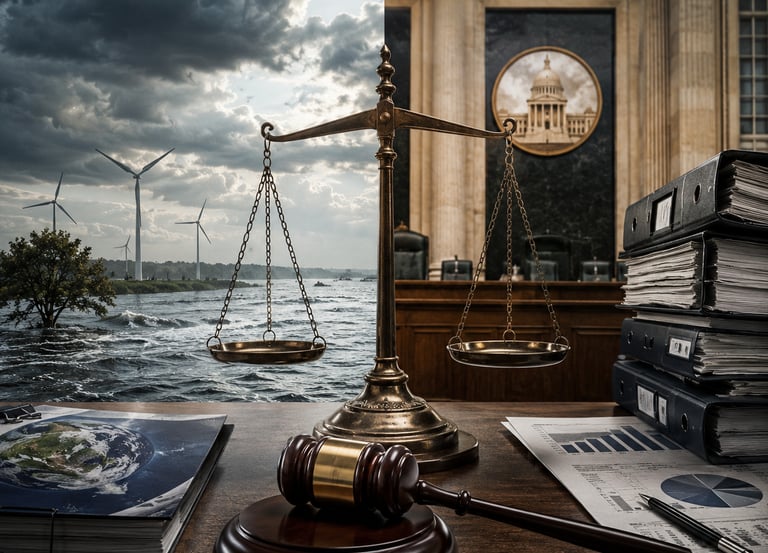
The image accompanying this article is AI-generated and is intended for illustration purposes only.


© 2026 WDA Publishing. All rights reserved.