
When Context Captures Scripture
Theology, Race, Revolution and the Political Use of the Bible
POLITICS & SOCIETY
Dr Danie Adendorff
6/10/202618 min read

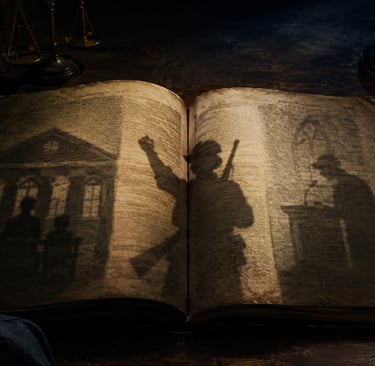
When Context Captures Scripture: Theology, Race, Revolution and the Political Use of the Bible
By Dr Danie Adendorff
The Bible verse as weapon.
You can link almost any agenda to a Bible verse if you remove the verse from its moral, historical, textual, and theological discipline.
That is the uncomfortable truth at the centre of this essay. The Bible has been used to comfort the grieving, guide the humble, restrain the violent, awaken conscience, call nations to repentance, and remind human beings that power is never ultimate. But the same Bible has also been recruited into causes that did not want to be judged by it. It has been quoted by slaveholders and abolitionists, segregationists and integrationists, revolutionaries and conservatives, nationalists and internationalists, rulers and rebels.
The problem is not Scripture. The problem is the ideological user of Scripture.
A biblical text can be quoted accurately and still be used dishonestly. A verse can be true in isolation and false in deployment. A theological argument can sound orthodox while serving an immoral structure. Scripture becomes vulnerable to abuse when its wider witness is silenced and selected fragments are forced to serve a cause already chosen.
This is what I call Context-Captured Theology.
What I mean by Context-Captured Theology.
Contextual theology is not automatically corrupt. In formal theological language, contextual theology recognises that theology is done in a concrete setting. Human beings read from somewhere. They read from a language, a history, a culture, a trauma, a class position, a political order, a church tradition, and a social struggle. No reader floats above history.
Stephen B. Bevans’s models of contextual theology describe several legitimate ways in which gospel, church, culture, social location, and praxis interact. Juan Luis Segundo’s hermeneutic circle likewise insists that theology often begins with a real historical question, moves to Scripture, and returns to praxis with renewed judgement. These are not the enemy of theology; they are serious attempts to make theology accountable to lived reality. [7][8]
Nor is the problem simply proof-texting, although proof-texting is often one of its tools. Nor is it merely eisegesis, the act of reading one’s assumptions into a text. Nor is it identical with ideological criticism in biblical studies, which analyses how social interests shape interpretation. Context-Captured Theology names something more specific and operational: the moment when context ceases to be an interpretive location and becomes the controlling authority over Scripture.
Context-Captured Theology is theology in which biblical texts are selectively interpreted, distorted, or weaponised to provide moral legitimacy for a prior ideological agenda, whether racial, revolutionary, nationalist, class-based, imperial, liberationist, sectarian, or personal.
In disciplined theology, the text is allowed to resist us. It can contradict our tribe, disturb our class, judge our nation, expose our grievance, limit our revolution, and call our own side to repentance. In context-captured theology, the opposite happens. The ideology writes the conclusion first; biblical texts are then searched for usable support.
Disciplined theology asks: What does the text say? What did it mean in its original setting? What does the wider canon permit? What are the moral limits of interpretation? What fruit does this reading produce? Does it judge my own side as well as my enemy?
Context-captured theology asks different questions: How can I make this text support my racial order, my revolution, my national destiny, my political party, my class struggle, or my grievance? How can I use sacred language to make my cause appear beyond moral challenge?
That is where Scripture becomes ammunition.
How Scripture is captured: three close readings.
Context-captured theology can be seen most clearly when particular biblical texts are lifted from their literary, historical, and canonical discipline. Three examples are especially important because they recur in the theological controversies discussed below: Genesis 9 and 11, Exodus 1-15, and Romans 13.
Genesis 9 and 11: from human failure to racial architecture.
Segregationist theology repeatedly returned to Genesis. Two episodes were especially vulnerable to misuse: the curse associated with Noah’s family in Genesis 9 and the scattering at Babel in Genesis 11. Both could be turned into racial architecture if severed from the text’s own limits and from the wider biblical witness. Walter Brueggemann’s Genesis commentary is useful here because it treats Genesis not as a racial taxonomy but as theological narration about creation, vocation, promise, disorder, and divine initiative. [3][4]
In the so-called “curse of Ham” reading, the first major distortion is elementary: Genesis 9 does not curse Ham as a race, nor does it identify Black people, Africans, or any modern racial category. The curse falls on Canaan. That point matters because the later racial use of the text required a substitution: Canaan had to become Ham, Ham had to become Africa, and Africa had to become a permanent racial destiny. None of those moves is demanded by the text. [3][4]
What is excised? The actual object of the curse. What is suppressed? The absence of any reference to skin colour or permanent racial hierarchy. What is ignored? The wider biblical witness that rebukes oppression, man-stealing, partiality, and the denial of neighbour-love. A captured reading turns a family episode in primeval narrative into a racial constitution.
The Babel story is similarly captured when it is converted into a divine charter for segregation. Genesis 11 describes human pride, imperial concentration, linguistic confusion, and scattering. It is not a clean mandate for racial separation, still less for white supremacy. The problem at Babel is not that human beings live too closely across racial lines; it is that they seek concentrated autonomy, self-exaltation, and security apart from God.
The wider canon complicates any racial-separatist reading. Pentecost in Acts 2 does not erase language and peoplehood, but it reverses Babel’s alienation by making speech intelligible across difference. The Christian trajectory is not racial fusion by coercion, but neither is it sacred segregation. It is reconciled intelligibility under the judgement and mercy of God. [3]
Exodus 1-15: liberation without a blank cheque.
Exodus is the great biblical narrative of liberation from oppression. Pharaoh enslaves, controls, kills, and fears the demographic growth of the oppressed. God hears the cry of the enslaved, calls Moses, confronts imperial power, and leads Israel out of bondage. No serious Christian theology can ignore the liberating force of Exodus. Brevard Childs’s Exodus commentary is particularly important because it reads Exodus in its final canonical form, where deliverance, covenant, worship, law, and wilderness testing belong together. [3][5]
But Exodus can also be captured. The capture occurs when “we are Israel” and “our enemy is Pharaoh” become automatic, total, and self-exempting claims. The oppressed are then treated as permanently innocent, their leaders as unquestionable, and their political programme as the direct continuation of divine deliverance.
What is excised? The fact that liberation in Exodus leads to covenant, law, worship, and moral discipline. What is suppressed? The wilderness narratives in which the liberated people themselves become disobedient, fearful, idolatrous, and unjust. What is ignored? The prophetic tradition in which God repeatedly judges Israel after liberation. Exodus is not a blank cheque for any movement that names itself oppressed.
A disciplined Exodus theology therefore says: God hears the oppressed, confronts tyranny, and acts for liberation. But it also says: the liberated people remain accountable. Liberation is not merely a transfer of power from Pharaoh to the formerly oppressed. It is entry into judgement, covenant, and responsibility.
Romans 13: order without idolatry.
Romans 13 has often been the refuge of state-aligned theology. “Be subject to the governing authorities” becomes the isolated command; obedience becomes absolute; resistance becomes rebellion against God; and the state becomes shielded from prophetic judgement. This was precisely the kind of use attacked by the Kairos Document in relation to apartheid State Theology. James D. G. Dunn’s Romans commentary and wider Pauline scholarship help here by placing Romans 13 inside the argument of Romans rather than treating it as an autonomous political constitution. [6][9]
The capture of Romans 13 happens by isolation. Romans 13 is separated from Romans 12, where Paul commands non-retaliation, enemy-love, and overcoming evil with good. It is separated from the historical reality of the Roman Empire, which was not a neutral liberal state. It is separated from Acts 5, where obedience to God can require disobedience to human authorities. It is separated from Revelation 13, where imperial power becomes beastly, idolatrous, and hostile to the saints. [3][6]
What is excised? The conditional moral purpose of authority as servant of good rather than terror to the innocent. What is suppressed? The possibility that a regime can become so systematically unjust that its claim to serve good collapses. What is ignored? The wider canonical tension between honouring order and resisting idolatrous power.
But Romans 13 can also be captured in the opposite direction if every state is treated as illegitimate and every resistance movement as holy. The disciplined reading is neither statist absolutism nor revolutionary absolutism. It recognises authority as accountable under God, order as limited by justice, and resistance as morally serious rather than automatically sanctified.
1957: When segregation quoted Scripture.
The first historical case is Herman L. Hoeh’s “The Race Question,” published in The Plain Truth in April 1957. The Plain Truth was the magazine of Herbert W. Armstrong’s Radio Church of God. The article appeared in the aftermath of Brown v. Board of Education, the 1954 United States Supreme Court decision that declared racial segregation in public schools unconstitutional. [1][2]
Hoeh’s article is explicitly concerned with race, segregation, integration, and interracial marriage. Its opening questions ask why different races exist, whether racial intermarriage is wrong, whether segregation is biblical, and what should be done about integration. It condemns “discrimination” in the abstract but then defends “segregation” as supposedly biblical. That distinction is the moral mechanism of the argument. [1]
The document’s logic is revealing. It does not simply say that racial hostility is acceptable. It does something more sophisticated. It says that discrimination is wrong, but separation is right. In this way, it condemns visible cruelty while preserving the structure beneath it. It treats segregation not as a system of domination but as divine order.
The author had already accepted segregation as the desired conclusion. He then constructed a biblical, historical, anti-communist, and pseudo-scientific framework to sanctify that conclusion. The text links integration to political manipulation, civil-rights pressure to communist strategy, racial separation to Babel, and interracial marriage to divine disobedience. This is not disciplined theology. It is ideology wearing theological clothing.
The key point is not merely that the document is old. The date matters, but it does not excuse the argument. In 1957, the American racial order was under intense legal and moral pressure. School desegregation threatened a long-standing structure of white social control. The theological purpose of the article was to reassure white religious readers that resistance to integration was not merely social preference; it could be understood as obedience to God.
That is the work of context-captured theology. It gives moral cover to an existing order by translating social fear into biblical necessity.
In white supremacist or segregationist theology, Black people were often dehumanised, biologically essentialised, paternalised, or placed in a divinely inferior social position. The language varied. The mechanism remained constant. Scripture was not allowed to interrogate racial hierarchy. Scripture was made to serve it.
The 1970s: When liberation became revolution.
The second case belongs to a different moral landscape: Latin America in the 1970s, especially Nicaragua and the Sandinista revolutionary moment. Unlike the 1957 case and the Kairos case, this is not anchored in one official ecclesial manifesto. It is therefore best treated as an illustrative case rather than an evidentially identical case. Its documentary anchor is Ernesto Cardenal’s The Gospel in Solentiname, a record of Gospel conversations among peasants in the Solentiname community. [12][13]
Liberation theology emerged from real suffering: poverty, dictatorship, exploitation, inequality, and political violence. It insisted that Christian theology could not remain indifferent to the poor and oppressed. That claim cannot be dismissed lightly. Any theology that is blind to suffering has already lost moral seriousness.
Cardenal’s Solentiname conversations show both the strength and danger of this reading practice. Their strength is that the Gospel is read among the poor rather than merely about the poor. The campesinos hear Jesus’ words in relation to hunger, injustice, land, exploitation, and the political order under which they live. That is not automatically capture; it is context speaking to Scripture and Scripture speaking back to context.
The danger appears when the Kingdom of God is read so directly through revolutionary expectation that the distance between discipleship and political revolution narrows too far. In one Solentiname discussion on the Gospel teaching about the kingdom of God, the contrast is drawn between the kingdom as equality and brotherhood and the existing system of rich and poor; the conclusion is that society must change for the kingdom to exist. [12]
This is a serious theological move. It can awaken conscience against injustice. But it can also absorb eschatological hope into political transformation, especially when the surrounding revolutionary environment already offers a movement, a party, a strategy, and an armed struggle.
This does not mean all liberation theology was Marxist. Nor does it mean every Christian who opposed dictatorship was a guerrilla theologian. Many Christians who embraced liberation theology did so because they saw poverty, repression, and structural injustice as incompatible with the Gospel.
The problem is more precise. Some radicalised forms of liberation theology risked turning Jesus into a revolutionary emblem rather than allowing Him to remain the judge of every revolution. In such readings, the poor can become the exclusive bearer of theological truth, the revolution can become salvific, and the guerrilla fighter can be imagined as the modern disciple.
In Nicaragua, the Sandinista National Liberation Front emerged as a left-wing revolutionary movement opposed to the Somoza dictatorship. Its ideology combined nationalist, socialist, anti-imperialist, and revolutionary elements. Within that environment, Christian base communities, priests, lay Christians, and religious activists became part of the revolutionary atmosphere. After the 1979 revolution, priests such as Ernesto Cardenal and Miguel d’Escoto occupied senior public roles in the revolutionary state. [14]
When liberation theology becomes context-captured, salvation history is absorbed into revolutionary struggle. Jesus is made to resemble Marx, Che Guevara, or the armed liberator. The cross becomes the flag of the movement. The Kingdom of God is compressed into political victory.
A theology born from suffering is not automatically immune from corruption. The oppressed can see truths the powerful refuse to see. But suffering does not make any movement infallible. Revolution also requires judgement. Liberation also requires moral limits. The poor must be defended, but they must not be converted into an ideological instrument by leaders, parties, or armed movements claiming divine authority.
1985: Kairos and the South African prophetic turn.
The third case is the South African Kairos Document of 1985, produced during the deepening crisis of apartheid. It was a collective theological intervention by theologians, clergy, and lay leaders associated with the Institute for Contextual Theology. Frank Chikane was central to the process as organiser, convener, and leading figure. Albert Nolan, the Dominican theologian associated with the Institute for Contextual Theology, is widely identified with the Kairos drafting circle, although the document itself was published as a collective intervention. Desmond Tutu was not the author of the document, but he became the most visible international face of the wider anti-apartheid Christian witness in which the Kairos Document found public resonance. [9][10][15]
The Kairos Document identified three theologies: State Theology, Church Theology, and Prophetic Theology. State Theology legitimised apartheid, law-and-order ideology, racial hierarchy, and state power. Church Theology was, in the eyes of Kairos, a cautious moderate theology that spoke of peace, reconciliation, and non-violence, but failed to confront the structural reality of oppression. Prophetic Theology was theology from the side of the oppressed, calling for justice, resistance, liberation, and political transformation. [9]
The Kairos Document was morally opposite to the 1957 segregationist document. The 1957 text defended racial exclusion. Kairos attacked apartheid oppression. They are not morally equivalent.
But the Kairos Document did more than condemn apartheid. It challenged the churches’ blanket condemnation of violence and argued that the structural, institutional, and unrepentant violence of the apartheid state could not be morally equated with the desperate attempts of the oppressed to defend themselves. It did not give unlimited theological permission to every act of force, but it did theologically legitimise participation in the liberation struggle and brought political liberation into close proximity with spiritual obedience. [9]
This is precisely why it belongs in an analysis of context-captured theology. The struggle against apartheid became not merely a political cause, but a theological demand.
The thesis becomes sharper when Kairos is placed alongside the intra-Christian response it provoked. Concerned Evangelicals produced Evangelical Witness in South Africa in 1986 as an evangelical critique of their own theology and practice. The point is not that Evangelical Witness simply refuted Kairos. Rather, it showed that anti-apartheid Christians themselves contested how Scripture should be read under crisis. It was a struggle over evangelical identity, social responsibility, political obedience, and the moral meaning of witness inside the same broad opposition to apartheid. [11]
That intra-Christian contest is important. It demonstrates that context-captured theology is not detected only by asking whether a cause is right or wrong. It is detected by asking whether Scripture is still free to judge the cause, its methods, its violence, its silences, and its future.
Here the moral problem is complex. In the case of apartheid, the injustice was real. The state was coercive. The racial order was indefensible. A prophetic Christian denunciation of apartheid was not only legitimate; it was necessary.
Yet even necessary prophetic theology must remain under judgement. If theology becomes completely absorbed by liberation politics, it risks losing the capacity to judge the liberation movement itself. It may condemn the oppressor accurately but fail to examine the moral future of the movement that claims to replace him. It may expose the sin of apartheid while leaving insufficient theological discipline for what comes after apartheid.
This is the sharper lesson of Kairos. The theological problem was not its condemnation of apartheid. That condemnation was justified. The theological risk was the narrowing of distance between spiritual liberation and political liberation, and between prophetic obedience and participation in a liberation struggle that included forceful or armed resistance.
That risk must be named honestly. Once the guerrilla fighter, insurgent, or revolutionary militant is placed too close to the category of spiritual liberator, theology begins to lose its independent power of judgement. It may still speak against oppression. But it may become less able to speak against the sins committed in the name of liberation.
That is why the test is not whether theology is conservative or radical, white or Black, state-aligned or revolutionary. The test is whether Scripture remains free to judge the cause that quotes it.
The shared mechanism.
The danger of ideological theology is not that it quotes the Bible falsely in every instance. The danger is that it quotes the Bible selectively, structurally, and purposefully in service of a conclusion already decided outside the Bible.
That is the shared mechanism.
In 1957, Scripture was pressed into the service of racial preservation. In 1970s revolutionary Christianity, Scripture could be pressed into the service of revolutionary struggle. In 1985 South Africa, Scripture was pressed into the service of anti-apartheid resistance, majority-rule transformation, and the theological legitimisation of participation in liberation struggle, including forceful resistance under certain moral conditions.
The moral content of these cases differs sharply. Segregationist theology defended injustice. Anti-apartheid theology opposed injustice. Liberation theology often arose from real oppression. But the methodological warning remains: every theology must be examined not only by the justice of its starting point, but by the discipline of its method and the moral accountability of its conclusion.
A cause may be just and still become theologically dangerous if it refuses correction. A movement may begin in suffering and still become morally self-protective. A church may speak prophetically against one evil and still fail to judge the next evil forming inside its own preferred political future.
How to recognise context-captured theology.
The diagnostic signs of context-captured theology fall into three broad categories.
First: selective textual method.
Theology is likely being captured when it depends on isolated proof-texts while suppressing literary context, historical setting, and counter-texts from the wider canon. Genesis 9 becomes racial destiny only when Canaan is displaced by Ham and the absence of race is ignored. Romans 13 becomes state absolutism only when Romans 12, Acts 5, and Revelation 13 are pushed out of view.
Second: moral immunity for one’s own side.
Theology is likely being captured when it always confirms the interests of the group producing it and never seriously judges the sins of its own side. The favoured group may be a race, a nation, a class, a liberation movement, a church, or a political party. The capture is visible when dissent is treated as rebellion against God and when cruelty is explained away because it belongs to the approved cause.
Third: sacralisation of power or violence.
Theology is likely being captured when state coercion, terrorism, insurgency, guerrilla war, or revolutionary force is given sacred protection because it belongs to the favoured side. Political victory then becomes divine approval. The enemy becomes an object rather than a neighbour. The movement becomes more loyal to its own survival than to truth.
This is not an argument against Scripture. It is an argument against the capture of Scripture. It is not an argument against theology. It is an argument against theology that has surrendered its moral independence to ideology. Sacred texts become most vulnerable to misuse when their full witness is narrowed into a slogan, a weapon, or a sanction for the cause already chosen.
The test of honest theology.
Honest theology allows Scripture to contradict us.
It does not merely ask whether the Bible can be made useful to our cause. It asks whether our cause can survive the full judgement of the Bible. It allows Scripture to test motive, method, language, enemy-image, power, revenge, and consequence. It does not allow any race, class, revolution, nation, party, church, liberation movement, or leader to occupy the place of God.
That is the essential distinction.
A disciplined Christian reading of Scripture must ask not only, “Where is my enemy wrong?” but also, “Where is my own side becoming blind?” Not only, “Where is the oppressor guilty?” but also, “What sins will my movement commit once it gains power?” Not only, “How do I resist injustice?” but also, “How do I prevent resistance from becoming another form of domination?”
Without those questions, theology becomes propaganda.
Conclusion: The sacred must not become propaganda.
This essay is primarily about Christians and the Bible. But the underlying phenomenon is not confined to Christianity. It appears wherever sacred texts, sacred memories, or sacred identities are forced into the service of political power, racial grievance, revolutionary violence, sectarian identity, or national destiny.
That is why this matter is so serious.
When Scripture is no longer allowed to contradict our race, our class, our revolution, our nation, our party, or our grievance, theology has ceased to be theology. It has become moral camouflage. It has become a sanctified language for conclusions reached elsewhere.
The first duty of theology is not to defend our side. It is to submit our side to judgement. When theology becomes propaganda, God is no longer being heard; He is being used.
The Bible must never become ammunition for a conclusion that conscience, truth, and God’s wider moral witness would otherwise condemn.
Sources and notes.
Source-grading key: A2 = primary source or official archival source, externally corroborated. B2 = credible primary or near-primary source, but hosted outside an official institutional archive or requiring provenance caution. B3 = credible secondary source, useful for context but not sufficient alone for contested claims. C3 = usable background or journalistic source, but not central to evidentiary claims.
1. Herman L. Hoeh, “The Race Question,” The Plain Truth, Vol. XXII, No. 4, April 1957. Source grade: B2. Hoeh’s article is the identifiable 1957 American segregationist-theological source used here. The April 1957 issue of The Plain Truth identifies Herbert W. Armstrong as publisher and editor and the magazine as copyrighted by the Radio Church of God. The source is graded B2 rather than A2 because the surviving facsimile is hosted in a non-institutional denominational/archive environment, but the internal publication data and article text are clear and externally consistent.
2. Brown v. Board of Education, 347 U.S. 483, 17 May 1954. Source grade: A2. The legal context for Hoeh’s 1957 article is the post-Brown American desegregation crisis. The decision ruled that separating children in public schools on the basis of race was unconstitutional and rejected the “separate but equal” doctrine in public education.
3. Biblical texts: Genesis 9; Genesis 11; Exodus 1-15; Romans 12-13; Acts 2 and 5; Revelation 13. Source grade: A2 as canonical primary texts for theological interpretation, with interpretive claims graded separately. The close readings depend on the internal literary and canonical relationships among these texts. The biblical texts themselves are primary theological texts; claims about their interpretation are supported by additional commentary sources below.
4. Walter Brueggemann, Genesis, Interpretation: A Bible Commentary for Teaching and Preaching (Atlanta: John Knox Press, 1982). Source grade: B2. Brueggemann supports a theological reading of Genesis as proclamation about creation, disorder, promise, and divine purpose rather than racial taxonomy. His commentary helps stabilise the Genesis 9 and 11 close readings.
5. Brevard S. Childs, The Book of Exodus: A Critical, Theological Commentary, Old Testament Library (Philadelphia: Westminster Press, 1974). Source grade: B2. Childs supports reading Exodus in its final canonical shape, holding together deliverance, covenant, worship, law, wilderness testing, and theological interpretation.
6. James D. G. Dunn, Romans 9-16, Word Biblical Commentary 38B (Dallas: Word Books, 1988). Source grade: B2. Dunn supports reading Romans 13 as part of the larger argumentative structure of Romans rather than as an isolated absolutist command of political obedience.
7. Stephen B. Bevans, Models of Contextual Theology, revised and expanded ed. (Maryknoll, NY: Orbis Books, 2002). Source grade: B2. Bevans provides the established academic framework for legitimate contextual theology and its models, against which Context-Captured Theology is positioned as a diagnostic category.
8. Juan Luis Segundo, The Liberation of Theology, trans. John Drury (Maryknoll, NY: Orbis Books, 1976). Source grade: B2. Segundo’s hermeneutic circle is used to distinguish responsible context-aware interpretation from ideological capture.
9. The Kairos Theologians, The Kairos Document: A Theological Comment on the Political Crisis in South Africa, first issued 1985; revised second edition 1986. Source grade: A2. The document identifies State Theology, Church Theology, and Prophetic Theology; criticises apartheid State Theology’s use of Romans 13; and calls Christians to participate in the struggle for liberation and a just society.
10. John W. de Gruchy, with Steve de Gruchy, The Church Struggle in South Africa, 25th anniversary ed. (London: SCM Press, 2004). Source grade: B2. De Gruchy’s account supports the contextual placement of the Kairos Document within the South African church struggle and supports the roles of the Institute for Contextual Theology, Frank Chikane, and the wider anti-apartheid church context.
11. Concerned Evangelicals, Evangelical Witness in South Africa: Evangelicals Critique Their Own Theology and Practice (Dobsonville: Concerned Evangelicals, 1986), with contextual support from Christopher A. Lund, “A Critical Examination of Evangelicalism in South Africa, with Particular Reference to the Evangelical Witness Document and Concerned Evangelicals” (University of Cape Town, 1989), and K. T. Resane, “Theology of Dialogue in Peace Negotiations and Settlement,” 2019. Source grade: B2/B3. This material supports the discussion of intra-Christian contestation around Kairos and evangelical anti-apartheid witness.
12. Ernesto Cardenal, The Gospel in Solentiname, trans. Donald D. Walsh (Maryknoll, NY: Orbis Books, 1976; one-volume edition, Orbis Books, 2010). Source grade: B2. This text provides the documentary anchor for the Nicaragua section. The case is treated as illustrative rather than as an official Sandinista theological manifesto.
13. Jean-Pierre Reed, “The Bible, Religious Storytelling, and Revolution: The Case of the Nicaraguan Revolution,” Critical Research on Religion, 2017. Source grade: B3. Reed’s study supports the use of The Gospel in Solentiname as a primary record of religious storytelling under a growing revolutionary horizon.
14. Contemporary and later reporting on Ernesto Cardenal, Miguel d’Escoto, and clergy in the Sandinista government. Source grade: B2/C3 depending on outlet. Ernesto Cardenal served as Nicaragua’s Minister of Culture after the 1979 Sandinista victory, while Miguel d’Escoto served as Foreign Minister. Reporting by AP, the Washington Post, National Catholic Reporter, and Catholic News Service-derived accounts records Pope John Paul II’s 1983 public confrontation with Cardenal and later disciplinary action against priests involved in the Sandinista government.
15. T. Gxhaweni and C. Twala, “The Kairos Document, Church(es), Christianity and the Liberation Struggle in South Africa during the 1980s: A Reappraisal,” Interdisciplinary Journal of Sociality Studies, 2025. Source grade: B3/B2. This recent article supports the continuing scholarly reassessment of Kairos in relation to Christianity and the liberation struggle in South Africa during the 1980s.
Author workflow disclosure.
This article was produced through an AI-assisted but human-directed workflow. AI support was used for accessibility assistance, structuring, language refinement, source-discovery prompts, revision planning, and conversion of editorial comments into amendments. Dr Danie Adendorff retained responsibility for the argument, accepted or rejected changes, checked the logic of claims, assessed source credibility, and remains accountable for the final text. AI-generated material was not treated as empirical evidence, and synthetic or illustrative examples were not presented as observed data.


© 2026 WDA Publishing. All rights reserved.