
When Drones Took Over the Infantry’s Work: Ukraine and the Transformation of Ground Combat
A strategic analysis of how Ukraine’s drone-led battlefield adaptation is transforming the infantry role without making infantry obsolete.
WAR, SECURITY & GEOPOLITICS
Dr Danie Adendorff
5/31/202610 min read
When Drones Took Over the Infantry’s Work: Ukraine and the Transformation of Ground Combat
Ukraine has not abolished infantry, but it may have shown that the most dangerous work of infantry can increasingly be performed, shaped or preceded by unmanned systems.
Introduction
Ukraine has not made infantry obsolete. That would be too simple, and it would be wrong. Infantry still holds ground, clears positions, occupies terrain, protects civilians, consolidates gains and gives political meaning to military control. No drone can raise a flag, reassure a village, search a cellar, process prisoners, secure a crossroads indefinitely or turn tactical violence into territorial authority.
But Ukraine has exposed something equally important: exposed infantry, operating without persistent drone support, is becoming dangerously obsolete.
The battlefield is no longer defined only by trenches, artillery, armour and human assault. It is increasingly defined by the sensor feed, the drone operator, the electronic-warfare contest and the kill zone between detection and movement. The soldier still matters, but the soldier now moves under a sky filled with machines. In that environment, many tasks once performed by infantry patrols, forward observers, raiding parties, ambush teams and assault-support elements are now performed, prepared or shaped by unmanned systems.
The central question is therefore not whether drones have replaced infantry. They have not. The better question is whether drones have taken over much of infantry’s most dangerous work. In Ukraine, the answer is increasingly yes.
1. The Old Infantry Problem: Taking Ground by Human Exposure
The infantryman has always carried the final burden of land warfare. Artillery can break positions. Armour can penetrate. Air power can destroy. Engineers can open routes. Intelligence can identify the enemy. But infantry has historically been required to enter the contested ground, confirm what is there, fight through uncertainty, hold the position and convert destruction into control.
This traditional role includes patrol, reconnaissance, screening, ambush, close combat, trench clearing, route denial, assault support, casualty extraction, local security and consolidation after firepower. It is the most human part of war because it requires soldiers to move physically through terrain where uncertainty is greatest and danger is closest.
The cost is exposure. Infantry must often discover the enemy by being seen, fired upon or struck. In previous wars, this exposure was mitigated by cover, darkness, smoke, dispersion, surprise, artillery preparation and armoured support. In Ukraine, those protections still matter, but they are no longer sufficient. Persistent aerial observation and cheap precision attack have made movement itself dangerous.
The infantry problem has therefore changed. It is no longer only how to take ground. It is how to move, observe, approach, supply, evacuate and survive in an environment where almost every movement can be detected and attacked.
That is where drones have entered the infantry battle.
2. Ukraine’s Drone Breakthrough: From Support Tool to Combat System
Ukraine’s drone revolution should not be understood merely as the spread of useful gadgets. It is a military-organisational adaptation. The significance lies not only in the drone itself, but in the speed with which Ukraine has turned battlefield need into doctrine, production, training, command structures and combat practice.
Ukraine’s creation of the Unmanned Systems Forces marked an important institutional threshold. It signalled that drones were no longer auxiliary tools used by enthusiasts at the edge of the force. They were becoming a formal element of the armed forces, with dedicated staff positions, units, training, production pathways, logistics and operational coordination.
That matters because unmanned warfare is not simply about buying drones. A drone without trained operators, secure communications, spare parts, batteries, electronic-warfare support, target validation, airspace coordination and tactical integration is a disposable camera with explosives. A drone inside a functioning combat system becomes reconnaissance, fire correction, ambush, interdiction, deception, supply, evacuation support and operational shaping.
Ukraine has increasingly moved toward this second model. Its drone ecosystem includes FPV attack drones, ISR quadcopters, fixed-wing reconnaissance drones, fibre-optic drones, long-range strike drones, ground robotic vehicles, maritime drones and drone-enabled artillery correction. These systems do not all perform the same function, but together they create a layered unmanned combat environment.
The most important change is that drones have moved from the role of battlefield assistant to battlefield organiser. They increasingly decide what can move, where it can move, when it can move and at what cost.
3. The Drone as Scout, Gunner, Raider and Ambush Party
Many traditional infantry tasks have not disappeared, but their first execution is increasingly unmanned.
The patrol once moved forward to discover the enemy. Now a quadcopter or fixed-wing reconnaissance drone may do the first search. The forward observer once had to expose himself to direct the guns. Now drones can identify positions, transmit coordinates and correct artillery fire in real time. The ambush team once waited close to a route or track. Now FPV drones can loiter, strike vehicles and attack individual soldiers without requiring an infantry team to lie in wait within direct fire range.
The raiding party once crossed dangerous ground to attack a vulnerable post. Now drone teams can strike command posts, ammunition points, air-defence systems, logistics vehicles and troop concentrations from positions far behind the immediate line of contact. Long-range and mid-range drones extend that logic deeper into the Russian rear, making previously safer areas vulnerable to attack.
Ground robotic systems extend the transformation further. Robots can carry ammunition, water, food, batteries and supplies into areas where vehicles are too visible and soldiers are too exposed. They can assist casualty evacuation, lay mines, conduct reconnaissance and, in some cases, mount weapons or explosive charges. They are not invulnerable, but they change the casualty equation. A destroyed robot is a material loss. A destroyed soldier is a human, military, political and moral loss.
This is the logic behind the Ukrainian model: place machines first where exposure is greatest, then use soldiers where human judgement, control and occupation remain indispensable.
4. The Wider Kill Zone: Why Movement Became the New Vulnerability
The most important tactical transformation in Ukraine is the widening of the kill zone.
The old front line was dangerous because it was where opposing forces met. The new front is dangerous because drones extend detection and strike deep into the space behind the trench. Roads, tracks, tree lines, assembly areas, logistics points, casualty evacuation routes and vehicle hides are all vulnerable. Movement has become a signature. Concentration has become an invitation. Delay after detection can be fatal.
This has profound consequences for infantry.
First, troop rotation becomes harder. Moving men into and out of trenches is no longer a routine logistical matter. It becomes a planned operation under aerial surveillance.
Second, evacuation becomes more dangerous. The wounded are not merely casualties; they can become bait for additional strikes if evacuation routes are observed.
Third, vehicle support becomes more constrained. Armour, trucks, ambulances and light vehicles are vulnerable not only to mines and artillery but to cheap drones that can track, pursue and strike.
Fourth, assault itself changes. A massed infantry attack across observed ground risks becoming a procession of targets. The attacker must either suppress the drone system, mask movement, disperse into small groups, use deception, or accept severe losses.
This is why drones have a disproportionate effect on Russian tactics. Russia still has manpower, artillery, glide bombs and mass. But mass becomes less decisive when every movement is observed and when small, cheap systems can punish each exposed vehicle or group of soldiers. Russia can still advance, and it has done so. But the cost of advancing through a drone-saturated environment is high.
5. Why Russia’s Mass Still Matters — and Why It Bleeds
A serious analysis must not turn Ukraine’s drone adaptation into propaganda. Russia is not technologically helpless. It has adapted, copied, produced and innovated. Russian forces use FPV drones, reconnaissance drones, glide bombs, artillery, electronic warfare and dismounted infantry in mutually reinforcing ways. They have also used small assault groups to probe Ukrainian positions, draw fire, identify defences and then attack with drones, artillery and glide bombs.
Russia’s mass still matters. It can absorb losses that Ukraine cannot absorb as easily. It can sustain pressure across multiple axes. It can use glide bombs to devastate defensive positions. It can generate drones in large numbers. It can adapt to Ukrainian innovations, including through electronic warfare, fibre-optic control methods, drone interceptors and tactical dispersion.
But the same Russian mass also bleeds under persistent observation. The logic of attrition is altered when human movement is repeatedly detected from above and attacked by cheap systems. Infantry can still be used as expendable reconnaissance, but such use becomes strategically wasteful when the defender can convert each exposed movement into targeting data.
This is the deeper Ukrainian achievement. Ukraine is not simply killing with drones. It is changing the cost structure of Russian movement. Every truck, assault group, motorbike team, ammunition vehicle, trench rotation and field base becomes a possible target inside a widening sensor-strike web.
That does not guarantee Ukrainian victory. Drones alone cannot substitute for artillery, air defence, manpower, engineering, logistics, training or operational reserves. But they can deny Russia the easy use of its numerical advantage. They make mass less comfortable. They make movement more expensive. They make poor tactics more visible and more punishable.
6. Replacement or Transformation? The Infantry Is Not Dead, but It Is No Longer Alone
The phrase “drones took over the infantry’s work” is powerful, but it must be handled with precision.
Drones have taken over some infantry functions directly. They can scout, observe, ambush, strike, harass, interdict, deliver small loads, support evacuation and deny movement. They can perform tasks that once required a soldier to crawl, patrol, expose himself, enter a grey zone or wait near the enemy.
Drones have transformed other infantry functions indirectly. Infantry still assaults, clears, holds and consolidates, but it now does so after drone reconnaissance, under drone overwatch, with drone strike support and inside a drone-contested battlespace. The infantry section is no longer only a human formation. It increasingly operates as part of a human-machine combat cell.
But drones cannot perform the whole infantry role. They cannot fully clear complex urban terrain. They cannot search all concealed spaces. They cannot distinguish intent in every human encounter. They cannot govern, reassure, detain, negotiate or hold terrain in the political sense. They cannot replace discipline, courage, judgement or command responsibility.
The correct conclusion is therefore not replacement, but transformation. The infantry is not dead. The exposed infantryman, sent forward without unmanned reconnaissance, electronic-warfare support, counter-drone cover and machine-enabled overwatch, is becoming an avoidable casualty.
The future infantryman will not be less important. He may become more important because fewer soldiers will be risked in more demanding roles. But he will fight differently. He will be a controller, observer, sensor manager, target validator, drone-supported manoeuvre actor and final holder of terrain.
7. The Strategic Lesson: Machines Can Reduce Exposure, but Humans Still Carry Consequence
Ukraine’s drone success is not only technological. It is an intelligence-decision adaptation cycle.
This is where Dr Danie Adendorff’s Executive Intelligence Pipeline is useful: Signal → Validation → Interpretation → Escalation → Decision → Action → Adaptation. Ukraine’s drone war illustrates the pipeline under fire. Battlefield signals are captured by operators and units. Validated lessons move into tactical practice. Successful methods are interpreted, escalated, produced, trained and deployed. Failed methods are adapted or discarded.
The decisive advantage is therefore not merely the drone. It is the speed of learning.
An army that sees battlefield change but does not adapt remains trapped in old doctrine. An army that collects drone footage but does not convert it into decisions merely produces video. An army that buys technology without changing command, training, procurement and logistics buys novelty, not combat power.
Ukraine’s advantage has often been its ability to compress the cycle between observation and adaptation. Drone operators identify a problem. Engineers redesign. Units test. Commanders approve. Production scales. Tactics change. The loop is imperfect, uneven and under constant pressure, but it exists.
This contrasts with command systems that suppress initiative, punish bottom-up learning or continue mass assaults because institutional habit is stronger than battlefield evidence. In such systems, soldiers pay for the delay between signal and decision.
The lesson is not that drones replace soldiers. The lesson is that armies which convert battlefield signals into rapid doctrinal adaptation can make every soldier less exposed and every enemy movement more costly.
8. Implications for Future Armies
For NATO, the lesson is immediate: infantry without organic drones, counter-drone systems, electronic-warfare protection and rapid tactical data integration will be dangerously exposed. The platoon, company and battalion must be redesigned around persistent aerial observation, drone logistics, drone strike, counter-drone defence and electromagnetic resilience.
For small states, Ukraine demonstrates that unmanned systems can help offset numerical inferiority. They do not remove the need for trained soldiers, artillery or air defence, but they provide a means to impose cost on larger formations and complicate invasion planning.
For African militaries and border-security forces, the implications are also serious. Drones may reshape border surveillance, anti-insurgency operations, base protection, convoy security, maritime approaches and critical-infrastructure defence. But the wrong lesson would be to buy drones without building doctrine. The real requirement is trained operators, secure communications, data exploitation, maintenance, legal accountability and integration with human command.
For procurement, drones must be treated less like prestige platforms and more like consumable battlefield systems. They will be lost in large numbers. Supply chains, batteries, spare parts, software updates, replacement operators and electronic-warfare adaptation are not secondary issues. They are the system.
For ethics and command responsibility, the conclusion is equally clear. Machines can reduce exposure, but they do not carry consequence. The responsibility for target selection, escalation, proportionality, civilian harm, mission design and tactical risk remains human. AI-assisted or drone-enabled warfare does not dissolve accountability. It moves accountability upward into doctrine, procurement, training and command design.
Conclusion: The Infantry Era Has Not Ended — The Exposed Infantry Era May Be Ending
Ukraine has not discovered a magic weapon. Drones jam, fail, crash, lose signal, run out of battery, suffer weather limitations, require skilled operators and depend on vulnerable supply chains. Russia adapts. Electronic warfare adapts. Counter-drone systems adapt. The battlefield remains a contest, not a one-sided technological revolution.
But Ukraine has demonstrated a profound shift in the organisation of ground combat. Drones now scout where infantry once patrolled. They strike where raiding parties once moved. They ambush where soldiers once waited. They deliver supplies where vehicles would be destroyed. They extend the front line into a wider kill zone where movement itself becomes dangerous.
Infantry remains essential. But infantry is no longer alone, and it can no longer be treated as the default answer to every tactical problem. The most advanced infantry of the future may be the infantry that exposes itself least, sees first, strikes through machines, moves only when necessary and holds only after the drone system has shaped the ground.
The infantry era has not ended. The exposed infantry era may be ending.
Selected Credible References and Source Notes
1. President of Ukraine. “I signed a decree initiating the establishment of a separate branch of forces – the Unmanned Systems Forces – address by the President of Ukraine.” 6 February 2024. https://www.president.gov.ua/en/news/pidpisav-ukaz-yakij-rozpochinaye-stvorennya-okremogo-rodu-si-88817
2. CSIS — Kateryna Bondar. “Why Ukraine is Establishing Unmanned Forces Across Its Defense Sector and What the United States Can Learn from It.” 19 November 2024. https://www.csis.org/analysis/why-ukraine-establishing-unmanned-forces
3. Reuters. “Ukraine says it is employing new integrated drone-infantry warfare system.” 15 April 2026. https://www.reuters.com/business/aerospace-defense/ukraine-says-it-is-employing-new-integrated-drone-infantry-warfare-system-2026-04-15/
4. Reuters — Max Hunder, Sabine Siebold, Manuel Ausloos and others. “Enter the kill zone: Ukraine’s drone-infested front slows Russian advance.” 17 July 2025. https://www.reuters.com/business/aerospace-defense/enter-kill-zone-ukraines-drone-infested-front-slows-russian-advance-2025-07-17/
5. Reuters — Vladyslav Smilianets and Valentyn Ogirenko. “On the ground with Ukraine’s drone forces targeting Russia’s battlefield rear.” 28 May 2026. https://www.reuters.com/business/aerospace-defense/ground-with-ukraines-drone-forces-targeting-russias-battlefield-rear-2026-05-28/
6. CSIS. “Technological Evolution on the Battlefield.” 16 September 2025. https://www.csis.org/analysis/chapter-9-technological-evolution-battlefield
7. CSIS. “Russia’s Grinding War in Ukraine.” 27 January 2026. https://www.csis.org/analysis/russias-grinding-war-ukraine
8. Ukraine Unmanned Systems Forces official website. Institutional description of the Unmanned Systems Forces and their air, ground and surface unmanned-systems role. Official Ukrainian source; use as institutional description, not independent assessment. https://usforces.army/en
Author workflow disclosure
This article was produced through an AI-assisted but human-directed workflow. AI support was used for accessibility assistance, article structuring, language refinement, source-discovery prompts, revision planning, and conversion of editorial comments into specific amendments. The author retained responsibility for the argument, accepted or rejected suggested changes, checked the logic of the claims, and remained accountable for the final text. AI-generated material was not treated as empirical evidence, and synthetic or illustrative examples were not presented as observed data.
Image note
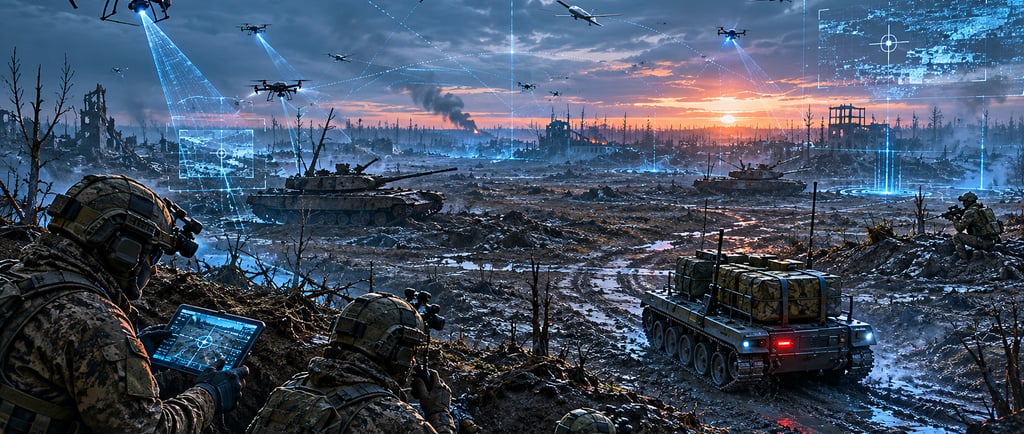
The image accompanying this article is AI-generated and is intended for illustration purposes only.


© 2026 WDA Publishing. All rights reserved.