
When Soldiers Surrender to Drones
The Ukraine war is showing that drones and ground robots are no longer only tools of reconnaissance and attack; they are beginning to change how soldiers surrender, how prisoners are captured, and how the law of armed conflict must be applied under machine-mediated battlefield conditions.
WAR, SECURITY & GEOPOLITICS
Dr Danie Adendorff
5/27/202611 min read
When Soldiers Surrender to Drones
The New Battlefield Reality of Remote Capture
Introduction: A Small Incident with Large Implications
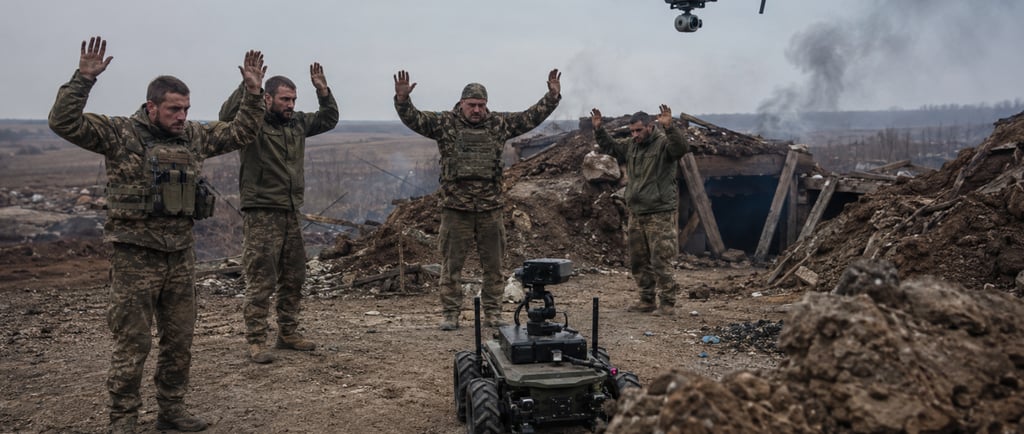
A recent report from Ukraine’s State Border Guard Service deserves more serious attention than the usual cycle of battlefield video, social-media amplification, and short-lived tactical commentary. According to Ukrinform, fighters from Ukraine’s ‘Forpost’ Brigade captured four Russian servicemen with the assistance of a Matrice 4T drone. The report, published on 26 May 2026, stated that Ukrainian border guards released video footage of the incident.
At first glance, this may appear to be another minor episode in a war saturated by drones. It is not. The significance lies in the changing relationship between the human combatant and the unmanned system. In this case, the drone was not merely observing the battlefield, directing artillery, or dropping munitions. It appears to have functioned as part of a capture process. It helped locate, dominate, control, and facilitate the surrender of enemy personnel.
That distinction matters. The modern battlefield is moving from drone-enabled killing toward drone-enabled coercion, communication, isolation, and capture. The soldier under observation is no longer responding only to a visible human enemy. Increasingly, he may be responding to a distributed human-machine combat system: aerial drone, ground robot, remote operator, nearby assault team, electronic surveillance, and psychological pressure combined into a single tactical effect.
This is the early emergence of technologically enabled surrender.
From Surveillance to Surrender
Drones entered the public imagination largely as tools of surveillance and precision strike. In Ukraine, they have become something broader: a pervasive layer of battlefield presence. Reuters has reported that drone use in Ukraine is now deeply integrated into combat formations, with specialised drone units supporting reconnaissance, artillery spotting, FPV strike, and precision bombing across both armies.
That density of unmanned observation changes the psychology of the front line. A soldier in a trench, treeline, ruin, or vehicle is not merely hiding from infantry patrols or artillery observers. He may be under continuous aerial watch. He may be tracked by thermal cameras. He may be unable to move supplies, evacuate wounded, or reposition without being detected. In such conditions, the drone becomes more than a sensor. It becomes a form of battlefield pressure.
The DJI Matrice 4T is a plausible platform for such a role because the Matrice 4 series includes multi-sensor capability, including thermal imaging, telephoto observation, range-finding, and intelligent detection functions. Those capabilities are precisely the kinds of tools that make remote overwatch, identification, and movement control possible.
The operational logic is clear. A drone can detect soldiers who may be isolated, wounded, abandoned, or unwilling to continue fighting. It can observe whether they drop weapons, raise hands, display a sign, or follow instructions. It can maintain overwatch while Ukrainian forces decide whether to approach, guide the surrendering personnel toward friendly lines, or send a ground robot or assault team forward.
This does not eliminate human decision-making. It relocates it. The human captor may be kilometres away, watching through a screen.
Ukraine Formalised the Concept Early
This phenomenon did not appear suddenly in 2026. Ukraine had already recognised the possibility of drone-facilitated surrender in 2022. In December 2022, Ukraine released an instructional video explaining how Russian soldiers could surrender to a Ukrainian drone as part of the ‘I Want to Live’ initiative. Business Insider reported that the video provided step-by-step instructions for Russian soldiers who wished to surrender by drone.
Ukrainian Pravda reported the same development at the time, noting that Ukraine’s General Staff had published instructions for Russian servicemen on how to surrender using Ukrainian drones. The Lieber Institute at West Point also analysed the ‘I Want to Live’ project in January 2023, identifying it as an early example of technologically enabled surrender.
This matters because it shows intention and adaptation. Drone surrender was not merely improvised by frightened soldiers on the battlefield. Ukraine understood that unmanned systems could help create a surrender channel. That channel had tactical, humanitarian, psychological, and informational value.
Tactically, it allowed Ukrainian units to reduce risk to their own soldiers. Humanitarianly, it created a route by which enemy troops could survive. Psychologically, it communicated to Russian soldiers that surrender was possible even under drone surveillance. Informationally, it demonstrated Ukrainian technological initiative and Russian battlefield vulnerability.
Ground Robots Add a New Dimension
The most important development is not only aerial drone surrender. It is the integration of unmanned ground vehicles into capture and assault operations.
In July 2025, the Kyiv Independent reported that Ukraine’s 3rd Separate Assault Brigade said Russian troops had surrendered to its ground drones in what the brigade presented as a historic first. The reported operation involved drones and ground robotic systems rather than a conventional infantry assault. Ukrainian Pravda also reported the brigade’s claim that Russian troops surrendered to Ukrainian ground robotic systems, citing video released by the unit.
Ukrinform reported the same operation, quoting the brigade’s statement that Russian soldiers had surrendered to ground robots during an operation in the Kharkiv region, with no Ukrainian infantry casualties claimed. United24 Media similarly reported that troops from the 2nd Assault Battalion used FPV drones and ground robotic complexes to clear Russian positions, after which Russian soldiers surrendered.
These reports should still be treated with source discipline. They are based substantially on Ukrainian military claims and released footage. They require geolocation, full-video context, and independent corroboration before being treated as fully established in every detail. But the pattern is now too substantial to dismiss. The battlefield is beginning to show cases where unmanned systems do not merely support capture; they become the visible coercive force to which soldiers respond.
That is a doctrinal shift.
The DevDroid Cases: When the Manufacturer Is Surprised
Business Insider reported in May 2026 that Ukrainian defence manufacturer DevDroid was surprised to see Russian soldiers surrendering to its ground robots. The report described a January incident in which a DevDroid TW-7.62 robotic system reportedly captured three Russian soldiers, with aerial drone support and Ukrainian troops likely nearby.
This example is especially revealing. The manufacturer apparently designed the robot for combat utility, risk reduction, and remote operations. Yet the battlefield produced an additional effect: surrender. That is often how military innovation works. Systems are built for one function, then operational conditions reveal another.
A ground robot with a weapon, camera, communications link, and remote operator is not simply a machine. To the soldier facing it, it is a proxy for an adversary who can see, decide, threaten, and potentially kill. If surrender seems safer than resistance, the robot becomes a capture instrument.
This is where the conceptual line becomes important. The robot is not legally taking prisoners by itself in any meaningful human sense. A human command structure remains responsible. But the robot may be the immediate instrument through which the enemy experiences coercion, communicates surrender, and is guided into custody.
What Is Actually Happening on the Battlefield?
The phenomenon can be understood through several mechanisms.
First, drones provide detection and exposure. They remove concealment and make soldiers feel that escape or continued resistance is futile.
Second, drones create psychological dominance. Persistent overhead surveillance produces a sense of inevitability. A soldier who knows he can be seen, tracked, and struck may choose surrender before a firefight begins.
Third, drones enable communication. They can drop notes, display behaviour, use loudspeakers, or guide soldiers visually. Ukraine’s early surrender instructions recognised this possibility explicitly.
Fourth, drones and robots provide armed overwatch. A surrendering soldier may be monitored continuously while Ukrainian forces assess whether he is genuinely surrendering or attempting deception.
Fifth, ground robots reduce the risk of initial contact. Approaching surrendering enemy personnel is dangerous. They may still be armed, confused, wounded, booby-trapped, or acting under orders to deceive. A robot can move closer before exposing Ukrainian infantry.
Sixth, unmanned systems can help solve the tactical problem of distance. A drone operator may observe surrender before any friendly soldier is physically close enough to take custody. The system can keep watch until capture becomes feasible.
This is why the phrase ‘surrendering to drones’ is slightly misleading. Soldiers are not surrendering to autonomous machines as legal persons. They are surrendering through a machine-mediated process controlled by human forces.
The Legal Position: Surrender Still Counts
The law of armed conflict does not stop applying because a drone is involved. The core rule remains clear: a combatant who clearly expresses an intention to surrender and refrains from hostile acts is hors de combat and must not be attacked.
The ICRC’s customary international humanitarian law database states that a person is hors de combat if he is in the power of an adverse party, clearly expresses an intention to surrender, or is incapacitated by wounds or sickness, provided he abstains from hostile acts and does not attempt escape. Such a person may not be made the object of attack.
The ICRC has also addressed drones specifically, stating that international humanitarian law protects anyone recognised as hors de combat, including people who clearly express an intention to surrender, and that they must not be attacked.
The difficulty is practical, not conceptual. A drone can observe surrender, but it cannot always take custody. It cannot physically search the soldier, remove weapons, provide medical treatment, or protect the prisoner from fire. The Lieber Institute has therefore warned that drone-facilitated surrender creates legal and practical challenges for armed forces seeking to implement such procedures in compliance with the law of armed conflict.
This is the key legal tension: the right to surrender must remain meaningful even when the first ‘captor’ visible to the surrendering soldier is a drone.
The Operational Problem: Custody, Control, and Risk
Traditional surrender assumes some form of human contact. A soldier raises his hands. He drops his weapon. The opposing force approaches, secures him, searches him, and moves him to the rear. That process is already dangerous in conventional combat.
Drone-facilitated surrender complicates every stage.
How does the drone operator know the soldier is genuinely surrendering? What if he raises his hands but retains a grenade? What if the drone feed is degraded by electronic warfare, smoke, weather, terrain, or signal loss? What if the surrendering soldier is under Russian fire while moving toward Ukrainian lines? What if Ukrainian troops cannot safely approach? What if a nearby Russian unit uses the surrender as bait?
These are not abstract questions. They go directly to command responsibility, rules of engagement, unit training, and operational planning. A force that invites or accepts surrender through drones must also plan how to complete the capture safely and lawfully.
This is why technologically enabled surrender should not be treated as a social-media spectacle. It is a serious command problem.
Why This Matters for Future War
The Ukraine war is showing a broader shift from human-visible battle to machine-mediated battle. Soldiers increasingly fight, hide, move, supply, evacuate, and surrender under the observation of sensors and unmanned platforms.
The Associated Press reported in 2025 that Ukrainian forces were increasingly using remote-controlled vehicles for dangerous missions such as mine clearing, supply movement, and casualty evacuation. These systems reduce exposure for soldiers but remain vulnerable to enemy detection and attack. Reuters similarly reported that Ukraine’s Khartiia Brigade had pioneered remote-controlled ground assaults, including machine-gun-equipped unmanned vehicles and mine-related systems guided by aerial drones.
These developments point toward a future battlefield where unmanned systems perform more of the first-contact functions once carried out by infantry: scouting, probing, suppressing, communicating, and testing enemy intent.
That does not mean infantry disappears. It means infantry may arrive later, after drones and robots have already shaped the tactical situation. In some cases, soldiers may surrender before opposing infantry ever appears.
The Moral and Psychological Dimension
There is also a deeper human question. What does it mean for a soldier to surrender to a machine?
The answer is that he is not surrendering to the machine as such. He is surrendering to the human enemy power represented through the machine. But the psychological experience is different. The soldier does not see the face of the captor. He sees the sensor, the quadcopter, the tracked robot, the weapon mount, the camera lens, or the hovering object above him.
This may intensify fear. It may also reduce the emotional barrier to surrender. Some soldiers may find it easier to surrender to a remote system than to approach enemy infantry under fire. Others may fear that a drone cannot interpret surrender correctly and will strike anyway.
That uncertainty is operationally dangerous. If soldiers believe drones cannot accept surrender, they may fight to the death. If they believe surrendering to drones works, surrender becomes a battlefield option. This is why credible procedures matter. A surrender system must be understood by both sides if it is to reduce unnecessary killing.
Source Confidence and Caution
The strongest evidence supports the general trend: drones and ground robots are increasingly used by Ukraine for surveillance, strike, logistics, assault support, and surrender facilitation. That is supported by reputable media reporting, official Ukrainian releases, legal analysis, and battlefield video reporting.
The specific Forpost/Matrice 4T incident should be treated as medium-high confidence, not absolute certainty. Ukrinform reported the official Ukrainian claim and the existence of released video, but the case would become stronger with independent geolocation, full unedited footage, and third-party confirmation.
The 3rd Assault Brigade ground-robot surrender cases are also medium-high confidence as reported incidents, but individual tactical details remain dependent on Ukrainian military claims and video context.
Manufacturer-linked claims, such as the DevDroid cases, are analytically useful but require caution. They are plausible and reported by reputable media, but company statements should not be treated as independently verified battlefield records without additional corroboration.
The legal principle, by contrast, is high confidence. Surrender remains protected under international humanitarian law, including when communicated through or observed by drones.
Conclusion: The Capture Function Is Being Automated Around the Edges
The most important lesson is not that machines are replacing human soldiers. That is too crude. The real development is subtler: machines are beginning to mediate the space between combat and capture.
Drones detect. Robots approach. Operators observe. Infantry waits. A soldier raises his hands. A camera records the gesture. A remote team decides whether he is surrendering or still a threat. A route is indicated. A capture team or ground system moves forward. Custody may follow minutes later.
This is not science fiction. It is an emerging battlefield practice.
For commanders, the implication is clear: surrender procedures must now be designed for machine-mediated contact. For lawyers, the challenge is ensuring that existing protections remain effective when surrender is communicated through sensors rather than face-to-face contact. For military analysts, the deeper point is that unmanned systems are no longer merely extending the reach of firepower. They are extending the reach of coercion, communication, and control.
The future battlefield will not only ask who can kill at greater distance. It will also ask who can induce surrender, accept surrender, and lawfully control surrender under conditions where the first visible representative of military power may be a drone.
That is a profound change in the conduct of war.
Selected Sources
Ukrinform. “Border guards capture four Russian soldiers with drone assistance.” 26 May 2026. https://www.ukrinform.net/rubric-ato/4127530-border-guards-capture-four-russian-soldiers-with-drone-assistance.html
Business Insider. “Watch: Ukraine Army Video Tells Russians How to Surrender to Drone.” 13 December 2022. https://www.businessinsider.com/ukraine-army-video-tells-russians-how-to-surrender-to-drone-2022-12
The Kyiv Independent. “In historic feat, Ukraine’s 3rd Brigade captures Russian troops using only drones and robots, military says.” 9 July 2025. https://kyivindependent.com/ukrainian-assault-brigade-captures-russian-troops-using-only-drones-and-robots-in-historic-operation-military-says-06-2025/
Ukrainian Pravda. “Ground robots of Ukraine’s 3rd Assault Brigade force Russian troops to surrender – video.” 9 July 2025. https://www.pravda.com.ua/eng/news/2025/07/09/7520954/
Ukrinform. “Ukrainian forces use ground robots to seize enemy position, capture Russian soldiers.” 9 July 2025. https://www.ukrinform.net/rubric-ato/4013264-ukrainian-forces-use-ground-robots-to-seize-enemy-position-capture-russian-soldiers.html
Business Insider. “A Ukrainian arms maker was surprised to see Russian soldiers surrender to its war robots.” May 2026. https://www.businessinsider.com/russians-surrendering-to-ukraine-ground-robots-surprise-to-maker-2026-5
Reuters. “Ukrainian brigade pioneers remote-controlled ground assaults.” 16 January 2025. https://www.reuters.com/world/europe/ukrainian-brigade-pioneers-remote-controlled-ground-assaults-2025-01-16/
Associated Press. “Ukraine uses remote-controlled vehicles for dangerous missions to protect soldiers.” 2025. https://apnews.com/article/cda457f0d153d279564ca200a4bc303b
ICRC. “Hors de combat — How does law protect in war?” https://casebook.icrc.org/a_to_z/glossary/hors-de-combat
ICRC. “International humanitarian law and the use of drones in armed conflict.” 10 December 2025. https://www.icrc.org/en/article/faq-international-humanitarian-law-drones-armed-conflict
Lieber Institute, West Point. “The Legal and Practical Challenges of Surrendering to Drones.” 8 February 2023. https://lieber.westpoint.edu/legal-practical-challenges-surrender-drones/
Lieber Institute, West Point. “I Want to Live Project: Technologically Enabled Surrender.” January 2023. https://lieber.westpoint.edu/i-want-to-live-project-technologically-enabled-surrender/
Author workflow disclosure
This article was produced through an AI-assisted but human-directed workflow. AI support was used for accessibility assistance, article structuring, language refinement, source-discovery prompts, revision planning, and conversion of editorial comments into specific amendments. The author retained responsibility for the argument, accepted or rejected suggested changes, checked the logic of the claims, and remained accountable for the final text. AI-generated material was not treated as empirical evidence, and synthetic or illustrative examples were not presented as observed data.
Image note
The image accompanying this article is AI-generated and is intended for illustration purposes only.


© 2026 WDA Publishing. All rights reserved.