
When Superpowers Discover Limits: Russia, America, and the Wars That Refuse to Obey Power
The age of automatic conversion is over: military superiority no longer guarantees political result when the opponent can endure, adapt, and deny the stronger actor a clean end state.
WAR, SECURITY & GEOPOLITICSPOLITICS & SOCIETY
Dr Danie Adendorff
6/5/202618 min read
When Superpowers Discover Limits: Russia, America, and the Wars That Refuse to Obey Power
By Dr Danie Adendorff
Russia in Ukraine and America in the Middle East are not morally equivalent conflicts. But both reveal a common strategic problem: military power can punish, degrade, and disrupt, yet still fail to compel political submission from resilient opponents.
Abstract
Russia in Ukraine and America in the Middle East are not morally equivalent conflicts, but both reveal a common strategic condition: the age of automatic conversion is over. Great powers can still punish, degrade, deter, and disrupt, yet they increasingly struggle to convert military superiority into political submission when opponents are resilient, adaptive, embedded, and willing to absorb punishment. This article argues that Russia's failure to force Ukrainian subordination and America's difficulty in converting pressure on Iran into durable regional settlement expose the same strategic problem: power remains formidable, but its political conversion is no longer guaranteed.
The age of automatic conversion is over: military superiority no longer guarantees political result when the opponent can endure, adapt, and deny the stronger actor a clean end state.
The question beneath the headlines.
The question is tempting because it is dramatic: are the world's greatest superpowers losing their wars?
It is also too imprecise. Russia and the United States are not fighting the same kind of war. Their legal, moral, political, and operational positions are fundamentally different. Russia is the aggressor in Ukraine. Ukraine is defending its sovereignty against invasion. The United States is operating in a Middle Eastern conflict environment shaped by Iran, Israel, nuclear risk, maritime security, alliance obligations, energy markets, and escalation management. These two cases should not be collapsed into moral equivalence.
Yet the comparison is still valuable if handled carefully. The convergence is not moral. It is strategic.
Russia and the United States both possess enormous coercive capacity. Russia can mobilise manpower, fire missiles, sustain attrition, and devastate Ukrainian infrastructure. The United States can project force globally, strike at distance, control sea lanes, sanction adversaries, reassure allies, and dominate conventional military escalation against most regional opponents. But in both theatres, the central political result remains unresolved.
Russia has not converted invasion and attrition into Ukrainian submission. The United States has not converted strikes, deterrence, sanctions, blockade pressure, and alliance coordination into a durable Iranian settlement or stable regional order. In both cases, the problem is not the absence of power. It is the non-conversion of power into political obedience.
That is the deeper issue. Modern great powers can still destroy. They can still punish. They can still disrupt. But destruction is not decision. Punishment is not settlement. Military superiority is not political control.
The false simplicity of winning and losing.
A serious discussion must begin by defining what losing means. States can lose tactically, operationally, strategically, politically, economically, reputationally, or morally. These categories do not always move together.
Russia is not defeated in the narrow military sense. It still occupies Ukrainian territory. It continues to launch missile and drone strikes. It retains the capacity to impose enormous damage. It can still mobilise manpower and sustain a long war. But Russia has failed, so far, to achieve the larger political objective that gave the war its meaning: the subordination of Ukraine as an independent strategic actor.
The United States is not losing in the same way. It is not attempting to conquer Iran. It is not fighting a large land war on its own border. It is not seeking territorial annexation. Its difficulty is different: coercive conversion. Washington can damage Iran, deter some actions, protect some shipping, coordinate allies, and apply financial pressure. But a damaged Iran is not necessarily a compliant Iran. A degraded nuclear programme is not necessarily a terminated nuclear programme. A ceasefire is not necessarily a settlement. A reopened maritime route is not necessarily a stable regional order.
The more accurate question is therefore not whether both superpowers are losing. It is whether both are discovering that superior military power no longer guarantees political outcome when the opponent is resilient, adaptive, embedded, and willing to absorb punishment.
Russia in Ukraine: the war that refused to collapse.
The Russian war in Ukraine began from a profound misreading of political and military reality. Moscow appears to have underestimated Ukrainian national identity, state resilience, military adaptability, and the willingness of Western states to sustain Kyiv. That underestimation was not peripheral. It shaped the initial theory of victory.
Russia's early expectation appears to have been that Ukraine would fracture quickly under military shock, political intimidation, and elite pressure. Instead, the invasion strengthened Ukrainian national cohesion, expanded Western support, and transformed Ukraine into a long-war actor. The intended rapid coercion became a grinding attritional struggle.
RUSI's Jack Watling has argued that Russia's aggression is likely to persist through 2026 and that Ukraine's strategic task is not merely to survive, but to demonstrate that it can sustain resistance while expanding the costs imposed on the Kremlin. This is a crucial formulation because it shifts the analytical frame away from the simplistic question of daily territorial movement. The issue is whether Ukraine can make Russia's theory of victory politically and economically unsustainable.
IISS has similarly rejected the idea of a comfortable stalemate. Its February 2026 analysis described the Russia-Ukraine war as escalation rather than stalemate, noting that Russia gained less than one per cent of Ukrainian territory in 2025 while suffering enormous losses. The significance of this finding is not that Ukraine is winning outright. It is that Russia is paying a very high price for limited territorial movement.
CSIS has described the war as a grinding contest in which casualty levels are extremely high and Russian losses are explained partly by poor tactics, weak combined-arms performance, corruption, morale problems, and Ukraine's defence-in-depth. RAND has added another layer by arguing that the war is increasingly coming home to Russia through demographic, criminal, social, and economic effects.
The convergence among these respected military and strategic commentators is clear. Russia can sustain violence, but it has not produced submission. It can seize pieces of ground, but it has not secured the political object. It can claim inevitability, but the war continues to generate costs that travel back into Russian society and the Russian economy.
The distinction matters. A state can continue fighting while still failing strategically. Russia's predicament is not that it lacks power. It is that its power has not achieved the intended political transformation of Ukraine.
Ukraine's resilience as strategic power.
Ukraine's resilience is often discussed emotionally, but it should also be understood analytically. Resilience is not merely courage. It is a form of strategic power.
Ukraine has survived because it combined national will, adaptive military learning, external assistance, distributed intelligence, technological improvisation, drone innovation, and political mobilisation. Its defence has not been static. It has evolved. Ukraine has adapted under fire, and that adaptation has raised the cost of Russian coercion.
This is one of the most important lessons of the war. A weaker state does not need to defeat a stronger state symmetrically. It must deny the stronger state a politically acceptable outcome at acceptable cost.
Ukraine has preserved the political fact of Ukrainian sovereignty. It has maintained a functioning state. It has kept an army in the field. It has kept external support alive. It has forced Russia into a war far longer and more expensive than the Kremlin appears to have expected. It has developed drone and long-range strike capabilities that increasingly bring the war back into Russian depth. It has transformed Russia's invasion into a strategic catalyst for European rearmament and NATO consolidation.
This does not mean Ukraine's position is easy. The human cost is severe. Civilian deaths, military casualties, infrastructure destruction, displacement, energy-system damage, demographic loss, and economic hardship remain central. The World Bank has estimated Ukraine's reconstruction and recovery needs at hundreds of billions of dollars. UN human-rights reporting continues to record severe civilian harm. Resilience must not be romanticised. It is a terrible achievement under terrible pressure.
Yet strategically, resilience has become Ukraine's answer to Russian mass. Russia sought collapse. Ukraine produced endurance. Russia sought intimidation. Ukraine produced adaptation. Russia sought political subordination. Ukraine preserved strategic agency.
That is why Russia's war is in trouble even when Russian forces still fight. Trouble does not mean immediate defeat. It means the political mechanism of victory is not working.
America and Iran: punishment without settlement.
The United States faces a different but structurally related problem in the Middle East. Washington is not fighting Russia's war. It is not an aggressor seeking territorial conquest in the same sense. Its objectives are framed around nuclear restraint, deterrence, maritime security, Israeli security, Gulf-state reassurance, regional order, and the reduction of Iranian coercive behaviour.
Yet the strategic difficulty is similar: coercive power has not produced clean political compliance.
IISS's analysis of the war against Iran described the outcome of the U.S.-Israel campaign as strategically inconclusive, despite claims that Iran's nuclear programme had been severely damaged or obliterated. This distinction is fundamental. Military destruction may degrade a programme, but degradation is not the same as verified termination. A facility can be bombed while knowledge, material, personnel, and political intent survive.
Reuters has reported that the first IAEA report since the February 2026 strikes showed little change in Iran's nuclear activities and continuing uncertainty about enriched uranium stockpiles and access to bombed sites. That is a strategic warning. If the object of the campaign is nuclear restraint, then the decisive measure is not the number of targets hit. It is whether the nuclear problem becomes more governable, verifiable, and politically constrained.
CSIS commentators Nikita Shah, Emily Harding, Daniel Byman, Eliot A. Cohen, Kateryna Bondar, Jonathan Burchell, and Mark Cancian have examined the unintended consequences of the U.S.-Iran conflict for defence and security. Their collective emphasis is important: the conflict does not only produce military effects. It creates hybrid risks, escalation pathways, proxy threats, technological adaptation, defence-industrial pressures, and alliance complications.
The Washington Institute's Michael Singh has argued that reopening the Strait of Hormuz in exchange for lifting the U.S. blockade may need to precede attempts to resolve more complex issues such as enriched uranium, missiles, and Iranian support for proxies. That assessment is strategically revealing. It implies that even a superpower may need to sequence its objectives because the total problem is too complex to solve through force alone.
Reuters' Samia Nakhoul has framed the emerging diplomatic possibility as an interim outcome that could leave Iran battered but not broken. That phrase captures the American problem precisely. The United States and Israel may severely damage Iran. But if Iran survives politically, retains leverage, preserves enough nuclear ambiguity, sustains proxy influence, and extracts concessions through crisis, then military punishment has not produced decisive political settlement.
Iran's resilience is not legitimacy, but it is strategic durability.
Iran's resilience must not be confused with moral legitimacy. The Islamic Republic is a coercive regime with a long record of domestic repression, regional proxy activity, nuclear confrontation, and destabilising conduct. Its endurance does not make it admirable. But strategic analysis must distinguish between legitimacy and durability.
Iran's regime has spent decades preparing to survive against stronger adversaries. Its strategic method rests on redundancy, dispersion, proxies, missiles, drones, maritime leverage, hardened facilities, political control, and escalation ambiguity. Iran does not need to defeat the United States conventionally. It needs to make American objectives costly, uncertain, and politically difficult.
The Strait of Hormuz is the clearest example. For Washington and its partners, the Strait is a vital artery of global energy trade and maritime security. For Tehran, it is leverage. Iran cannot match American global naval power. But it can threaten a narrow geography whose disruption carries global economic consequences.
That is why the Middle Eastern conflict is not merely a military contest. It is an economic and political contest conducted through military instruments. A missile strike, a blockade, a tanker incident, an attack on a Gulf installation, or a proxy escalation can all produce effects far beyond the battlefield.
Iran should also not be treated as a perfectly unified actor. References to Iran in this article refer to the Iranian state and regime system as a strategic actor, not to a single uncontested decision-maker or a politically homogeneous elite. Leadership structures, factional interests, institutional rivalries, and regime-survival calculations all matter. But the broader pattern remains: the Iranian system has shown a capacity to absorb punishment, preserve leverage, and avoid the kind of political submission that coercive pressure was intended to produce.
Iran's resilience is therefore asymmetric. It is not the resilience of a democratic society defending national survival, as in Ukraine. It is the resilience of a coercive state and its networked regional strategy. But it still matters strategically because it denies the stronger power an easy conversion of force into settlement.
The economic layer: when war escapes the battlefield.
The economic dimension is essential because both wars impose costs beyond military casualties and target damage.
For Russia, the war has become a political-economy problem. IISS has warned that Russia's war on Ukraine is likely to prove economically unsustainable on its present course, with the Kremlin approaching a fundamental choice between escalating demands on society and the economy or scaling back war aims. Reuters reporting from Russia's St Petersburg economic forum showed competing elite visions: some voices urging preparation for a long confrontation with the West, others recognising the economic logic of negotiation.
This is not the image of a state moving smoothly toward victory. It is the image of a state trying to reconcile battlefield ambition with economic strain, sanctions adaptation, militarisation, labour pressures, capital constraints, and elite uncertainty. Russia has built a war economy, but a war economy is not costless. It can sustain conflict while hollowing out future flexibility.
For the United States, the economic problem is different. America's homeland is not under attack in the way Ukraine is. Its economy is vastly larger and more resilient than Iran's or Russia's. But the Middle Eastern conflict transmits costs through oil, inflation, shipping risk, insurance, defence expenditure, and political pressure.
CEPR analysis by Lutz Kilian, Michael D. Plante, Alexander W. Richter, and Xiaoqing Zhou estimated that even a cautiously optimistic scenario involving a one-quarter closure of the Strait of Hormuz followed by gradual resumption of exports could raise U.S. headline inflation by 0.6 percentage points and core inflation by 0.2 percentage points in 2026. Reuters reporting on Federal Reserve Bank of Boston research similarly indicated that the Middle East energy shock may have a smaller employment effect than the oil shocks of the 1970s, but that inflation remains the primary policy risk. Chatham House has warned that a more severe and prolonged Iran conflict could push oil prices sharply higher, with uneven regional economic effects and particular vulnerability in the eurozone.
The economic convergence is again structural, not identical. Russia's war threatens the sustainability of its own political economy. America's Iran conflict threatens inflation, maritime risk, energy stability, and the credibility of global economic management. Russia is economically consumed by its war. America is economically exposed to the regional consequences of its war.
Both cases show that war cannot be confined to the battlefield. It migrates into budgets, prices, supply chains, energy markets, investment decisions, public patience, and elite politics.
Why weaker actors survive stronger pressure.
The recurring great-power error is the assumption that material inferiority will produce political concession. This assumption repeatedly fails because weaker actors do not calculate pain in the same way stronger actors expect them to.
Ukraine's calculation is shaped by national survival. If the alternative to resistance is subordination, occupation, territorial dismemberment, or loss of sovereignty, then continued resistance remains rational even under extreme cost. Russia may assume that suffering should compel Ukraine to concede. Ukraine may conclude that suffering proves the necessity of continued resistance.
Iran's calculation is shaped by regime survival and asymmetric leverage. If the leadership believes that concession under pressure could produce internal vulnerability, elite fracture, or strategic encirclement, then endurance may appear safer than compliance. The regime may present survival itself as victory, particularly if it can claim that the United States and Israel failed to impose total capitulation.
This is the central point that many great powers misread: pain is not always persuasive. Sometimes it is consolidating. Sometimes it radicalises. Sometimes it clarifies stakes. Sometimes it strengthens the narrative that the weaker actor is resisting domination.
The political commentator sees this as legitimacy, narrative, and elite survival. The war commentator sees it as force endurance and adaptation. The economist sees it as cost absorption and delayed collapse. The strategist must see all three at once.
Stalemate as a political condition.
Stalemate is not merely a map line. It is a political condition in which no actor can impose its preferred end state at acceptable cost.
In Ukraine, stalemate is not inactive. It is violent, mobile, and adaptive. Russia attacks. Ukraine counters. Drones alter the battlefield. Long-range strikes expand the depth of war. Defensive systems evolve. Offensive operations produce limited gains at heavy cost. The front line may move, but the political object remains unresolved.
In the Middle East, stalemate looks different. It may involve ceasefires, maritime incidents, proxy attacks, negotiations, sanctions, airstrikes, blockade pressure, and nuclear inspections. The geography is not a continuous trench line. But the political condition is similar: no side has yet secured a stable settlement on acceptable terms.
Reuters' reporting on U.S.-brokered ceasefires in the Middle East is instructive. Ceasefires have not stopped violence where underlying political disputes remain unresolved. Lebanon, Gaza, Iran, Hormuz, and the nuclear file remain interconnected. A ceasefire can reduce immediate violence while leaving the conflict structure intact.
This is why great powers often mistake pauses for progress. Violence can decline without the war being solved. Negotiations can resume without the political problem being closed. Military pressure can force talks without forcing agreement.
The military dimension: adaptation defeats expectation.
The military convergence between Ukraine and Iran lies in adaptation.
Ukraine's adaptation is battlefield-centred. It has used drones, intelligence fusion, long-range strike systems, improvised procurement, distributed command, and defensive depth to offset Russian mass. Ukraine has not matched Russia tank-for-tank or shell-for-shell in all respects. It has instead changed the cost structure of Russian operations.
Iran's adaptation is theatre-centred. It uses missiles, drones, proxies, maritime disruption, hardened sites, and escalation ambiguity to offset American and Israeli superiority. It does not seek conventional parity. It seeks coercive friction.
These are different military cultures and different strategic purposes. But they share a key feature: both reduce the stronger actor's ability to rely on inherited assumptions of dominance.
This is one reason modern wars become harder to terminate. Adaptation keeps the contest alive. Each side learns. Each side adjusts. Each side finds new ways to impose cost. The stronger actor may retain superiority, but superiority becomes less decisive as the weaker actor discovers methods of survival.
The political dimension: maximal aims meet limited mechanisms
The political problem is even harder than the military problem.
Russia's difficulty is that its objectives have often exceeded what the battlefield can deliver. If Moscow seeks Ukraine's political subordination, territorial concessions, demilitarisation, Western disengagement, and recognition of Russian gains, it requires more than battlefield pressure. It requires Ukraine to accept a political future that Ukraine has fought for years to prevent. The longer the war continues, the more difficult that acceptance becomes.
America's difficulty is that its objectives in relation to Iran are multiple and internally demanding. Washington seeks nuclear restraint, missile limitations, proxy reduction, maritime security, Israeli security, Gulf reassurance, sanctions leverage, domestic political credibility, and regional de-escalation. These objectives are not impossible, but they are not all equally achievable through force. Some require verification. Some require negotiation. Some require regional buy-in. Some require Iranian consent. Some require Israeli restraint. Some require Gulf confidence. Some require time.
The result is a war-termination problem. Great powers often know how to apply pressure before they know what precise political arrangement will end the pressure. That is strategically dangerous. A campaign can begin with confidence and then discover that its end state is harder to define than its target list.
The reputational burden of superpower status.
Superpowers carry a special burden: the expectation of decision. When they act militarily, the world expects results. If results do not follow, adversaries and allies both draw conclusions.
For Russia, the reputational damage is severe. The invasion was supposed to demonstrate Russian power and Western weakness. Instead, it exposed Russian military deficiencies, strengthened Ukrainian identity, expanded NATO's strategic relevance, and turned Russia into a long-war state.
For the United States, the reputational issue is more complex. America still possesses unmatched military capability. But if Washington can strike without settling, deter without stabilising, sanction without compelling, and negotiate without closing, then the perception of American decisiveness is affected. This matters far beyond Iran. China, Russia, Gulf states, Israel, Europe, and non-state actors all watch whether American power produces political results or merely episodes of military pressure.
This reputational problem is not the same as defeat. But it is strategically important. Power that does not produce settlement begins to look less decisive, even when it remains formidable.
The limits of the comparison.
The comparison must remain disciplined.
Russia and America are not the same kind of belligerent in these cases. Russia launched a war of aggression against Ukraine. Ukraine is defending its national survival. The United States is operating in a regional conflict environment involving Iran's nuclear programme, proxy networks, maritime security, Israeli security, and Gulf stability. Iran is not Ukraine. America is not Russia. Ukraine's resilience and Iran's resilience are not morally equivalent.
The military theatres are also different. Ukraine is a large land war. The Iran conflict is a regional coercive system involving air power, maritime routes, proxies, sanctions, nuclear inspections, and diplomacy. Russia seeks territorial and political domination. America seeks behavioural change, deterrence, nuclear restraint, and regional order.
But these differences do not invalidate the comparison. They define its limits. The point is not that the conflicts are morally alike. The point is that both reveal how difficult it has become for even the strongest states to translate coercive power into political settlement.
The convergence: coercive frustration.
The best term for the shared condition is coercive frustration.
Russia is coercively frustrated because Ukraine has not submitted. America is coercively frustrated because Iran has not clearly complied. Russia can continue the war, but continuation is not victory. America can continue pressure, but pressure is not settlement.
In both cases, the stronger actor faces an opponent that has found ways to survive the pressure. Ukraine survives through national mobilisation, military adaptation, external support, and the existential logic of sovereignty. Iran survives through regime control, asymmetric leverage, proxies, maritime risk, nuclear ambiguity, and the political use of endurance.
The convergence is therefore not in the morality of the actors. It is in the structure of strategic frustration: power applied without decisive political conversion.
What the commentators collectively show.
The respected commentators and institutions do not all make the same argument. That is precisely why their convergence matters.
RUSI emphasises the persistence of Russian aggression and the need to increase costs on Moscow. IISS emphasises escalation rather than comfortable stalemate. CSIS highlights attrition, unintended consequences, and defence-security risks. RAND warns that war effects are returning into Russian domestic life. Reuters captures elite political-economic tension in Russia and fragile diplomatic manoeuvring in the Middle East. The Washington Institute focuses on sequencing U.S. objectives in Iran. CEPR and Federal Reserve-linked economic analysis quantify inflationary consequences. Chatham House highlights global economic exposure.
Taken together, they converge around a powerful conclusion: neither war can be understood purely by counting destroyed targets, occupied kilometres, missile launches, sanctions packages, or naval deployments. The decisive measure is whether coercion produces the desired political outcome.
So far, in both cases, it has not done so conclusively.
Conclusion: the age of automatic conversion is over
The age of automatic conversion is over. Great powers may still dominate the battlespace, but they no longer automatically dominate the political outcome. In Ukraine and the Middle East, the decisive question is no longer only who can impose the greatest damage, but who can convert pressure into settlement before endurance, adaptation, and unresolved political will turn military superiority into strategic frustration.
Are the world's greatest superpowers losing their wars? The more precise answer is that they are losing the assumption that superior force guarantees political result.
Russia is not yet defeated, but it has failed to achieve decisive Ukrainian submission. The United States is not defeated, but it is constrained by the difficulty of turning pressure on Iran into durable compliance and regional settlement. In both cases, the opposing side's endurance has become the central strategic fact.
This is the lesson that matters beyond Ukraine and Iran. Future wars will not be decided only by who has the largest arsenal, the strongest navy, the most advanced aircraft, the deepest sanctions regime, or the most sophisticated intelligence system. They will also be decided by who can endure, adapt, absorb punishment, preserve political agency, and deny the stronger actor a clean end state.
Superpowers do not lose only when their armies collapse. They also lose when their power creates consequences that their strategy cannot resolve.
Source notes
This article draws on recent analysis and reporting from RUSI, IISS, CSIS, RAND, Reuters, the Washington Institute for Near East Policy, CEPR/VoxEU, Federal Reserve Bank of Boston research as reported by Reuters, Chatham House, the World Bank, and UN human-rights reporting. The article uses these sources not as rhetorical decoration, but as converging evidence across military, political, and economic dimensions.
1. Watling, J. (2026) 'Russia's Aggression in Ukraine Will Persist Through 2026', Royal United Services Institute, 23 February 2026. https://my.rusi.org/resource/russias-aggression-in-ukraine-will-persist-through-2026.html
2. IISS (2026) 'Russia-Ukraine War: escalation, not stalemate', International Institute for Strategic Studies, 25 February 2026. https://www.iiss.org/online-analysis/online-analysis/2026/02/russiaukraine-war-escalation-not-stalemate/
3. CSIS (2026) 'Russia's Grinding War in Ukraine', Center for Strategic and International Studies, 27 January 2026. https://www.csis.org/analysis/russias-grinding-war-ukraine
4. RAND (2026) 'The War Is Coming Home to Russia', RAND Corporation, 20 February 2026. https://www.rand.org/pubs/commentary/2026/02/the-war-is-coming-home-to-russia.html
5. Reuters (2026) 'Putin faces rival visions of war and peace at Russia's Davos', 4 June 2026. https://www.reuters.com/business/putin-faces-rival-visions-war-peace-russias-davos-2026-06-04/
6. IISS (2026) 'The War Against Iran', Survival Online, 10 April 2026. https://www.iiss.org/online-analysis/survival-online/2026/04/the-war-against-iran/
7. Reuters (2026) 'First IAEA report on Iran's nuclear programme since February shows little change despite war', 4 June 2026. https://www.reuters.com/world/middle-east/first-iaea-report-irans-nuclear-programme-since-february-shows-little-change-2026-06-04/
8. CSIS (2026) 'What Are the Unintended Consequences of the U.S.-Iran Conflict for Defense and Security?', Center for Strategic and International Studies, 9 April 2026. https://www.csis.org/analysis/what-are-unintended-consequences-us-iran-conflict-defense-and-security
9. Singh, M. (2026) 'How to Accomplish U.S. Objectives in Iran', The Washington Institute for Near East Policy, 14 May 2026. https://www.washingtoninstitute.org/policy-analysis/how-accomplish-us-objectives-iran
10. Nakhoul, S. (2026) 'War may end in interim deal that leaves Iran battered but not broken', Reuters, 3 June 2026. https://www.internazionale.it/ultime-notizie-reuters/2026/06/03/analysis-war-may-end-in-interim-deal-that-leaves-iran-battered-but-unbowed
11. Kilian, L., Plante, M. D., Richter, A. W. and Zhou, X. (2026) 'Quantifying the impact of the Iran war on US inflation', CEPR/VoxEU. https://cepr.org/voxeu/columns/quantifying-impact-iran-war-us-inflation
12. Derby, M. S. (2026) 'Boston Fed paper says Fed can concentrate on inflation risks amid energy shock', Reuters, 4 June 2026. https://www.reuters.com/markets/us/boston-fed-paper-says-fed-can-concentrate-inflation-risks-amid-energy-shock-2026-06-04/
13. Chatham House (2026) 'How will the Iran war affect the global economy?', 6 March 2026. https://www.chathamhouse.org/2026/03/how-will-iran-war-affect-global-economy
14. IISS (2026) 'The Coming Crisis in Russia's Political Economy', International Institute for Strategic Studies, 18 May 2026. https://www.iiss.org/research-paper/2026/05/the-coming-crisis-in-russias-political-economy/
15. World Bank (2026) Ukraine Rapid Damage and Needs Assessment / reconstruction and recovery estimates. https://www.worldbank.org/en/country/ukraine
16. UN Human Rights Monitoring Mission in Ukraine (2026) Protection of Civilians in Armed Conflict reporting. https://ukraine.ohchr.org/
Author workflow disclosure
This article was produced through an AI-assisted but human-directed workflow. AI support was used for accessibility assistance, structuring, language refinement, source-discovery prompts, revision planning, and conversion of editorial comments into amendments. Dr Danie Adendorff retained responsibility for the argument, accepted or rejected changes, checked the logic of claims, assessed source credibility, and remains accountable for the final text. AI-generated material was not treated as empirical evidence, and synthetic or illustrative examples were not presented as observed data.
Image note
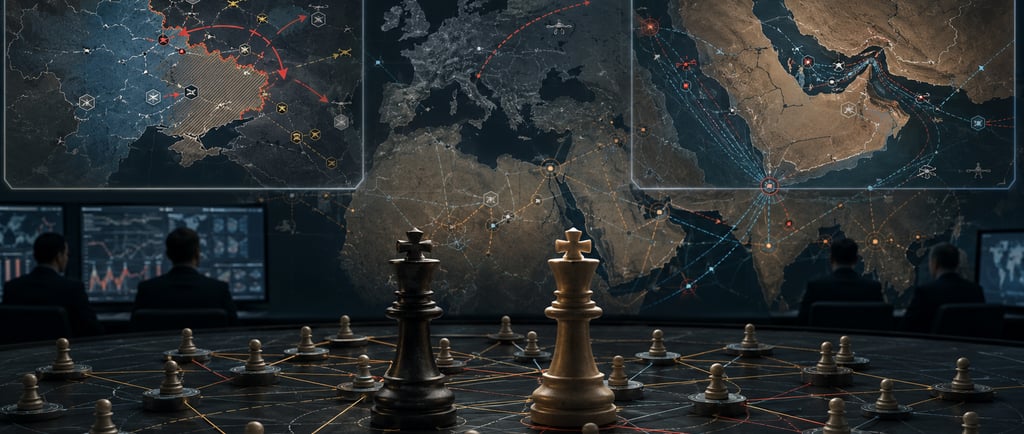
The image accompanying this article is AI-generated and is intended for illustration purposes only.


© 2026 WDA Publishing. All rights reserved.