
When the Kill Chain Loses the Human
A serious war-analysis essay on how autonomous drones challenge the legal, moral, and command boundaries between human judgement and machine-executed lethal force.
WAR, SECURITY & GEOPOLITICS
Dr Danie Adendorff
6/13/202618 min read
When the Kill Chain Loses the Human
A reported Ukrainian test of fully autonomous attack drones may mark a legal and moral boundary in the AI age of warfare: the transfer of lethal target selection from accountable human judgement to machine-executed decision.
The most serious claims in war should be approached with discipline before outrage. That is especially true when the claim concerns artificial intelligence, autonomous weapons and the death of human beings on the battlefield.
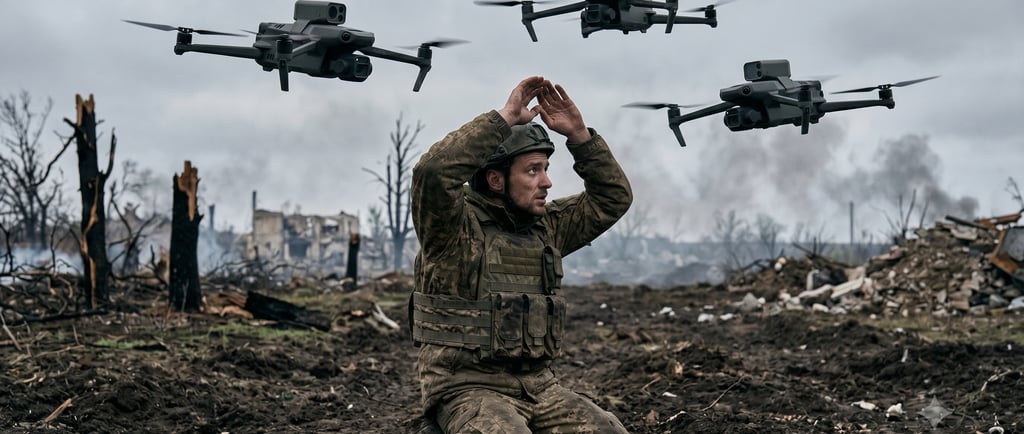
Recent reporting, citing New Scientist and a senior figure in Ukraine's defence industry, alleges that a one-off Ukrainian test used fully autonomous AI-controlled drones near Bakhmut and Chasiv Yar approximately two years ago. According to that reporting, ten drones were launched, flew several kilometres towards the front, entered a mode in which an AI model searched for and engaged targets independently, and killed Russian soldiers without a human authorising the strike at the moment of engagement.
The report is significant, but its evidential status matters. The central account appears to originate from a single named source - a drone manufacturer describing, roughly two years after the fact, a capability his own industry produces - and a source of that kind carries obvious incentives to demonstrate capability, signal deterrent intent and attract attention. The Ukrainian Ministry of Defence has not publicly confirmed the incident. The reported attacks were not recorded by the autonomous drones themselves, and the outcome was apparently verified afterwards by human-piloted drones. On a disciplined source-grading standard, an uncorroborated single-source account from an interested party does not by itself meet the threshold for an established fact. The claim should therefore be treated neither as propaganda nor as settled history. It should be treated as a serious and credible but still incompletely corroborated indication that a boundary long discussed in arms-control law and military ethics may already have been crossed - and, as the Libyan precedent discussed below suggests, perhaps not for the first time.
If the reporting is accurate, the decisive fact is not simply that drones killed soldiers. Drones, artillery, missiles, mines, aircraft and infantry already kill in war. The decisive fact is that the final selection and engagement of human targets may have occurred without a person seeing the target, judging the circumstances, authorising the strike, or retaining an abort option at the moment of lethal force.
That is not merely automation. It is autonomous lethal decision-making.
What was reported.
According to secondary reporting of the New Scientist account, the test involved ten AI-controlled quadcopters used near Bakhmut and Chasiv Yar during a Ukrainian counteroffensive phase. The drones were reportedly programmed to fly three to five kilometres over roughly ten minutes before switching into what was described as 'Terminator mode'. Once activated, the system allegedly searched for and engaged targets independently.
The reported details are important. There was allegedly no live video feed, no connection to the drones, no possibility of intervention, and no abort option once the autonomous mode was engaged. Because the drones did not transmit recordings of their attacks, human-piloted drones were reportedly sent afterwards to inspect the area and verify the effects. The claimed outcome was several dead Russian soldiers and a destroyed truck.
Drone-maker Alexander Kokhanovskyy reportedly said the system was tested but not implemented more widely. He is also reported to have said that Ukraine's current rules prohibit the use of AI in the final stage of target engagement, even though AI assistance in navigation, target acquisition and tracking is already widespread in battlefield systems.
The same reporting contains an important counter-voice from within the Ukrainian military. Major Danylo Polozhukhno, a senior officer in Ukraine's 21st Separate Unmanned Systems Regiment - who was neither aware of nor involved in the reported test - reportedly told New Scientist that his units use semi-autonomous systems but always keep a human in the loop, and that Ukraine does not field fully autonomous systems that independently select and engage targets without operator involvement. He stressed Ukraine's adherence to international humanitarian law and its care to prevent civilian harm. This counter-voice cuts in two directions. It does not refute Kokhanovskyy's account; an officer in one regiment cannot speak to a one-off test conducted by an unnamed unit. But it establishes that the doctrinal line this article defends - meaningful human control at the point of lethal engagement - is the line Ukraine's own operators claim to hold. The disputed question is therefore not whether that line should exist, but whether it was momentarily crossed in a single test.
These qualifications do not make the incident irrelevant. They make it analytically sharper. The question is not whether Ukraine has secretly deployed a large fleet of autonomous killing machines. The question is whether a combat test has already demonstrated that a machine can be launched into a battlespace with a target profile and then left to decide which human beings will die.
That is the threshold arms-control experts have been warning about for more than a decade.
Automation is not the same as autonomous lethal judgement.
Modern war already contains many forms of automation. A drone may stabilise itself in flight. A missile may follow a programmed route. A sensor may lock onto a heat signature. A loitering munition may circle an area. A targeting system may recommend a possible object of interest. None of these functions alone necessarily means that a machine has made the lethal decision.
The relevant distinctions are as follows.
A remote-controlled drone remains under direct human operation. The operator sees, interprets and decides.
An automated system may perform technical functions such as navigation, stabilisation, tracking or terminal guidance, but the human still determines the target and authorises the attack.
A semi-autonomous system may acquire or track a target automatically, but still requires a human to approve the strike.
A fully autonomous weapon system, in the relevant legal and ethical sense, selects and engages targets after activation without further human intervention.
The legal and moral boundary is crossed when the machine, rather than an accountable human, determines the specific target, timing and place of lethal force. This is the central point. The concern is not that software assists a soldier. The concern is that software becomes the operational selector of who is killed.
That distinction matters because war is not merely a technical process of detecting objects and applying force. It is a legally governed human activity. It involves judgement under uncertainty, moral burden, command responsibility and state accountability. A targeting decision is not simply a pattern-recognition task. It is a decision about lawful violence.
The legal problem.
International humanitarian law does not disappear because a weapon is autonomous. The principles of distinction, proportionality, precautions in attack, military necessity and humanity continue to apply. The difficulty is that these principles were written for human agents and human command structures, not for sensor-driven machines executing target profiles after launch.
Distinction requires parties to distinguish between combatants and civilians, and between military objectives and civilian objects. A machine may classify shapes, movement patterns, heat signatures, uniforms, weapons or vehicles. But classification is not identical to legal distinction. Legal distinction depends on context. A person carrying an object is not necessarily a combatant. A truck is not necessarily a military objective. A soldier may be hors de combat. A civilian may be present near a lawful target. A battlefield may change between launch and engagement.
Proportionality requires judgement about whether expected incidental civilian harm would be excessive in relation to the concrete and direct military advantage anticipated. This is not a narrow computational comparison. It requires assessment of circumstances, foreseeable harm, military value and uncertainty. An algorithm may calculate probabilities. It cannot bear legal judgement.
Precautions in attack require feasible steps to verify targets, choose means and methods that reduce civilian harm, and cancel or suspend an attack if it becomes apparent that the target is not lawful or that the expected harm would be excessive. A weapon with no communication link and no abort option creates an immediate legal concern: after launch, who can cancel the attack if the facts change?
Article 36-style weapons reviews are therefore central. States must determine whether new weapons, means or methods of warfare can be used in accordance with international law. For autonomous systems, this cannot be a paper review alone. It requires technical testing, operational realism, explainability, reliability evaluation, adversarial testing, environmental limits and command-use restrictions. A weapon may behave acceptably in a controlled test and unlawfully in a dense, degraded, confused or civilian-populated battlespace.
The accountability problem is equally serious. If an autonomous system kills unlawfully, who is responsible? The commander who authorised the mission? The operator who launched the system? The engineer who designed the classifier? The company that trained the model? The state that approved the weapon? The intelligence officer who defined the target profile? The doctrine writer who permitted autonomous engagement? The answer cannot be "the machine." Machines hold no legal duties, cannot be court-martialled, and commit no crimes; they cannot answer to the dead.
The law can tolerate technical complexity. It cannot tolerate the evaporation of responsibility.
The moral problem.
The moral issue is not whether combatants may lawfully be killed in war. They may be, within the rules of armed conflict. The issue is whether a human being may be selected and killed by a machine process that no human controls at the moment the lethal decision is made.
This distinction matters because lawful killing in war remains a grave moral act. A soldier may be a lawful target, but he does not cease to be a human being. The fact that Russian soldiers are fighting in an unlawful invasion does not remove the moral seriousness of their deaths. A legal combatant may be killed, but he must not be reduced conceptually to a disposable sensor signature.
Autonomous lethal targeting risks a cascade of substitutions: the target becomes a pattern rather than a person, the operator becomes the launcher of a process rather than a decision-maker, the commander becomes a manager of statistical outputs rather than an accountable authoriser of force, and the post-strike review becomes a moral substitute for judgement that should have preceded the strike.
There is also a dignity question. To say that a machine should not decide who dies is not sentimental pacifism. It is a claim about the minimum moral structure of war. Even when force is lawful, the decision to use force against a person should remain attached to human judgement, human responsibility and human command.
AI may assist the kill chain, but it must not become the moral author of the kill.
The operational argument for autonomy.
The argument for autonomous weapons is not trivial. It deserves to be stated fairly.
Electronic warfare breaks drone links. Russian jamming has forced Ukrainian drone developers to seek systems that can navigate and strike without continuous communication. Human operators are scarce. FPV drones demand skill, concentration and exposure to countermeasures. Speed matters. If a human must approve every final strike, a fleeting target may disappear. Autonomous terminal guidance may reduce missed attacks. Cheap drones may be more available than artillery shells or missiles. Autonomous systems may reduce risk to friendly troops. Swarms may overwhelm air defences. If adversaries remove humans from the kill chain, there will be pressure to match them.
These are real operational pressures. They are precisely why the legal and moral debate cannot remain abstract. Battlefield economics favour autonomy. Tactical necessity favours speed. Attritional war favours cheaper kill mechanisms. Electronic warfare favours systems that no longer depend on a human link.
But operational utility does not settle legality or morality. It intensifies the need for enforceable limits. Usefulness is not lawfulness; the preservation of friendly lives is not the preservation of civilian protection; and an adversary's conduct does not release a state from its own legal obligations.
War has always rewarded speed. Law exists partly to prevent speed from becoming licence.
The mine analogy and why it is incomplete.
Supporters of autonomous weapons often invoke the mine analogy. A mine is activated by a human, left in an area and later detonates without a human pressing a button at the moment of death. If mines have long existed, the argument goes, autonomous drones are not conceptually new.
The analogy has partial force. It reminds us that "human in the loop" has never been absolute in every weapon. But the analogy is incomplete.
Mines are generally pre-positioned and triggered by contact, pressure, magnetic influence or proximity. They are dangerous precisely because they are indiscriminate and persistent, which is why anti-personnel mines are widely prohibited and other mines are heavily regulated. Their moral and legal problem is not a defence of autonomous killing; it is a warning from history.
An autonomous drone is different in important respects. It moves through space. It searches. It classifies. It may pursue. It may adapt its path. It may be given a target profile and then decide which observed object or person satisfies that profile. It is not merely a dormant hazard. It is a mobile selector of lethal force.
That mobility changes the legal and moral character of the system. A drone that searches for human beings is closer to a robotic hunter than to a buried explosive. It does not merely wait for a target to trigger it. It goes looking.
The accountability gap.
Autonomous weapons fragment responsibility across an entire socio-technical chain.
The software developer may say the model performed within specification. The data trainer may say the training set was appropriate. The manufacturer may say the system passed testing. The weapons reviewer may say the system was lawful under defined conditions. The commander may say the mission was authorised against a legitimate military objective. The operator may say he launched but did not select the target. The political authority may say it approved a capability, not a specific unlawful killing. The state may deny operational details on national-security grounds.
This is how accountability evaporates: not because nobody was involved, but because everyone was involved only partially.
That is unacceptable in lethal force. Accountability must be designed before deployment, not reconstructed after civilians, friendly forces or misidentified combatants are killed. An autonomous weapon that cannot produce an audit trail, cannot explain its target classification, cannot be bounded in time and space, and cannot be supervised or deactivated where feasible should not be treated as an ordinary weapon with a software upgrade. It should be treated as a command-responsibility hazard.
The question is not only "Can the system kill effectively?" It is "Can the state explain lawfully why this person was killed, by whom, under what authority, within what rules, on what evidence, and with what opportunity for intervention?"
If the answer is no, the weapon has outrun accountability.
The Human Return Point.
This is where the concept of the Human Return Point becomes decisive.
The Human Return Point is the point in a decision system where human judgement must re-enter before consequence becomes irreversible. In ordinary executive decision-making, it is the point before commitment, before expenditure, before escalation, before irreversible harm. In military targeting, it is the point before lethal force is applied.
For autonomous weapons, the Human Return Point cannot be after detonation. A human viewing wreckage after the strike is not a human in the kill chain. It is a human arriving after consequence.
Post-strike review may support battle damage assessment, lessons learned or accountability investigation. It cannot substitute for meaningful human control before the act of killing. If a machine has already searched, selected and destroyed the target, then human judgement has not been retained at the decisive point. It has been displaced.
This is the critical weakness in many autonomy arguments. They treat human involvement at launch as sufficient. But the relevant decision is not merely whether to launch a weapon into an area. The relevant decision is whether a human retains meaningful authority over the specific lethal act, against the specific target, in the specific circumstances that exist at the moment of attack.
If human judgement re-enters only after the dead are counted, it has re-entered too late.
Decision before consequence.
The reported Ukraine test also illustrates a wider doctrine of decision before consequence.
AI-era warfare compresses the distance between detection, classification, decision and action. The machine can sense faster than the human, classify faster than the human, navigate faster than the human and strike faster than the human. That speed creates operational advantage. It also creates moral and legal danger.
The central governance question is not whether AI can be useful in war. It can be. AI can assist navigation, object recognition, intelligence processing, route selection, counter-drone interception, logistics, electronic-warfare adaptation and battle-damage assessment. The question is where human judgement must remain non-negotiable.
In lethal targeting, the answer should be clear. AI may support the human decision. It may not replace accountable lethal judgement. The machine may assist the kill chain, but it must not become the decision authority within it.
This is not technological nostalgia. It is consequence-governance. The more powerful and rapid the system becomes, the more important it is to define the human decision point before action becomes irreversible.
Decision before consequence means that the legal and moral burden must be carried before the strike, not after the investigation.
What regulation should require.
The regulatory task is not to pretend that autonomy can be uninvented. That is unrealistic. The technology will continue to develop because the battlefield rewards it. The task is to define where autonomy may be used, where it must be bounded, and where it must be prohibited.
One caveat must frame everything that follows. Prescription is not the same as enforcement. The major military powers - the United States, Russia and China - have so far resisted a binding international instrument, and as legal commentary on the Convention on Certain Conventional Weapons process has noted, the prospect of the Group of Governmental Experts producing a legally binding protocol before its 2026 deadline remains uncertain. The requirements below therefore describe what a credible regime should contain, not what the international system is presently willing to compel. That gap between norm and enforcement is itself part of the danger, and it is the reason national-level discipline - weapons reviews, command certification and doctrine - cannot wait for a treaty that may never arrive.
A credible regulatory framework should include several core requirements.
First, autonomous weapon systems designed or used to apply force against human beings without meaningful human control should be prohibited. The ICRC has taken a clear position on this point, and the ethical basis is strong: the decision to kill a person should not be delegated to sensor, software and machine processes.
Second, all autonomous and semi-autonomous weapon systems should undergo rigorous legal weapons review before deployment. The review should not be a formalistic approval. It should examine the actual technical behaviour of the system under realistic operational conditions, including degraded communications, electronic warfare, weather, civilian presence, adversarial deception and target ambiguity.
Third, autonomous systems that are not prohibited should be bounded by geography, duration, target type, operational environment and rules of engagement. An anti-drone interceptor operating against incoming unmanned systems in a defined airspace is not the same as a system searching for human beings in a mixed civilian-combatant environment.
Fourth, audit trails should be mandatory. A state that uses autonomous force should be able to reconstruct the authorisation chain, target profile, sensor inputs, classification logic, engagement conditions and post-strike assessment. Without traceability, responsibility becomes rhetorical rather than real.
Fifth, human override, abort or deactivation should be required wherever technically feasible. Where no such option exists, the permissible operating environment should be correspondingly narrower.
Sixth, commanders should certify not only that the system has passed testing, but that it can be used lawfully in the actual operational environment. A weapon that may be lawful in open terrain against armoured vehicles may be unlawful in an urban village where combatants, civilians, medics, prisoners and damaged vehicles coexist.
Seventh, there should be international reporting norms for testing and deployment. States may not disclose operational secrets, but the world should not learn years later that the threshold of autonomous anti-personnel killing may already have been crossed.
Why transparency matters.
The reported delay of roughly two years before public knowledge is itself strategically significant. If the report is accurate, the autonomy threshold was crossed while diplomats, lawyers and arms-control experts were still debating the hypothetical future. That should concern every serious state, not only those opposed to autonomous weapons.
Opacity is dangerous because it allows doctrine to evolve without democratic scrutiny, weapons to mature without public accountability and norms to shift before law can respond. It also creates incentives for adversaries to assume the worst. If one state believes another has already used autonomous killing systems, it may accelerate its own development, loosen its own restrictions or deploy less-tested systems under pressure.
In this way, secrecy can become an arms-race accelerant.
The issue is not whether Ukraine's reasons were militarily understandable. Ukraine is fighting a brutal defensive war against a larger invader. Its need for technological advantage is obvious. But legal and moral boundaries are most important precisely when the pressure to cross them is greatest. If necessity alone governs autonomy, then every army will eventually claim necessity.
That is how exceptional tests become normal doctrine.
The strategic consequence.
The strategic implications extend beyond Ukraine.
Cheap autonomous drones could proliferate to weaker states, militias, private armed groups and terrorist organisations. Autonomous swarms could lower the threshold for violence by making attacks cheaper, deniable and less dependent on trained operators. Misidentification could produce civilian casualties, friendly fire or unintended escalation. Machines operating at speed could compress human decision time in crises. States could hide behind proprietary systems, classified models and contractor responsibility.
It would also be wrong to treat the reported Ukrainian test as the first whisper of this future. In March 2021, the United Nations Panel of Experts on Libya reported that retreating forces had been 'hunted down and remotely engaged' by loitering munitions including the Turkish-made STM Kargu-2, which it described as having been programmed to attack without data connectivity between operator and munition - 'a true "fire, forget and find" capability'. That report did not establish that anyone was killed by the system acting autonomously, and analysts have since contested both the autonomy and the casualties. But the pattern is instructive precisely because it is contested: the threshold has been approached before, in fragments, under conditions that resist clean confirmation. Each ambiguous instance makes the next one easier to treat as unremarkable. That is how a boundary erodes - not through a single decisive breach announced to the world, but through a sequence of deniable, individually explicable steps.
The greatest danger may therefore be normalisation. Once autonomous anti-personnel killing is treated as a technical inevitability, law will be asked merely to manage what strategy has already accepted. That would be a profound failure.
The purpose of law is not to stop military innovation. The purpose of law is to discipline force before innovation dissolves responsibility.
Conclusion.
The line that matters is not between manned and unmanned war. It is not between analogue and digital weapons. It is not even between old weapons and new technologies. The line is between human-accountable lethal judgement and machine-executed lethal selection.
If the reported Ukrainian test is accurate, that line has been crossed in a battlefield anti-personnel context with a clarity that previous contested cases only foreshadowed. A machine would, on that account, have been launched into combat, given a target profile, disconnected from human supervision, and left to decide which human beings would die. The account is not yet confirmed, and it should not be treated as settled history. But its plausibility alone is enough to make the question urgent, and even on the most cautious reading - and even allowing for the contested Libyan precedent - the direction of travel is not in doubt. Even if the test was limited, even if it was not repeated, even if it occurred under the extreme pressures of Ukraine's defensive war, the legal and moral significance remains.
The task now is not to pretend the technology can be uninvented. It cannot. The task is to decide where human judgement must remain non-negotiable before the kill chain becomes a machine process and human accountability arrives only after consequence.
A state may automate flight. It may automate navigation. It may automate detection. It may automate counter-drone interception under strict conditions. But when the object of force is a human being, the final decision must remain attached to human judgement, human command and human responsibility.
The kill switch may be technical.
The authority to kill must remain human.
Sources and notes.
New Scientist / secondary reporting: The reported Ukrainian autonomous-drone test is treated here as credible reporting derived from New Scientist reporting by Matthew Sparkes and secondary reporting, not as independently confirmed official fact. Because the New Scientist page could not be directly verified in this workflow, the exact New Scientist article title, date and URL should be checked before final publication if direct access is available. The central account appears to rest on a single named and commercially interested source, the drone-maker Alexander Kokhanovskyy, who reportedly stated that he was not present at the test. Key evidential limitations are therefore the single-source and self-interested provenance of the core claim, the absence of public Ukrainian Ministry of Defence confirmation, the absence of direct strike recordings from the autonomous drones, and the reliance on post-strike verification by human-piloted drones. The same reporting also carries an on-record statement from Major Danylo Polozhukhno of Ukraine's 21st Separate Unmanned Systems Regiment that Ukrainian units retain human control over lethal engagement. Secondary report consulted: Jakob Steinschaden, "Terminator Mode: Fully Autonomous Drones Have Killed Soldiers for the First Time," Trending Topics, 12 June 2026, https://www.trendingtopics.eu/terminator-mode-fully-autonomous-drones-have-killed-soldiers-for-the-first-time/
ICRC definition and regulatory position: The International Committee of the Red Cross is used for the definition of autonomous weapon systems as systems that select and apply force to targets without human intervention after activation, and for the argument that unpredictable systems and systems designed or used to apply force against persons should be prohibited. See International Committee of the Red Cross, "ICRC position on autonomous weapon systems," 12 May 2021, https://www.icrc.org/en/document/icrc-position-autonomous-weapon-systems; and International Committee of the Red Cross, "Autonomous Weapon Systems and International Humanitarian Law: Selected Issues," 3 March 2026, https://www.icrc.org/en/article/autonomous-weapon-systems-and-international-humanitarian-law-selected-issues
United Nations process: The UN General Assembly source is used for the current international process concerning lethal autonomous weapons systems and the fact that the General Assembly adopted Resolution A/RES/79/62 on lethal autonomous weapons systems during its 79th session. See United Nations General Assembly, "Lethal autonomous weapons systems: resolution / adopted by the General Assembly," A/RES/79/62, 2024, https://digitallibrary.un.org/record/4071100
Libya precedent: The UN Libya Panel source is used only for the contested precedent involving the STM Kargu-2 and related loitering munitions. The source describes a "fire, forget and find" capability and attacks against retreating forces, but it does not conclusively establish that deaths were caused by a munition acting autonomously. See United Nations Security Council, "Final report of the Panel of Experts on Libya established pursuant to Security Council resolution 1973 (2011)," S/2021/229, 8 March 2021, https://digitallibrary.un.org/record/3905159/files/S_2021_229-EN.pdf
U.S. Department of Defense policy: DoD Directive 3000.09 is used for the policy language concerning appropriate levels of human judgement over the use of force in autonomous and semi-autonomous weapon systems. See U.S. Department of Defense, "Directive 3000.09: Autonomy in Weapon Systems," updated 25 January 2023, https://www.esd.whs.mil/Portals/54/Documents/DD/issuances/dodd/300009p.pdf
SIPRI weapons-review analysis: SIPRI is used for the Article 36 weapons-review discussion and the need to test increasingly autonomous systems under realistic operational constraints. See Vincent Boulanin, "Implementing Article 36 Weapon Reviews in the Light of Increasing Autonomy in Weapon Systems," SIPRI Insights on Peace and Security, November 2015, https://www.sipri.org/publications/2015/sipri-insights-peace-and-security/implementing-article-36-weapon-reviews-light-increasing-autonomy-weapon-systems
SIPRI accountability analysis: SIPRI is used for the accountability argument that human responsibility must be retained across the development and use of autonomous weapon systems because machines cannot bear legal responsibility for violations. See Marta Bo, Laura Bruun and Vincent Boulanin, "Retaining Human Responsibility in the Development and Use of Autonomous Weapon Systems: On Accountability for Violations of International Humanitarian Law Involving AWS," SIPRI, October 2022, https://www.sipri.org/publications/2022/policy-reports/retaining-human-responsibility-development-and-use-autonomous-weapon-systems-accountability
Lieber Institute legal commentary: The Lieber Institute source is used for legal-accountability analysis and the difficulty of attributing responsibility across commanders, operators, developers and states when AI-enabled autonomous systems are used in lethal force. See Gerald Mako, "Legal Accountability for AI-Driven Autonomous Weapons," Lieber Institute, West Point, 9 March 2026.
Author workflow disclosure.
This article was produced through an AI-assisted but human-directed workflow. AI support was used for accessibility assistance, structuring, language refinement, source-discovery prompts, revision planning, and conversion of editorial comments into amendments. Dr Danie Adendorff retained responsibility for the argument, accepted or rejected changes, checked the logic of claims, assessed source credibility, and remained accountable for the final text. AI-generated material was not treated as empirical evidence. Synthetic or illustrative examples were not presented as observed data.


© 2026 WDA Publishing. All rights reserved.