
Who Supports Whom in the Middle East?
The New Political and Security Map After Gaza, Iran, and the Regional War
WAR, SECURITY & GEOPOLITICS
Dr Danie Adendorff
5/17/202612 min read
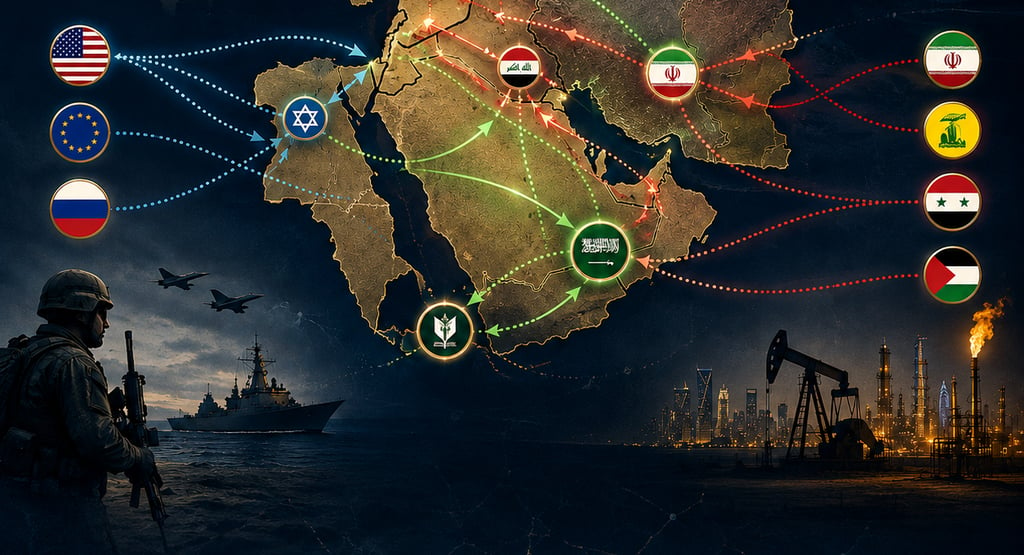
The Middle East is no longer organised around a simple Arab–Israeli divide, nor can it be understood as a neat contest between Iran and the West. Since the Hamas attack on Israel on 7 October 2023, and especially after the escalation into direct US–Israeli conflict with Iran in February 2026, the region has become a dense web of alliances, rivalries, proxy forces, diplomatic hedging, maritime pressure, and competing security agendas.
The question ‘who supports whom?’ now has no simple answer. Some states condemn Israel in public while maintaining security channels behind closed doors. Some Gulf states fear Iran but avoid open confrontation with Tehran. Qatar hosts US military infrastructure while also acting as a channel to Hamas. Oman talks to Iran and the United States. Türkiye condemns Israel but remains inside NATO. Iraq declares neutrality while Iran-aligned militias operate inside its territory. The region is not divided into two clean camps. It is a network of conditional relationships.
The first major shock was the Hamas assault of 7 October 2023, which triggered the Gaza war and pulled Hezbollah, the Houthis, Iraqi militia factions, Iran, the United States, and several Gulf states into a wider regional security crisis. The second shock came when the United States and Israel launched strikes against Iran in February 2026, turning what had long been a proxy confrontation into a direct regional war. The resulting conflict damaged infrastructure, disrupted economies, exposed Gulf vulnerabilities, and reshaped the regional balance.
At the centre of the conflict stands Iran’s regional network, often called the ‘axis of resistance’. This includes Hezbollah in Lebanon, Palestinian Islamic Jihad, elements of Hamas, the Houthis in Yemen, and several Iraqi militia factions. But this network should not be misunderstood as a single army under one central command. Iran provides money, weapons, training, ideology, political cover, and strategic direction, but the level of control varies. Hezbollah is Iran’s deepest and most institutionalised armed partner. The Houthis are Iran-aligned but not simply Iranian puppets. Hamas has received Iranian support, but it also pursues its own Palestinian political and military objectives.
Israel sits on the other side of this network as Iran’s central regional adversary. It is strongly supported by the United States and maintains quiet or functional security relationships with Egypt and Jordan because of peace treaties and border-security imperatives. It also has formal relations with the UAE and Bahrain through the Abraham Accords. However, Gaza has made open Arab normalisation with Israel politically much more difficult. Saudi Arabia, which had been moving cautiously toward possible normalisation, has made clear that any future recognition of Israel must be tied to a credible Palestinian settlement.
The Gulf states are perhaps the most important example of strategic hedging. Saudi Arabia, the UAE, Qatar, Oman, Kuwait, and Bahrain all rely in different ways on American security power, but none wants an uncontrolled regional war. Saudi Arabia sees Iran as a major strategic threat, especially because of missile, drone, and Houthi risks. At the same time, Riyadh has pursued de-escalation with Tehran because its economic transformation agenda depends on stability. The UAE is closer to Israel and the United States, but it is also exposed to Iranian pressure because of its ports, energy infrastructure, and position near the Strait of Hormuz.
Qatar occupies a very different position. It is not a conventional military balancer like Saudi Arabia or the UAE. Its influence comes from mediation, money, diplomacy, and access. Qatar hosts major US military facilities while also maintaining channels to Hamas and Iran. This makes it useful to Washington, Israel, Hamas, and regional negotiators, but also politically vulnerable. To critics, Qatar appears too close to Hamas. To diplomats, it is one of the few actors able to speak to multiple sides at once.
Oman plays a quieter but equally important role. It has long served as a backchannel between Iran and the West. In periods of direct escalation, this role becomes more valuable. Oman’s power lies precisely in avoiding loud alignment. It is inside the Gulf system but not aggressively anti-Iranian. It is acceptable to Washington but not viewed by Tehran as simply a hostile instrument.
Egypt and Jordan are old pillars of regional diplomacy. Both have peace treaties with Israel. Both cooperate with the United States. Both support Palestinian statehood. Both also face domestic political pressure because of Gaza. Egypt is central because Gaza cannot be managed without Cairo: borders, aid, ceasefire talks, hostage negotiations, and post-war governance all pass through Egyptian calculations. Jordan is exposed because of its Palestinian population, its custodial role in Jerusalem’s Islamic holy sites, and its fear of West Bank destabilisation.
Lebanon is not a unified strategic actor. The Lebanese state, Lebanese army, Hezbollah, and sectarian-political factions do not all serve the same strategic logic. Hezbollah is Iran-backed and militarily hostile to Israel. The Lebanese state, by contrast, needs Western, Arab, and international support. This dual structure makes Lebanon one of the region’s most fragile arenas. Hezbollah’s role after 7 October opened the northern front with Israel, but the cost to Lebanon has been severe. The wider war has weakened parts of Iran’s regional network and increased pressure on Hezbollah’s military and political position.
Iraq is another state caught between formal sovereignty and militia penetration. Baghdad maintains relations with Washington, Tehran, Gulf capitals, and international institutions. Yet several Popular Mobilisation Forces factions have close ties to Iran. Iraq may declare neutrality, but Iran-aligned armed groups can still act in ways that expose the country to US, Israeli, or regional pressure. This makes Iraq both a state and a battlefield of influence.
Yemen’s Houthis have become one of the most disruptive non-state actors in the region. Their Red Sea attacks transformed the Gaza war into a global maritime-security crisis. By threatening shipping through the Bab el-Mandeb and Red Sea routes, the Houthis placed pressure not only on Israel but also on global trade, insurance markets, naval deployments, and the Suez Canal economy. Their importance lies in a strategic fact often underestimated: a relatively poor armed movement can impose costs on the global economy if it can threaten a maritime chokepoint.
Türkiye follows its own course. It is a NATO member, but it is not a passive Western-aligned state. Ankara is critical of Israel, supportive of Palestinian political claims, hostile to PKK/YPG-linked Kurdish structures, and pragmatic in its dealings with Russia, Iran, Qatar, and the West. Türkiye’s position has become more visible as regional mediation has expanded beyond the traditional Gulf channels.
The external powers add another layer. The United States remains the decisive hard-security actor: arms, intelligence, air defence, bases, sanctions, and naval power still depend heavily on Washington. But American dominance is no longer uncontested. China is not replacing the United States militarily, but it is increasingly important economically and diplomatically, especially with Iran, Saudi Arabia, and the Gulf. Russia remains influential through Syria, energy politics, and its relationship with Iran. The European powers remain involved through sanctions, diplomacy, maritime missions, humanitarian policy, and legal pressure.
The most dangerous feature of the new Middle East is the fusion of war and geography. The Strait of Hormuz, Bab el-Mandeb, Red Sea, Suez Canal, Eastern Mediterranean, and Gulf ports are now part of the strategic battlefield. The region’s alignments are no longer determined only by ideology, religion, or alliances. They are also determined by who can protect, threaten, bypass, or control maritime routes.
The strategic conclusion is clear. Iran has gained coercive reach but lost deniability. Israel has demonstrated military reach but faces diplomatic compression. The Gulf states have learned that economic transformation cannot survive without hard security. Qatar, Oman, Egypt, Türkiye, and Pakistan have gained value as mediators because they can speak across enemy lines. The United States remains indispensable, but China and Russia have more room to exploit regional fatigue with Western power.
The Middle East is therefore not moving toward a stable alliance system. It is moving toward a conditional, transactional, militarised, and maritime-exposed order. The real question is no longer simply ‘who supports whom?’ It is this: who can deter escalation, preserve trade routes, maintain diplomatic channels, and prevent proxy wars from becoming a permanent regional war system? The Middle East is no longer organised around a simple Arab–Israeli divide, nor can it be understood as a neat contest between Iran and the West. Since the Hamas attack on Israel on 7 October 2023, and especially after the escalation into direct US–Israeli conflict with Iran in February 2026, the region has become a dense web of alliances, rivalries, proxy forces, diplomatic hedging, maritime pressure, and competing security agendas.
The question ‘who supports whom?’ now has no simple answer. Some states condemn Israel in public while maintaining security channels behind closed doors. Some Gulf states fear Iran but avoid open confrontation with Tehran. Qatar hosts US military infrastructure while also acting as a channel to Hamas. Oman talks to Iran and the United States. Türkiye condemns Israel but remains inside NATO. Iraq declares neutrality while Iran-aligned militias operate inside its territory. The region is not divided into two clean camps. It is a network of conditional relationships.
The first major shock was the Hamas assault of 7 October 2023, which triggered the Gaza war and pulled Hezbollah, the Houthis, Iraqi militia factions, Iran, the United States, and several Gulf states into a wider regional security crisis. The second shock came when the United States and Israel launched strikes against Iran in February 2026, turning what had long been a proxy confrontation into a direct regional war. The resulting conflict damaged infrastructure, disrupted economies, exposed Gulf vulnerabilities, and reshaped the regional balance.
At the centre of the conflict stands Iran’s regional network, often called the ‘axis of resistance’. This includes Hezbollah in Lebanon, Palestinian Islamic Jihad, elements of Hamas, the Houthis in Yemen, and several Iraqi militia factions. But this network should not be misunderstood as a single army under one central command. Iran provides money, weapons, training, ideology, political cover, and strategic direction, but the level of control varies. Hezbollah is Iran’s deepest and most institutionalised armed partner. The Houthis are Iran-aligned but not simply Iranian puppets. Hamas has received Iranian support, but it also pursues its own Palestinian political and military objectives.
Israel sits on the other side of this network as Iran’s central regional adversary. It is strongly supported by the United States and maintains quiet or functional security relationships with Egypt and Jordan because of peace treaties and border-security imperatives. It also has formal relations with the UAE and Bahrain through the Abraham Accords. However, Gaza has made open Arab normalisation with Israel politically much more difficult. Saudi Arabia, which had been moving cautiously toward possible normalisation, has made clear that any future recognition of Israel must be tied to a credible Palestinian settlement.
The Gulf states are perhaps the most important example of strategic hedging. Saudi Arabia, the UAE, Qatar, Oman, Kuwait, and Bahrain all rely in different ways on American security power, but none wants an uncontrolled regional war. Saudi Arabia sees Iran as a major strategic threat, especially because of missile, drone, and Houthi risks. At the same time, Riyadh has pursued de-escalation with Tehran because its economic transformation agenda depends on stability. The UAE is closer to Israel and the United States, but it is also exposed to Iranian pressure because of its ports, energy infrastructure, and position near the Strait of Hormuz.
Qatar occupies a very different position. It is not a conventional military balancer like Saudi Arabia or the UAE. Its influence comes from mediation, money, diplomacy, and access. Qatar hosts major US military facilities while also maintaining channels to Hamas and Iran. This makes it useful to Washington, Israel, Hamas, and regional negotiators, but also politically vulnerable. To critics, Qatar appears too close to Hamas. To diplomats, it is one of the few actors able to speak to multiple sides at once.
Oman plays a quieter but equally important role. It has long served as a backchannel between Iran and the West. In periods of direct escalation, this role becomes more valuable. Oman’s power lies precisely in avoiding loud alignment. It is inside the Gulf system but not aggressively anti-Iranian. It is acceptable to Washington but not viewed by Tehran as simply a hostile instrument.
Egypt and Jordan are old pillars of regional diplomacy. Both have peace treaties with Israel. Both cooperate with the United States. Both support Palestinian statehood. Both also face domestic political pressure because of Gaza. Egypt is central because Gaza cannot be managed without Cairo: borders, aid, ceasefire talks, hostage negotiations, and post-war governance all pass through Egyptian calculations. Jordan is exposed because of its Palestinian population, its custodial role in Jerusalem’s Islamic holy sites, and its fear of West Bank destabilisation.
Lebanon is not a unified strategic actor. The Lebanese state, Lebanese army, Hezbollah, and sectarian-political factions do not all serve the same strategic logic. Hezbollah is Iran-backed and militarily hostile to Israel. The Lebanese state, by contrast, needs Western, Arab, and international support. This dual structure makes Lebanon one of the region’s most fragile arenas. Hezbollah’s role after 7 October opened the northern front with Israel, but the cost to Lebanon has been severe. The wider war has weakened parts of Iran’s regional network and increased pressure on Hezbollah’s military and political position.
Iraq is another state caught between formal sovereignty and militia penetration. Baghdad maintains relations with Washington, Tehran, Gulf capitals, and international institutions. Yet several Popular Mobilisation Forces factions have close ties to Iran. Iraq may declare neutrality, but Iran-aligned armed groups can still act in ways that expose the country to US, Israeli, or regional pressure. This makes Iraq both a state and a battlefield of influence.
Yemen’s Houthis have become one of the most disruptive non-state actors in the region. Their Red Sea attacks transformed the Gaza war into a global maritime-security crisis. By threatening shipping through the Bab el-Mandeb and Red Sea routes, the Houthis placed pressure not only on Israel but also on global trade, insurance markets, naval deployments, and the Suez Canal economy. Their importance lies in a strategic fact often underestimated: a relatively poor armed movement can impose costs on the global economy if it can threaten a maritime chokepoint.
Türkiye follows its own course. It is a NATO member, but it is not a passive Western-aligned state. Ankara is critical of Israel, supportive of Palestinian political claims, hostile to PKK/YPG-linked Kurdish structures, and pragmatic in its dealings with Russia, Iran, Qatar, and the West. Türkiye’s position has become more visible as regional mediation has expanded beyond the traditional Gulf channels.
The external powers add another layer. The United States remains the decisive hard-security actor: arms, intelligence, air defence, bases, sanctions, and naval power still depend heavily on Washington. But American dominance is no longer uncontested. China is not replacing the United States militarily, but it is increasingly important economically and diplomatically, especially with Iran, Saudi Arabia, and the Gulf. Russia remains influential through Syria, energy politics, and its relationship with Iran. The European powers remain involved through sanctions, diplomacy, maritime missions, humanitarian policy, and legal pressure.
The most dangerous feature of the new Middle East is the fusion of war and geography. The Strait of Hormuz, Bab el-Mandeb, Red Sea, Suez Canal, Eastern Mediterranean, and Gulf ports are now part of the strategic battlefield. The region’s alignments are no longer determined only by ideology, religion, or alliances. They are also determined by who can protect, threaten, bypass, or control maritime routes.
The strategic conclusion is clear. Iran has gained coercive reach but lost deniability. Israel has demonstrated military reach but faces diplomatic compression. The Gulf states have learned that economic transformation cannot survive without hard security. Qatar, Oman, Egypt, Türkiye, and Pakistan have gained value as mediators because they can speak across enemy lines. The United States remains indispensable, but China and Russia have more room to exploit regional fatigue with Western power.
The Middle East is therefore not moving toward a stable alliance system. It is moving toward a conditional, transactional, militarised, and maritime-exposed order. The real question is no longer simply ‘who supports whom?’ It is this: who can deter escalation, preserve trade routes, maintain diplomatic channels, and prevent proxy wars from becoming a permanent regional war system?
Selected Sources and Evidence
Counter Terrorism Center at West Point, “Regional Terrorism Trends Before and After October 7,” CTC Sentinel, 2025. This supports the article’s framing that the 7 October 2023 Hamas attack triggered a wider regional escalation and reshaped the operating environment for Iran-backed and other violent non-state actors.
Reuters, “Qatari negotiating team in Tehran to try to help secure US-Iran deal to end war, says source,” 22 May 2026. This supports the article’s treatment of Qatar as a regional mediator and provides current evidence on U.S.–Iran war diplomacy, Tehran negotiations, Qatar’s role, and the wider regional stakes around the Strait of Hormuz and Gulf security.
The Guardian, “Qatar sends mediators to Tehran in sign talks to reopen Strait of Hormuz are reaching climax,” 22 May 2026. This supports the article’s discussion of Qatar, Oman, Pakistan, Gulf-state concerns, the Strait of Hormuz, and diplomacy around de-escalation and maritime access.
The Washington Institute for Near East Policy, “Gulf De-escalation and Hedging in the Shadow of US Retrenchment,” 12 September 2023. This supports the article’s analysis of Gulf hedging, especially Saudi and Emirati attempts to de-escalate with Iran while still relying on U.S. security power.
International Transport Forum / OECD, “The Red Sea Crisis: Impacts on Global Shipping and the Case for Action,” 18 March 2024. This supports the article’s treatment of Houthi attacks, Bab el-Mandeb and Red Sea disruption, shipping costs, Suez-route pressure, and the strategic vulnerability of maritime chokepoints.
U.S. Department of State, Office of the Historian, “Camp David Accords and the Arab-Israeli Peace Process.” This supports the article’s reference to Egypt as a long-standing peace-treaty state and diplomatic actor in the Arab–Israeli security architecture.
Chatham House, “The Abraham Accords and Israel–UAE Normalization,” 28 March 2023. This supports the article’s treatment of the Abraham Accords, Israel–UAE relations, and the strategic, political, and economic dimensions of Gulf normalisation with Israel.
House of Commons Library, “Israel and the Abraham Accords in 2025: Five Years On,” 30 September 2025. This supports the article’s discussion of the continuing but politically pressured normalisation architecture after Gaza, including the UAE, Bahrain, Morocco and wider regional implications.
Associated Press, “Oman foreign minister says there will be sixth round of negotiations between Iran and US on Sunday,” 2025. This supports the article’s identification of Oman as a long-standing intermediary and backchannel between Iran and the United States
Source note: This article is based on open-source reporting and strategic analysis. It is written as a public-facing blog article rather than a classified or official intelligence assessment.
Author workflow disclosure
This article was produced through an AI-assisted but human-directed workflow. AI support was used for accessibility assistance, article structuring, language refinement, source-discovery prompts, revision planning, and conversion of editorial comments into specific amendments. The author retained responsibility for the argument, accepted or rejected suggested changes, checked the logic of the claims, and remained accountable for the final text. AI-generated material was not treated as empirical evidence, and synthetic or illustrative examples were not presented as observed data.
Image note
The image accompanying this article is AI-generated and is intended for illustration purposes only.


© 2026 WDA Publishing. All rights reserved.