
Winning the Strike Phase, Losing the Consequence Phase: Trump, Iran, and the Premature Peace Problem
A strategic decision-making analysis arguing that Trump’s Iran policy may have won the strike phase while risking strategic failure by converting military pressure into premature political exit before Iran’s coercive system was broken.
WAR, SECURITY & GEOPOLITICSLEADERSHIP & DECISION-MAKING
Dr Danie Adendorff
6/5/202615 min read
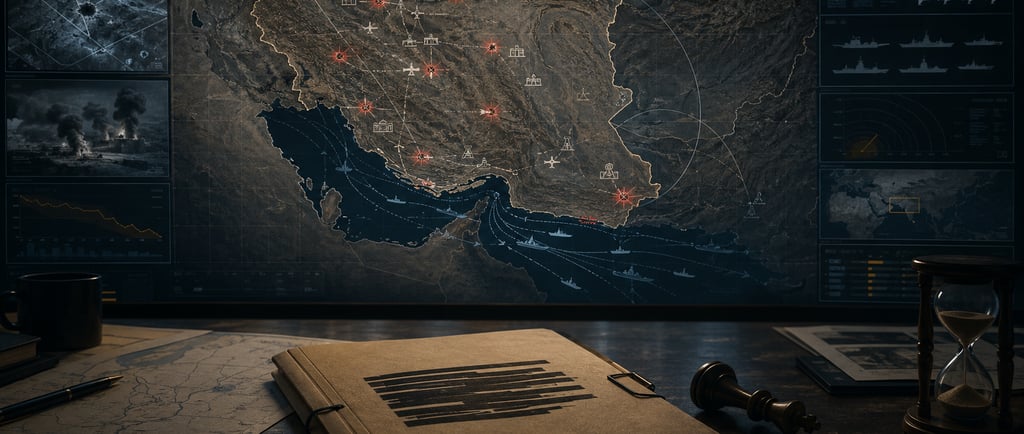
Winning the Strike Phase, Losing the Consequence Phase: Trump, Iran, and the Premature Peace Problem
How Washington may have converted military pressure into regime survival
By Dr Danie Adendorff
Introduction: force is not strategy until it produces consequence
In high-consequence statecraft, the decisive test is not whether a leader acts forcefully. It is whether force is converted into durable strategic consequence. A strike campaign can be dramatic, destructive, and tactically successful while still failing at the level that matters most: the political-strategic result.
That is the problem now confronting President Donald Trump’s Iran policy.
The issue is not whether the United States and Israel inflicted serious military damage on Iran. They almost certainly did. The issue is whether Trump has mistaken visible damage for strategic completion. The emerging evidence suggests a more troubling possibility: that Washington may have won the strike phase but is now at risk of losing the consequence phase.
This article argues that Trump’s Iran decision-making may represent a classic executive failure under pressure: broad initial objectives, insufficient consequence discipline, premature political exit, and post-hoc reframing by senior subordinates. In that framing, Secretary of State Marco Rubio’s recent public defence of the administration is not merely diplomatic explanation. It is also a narrowing of the standard by which success will be judged.
The question is therefore direct: did Trump stop before Iran’s coercive system was broken?
1. The original war logic was broader than Hormuz and the nuclear file
The later public framing of the conflict has increasingly centred on two issues: reopening the Strait of Hormuz and preventing Iran from acquiring a nuclear weapon. Both are legitimate strategic objectives. Neither is trivial. Hormuz is a global energy chokepoint, and Iran’s nuclear programme remains a central non-proliferation challenge.
But the original war logic was broader than that.
The White House’s 1 March 2026 release launching Operation Epic Fury described the campaign as intended to eliminate Iran’s nuclear threat, destroy the regime’s ballistic-missile arsenal, degrade its proxy terror networks, and cripple its naval forces. That was not a narrow Hormuz-and-uranium policy. It was a campaign framed around the coercive architecture of the Iranian state.
The same point was later reinforced by White House and administration statements compiled in April 2026. Trump was recorded as saying that the United States was destroying Iran’s missile capabilities, annihilating its navy, ensuring Iran could never obtain a nuclear weapon, and preventing the regime from continuing to arm, fund, and direct terrorist armies outside its borders. Press Secretary Karoline Leavitt described the objectives as destroying ballistic missiles, razing the missile industry, neutralising terrorist proxies, and guaranteeing that Iran could not obtain a nuclear weapon. Secretary Pete Hegseth and Secretary Rubio similarly framed the campaign around Iran’s navy, missile launchers, missile and drone production base, defence industrial infrastructure, and nuclear denial.
This matters because it independently corroborates the broad structure that Pesach Wolicki identified in his interview: navy, ballistic missiles, proxy-support capacity, nuclear capability, and pressure on the IRGC/regime system. Wolicki’s critique is therefore not floating on a single opinion-source reconstruction. It is aligned with the administration’s own early and mid-campaign language.
The broader policy baseline is also visible in National Security Presidential Memorandum/NSPM-2, issued in February 2025. That document stated that U.S. policy was to deny Iran a nuclear weapon and intercontinental ballistic missiles; neutralise Iran’s network and campaign of regional aggression; disrupt, degrade, or deny resources to the IRGC and its surrogates; and counter Iran’s development of missiles and other asymmetric and conventional capabilities.
Taken together, these sources show that the campaign’s original political logic was not merely nuclear containment. It was coercive-system degradation.
That distinction is central. The Iranian threat is not reducible to a single facility, a single stockpile, or a single waterway. The Islamic Republic’s strategic power rests on an integrated system: the IRGC, missile and drone forces, proxy networks, domestic repression, external finance, smuggling and sanctions-evasion channels, relationships with China and Russia, and the capacity to threaten maritime chokepoints. If those structures remain intact, then a deal that reopens Hormuz and defers the nuclear file may reduce immediate pressure while preserving the underlying threat system.
This is where the policy problem begins. Trump’s original campaign logic appeared expansive. The emerging settlement logic appears narrower. Between those two points lies the danger of strategic drift.
2. The narrowing of success: Hormuz, uranium, and diplomatic manageability
Current reporting suggests that the possible U.S.-Iran settlement framework has focused heavily on reopening the Strait of Hormuz and dealing with Iran’s highly enriched uranium. CBS News reported that Trump’s edits to a possible agreement focused on Hormuz reopening and the removal or destruction of highly enriched uranium. Reuters reported that Rubio told Congress the United States had not offered sanctions relief merely in exchange for reopening the strait and that sanctions relief would be tied to Iran giving up its nuclear programme.
Rubio’s defence is politically understandable. He is trying to demonstrate that the administration is not trading sanctions relief for shipping access alone. He is also trying to preserve leverage and prevent Congress from appearing to restrict Trump’s options while talks continue.
But politically understandable does not mean strategically sufficient.
The emerging public benchmark is now much narrower than the original implied war logic. The visible test of success has moved from the destruction or structural weakening of Iran’s coercive system to a more manageable diplomatic pair: open the waterway and constrain the nuclear file.
That is what I call retroactive objective compression.
Retroactive objective compression occurs when a government begins with broad, regime-threatening, or system-altering objectives, but later narrows the definition of success to whatever settlement appears politically available. It is not always dishonest. Sometimes circumstances compel narrower aims. But it becomes strategically dangerous when the new benchmark allows leaders to declare success while the adversary’s core recovery capacity remains intact.
In this case, the compression is stark. The question is being moved from “Did America break Iran’s war-making and proxy system?” to “Can shipping resume and can the nuclear file be pushed into a controlled negotiation?”
Those are not the same question.
3. Damage is not defeat
A destroyed facility is not the same as a defeated strategy. A crippled navy is not the same as a broken regime. A damaged missile force is not the same as the destruction of the decision system that will rebuild it.
This distinction is essential.
Rubio has argued that Iran has suffered massive destruction and is militarily degraded. Administration statements have similarly claimed major damage to Iran’s navy, missile capacity, air force, launchers, missile factories, drone factories, and conventional military base. Some of those claims may be accurate in significant respects. U.S. and Israeli operations may have damaged naval assets, air defences, launch infrastructure, command nodes, and nuclear facilities.
But strategic defeat requires more than damage. It requires that the adversary can no longer achieve its essential political objective.
Iran’s essential objective was not necessarily to defeat America militarily. It was to survive.
That is the core insight in Wolicki’s critique. He argues that Tehran calculated before the war that it could survive a brutal American assault more easily than it could survive capitulation to American demands. If the regime remains in power, retains its internal coercive organs, keeps key external networks alive, and eventually secures financial relief or maritime leverage, then Iran can present endurance as victory.
This is a familiar logic in asymmetric and revolutionary-state strategy. The weaker actor does not need to win symmetrically. It needs to outlast, preserve command authority, retain ideological legitimacy among its core supporters, and ensure that the stronger actor loses patience before the coercive system is structurally broken.
If Trump now accepts a settlement that leaves the IRGC, proxy networks, internal repression apparatus, and recovery channels broadly intact, the United States may have achieved punishment without strategic transformation.
That is not victory. It is damage without consequence.
4. Iran’s survival strategy: endure, bargain, rebuild
Iran’s strategic behaviour during the war appears consistent with a survival-and-leverage model. CSIS has described Iran’s escalation pattern as both horizontal and vertical: widening the geography of conflict while expanding the target set from military sites to civilian and critical infrastructure in non-combatant Gulf states. Reuters has also reported continuing Gulf flare-ups, Iranian conditions tied to Lebanon, and Hezbollah’s rejection of ceasefire terms that Washington hoped would support a broader diplomatic off-ramp.
There is a legitimate alternative interpretation. Iran’s behaviour could also be read as rational bargaining: a state under pressure maximising leverage before an expected negotiation. That interpretation should not be dismissed. States often escalate not because they expect victory, but because they want better terms.
The reason I read Iran’s behaviour as more than ordinary bargaining is that the bargaining is built around survival of the regime’s coercive system. Iran’s leverage does not come only from negotiating skill. It comes from the continued existence of its pressure instruments: Hormuz disruption, proxy activation, missile and drone attack capacity, internal repression, and external support networks. If those instruments remain available after a settlement, then bargaining and endurance become the same strategy.
The Strait of Hormuz is central to that leverage. Brookings’ Robert Kagan has argued that Iran’s control over access to Hormuz has reversed the power situation by giving Tehran leverage over a major portion of global energy supply. Brookings energy analysts have separately described the closure of Hormuz as the energy security crisis that specialists had long feared, noting that a relatively limited mix of drones, missiles, small boats, threats, insurance risk, and selective coercion can make the strait commercially unusable without requiring a large conventional navy.
Reuters’ recent oil-market analysis indicates that tanker flows through Hormuz remain constrained, opaque, and far from normal, with traders using stealth techniques and dark transit methods to move cargoes through a fragmented market. Even if some oil is escaping, that does not amount to restored maritime freedom. It may instead indicate a more dangerous, more opaque, and more coercive operating environment in which Iran retains significant influence over passage.
This is the strategic problem Trump now faces. If Hormuz is reopened only under conditions that tacitly recognise Iran’s leverage, the United States may secure short-term relief while institutionalising a long-term concession. If sanctions relief, oil revenue access, or indirect maritime-management mechanisms are added without structural constraints on Iran’s military and proxy system, then the regime receives what it needs most: time, revenue, legitimacy, and recovery space.
That is why the question is not simply whether a deal ends fighting. The question is what the deal preserves.
5. The Rubio problem: reframing failure as prudence
Rubio’s public position deserves careful treatment. He is not wrong to argue that diplomacy must remain possible. Nor is he wrong to insist that sanctions relief should be condition-based. A settlement that verifiably removes or destroys Iran’s highly enriched uranium, restores inspection, protects freedom of navigation, and preserves pressure on Iran’s coercive networks would be strategically defensible.
The problem is that Rubio’s framing may also function politically as a shield for an unfinished campaign.
By insisting that sanctions relief is tied to the nuclear programme and not merely to Hormuz, Rubio protects the administration against the charge of a simple concession-for-shipping trade. His statement that a Hormuz tolling system would make a diplomatic deal unfeasible also shows that he understands the maritime-sovereignty issue. That is important. Rubio is not simply surrendering the waterway question.
But that still leaves the broader strategic question unresolved.
What happens to the IRGC? What happens to Iran’s proxy architecture? What happens to ballistic missiles and drones? What happens to the repression machinery that prevents Iranian civil society from converting regime weakness into political change? What happens to Chinese and Russian support channels? What happens to Hezbollah, the Houthis, and other Iran-aligned coercive actors?
If the answer is “later negotiations,” then the administration has not completed the strategy. It has postponed the central issue.
Rubio’s reframing changes the public test. It invites Americans to ask whether Iran agrees to a nuclear concession and Hormuz reopens. It discourages them from asking whether Iran’s coercive system has been broken.
That is politically useful. It is analytically dangerous.
A competent administration may sometimes narrow objectives because circumstances demand it. But if it does so, it must be honest about the trade-off. It should say: “We are accepting a limited settlement because the costs of total coercive degradation are too high.” It should not imply that a narrower deal is equivalent to achieving the broader strategic aim.
The risk is that Washington is lowering the victory standard to fit the settlement now available.
6. Trump’s executive decision failure
The strategic responsibility rests with Trump. Not Rubio. Not the press office. Not congressional critics. Not commentators.
Trump is the decision-maker.
Under the Decision Before Consequence framework, the failure can be analysed through the Executive Intelligence Pipeline: signal, validation, interpretation, escalation, decision, action, and adaptation. Failure must not be inferred merely from an unfavourable outcome. It must be tied to observable behaviour.
On the signal stage, the relevant signals were public and persistent. NSPM-2 identified Iran’s nuclear pathway, ballistic missiles, regional aggression network, IRGC, surrogates, and asymmetric capabilities as U.S. policy targets. The White House’s own Operation Epic Fury releases then framed the campaign around Iran’s navy, missiles, proxy-support capacity, defence industrial base, and nuclear denial. The signal environment was therefore not ambiguous: the Iran problem had been defined as a system problem, not merely a nuclear or maritime problem.
On the validation stage, the observable concern is the gap between broad campaign objectives and the later public emphasis on Hormuz reopening and uranium disposal. Rubio’s June statement that sanctions relief was not offered merely for reopening the strait, and CBS reporting that Trump’s edits focused on Hormuz and highly enriched uranium, both suggest that the negotiation moved toward deliverables that are measurable but narrower than the earlier system-degradation objectives. That does not prove that validation failed inside government. It does show that the public validation standard shifted from “has the coercive system been structurally broken?” to “can the nuclear and maritime files be made negotiable?”
On the interpretation stage, the administration’s repeated claims of massive Iranian degradation are relevant but not decisive. Statements that Iran’s navy, missile launchers, drone factories, air force, and military-industrial base were destroyed or severely weakened may support a judgement of operational success. They do not, by themselves, prove strategic defeat. The interpretive risk is that Trump and his team appear to be treating operational degradation as sufficient evidence that Iran can now be managed diplomatically.
On the escalation stage, observable congressional and Republican hawk criticism matters. Reporting on Republican warnings, the House war-powers vote, and public concern over the emerging deal shows that unresolved consequences were being escalated politically outside the executive branch. The issue is whether those warnings altered the executive decision process. At present, the public record shows a president still pursuing a deal while facing criticism that the settlement may leave Iran strategically intact.
On the decision stage, Trump’s reported edits to the memorandum and his continued pursuit of a negotiated settlement are the observable actions. Negotiation is not inherently a failure. The possible failure lies in accepting political closure before the earlier strategic objectives have been demonstrably achieved.
On the action stage, the immediate practical test is whether the settlement restores verification, preserves sanctions leverage, reopens Hormuz without legitimising Iranian coercion, and constrains missile, drone, proxy, and IRGC recovery capacity. If it does not, then the action taken will have relieved pressure without securing consequence.
On the adaptation stage, the relevant question is whether Washington retains clear enforcement triggers, credible snapback mechanisms, and a demonstrated willingness to reimpose pressure if Iran exploits the pause. A settlement without enforceable adaptation mechanisms would invite Tehran to treat the agreement as recovery space rather than strategic constraint.
This is the central charge against Trump: not that he used force, and not that he considered negotiation. Negotiation is not weakness. Restraint is not automatically failure. The failure would be negotiating from a compressed definition of victory after broad coercive objectives had been publicly implied.
If this is what has happened, Trump has not merely made a diplomatic compromise. He has allowed political exit to precede strategic consequence.
7. The counterargument: restraint may still be rational
A serious article must acknowledge the counterargument.
There are credible reasons to avoid open-ended escalation. A wider war could damage Gulf infrastructure, intensify attacks on U.S. forces, accelerate energy inflation, destabilise allied economies, and produce regional disorder. Regime collapse in Iran could generate fragmentation, civil conflict, refugee flows, loose weapons, IRGC factionalism, and a struggle among external powers to shape the successor order. The United States may also have exhausted politically acceptable war aims, even if not militarily necessary capabilities.
There is also a wider force-planning argument. The United States cannot expend high-end munitions indefinitely in one theatre without considering readiness for other contingencies, particularly the Western Pacific. Strategic leaders must avoid solving one crisis in a way that degrades readiness for another.
There is also the possibility that Trump is preserving leverage while reducing immediate escalation risk. The current settlement may be interim rather than final. Nuclear material may still be removed. Inspections may resume. Sanctions may remain conditional. Iran may be more damaged than outside observers can currently measure. Some classified effects may not be visible.
These arguments matter.
But they do not defeat the critique. They refine it.
The critique is not that restraint is always wrong. The critique is that restraint without consequence discipline can become premature closure. A limited settlement can be wise if it freezes gains, constrains recovery, preserves leverage, and creates enforceable triggers for renewed pressure. It becomes strategically dangerous if it relieves pressure while allowing the adversary’s coercive system to regenerate.
The test is not whether Trump avoids escalation. The test is whether he avoids rewarding endurance.
8. What a competent strategic settlement would require
A serious settlement would need more than public language about nuclear weapons and Hormuz.
First, it would require verifiable control of Iran’s highly enriched uranium. AP has reported that the IAEA is unable to provide current information on the size, composition, or whereabouts of Iran’s enriched uranium stockpile and cannot fully discharge its safeguards responsibilities. That is a decisive warning. A settlement that does not restore inspection and verification is not a nuclear settlement. It is a political statement under uncertainty.
Second, it would require a freedom-of-navigation outcome in Hormuz that does not legitimise Iranian coercive control. Any system of fees, permits, tolls, or “management” that gives Iran de facto power over passage risks converting wartime disruption into a new maritime order.
Third, it would require constraints on missile and drone recovery. Iran’s conventional and asymmetric strike systems are not peripheral. They are the operational bridge between Iranian policy and regional coercion.
Fourth, it would require sustained pressure on proxy financing, weapons transfer, and command coordination. Hezbollah, the Houthis, Hamas, and associated networks cannot be treated as secondary issues if they remain the mechanism by which Tehran projects power while avoiding direct state-to-state accountability.
Fifth, it would require no sanctions relief without phased verification. Revenue restoration before behavioural constraint would allow Tehran to rebuild.
Sixth, it would require snapback triggers that are public enough to deter Iran and precise enough to avoid later ambiguity.
Seventh, it would require a political line on Iranian civil society. This does not necessarily mean promising regime change. It means refusing to abandon Iranian civil society rhetorically after invoking its freedom; preserving sanctions against repression organs; supporting secure communications, documentation of abuses, broadcasting, exile networks, and human-rights monitoring; and making clear that internal repression will remain a sanctions and accountability issue even if nuclear talks proceed. If Washington is not pursuing regime change, it must say so. If it is supporting civil society, it must define what that support means.
Eighth, it would require monitoring of Chinese and Russian support channels. A settlement that constrains formal Iranian behaviour while allowing external resupply, technology transfer, sanctions evasion, and revenue restoration would not prevent strategic recovery.
Finally, it would require an explicit consequence test: what exactly will Iran be unable to do after the settlement that it could do before the war?
If the answer is unclear, the settlement is not strategic. It is administrative.
9. Strategic judgement
The current evidence does not prove that Trump has already lost the Iran war. The final terms remain uncertain. Some military effects are not publicly visible. Diplomacy may still produce enforceable constraints. Iran may be weaker than its rhetoric suggests.
But the evidence does justify a severe warning.
Trump appears to be moving from expansive coercive rhetoric to compressed diplomatic deliverables. Rubio’s public defence narrows the success criteria. Iran still appears to retain significant leverage over Hormuz. The IAEA cannot yet verify the enriched uranium picture. Hezbollah and Lebanon remain tied to the wider settlement environment. Iran’s proxy and coercive architecture does not appear conclusively broken. Wolicki’s critique captures the political danger: Iran did not need to defeat America militarily. It needed to survive Trump politically.
That is the central strategic risk.
If the emerging settlement leaves the IRGC, proxy architecture, repression machinery, missile-drone recovery capacity, and external support networks intact, then Trump will not have ended the Iranian threat. He will have converted battlefield pressure into regime survival.
The real danger is not that America struck Iran. The danger is that America may have stopped before the consequences of striking Iran were strategically secured.
In the language of decision failure, this is the premature peace problem: the leader acts decisively in the strike phase but loses discipline in the consequence phase.
Iran did not need to win the war in the American sense. It needed to remain standing when Washington wanted a way out. If Trump allows pressure to become exit before consequence, then the real victor will not be peace. It will be the Iranian regime’s capacity to endure.
Selected Sources / References
Associated Press. “UN nuclear watchdog says it’s unable to implement its monitoring responsibilities in Iran.” 4 June 2026.
Brookings. “Has the US lost the Iran war?” The Brookings Current, with Robert Kagan, Melanie Sisson, and Michael O’Hanlon. May 2026.
Brookings. “The Iran war is making energy more expensive for everyone.” Samantha Gross and Adie Tomer. 13 May 2026.
CBS News. “Trump recently edited possible U.S.-Iran agreement, including on enriched uranium and Strait of Hormuz, source says.” 2026 live updates.
Center for Strategic and International Studies. “Visualizing Iran’s Escalation Strategy.” 27 March 2026.
Center for Strategic and International Studies. “Iran’s War Strategy: Don’t Calibrate — Escalate.” 16 March 2026.
Guardian. “Republican lawmakers warn of ‘disastrous mistake’ as Trump nears deal with Iran.” 24 May 2026.
Reuters. “Rubio says a Hormuz tolling system would make Iran diplomatic deal unfeasible.” 21 May 2026.
Reuters. “Rubio says US has not offered Iran sanctions relief to reopen strait.” 2 June 2026.
Reuters. “Oil falls as Lebanon-Israel ceasefire raises hopes of Iran deal.” 4 June 2026.
Reuters. “More oil escapes Hormuz, keeping traders guessing.” 4 June 2026.
The White House. “National Security Presidential Memorandum/NSPM-2.” 4 February 2025.
The White House. “Peace Through Strength: President Trump Launches Operation Epic Fury to Crush Iranian Regime, End Nuclear Threat.” 1 March 2026.
The White House. “President Trump’s Clear and Unchanging Objectives Drive Decisive Success Against Iranian Regime.” 1 April 2026.
Wolicki, Pesach. Jerusalem Post opinion article: “Trump said he’d save the Iranian people, but his deal saves the regime.” 28 May 2026.
Wolicki interview transcript supplied by Dr Danie Adendorff, June 2026.
Author workflow disclosure
This article was produced through an AI-assisted but human-directed workflow. AI support was used for structuring, language refinement, research planning, source-discovery prompts, and conversion of analytical notes into draft form. The author retained responsibility for the argument, accepted or rejected changes, assessed the credibility of sources, checked claim logic, and remains accountable for the final text. AI-generated material was not treated as empirical evidence.
Image note
If an AI-generated image is used with this article, add: The image accompanying this article is AI-generated and is intended for illustration purposes only.


© 2026 WDA Publishing. All rights reserved.