
You Can Win the Battle and Lose the War: Trump, Iran, and the Failure of Decision Before Consequence
A strategic analysis of how the U.S.–Israeli campaign against Iran may have achieved tactical military success while failing to secure its larger political and strategic objectives.
WAR, SECURITY & GEOPOLITICSLEADERSHIP & DECISION-MAKING
Dr Danie Adendorff
6/4/202614 min read
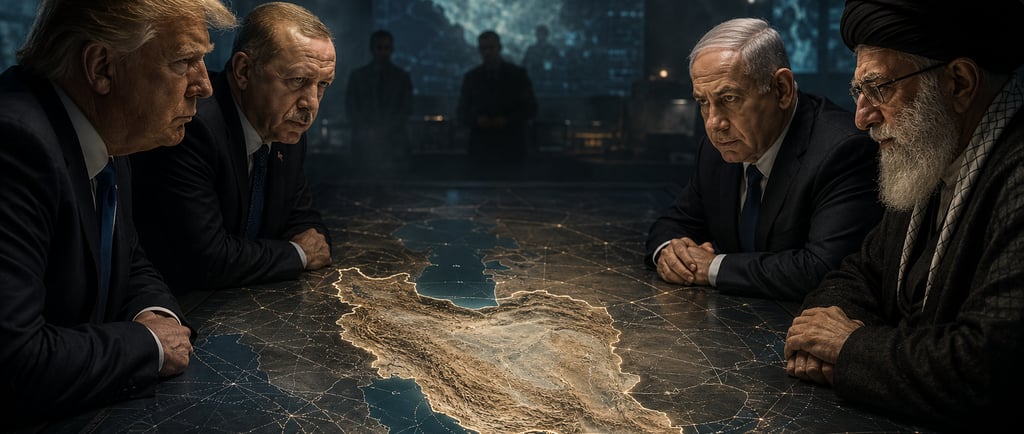
You Can Win the Battle and Lose the War: Trump, Iran, and the Failure of Decision Before Consequence
The Iran campaign may have shown American and Israeli military power. It did not necessarily show strategic judgement.
By Dr Danie Adendorff
War is not judged by the violence of its opening strike. It is judged by whether force achieves the political condition for which it was used. A state can destroy targets, kill commanders, disrupt infrastructure, and dominate the first phase of a campaign - and still fail strategically if it cannot convert force into settlement, settlement into control, and control into durable political advantage.
That is the central problem in the U.S.-Israeli war against Iran. The campaign demonstrated serious tactical and operational reach. It placed extraordinary pressure on Tehran, degraded elements of Iranian military infrastructure, and showed that American and Israeli forces could strike deep inside Iranian strategic space. Yet the more important question is not whether targets were hit. The serious question is whether the campaign achieved the political objectives that gave the war strategic meaning.
If the real objectives included regime change, durable neutralisation of Iran’s nuclear programme, recovery or accounting of nuclear-weapons-related material, restoration of regional deterrence, and a stable post-conflict order, then the campaign now looks much less like strategic victory and much more like a case study in decision failure. If, however, the objective was only limited degradation and temporary coercive pressure, then the assessment is more mixed. The central analytical task is therefore to distinguish military effect from strategic result.
This article does not argue that Iran won. Nor does it argue that American and Israeli military action was tactically ineffective. It argues something more important: military effectiveness is not the same as strategic success. Power without decision discipline produces destruction without closure. In the language of Decision Before Consequence, this was not merely a military campaign. It was a test of executive judgement under high-consequence conditions.
1. Winning the battle is not the same as winning the war
The distinction between tactical success, operational success, and strategic victory is not academic. It is the difference between destroying an enemy capability and achieving the political purpose for which war was launched.
Tactical success concerns the immediate performance of force: aircraft launched, targets destroyed, commanders killed, infrastructure degraded. Operational success concerns the wider military design: whether the campaign disrupted the enemy’s command system, constrained its manoeuvre, degraded its weapons pipeline, and produced cumulative advantage. Strategic victory is different. It asks whether military action created the desired political condition.
On this standard, the Iran campaign must be judged cautiously. Confirmed reporting supports the conclusion that the United States and Israel generated significant military effects. The broader strategic judgement is necessarily more inferential. The Iranian regime remained in place; the Islamic Revolutionary Guard Corps remained a central internal power structure; the nuclear-material question remained insufficiently transparent; and the Strait of Hormuz, Gulf maritime security, missiles, drones, and proxy networks continued to matter as Iranian instruments of leverage. These indicators do not prove that the campaign failed in every respect. They do show that military effect had not yet become strategic closure.
The core problem is therefore not whether the United States and Israel could hit Iran. They could. The problem is whether they could shape Iran after hitting it. That is where the campaign appears to have fallen short.
2. What were the real objectives?
The public defence of the war now appears narrower than some of the earlier language and planning indicators suggested. The campaign is increasingly described as a limited effort to degrade Iran’s military and nuclear capabilities. Such a limited objective is legitimate if it was genuinely the objective from the beginning. But if broader objectives were implied, planned for, or publicly encouraged before the outcome became uncomfortable, then a later retreat into minimalist language becomes part of the evidence, not merely an explanation.
The available record points to a wider strategic ambition than simple degradation. Serious reporting and policy analysis have described objectives that included regime pressure, leadership removal or transition, nuclear and ballistic-missile degradation, and the possibility of engineered political change. The UK House of Commons Library described the U.S.-Israeli strikes as aimed at inducing regime change and targeting Iran’s nuclear and ballistic missile programme. RUSI argued that the U.S.-Israeli strikes implied preferred political end-states and depended on assumptions about regime resilience, anti-regime sentiment, and the effects of airpower. CSIS identified a broad set of possible American objectives, ranging from nuclear denial and missile degradation to proxy disruption and regime change.
This matters because the strategic evaluation changes according to the real objective. If the objective was punishment, the campaign may be judged successful. If the objective was temporary degradation, it may be judged partially successful. If the objective was regime collapse, durable nuclear settlement, nuclear-material control, and restored deterrence, the result is far weaker.
The danger is retrospective objective management: after maximal aims fail, leaders and supporters claim that those aims were never central. That may sometimes be true. But war analysis cannot accept post-war language at face value. It must ask what leaders were trying to achieve before they knew whether the campaign would succeed.
3. The Ahmadinejad and Kurdish sequence: uncertain evidence, serious implications
The reported Ahmadinejad and Kurdish sequence must be handled with care. It is one of the article’s most consequential claims, but also one of its most sensitive evidentiary areas. The available reporting does not justify treating every detail as established fact. The safer assessment is that a regime-transition concept involving Ahmadinejad and Kurdish mobilisation is credible enough to analyse, but not sufficiently transparent to treat as fully proven in all operational detail.
That distinction matters. Ynet, Times of Israel, and reporting linked to Tamir Hayman’s PBS/Firing Line interview indicate that Mahmoud Ahmadinejad may have been considered as a transitional figure in a post-Khamenei scenario. The reported concept allegedly included a strike near his residence, not as an assassination attempt, but as part of a sequence intended to release or reposition him politically. Other reporting has suggested that Kurdish mobilisation in northwestern Iran was viewed as a major lever to destabilise the regime from within.
The first conclusion is therefore not certainty, but seriousness. If even the broad outline is accurate, the campaign was not merely a limited strike operation. It contained, or at least intersected with, a regime-transition architecture. That would place the campaign in a much more ambitious category than post-war minimalist explanations suggest.
The second conclusion is fragility. Using Ahmadinejad as a transitional figure would have been politically hazardous from inception. He is a former president of the Islamic Republic, not a broadly accepted democratic opposition figure. He carries hard-line baggage, domestic controversy, and international reputational liabilities. He may have appeared useful precisely because he was an insider and nationalist figure, but that same feature made him an unstable instrument for political transformation.
The third conclusion is analytical rather than factual: a plan that depends on a controversial insider, minority mobilisation, rapid regime fracture, and external military shock requires exceptionally disciplined intelligence validation. The evidence currently available does not demonstrate that such validation was adequate.
4. The Kurdish lever and the Turkish veto
The Kurdish element is central because it shows where operational imagination collided with geopolitical reality. The confirmed reporting does not establish every operational detail of the alleged Kurdish invasion concept. It does, however, support a narrower but important conclusion: Kurdish mobilisation was discussed as a serious strategic lever, Kurdish actors faced an unclear American end-state, and the option did not materialise.
Reuters reported that Kurdish forces were kept out of the war by mixed American signals, Iranian pressure, and regional constraints. Chatham House had already warned that Kurdish groups in Iran faced a dangerous dilemma because the U.S. end-state was unclear. Hayman-linked reporting further suggests that Kurdish military mobilisation was not a marginal idea, but a major part of the wider sequence. The Reuters and Chatham House material support the factual claim that the Kurdish lever failed to activate; the stronger claim that this was the central pillar of the entire regime-change plan remains an analytical inference supported by, but not fully proven from, open sources.
Turkey’s role was foreseeable. Any plan involving Kurdish military action in or near Iran had to anticipate Ankara’s reaction. President Erdoğan has consistently treated Kurdish armed mobilisation as a direct threat to Turkish security. If the war plan depended on Kurdish activation, Turkish opposition was not an unexpected complication. It was a first-order strategic constraint.
A competent adversarial stress test would have asked before the first strike: What happens if Turkey vetoes Kurdish participation? What happens if Iraqi Kurdish authorities hesitate? What happens if Iran pre-empts Kurdish mobilisation through strikes or intimidation? What happens if Washington signals encouragement and then withdraws political cover? What happens to Kurdish actors if they are encouraged to move and then left exposed?
These were not obscure risks. They were central to the design. If the internal-collapse theory depended on the Kurdish lever, and if that lever could be disabled by Turkey, Iranian deterrence, or American ambiguity, then the plan’s strategic backbone was fragile from inception. That last sentence is an assessment, not a confirmed operational record. It follows from the interaction between reported planning, publicly known Turkish security policy, and the observed non-activation of the Kurdish option.
5. The nuclear question: the verification problem that cannot be wished away
The nuclear issue is the most serious unresolved question. It should not be overstated, but neither should it be minimised.
On current public evidence, the most defensible claim is not that nuclear material was definitely lost, moved, hidden, or left unrecovered. The defensible claim is that the verification status remains unclear, and that such uncertainty is itself a strategic problem. Reuters reported that Iran had not informed the IAEA of the fate of its enriched uranium since the attacks and had not allowed inspectors to return to the relevant storage sites. Earlier IAEA reporting placed Iran’s stockpile of uranium enriched up to 60 percent at approximately 440.9 kg before the attacks. These are verification facts, not merely political allegations.
The IAEA dimension is therefore central. If the Agency has full access, updated accountancy, and credible confirmation of the status of nuclear material, that would strengthen the claim of strategic success. If access is incomplete, if accountancy is delayed, if inspection is constrained, or if key material remains unverified, then the campaign has not closed the nuclear file. It has displaced it into a harder verification environment.
This distinction matters because military action against nuclear infrastructure can create an illusion of resolution. A destroyed facility is visible. A dispersed stockpile is not. Damaged centrifuge halls can be photographed. Knowledge, material, technical teams, and undeclared pathways are harder to see. The most dangerous outcome is not necessarily failure to destroy a site. It is political declaration of success before verification has caught up with consequence.
The strategic question is therefore simple: did the campaign produce verifiable nuclear closure, or did it produce military damage combined with continuing uncertainty? On the present public record, the latter remains a serious possibility. Until IAEA access, accountancy, and material-status reporting are restored and made credible, the nuclear file cannot be treated as strategically closed.
6. Trump’s decision pathology: from decisions to inference
The critique of President Trump should not begin with personality. It must begin with decisions.
The observable decision pattern appears to include several features. First, the campaign moved between broad strategic ambition and narrower post-hoc justification. Second, it appears to have relied on assumptions about regime fragility, internal mobilisation, and the psychological effect of leadership decapitation. Third, it seems to have underestimated the operational and political difficulty of activating Kurdish pressure inside or near Iran. Fourth, it had to adjust when Turkey and regional actors resisted the Kurdish lever. Fifth, the emerging end-state appears closer to an interim arrangement than to decisive strategic closure.
From those decisions, a leadership inference can be drawn cautiously. The campaign bears signs of overconfidence bias, impatience with complex coalition constraints, and a preference for visible military effect over slow political architecture. This is where character becomes analytically relevant: not as insult, but as decision pathology.
Arrogance, in strategic decision terms, is inflated confidence in one’s capacity to impose political outcomes through force. Impatience is unwillingness to respect the time required for intelligence validation, coalition management, and end-state design. The quick-win illusion is the belief that tactical shock can substitute for political architecture. The Iran campaign appears vulnerable to all three.
This is not simply a Trump problem. It is a recurring executive failure in high-consequence decision-making. Leaders decide what victory should look like, select evidence that makes the desired outcome appear plausible, and then discover that adversaries, allies, proxies, geography, institutions, and time do not obey political narrative.
That is narrative command: the attempt to govern reality through the story leaders need to tell about it. Narrative command is dangerous because it reverses the intelligence process. Instead of allowing validated intelligence to discipline decision, it forces intelligence fragments to serve a preferred decision narrative.
In Decision Before Consequence terms, this is a breakdown of the Executive Intelligence Pipeline. Signals were available. The dangers were foreseeable. But validation did not sufficiently discipline ambition. Interpretation favoured optimism. Escalation outran political design. Adaptation became the search for a survivable exit.
7. What would success have looked like?
A rigorous failure argument requires a counterfactual. If the campaign is judged to have failed strategically, one must ask what success would have looked like.
A maximalist success would have required regime collapse, a credible transitional authority, secure control or verified accounting of nuclear material, suppression of IRGC counter-mobilisation, neutralisation of Iran’s missile and drone retaliation capacity, stabilisation of maritime routes, and regional acceptance of the post-war order. That was always an extraordinarily demanding standard.
A more limited but still meaningful success would have required less. It would have required verifiable nuclear rollback, restored IAEA access, an enforceable halt or severe restriction on enrichment, durable reduction in missile and drone threat, stabilised Gulf shipping, and a political settlement that constrained Iranian escalation without empowering the IRGC domestically.
A minimalist success would mean temporary degradation, limited sanctions leverage, and a pause in open hostilities. That may still be valuable. But it should not be confused with strategic victory.
The emerging problem is that the campaign may end closer to minimalist success while being justified in language that once implied something much larger. That gap between ambition and outcome is the centre of the failure argument.
8. Tactical brilliance, strategic emptiness
The United States and Israel did not gain nothing. That claim would be too absolute. Confirmed reporting and official statements support the conclusion that they gained battlefield and coercive effects: reach, damage, disruption, pressure, and possibly delay in parts of Iran’s military and nuclear ecosystem.
The strategic inference begins after that point. The proper comparison is not between action and inaction. The proper comparison is between objectives and outcomes. If the aim was punishment, the campaign succeeded. If the aim was degradation, the campaign likely succeeded in part. If the aim was to frighten Tehran into temporary concession, the campaign may have produced leverage. But if the aim was regime change, durable nuclear neutralisation, recovery or verified accounting of nuclear material, secure Gulf maritime order, removal of IRGC dominance, proxy dismantlement, and stable deterrence, the campaign failed or remains unproven.
The evidence therefore supports a differentiated judgement. Tactical and operational gains are visible. Strategic closure is not. Some unresolved indicators - regime survival, interim diplomacy, incomplete nuclear verification, Kurdish non-activation, and continuing maritime/security leverage - are confirmed or strongly reported. The conclusion that these indicators amount to strategic failure is an analytical assessment, not a single reported fact.
This is the classic danger of modern coercive war.
Airpower can destroy. It cannot, by itself, govern political consequence.
9. Decision Before Consequence: where the campaign failed
The Iran campaign is best understood as a case study in failed decision conversion.
The first failure was signal selection. Evidence of Iranian vulnerability appears to have been privileged over evidence of regime resilience. Opposition, ethnic grievance, elite tension, and public discontent may all have existed, but none automatically translated into regime collapse.
The second failure was validation. The Kurdish option was never merely military. It was political, regional, ethnic, Turkish, Iraqi, Iranian, and American at the same time. To validate it properly required testing whether Kurdish forces could move, whether they would be protected, whether Turkey would tolerate the move, whether Iran could deter it, and whether Washington would sustain the commitment.
The third failure was interpretation. Strikes were interpreted as a possible pathway to collapse rather than as one instrument in a much larger political contest. The regime’s coercive apparatus was not a passive target. It was an adaptive security system.
The fourth failure was escalation. The campaign escalated faster than the political end-state matured. The United States and Israel could initiate violence more easily than they could define the post-strike order.
The fifth failure was authority-accountability alignment. Who owned the consequences of encouraging internal pressure and then stepping back? Who owned the consequences of a failed transition concept? Who owned the nuclear verification gap if material remained unaccounted for or inaccessible? Strategic responsibility cannot be outsourced to proxies, allies, intelligence services, or post-war messaging.
The sixth failure was reversibility. Once war begins, leaders lose control over many variables. Iran can retaliate. Turkey can object. Kurds can hesitate. Gulf shipping can be disrupted. Markets can react. Congress can resist. The public can tire. The adversary can survive. A high-consequence decision requires reversibility assessment before action, not after consequences arrive.
The final failure was adaptation. Instead of adapting toward a coherent strategic settlement, the campaign appears to have adapted toward a politically survivable exit. That is not the same thing.
10. The war America may have won too early and lost too late
The strongest defensible conclusion is not that America suffered a battlefield defeat. It did not. Nor is it that Iran emerged stronger in every respect. It did not. Iran was damaged, pressured, and exposed.
The more precise conclusion is this: the United States and Israel appear to have won the opening campaign but failed, at least on current evidence, to secure strategic closure.
Some elements of that judgement are strongly supported by public reporting: the regime survived; the conflict appears to be moving toward an interim rather than final settlement; core disputes over missiles, enrichment, sanctions, maritime security, and regional deterrence remain unresolved; and the Kurdish mobilisation option did not materialise. Other elements remain informed analytical inference: the exact internal balance inside the IRGC, the full scope of the Ahmadinejad plan, the degree to which Washington privately redefined victory after maximal objectives became unreachable, and the final status of all nuclear material pending full verification.
That distinction is essential. The evidence does not yet permit every conclusion to be stated with equal confidence. But it does permit a serious strategic assessment: the campaign produced military damage without demonstrable political closure.
That is why this war may become a textbook example of the principle that one can win the battle and lose the war. The military instrument worked. The decision system did not.
The lesson is not anti-American. It is not pro-Iranian. It is not partisan. It is strategic. No state, however powerful, can bomb its way out of incoherent objectives. No president, however confident, can substitute personal conviction for validated intelligence. No alliance can achieve durable victory if it has not defined the political condition that follows force.
The Iran campaign should therefore be remembered not only as a war of missiles, aircraft, drones, covert plans, and maritime pressure. It should be remembered as a failure of decision before consequence.
Selected source notes and references
Reuters. “War may end in interim deal that leaves Iran battered but unbowed.” 3 June 2026.
Reuters. “Trump’s mixed messages and Iran’s bombs kept the Kurds out of the war.” 8 April 2026.
Reuters. “Iran’s strongest card in nuclear talks: its highly enriched uranium.” 29 May 2026.
International Atomic Energy Agency. “IAEA Director General’s Introductory Statement to the Board of Governors.” 2 March 2026.
International Atomic Energy Agency. “Monitoring and Verification in Iran.” Topic page and related safeguards statements.
RUSI. “Four Alternative End States in Iran - the Only Good One Becomes Unlikely.” 1 April 2026.
War on the Rocks. “Regime Change in Iran, Underpants Gnomes, and the Phase II Problem.” 13 April 2026.
War on the Rocks. “What’s Going On in Iran?” May 2026.
War on the Rocks. “Missiles Aren’t Strategy: Lessons From Iran for a Pacific Air War.” May 2026.
CSIS. “Who Is Winning the Iran War?” 2 April 2026.
CSIS. “U.S. and Israel Strike Iran - What Comes Next?”
Chatham House. Winthrop M. Rodgers. “Kurdish groups in Iran face risky dilemma amid unclear US endgame.” 9 March 2026.
House of Commons Library. “Israel/US-Iran conflict 2026: Background and UK response.” 24 April 2026.
Ynet. “Senior military intelligence figure reveals that there was plan to install Ahmadinejad to lead Iran.” June 2026.
Firing Line with Margaret Hoover. “How the war plan against Iran went haywire.” May 2026.
Times of Israel / New York Times reporting on the alleged Ahmadinejad transition plan.
The Guardian. “Looming Iran peace deal shows how Trump’s maximalist goals have shrunk.” 30 May 2026.
Author workflow disclosure
This article was produced through an AI-assisted but human-directed workflow. AI support was used for accessibility assistance, structuring, language refinement, source-discovery prompts, revision planning, and conversion of editorial comments into amendments. Dr Danie Adendorff retained responsibility for the argument, accepted or rejected changes, checked the logic of claims, assessed source credibility, and remained accountable for the final text. AI-generated material was not treated as empirical evidence, and synthetic or illustrative examples were not presented as observed data.


© 2026 WDA Publishing. All rights reserved.