
The Child as Checkpoint
A political opinion essay arguing that Britain’s under-16 social-media ban must be judged not only by its protective intention, but by the identity, age-assurance and permission infrastructure it may leave behind.
POLITICS & SOCIETY
Dr Danie Adendorff
6/19/202611 min read
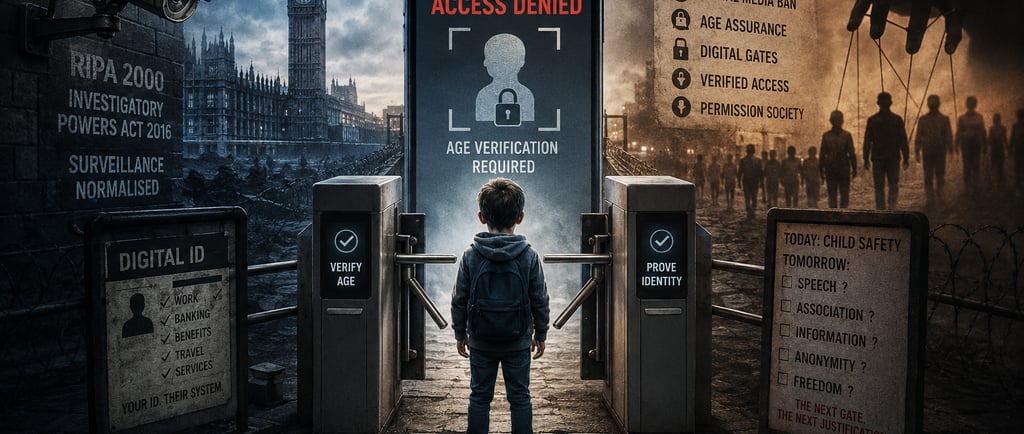
The Child as Checkpoint
Social-Media Bans, Digital ID and the Politics of Protective Deception
Dr Danie Adendorff
The child becomes the argument.
Britain’s under-16 social-media ban is no longer a distant proposal. The government has announced that, from Spring 2027, under-16s will be barred from certain major social-media platforms. Regulations are expected before Christmas 2026. The measure is aimed at platforms such as TikTok, Snapchat, YouTube, Instagram, Facebook and X, while messaging services such as WhatsApp and Signal are excluded from the ban. That distinction matters. The government is not proposing a total ban on children communicating online. It is targeting high-risk, algorithmic, user-to-user platforms.
A serious critic must begin with the truth the government is using. Online harm is real. Children are exposed to addictive design, self-harm material, bullying, sexualised content, predatory contact, commercial profiling and recommendation systems designed to maximise engagement. Many parents are outmatched by platform architecture. Schools are struggling with behavioural and psychological spillover from digital life. The state cannot simply pretend that this is a private family matter.
But a real harm does not automatically justify every instrument proposed in its name. The fact that children need protection does not settle the question of how protection should be delivered, what infrastructure it creates, and whether that infrastructure will remain confined to the original purpose.
This is the centre of the essay: when government presents control as care, the democratic question is not only whether the care is necessary. It is also what the machinery of care makes possible later.
Protective deception.
The phrase “protective deception” must be handled with discipline. It should not mean that every minister is lying, that child safety is invented, or that every official involved in online-safety policy is secretly constructing a surveillance state. That would be too crude, and it would weaken the argument.
Protective deception is more subtle. It occurs when government places the moral emphasis on the protected object while giving insufficient public attention to the control system being created underneath. The protected object may be entirely real: the child, the terror victim, the abused person, the defrauded taxpayer, the exploited worker, the threatened community. The deception lies not in the existence of the harm, but in the incomplete presentation of the remedy.
The public is asked to consent to the moral purpose before it has fully examined the administrative mechanism. That is how modern control often advances. It does not always arrive as a declared assault on liberty. It arrives as safety, efficiency, fraud prevention, protection, modernisation or care.
The older political lie was the direct falsehood. The modern political lie is often consent by emphasis.
The RIPA precedent.
RIPA is useful here not because it was simply an anti-terrorism law. It was not. The Regulation of Investigatory Powers Act 2000 was also a legal modernisation measure, a human-rights compliance measure and a statutory framework for regulating covert investigatory powers. It brought interception, communications data, directed surveillance, intrusive surveillance, covert human intelligence sources and access to protected electronic data under a clearer legal regime.
Yet RIPA also belongs to a wider political pattern. Intrusive capability was justified through the language of serious crime, national security and protection from hidden threats. The public was told that new legal tools were needed because danger had moved into communications systems, encrypted channels and covert networks.
Some of that was true. But it also illustrates the recurring structure of protective power. A harm is identified. A legal power is introduced. The power is regularised. Later statutes modernise and extend the same architecture. The Investigatory Powers Act 2016 then reorganised and updated parts of that investigatory framework for a more technologically complex age.
The point is not that every security power is illegitimate. The point is that protective language can become the permanent grammar through which the state builds capability. Once a power is normalised, the original crisis does not have to remain present for the architecture to survive.
Digital ID did not disappear. It fragmented.
The digital-ID story is even more instructive. The government’s attempt to make digital identity a mandatory route for workers met heavy public resistance. A petition against digital ID attracted nearly three million signatures, and the government scaled back the most politically toxic version of the scheme. That matters. It shows that public resistance can still interrupt centralising projects.
But it would be naïve to conclude that the identity agenda simply disappeared. The sharper lesson is that compulsory identity architecture can retreat from one obvious symbol and reappear through narrower, more acceptable use cases.
The government’s original digital-ID language included illegal working, secure borders, identity fraud and public-service convenience. After resistance, the emphasis shifted. Digital identity became less about compulsion and more about convenience, joined-up services and everyday administrative ease. The public rejected the blunt version. The softer architecture remains politically alive.
This is how modern identity systems may advance: not necessarily through one national card, but through a series of smaller gates. Employment checks. Border checks. Benefit checks. Banking checks. Housing checks. Age checks. Platform checks. Each gate has its own justification. Each gate can be defended separately. Together they habituate the citizen to the idea that ordinary life requires proof before participation.
The under-16 social-media ban should be read within that wider movement.
Age assurance is the bridge, but not always the whole bridge.
The strongest objection to this essay is that age assurance does not necessarily equal digital ID. That objection is correct as far as it goes. Some age-assurance methods may be designed to minimise privacy risks. On-device estimation, tokenised systems, double-blind verification, or age-only credentials could theoretically prove that a user is above a threshold without revealing full identity or creating a durable behavioural record.
That possibility must be acknowledged. The permission-society thesis is not that every age-check system automatically becomes a digital internal passport. The thesis is conditional: if age assurance is implemented through reusable identity credentials, facial estimation at scale, document matching, banking checks, mobile-network verification or digital identity services, then the practical effect is to normalise verified access to the digital public sphere.
That is not a fantasy. Ofcom’s own age-assurance framework identifies several methods capable of being highly effective, including facial age estimation, photo-ID matching, open banking, mobile-network operator checks, credit-card checks and digital identity services. The bridge between age checks and identity infrastructure is therefore not invented by critics. It is present in the implementation menu.
This is why the architecture matters more than the slogan. An age ban can be implemented in ways that minimise identity mediation, or in ways that deepen it. The political fight should be over that architecture before the systems become routine.
Enforcement targets platforms, but users are still checked.
The government says enforcement will target companies, not children. That is an important distinction. Children are not being criminalised for attempting to access platforms. Platforms will be required to take reasonable steps to keep under-16s out.
But this does not remove the permission problem. It relocates it.
If platforms must keep under-16s out, platforms must distinguish under-16s from those over 16. To do that, they need some means of checking age. That means the enforcement burden on companies can still become a verification burden on users.
The state may say: we are not checking the child. The company is checking the user.
For civil liberty, that distinction is not enough. If access to speech, culture, association and information depends on a verification process, the user still experiences a checkpoint. Whether the gatekeeper is a government department, a platform, an app store, a bank-linked service, a mobile-network operator or a certified digital-identity provider, the practical question remains the same: must I prove eligibility before I may enter?
That is why the child becomes the checkpoint. Child protection is the strongest moral case for building the gate. Once the gate exists, the future question is where else the same logic will be applied.
The strongest case for the ban.
The strongest argument for the government is not sentimental. It is practical. Existing platform duties have not solved the problem. Nominal age limits have failed. Self-declaration is plainly inadequate. Many children already access services whose own terms say they are too young to use them. The Online Safety Act has created a regulatory framework, but the government can argue that design duties and existing platform obligations are insufficient.
This is the serious case for stronger action. It deserves an answer.
The answer is not that government should do nothing. The answer is that a stronger child-safety regime must not become a general identity layer. If the state believes that existing regulation has failed, it should say so clearly, publish the evidence, explain why less intrusive measures are insufficient, and design the least identity-invasive enforcement model available.
A child-safety policy may be justified. A permission society is not.
Regulate the machine, but do not quietly register the person.
The government’s package includes more than an age gate. It also includes restrictions on livestreaming, stranger contact and design features. That is important. The policy does not simply regulate the child. It also regulates aspects of platform behaviour.
But regulating platform design and verifying user eligibility are not the same constitutional act.
A design rule says to the company: you may not build systems that exploit developmental vulnerability.
An age-verification rule says to the user: you may not enter until the system has checked you.
Both may be part of one policy package, but they do different political work. The first restrains corporate architecture. The second normalises access control. If the second becomes routine, the issue is no longer only online safety. It becomes the administrative conditioning of digital participation.
That is the danger. Not that one child-safety law immediately creates a digital dictatorship, but that each new protective gate makes the next gate easier to accept.
Australia is the test case, not the answer.
Australia matters because it has already moved in this direction. Its under-16 social-media restriction came into effect in December 2025, placing obligations on platforms to take reasonable steps to prevent under-16s from holding accounts.
The Australian experience should be watched carefully, not used carelessly. Supporters will say it shows that an age-based regime can be introduced without criminalising children or parents. Critics will point to circumvention, VPN use, migration to less regulated spaces, verification risks and platform inconsistency.
The important issue is escalation. If children bypass platform-level checks, does the state move next to app-store controls, device-level restrictions, VPN restrictions, payment checks or stronger identity systems? If platforms resist or underperform, does the regulator demand more intrusive verification? If age assurance fails at the platform layer, does the logic move deeper into the infrastructure of the internet?
That is the path to monitor. The first law is rarely the whole architecture. It is often the opening layer.
Algorithms manipulate attention; governments manipulate consent.
There is an irony in the government’s position. The case against social media rests partly on the claim that platforms manipulate attention and behaviour. That claim is credible. Many platforms are designed around engagement incentives. Emotion, repetition, outrage, comparison and dependency are profitable because they keep users inside the system.
But governments also shape behaviour. They frame issues, select evidence, repeat slogans, define emergencies, elevate sympathetic cases and marginalise inconvenient consequences. Media systems do the same through selection and repetition. Political parties do it through campaign language. Platforms do it through recommendation systems.
The citizen is therefore caught between competing systems of influence. Platforms organise attention for profit. Political institutions organise consent for authority. Media systems organise perception through framing.
This does not require a secret conspiracy. It requires incentives, weak scrutiny and public fatigue.
That is why this issue belongs in the wider argument about manipulation, media, algorithms and mental sovereignty. The social-media ban is not only a child-safety story. It is a case study in how modern societies govern attention, permission and public consent.
The democratic injury.
The democratic injury is not only privacy loss. It is the weakening of presumptive liberty.
In a free society, lawful participation should not normally require the citizen to prove permission in advance. A person should not have to identify himself before reading, speaking, associating, learning, disagreeing or entering public culture. Children are a special case, but special cases often create general infrastructure.
This is why the safeguards matter more than the slogan. If age assurance is used, it must be minimal, auditable, purpose-limited and resistant to function creep. It must not become a general identity layer. It must not generate a record of reading, viewing, associational or political habits. It must not destroy lawful anonymity for adults. It must not give unaccountable verification providers a gatekeeping role over civic life.
The state must not be allowed to convert every social harm into a checkpoint.
A democratic control test.
A serious child-safety policy should pass a democratic control test.
Necessity must be demonstrated with evidence, not assumed through moral urgency.
Proportionality must be tested against less intrusive alternatives, including stronger platform-design duties, default safety settings, parental tools, app-store controls, school-based policy and targeted enforcement against platforms that knowingly expose children to risk.
Data minimisation must be legally required. The least intrusive effective method should be the baseline.
Function creep must be prohibited. Age-assurance data or credentials must not migrate into policing, immigration, taxation, advertising, political monitoring or unrelated commercial profiling.
Lawful anonymity must be protected wherever possible. Anonymous and pseudonymous participation are not technical inconveniences. They are part of democratic life.
Independent audit must be mandatory. Platforms, verification providers and government departments should not be allowed to mark their own homework.
Error correction must be practical. A person wrongly excluded from lawful access must have a fast and meaningful remedy.
Sunset and review mechanisms must be real. A measure justified by child protection should not become permanent infrastructure by administrative inertia.
These are not anti-child-safety requirements. They are democratic safety requirements.
The architecture is cumulative.
Britain’s civil-liberties problem is not one law, one database, one camera, one online-safety rule or one digital-identity scheme. It is accumulation.
RIPA created a statutory language for covert investigatory powers. The Investigatory Powers Act 2016 updated and consolidated a more technologically complex surveillance framework. Digital ID was resisted in its blunt mandatory form, but identity-mediated services remain part of the policy landscape. Facial recognition continues to expand in policing and public-space governance. Online safety now moves from harmful content to age-restricted access.
Each measure has its own justification. Together, they change the operating conditions of citizenship.
That is the architecture of control: not necessarily one dramatic seizure of liberty, but a sequence of reasonable-sounding controls whose combined effect is rarely debated as a whole.
Conclusion: Do not make the child the passport to control.
Children must be protected. Platforms must be regulated. Predatory contact, addictive design and algorithmic exploitation require serious intervention. Parents and schools need support. Government has a legitimate role.
But child protection must not become the passport through which a permission society enters ordinary digital life.
The democratic demand is straightforward. Regulate the systems that exploit children. Do not build a civic order in which children, parents and eventually adults must repeatedly prove eligibility to participate in culture, speech, association and information.
Protection is legitimate when it limits harm. It becomes protective deception when it hides power.
The child must not become the checkpoint.
Sources and notes.
UK Government, “Fact sheet: New rules to protect children online,” GOV.UK, 2026.
https://www.gov.uk/government/publications/fact-sheet-new-rules-to-protect-children-online/fact-sheet-new-rules-to-protect-children-online
Reuters, “How will UK ban social media for under-16s work?”, 15 June 2026.
https://www.reuters.com/legal/litigation/how-will-uk-ban-social-media-under-16s-work-2026-06-15/
Ofcom, “Age assurance and children’s access assessments,” Ofcom online safety guidance, 2026.
https://www.ofcom.org.uk/online-safety/illegal-and-harmful-content/age-assurance
Reuters, “UK drops plans for mandatory digital ID for workers in latest U-turn, media reports,” 13 January 2026.
https://www.reuters.com/world/uk/uk-drops-plans-mandatory-digital-id-workers-latest-u-turn-media-reports-2026-01-13/
UK Parliament Petitions, “Do not introduce Digital ID cards,” petition 730194, closed 9 January 2026.
https://petition.parliament.uk/petitions/730194
Investigatory Powers Commissioner’s Office, “History of investigatory powers oversight,” IPCO.
https://www.ipco.org.uk/investigatory-powers/history/
Home Office, “Report on the operation of the Investigatory Powers Act 2016,” GOV.UK.
https://www.gov.uk/government/publications/report-on-the-operation-of-the-investigatory-powers-act-2016/home-office-report-on-the-operation-of-the-investigatory-powers-act-2016-accessible-version
eSafety Commissioner, “Social media age restrictions,” Australian Government.
https://www.esafety.gov.au/about-us/industry-regulation/social-media-age-restrictions
This article also builds on Dr Danie Adendorff’s previous work on Britain’s architecture of control, freedom as an antidote to control, political deception, algorithmic manipulation and mental sovereignty.
The Essays are here:
https://rumbls.com/freedom-as-the-antidote-milton-friedman-orwell-and-the-case-against-control
https://rumbls.com/the-architecture-of-control-britain
https://rumbls.com/when-the-mind-becomes-the-battlespace
Wikipedia, Reddit, LinkedIn, YouTube, Medium and Facebook were excluded as source bases.
Author workflow disclosure.
This article was produced through an AI-assisted but human-directed workflow. AI support was used for accessibility assistance, structuring, language refinement, source-discovery prompts, revision planning, and conversion of editorial comments into amendments. Dr Danie Adendorff retained responsibility for the argument, accepted or rejected changes, checked the logic of claims, assessed source credibility, and remains accountable for the final text. AI-generated material was not treated as empirical evidence, and synthetic or illustrative examples were not presented as observed data.
Image Dislosure
An AI-generated image is used with this article, the image is intended for illustration purposes only and should not be presented as documentary evidence.


© 2026 WDA Publishing. All rights reserved.